Interactive multiple-choice quiz: قوانين الغازات والغاز المثالي – MCQ - وفق الهيكل
هذا الاختبار يغطي مواضيع الكيمياء للفصل الدراسي الثالث للصف العاشر المتقدم، مع التركيز على قوانين الغازات الأساسية مثل قانون بويل، وقانون شارل، وقانون جاي لوساك. يتضمن الاختبار مسائل حسابية وتطبيقية على قانون دالتون للضغوط الجزئية وقانون الغاز المثالي $PV = nRT$. كما يحتوي على رسوم بيانية توضح العلاقات بين متغيرات الغاز ومقارنة بين سلوك الغاز المثالي والغاز الحقيقي في ظروف مختلفة.
🏆 انضم إلى التحدي واحصل على ترتيبك
اختبار شهادة تدريبي مؤقت للصف والمادة والفصل نفسه.
اختر إجابة واحدة لكل سؤال. عند الاختيار ستظهر النتيجة فورًا: الأخضر صحيح، والأحمر خطأ، وسيظهر تفسير الإجابة مباشرة إن كان متوفرًا. وبعد آخر سؤال ستظهر الدرجة النهائية تلقائيًا.
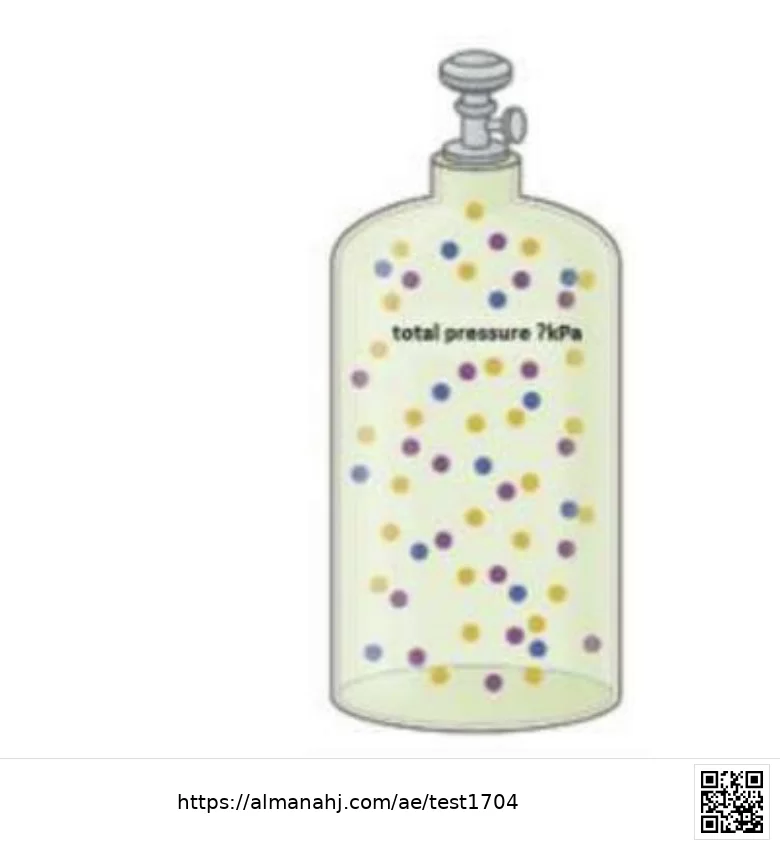
What is the total pressure for a mixture that contains three gases with partial pressures of 1.35 kPa, 3.81 kPa, and 5.22 kPa?
Explanation
According to Dalton's Law, the total pressure is the sum of partial pressures: Ptotal = 1.35 + 3.81 + 5.22 = 10.38 kPa.
Question 2
2
Points: 1
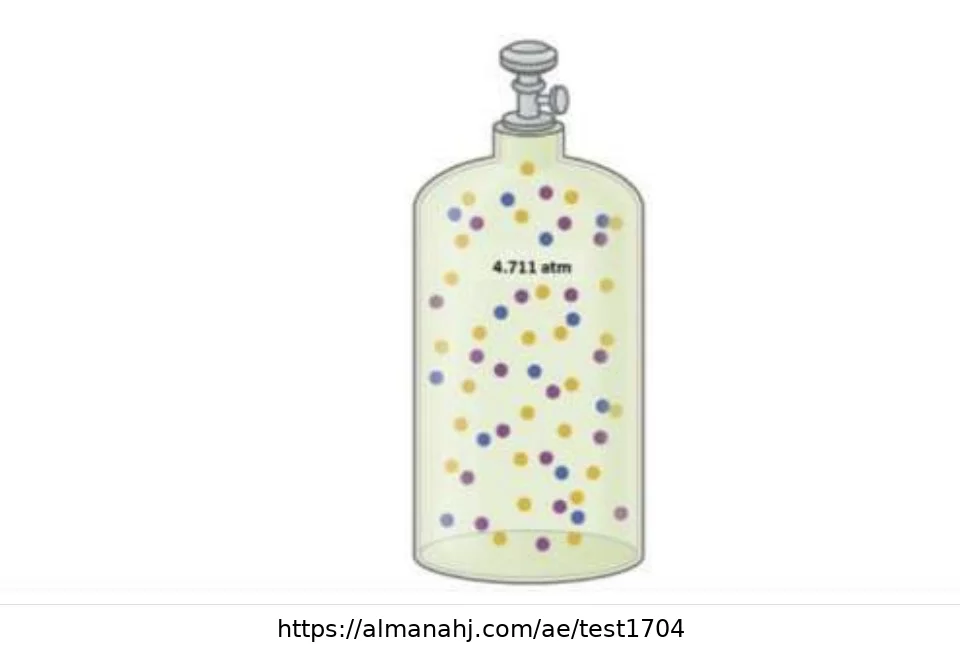
A sealed flask contains oxygen, helium, and nitrogen. If the total pressure in the flask is 4.711 atm, the partial pressure for O2 is 2.592 atm, and the partial pressure for He is 0.836 atm, what is the partial pressure of N2?
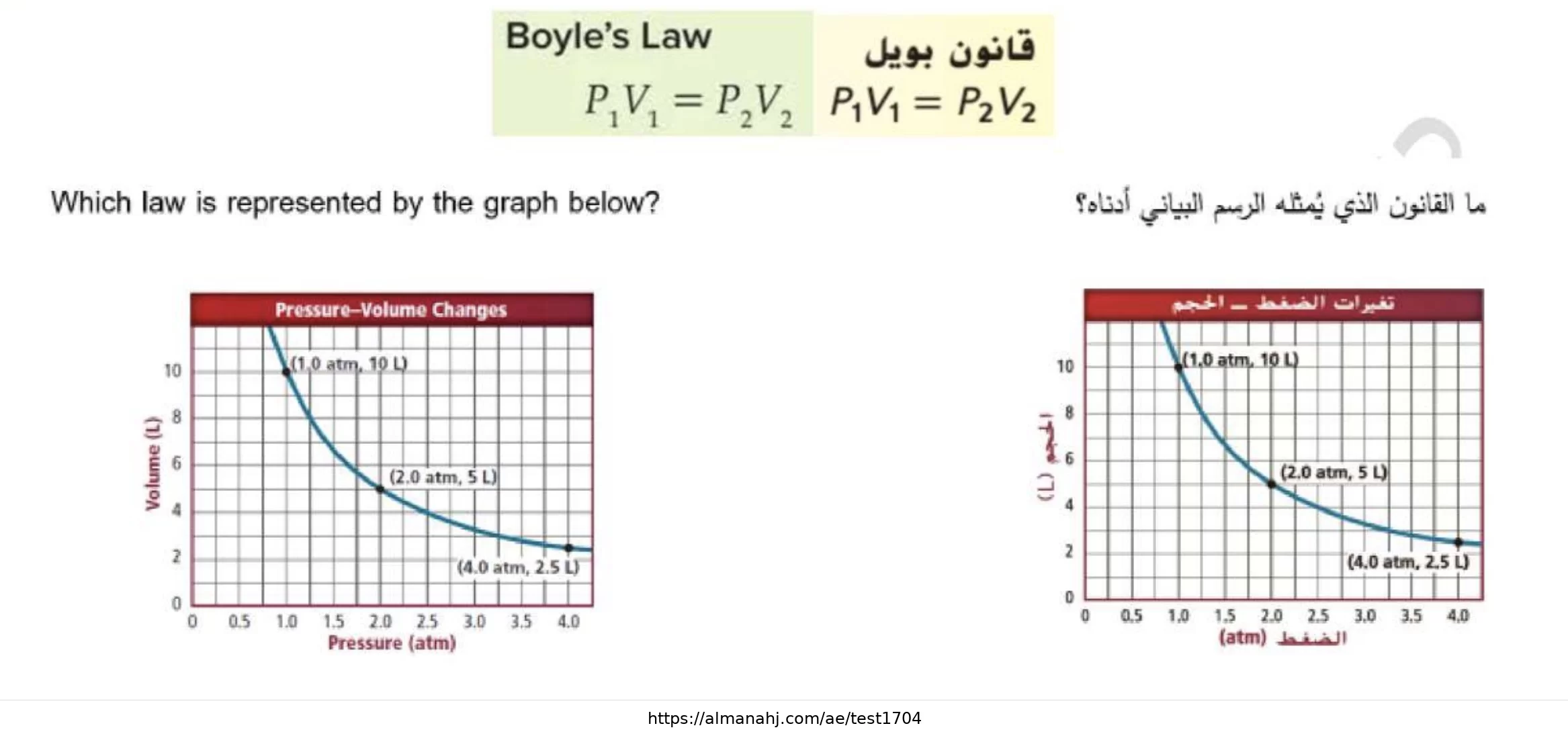
The graph shows an inverse relationship between pressure and volume, which is characteristic of Boyle's Law (P1V1 = P2V2).
Question 4
4
Points: 1
The volume of a gas is 400.0 mL, and the pressure is 1.00 atm. When the volume of the gas is 2.0 L, what is the pressure, if the temperature remains the same?
Explanation
Using Boyle's Law P1V1 = P2V2: convert volume to the same unit (400 mL = 0.4 L). $1.00 \times 0.4 = P_2 \times 2.0 \Rightarrow P_2 = 0.4 / 2.0 = 0.20 \text{ atm}$.
Question 5
5
Points: 1
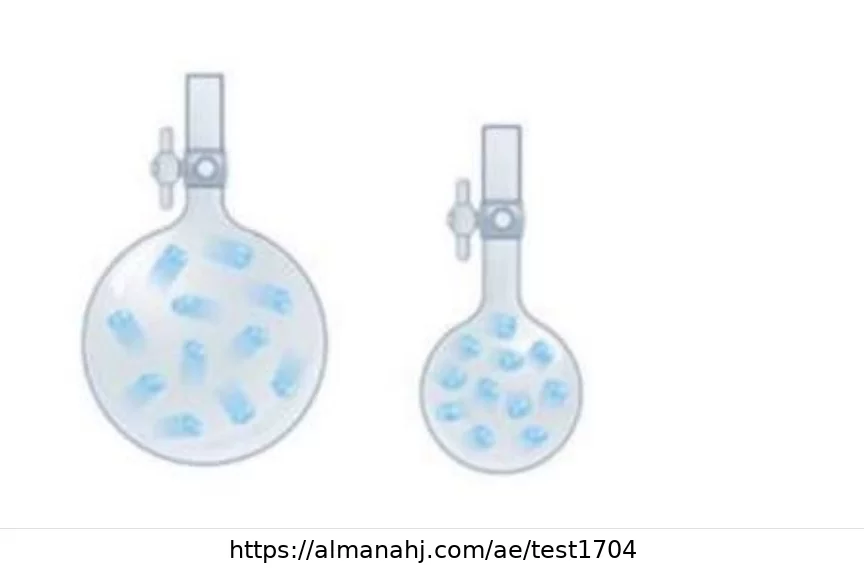
The pressure of a sample of helium in a 1.0 L container is 0.857 atm. What is the pressure if the same sample is placed in a 0.50 L container? (Assume that the temperature is constant.)
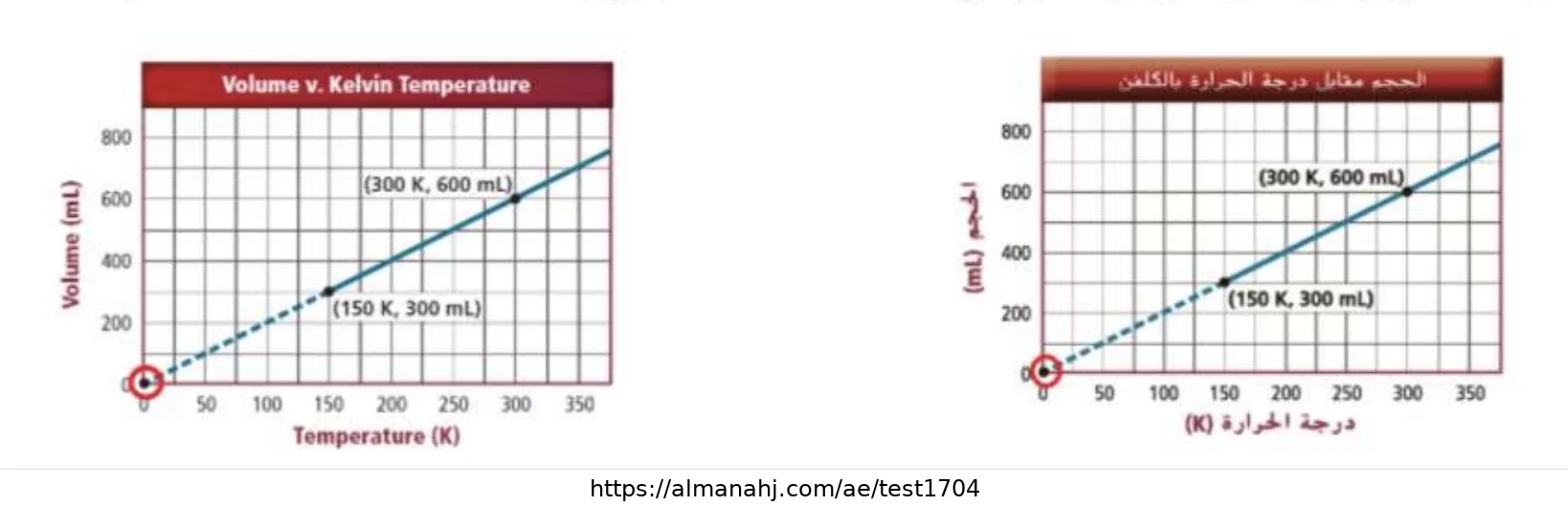
What is the point marked in red on the following graph called?
Explanation
The point where volume theoretically becomes zero on a Volume vs. Kelvin temperature graph is Absolute Zero.
Question 9
9
Points: 1
Which of the following statements is correct regarding the absolute zero?
Explanation
Absolute zero is defined as 0 K, which corresponds to $-273.15 ^\circ\text{C}$.
Question 10
10
Points: 1
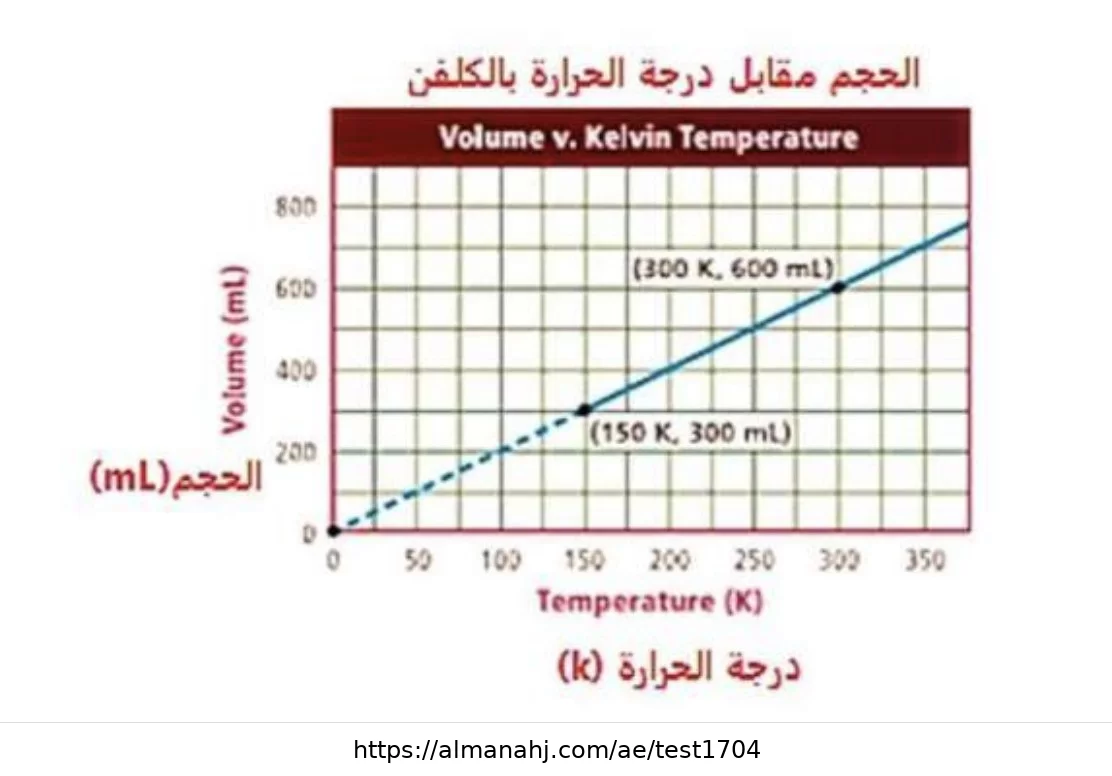
According to the graph below, which of the following statement is NOT correct?
Explanation
The graph shows a direct proportional relationship (Charles's Law); therefore, doubling the Kelvin temperature should double the volume. The statement that it does 'not' double is incorrect.
Question 11
11
Points: 1
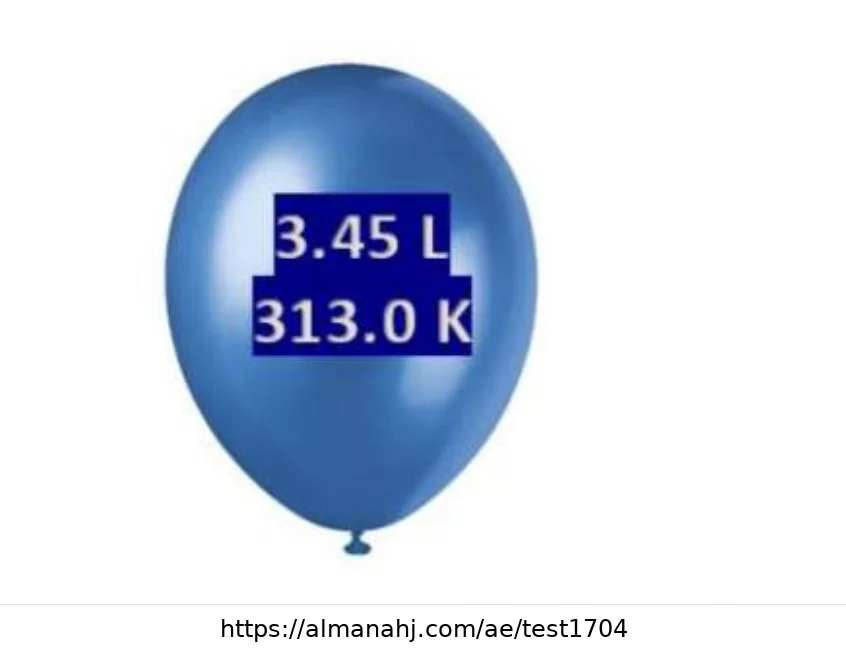
A gas occupies a volume of 0.85 L at 375 K. What temperature (K) is required to reduce the volume to 60% of the original volume?
Explanation
Using Charles's Law: $T_2 = T_1 \times \frac{V_2}{V_1}$. Since V2 = 0.60 V1, then T2 = 375 × 0.60 = 225 K.
Question 12
12
Points: 1
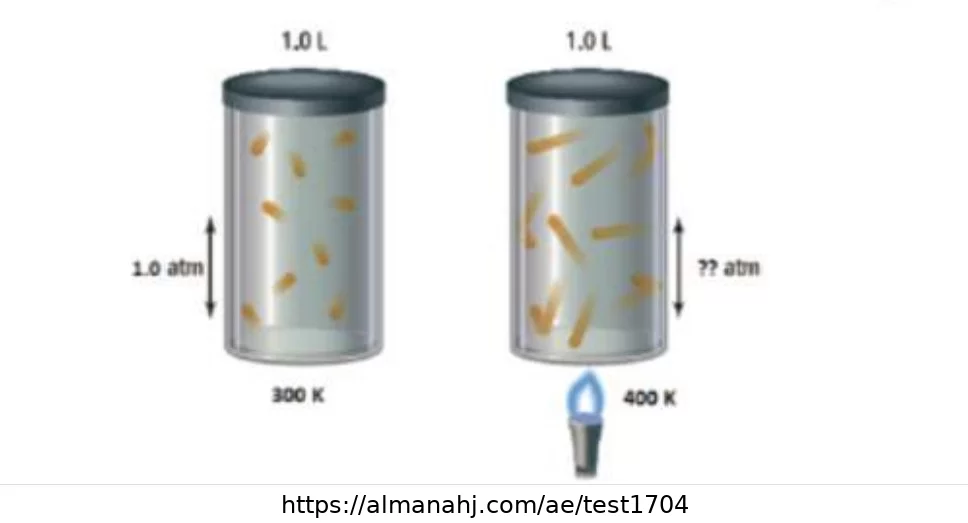
The pressure for a gas in a cylinder is 1.00 atm at 300 K. What will be the pressure if the temperature increases to 400 K?
Explanation
Using Gay-Lussac's Law: $\frac{P_1}{T_1} = \frac{P_2}{T_2} \Rightarrow \frac{1.00}{300} = \frac{P_2}{400} \Rightarrow P_2 = \frac{400}{300} = 1.33 \text{ atm}$. The closest option provided is 1.30 atm.
Question 13
13
Points: 1
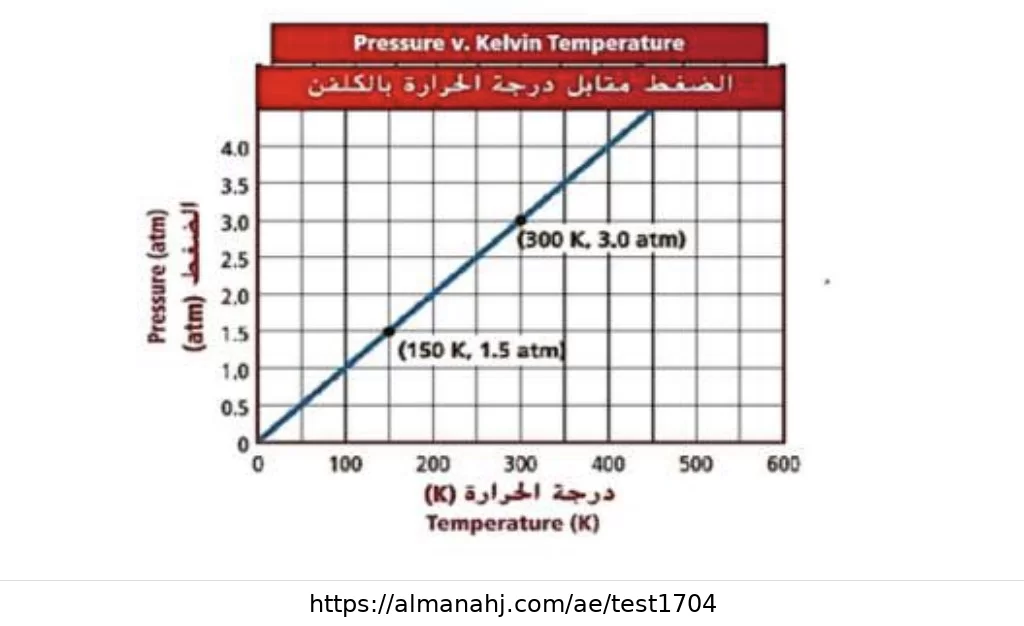
Which law is represented by the graph below?
Explanation
The graph shows a direct relationship between Pressure and Kelvin Temperature, which is Gay-Lussac's Law.
Question 14
14
Points: 1
“Equal volumes of gases at the same pressure and temperature contain equal numbers of particles.” This is the statement of...?
Explanation
Avogadro's principle states that equal volumes of all gases, at the same temperature and pressure, have the same number of molecules.
Question 15
15
Points: 1
What are the standard temperature and pressure (STP) for a gas?
Explanation
STP conditions are defined as $0 ^\circ\text{C}$ (273 K) and 1.00 atm pressure.
Question 16
16
Points: 1
According to Avogadro's principle, 1 mol of any gas at STP occupies a volume of ___________.
Explanation
The molar volume of an ideal gas at STP is 22.4 L.
Question 17
17
Points: 1
How much carbon dioxide gas, in grams, is in a 2.75 L balloon at STP? (Molar mass of carbon dioxide = 44.0 g/mol)
Explanation
Number of moles $= 2.75 / 22.4 \approx 0.1227 \text{ mol}$. Mass $= 0.1227 \times 44.0 \approx 5.40 \text{ g}$.
Question 18
18
Points: 1
How many neon atoms are there in 1.86 L sample at standard temperature and pressure (STP)?
A 4.25 L flask is filled with butane gas (C4H10) at a pressure of 1.5 atm and a temperature of $-20 ^\circ\text{C}$. What is the mass of butane in the flask? (Molar mass of butane = 58.1 g/mol)
Real gases approach ideal behavior at low pressures and high temperatures, where particles are far apart and intermolecular forces are negligible.
Question 23
23
Points: 1
Which of the following is a characteristic of the ideal gas?
Explanation
One assumption of the kinetic-molecular theory for ideal gases is that collisions are perfectly elastic, meaning no kinetic energy is lost.
Question 24
24
Points: 1
Regarding both ideal and real gases, which of the following is correct?
Explanation
Deviation from ideal behavior is most significant when pressure is high (particles forced together) and temperature is low (kinetic energy is low enough for intermolecular forces to act).
Result Tracking
Answered0 / 24
Correct Answers0
Wrong Answers0
Current Percentage0%
Quiz Completed
This is your final result after answering all questions.
Final Result
0/240%
Correct Answers0
Wrong Answers0
Answered Questions0 / 24
Total Possible Points24
You can reopen the page to start again.
يمكنك تسجيل الدخول لحفظ سجل محاولاتك، معرفة أخطائك المتكررة، والحصول على نصائح مخصصة. تسجيل الدخول باستخدام Google
Here are more quizzes for الصف العاشر المتقدم by الفصل الثالث and subject كيمياء
This section is rendered only when the user reaches it while scrolling.
...
🍪
إشعار ملفات تعريف الارتباط
يستخدم هذا الموقع ملفات تعريف الارتباط لتحسين تجربة التصفح وقياس الأداء وعرض المحتوى بشكل أفضل.
باستخدامك للموقع فإنك توافق على استخدامنا لها وفق
سياسة الخصوصية.