Interactive multiple-choice quiz: Revision / Chemistry / 10Adv / T3
مراجعة شاملة لمادة الكيمياء للصف العاشر المتقدم، الفصل الدراسي الثالث لعام ٢٠٢٥. يغطي الاختبار مواضيع نظرية الحركة الجزيئية، قوانين الغازات (بويل، شارل، جاي لوساك، القانون العام، وقانون الغاز المثالي)، وقوانين دالتون وجراهام وهنري. يتضمن أيضاً أسئلة حول خصائص الغازات الحقيقية والمثالية، وأنواع المخاليط والتركيز والمحاليل.
🏆 انضم إلى التحدي واحصل على ترتيبك
اختبار شهادة تدريبي مؤقت للصف والمادة والفصل نفسه.
اختر إجابة واحدة لكل سؤال. عند الاختيار ستظهر النتيجة فورًا: الأخضر صحيح، والأحمر خطأ، وسيظهر تفسير الإجابة مباشرة إن كان متوفرًا. وبعد آخر سؤال ستظهر الدرجة النهائية تلقائيًا.
According to the kinetic-molecular theory, gases condense into liquids due to... تبعاً لنظرية الحركة الجزيئية، الغازات تتكثف إلى سوائل بسبب...
Explanation
تتكثف الغازات إلى سوائل عندما تصبح القوى بين الجزيئات قوية بما يكفي لتقريب الجسيمات من بعضها البعض عند انخفاض الطاقة الحركية.
Question 2
2
Points: 1
Diffusion between two gases occurs faster if the gases are at... الانتشار بين غازين يحدث أسرع إذا كانت الغازات عند...
Explanation
تزيد سرعة الانتشار بزيادة درجة الحرارة (زيادة الطاقة الحركية) ونقص كتلة الجسيمات (قانون جراهام).
Question 3
3
Points: 1
Which of the following represent "a gas escapes through a tiny opening"? ماذا يعني "مرور الغاز عبر ثقب ضيق"؟
Explanation
التدفق (Effusion) هو عملية خروج الغاز عبر ثقب صغير جداً.
Question 4
4
Points: 1
Which of the following states that "the rate of effusion for a gas is inversely proportional to the square root of its molar mass"? أي القوانين ينص على أن "معدل تدفق الغاز يتناسب عكسياً مع الجذر التربيبي لكتلته المولية"؟
Explanation
قانون جراهام يصف العلاقة العكسية بين سرعة انتشار أو تدفق الغاز والجذر التربيعي لكتلته المولية.
Question 5
5
Points: 1
Calculate the ratio of diffusion rates for carbon monoxide and carbon dioxide. (molar mass: CO = 28, CO2 = 44)
Explanation
Ratio = $\sqrt{\frac{M_{CO_2}}{M_{CO}}} = \sqrt{\frac{44}{28}} \approx 1.25$
Question 6
6
Points: 1
Which of the following is correct about pressure units? أي مما يأتي صحيح فيما يتعلق بوحدات قياس الضغط؟
Explanation
وحدات الضغط القياسية هي 1 ضغط جوي يعادل 101.3 كيلو باسكال أو 760 تور (مليمتر زئبق).
Question 7
7
Points: 1
A mixture of oxygen (O2), carbon dioxide (CO2), and nitrogen (N2) has a total pressure of 0.97 atm. What is the partial pressure of O2 if the partial pressure of CO2 is 0.70 atm and the partial pressure of N2 is 0.12 atm?
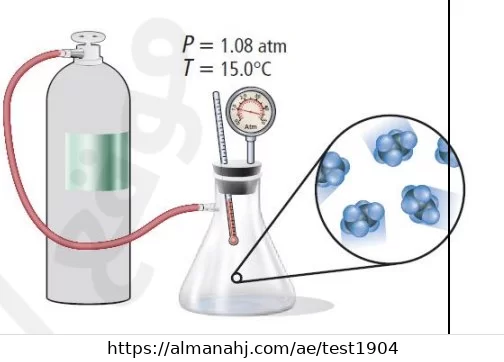
A helium balloon in a closed car occupies a volume of 2.32 L at $40.0^\circ \text{C}$. If the car is parked on a hot day and the temperature inside rises to $75.0^\circ \text{C}$, what is the new volume of the balloon, assuming the pressure remains constant?
The pressure of the oxygen gas inside a canister is 5.00 atm at $25.0^\circ \text{C}$. If the temperature falls to $-10.0^\circ \text{C}$, what is the new pressure inside the canister?
A gas at 110 kPa and $30.0^\circ \text{C}$ fills a flexible container with an initial volume of 2.00 L. If the temperature is raised to $80.0^\circ \text{C}$ and the pressure increases to 440 kPa, what is the new volume?
If 0.85 g of a gas at 4.0 atm of pressure dissolves in 1.0 L of water, how much will dissolve in 1.0 L of water at 1.0 atm of pressure and the same temperature?
The kinetic-molecular theory explains the behavior of... نظرية الحركة الجزيئية تصف سلوك...
Question 22
22
Points: 1
According to molecular motion theory, particles of matter are in motion in... تبعاً لنظرية الحركة الجزيئية، جسيمات المادة تكون في حالة حركة في...
Question 23
23
Points: 1
If two iron balls collide and their total kinetic energy remains the same before and after the collision, this is an example of...
Question 24
24
Points: 1
Which of the following is correct about gases?
Question 25
25
Points: 1
What definitely explains the lower density of gases compared with liquids?
Question 26
26
Points: 1
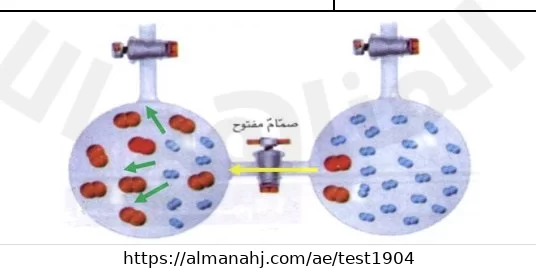
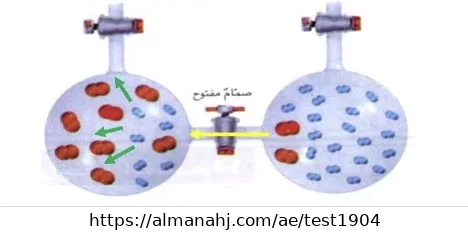
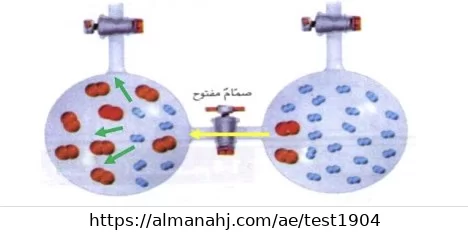
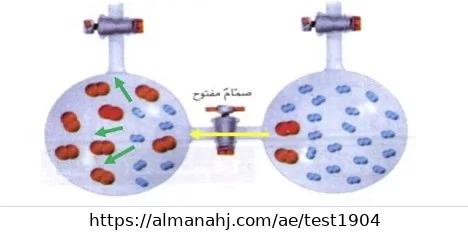
In the figure, the yellow arrow represents...
Question 27
27
Points: 1
In the figure, the green arrows represent...
Question 28
28
Points: 1
The random motion of gas particles causes gases to mix until they are evenly distributed. This process is called...
Question 29
29
Points: 1
In the kinetic-molecular theory, which term is a measure of the average kinetic energy of the particles in a sample of matter?
Question 30
30
Points: 1
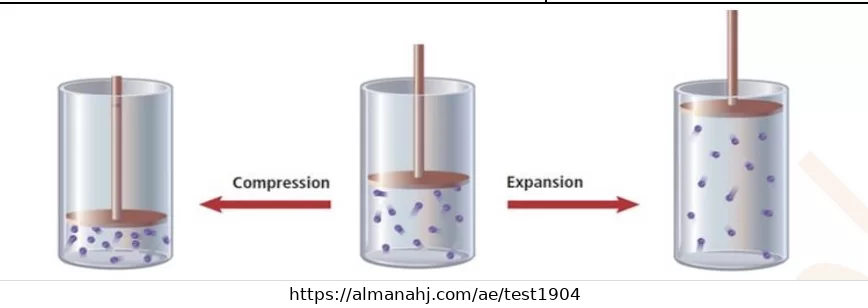
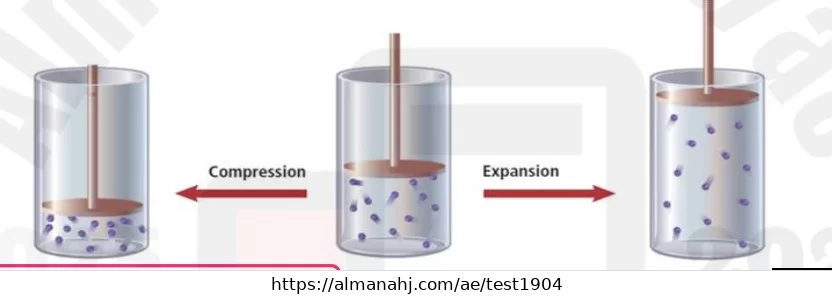
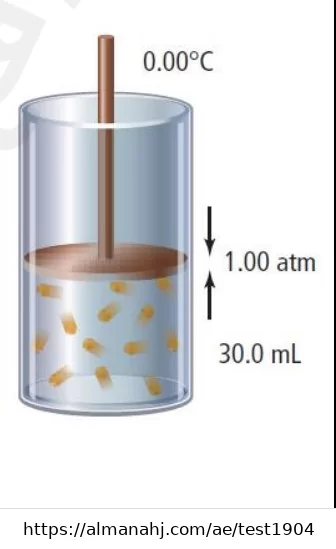
According to the figure, what happens during compression of a gas?
Question 31
31
Points: 1
According to the figure, what happens during expansion of a gas?
Question 32
32
Points: 1
Which is NOT an assumption of the kinetic-molecular theory?
Question 33
33
Points: 1
Which of the following statements is true?
Question 34
34
Points: 1
Which of the following is NOT an assumption of the kinetic-molecular theory of gases?
Question 35
35
Points: 1
Ammonia (NH3) has a molar mass of 17.0 g/mol and hydrogen chloride (HCl) has a molar mass of 36.5 g/mol. What is the ratio of their diffusion rates?
Question 36
36
Points: 1
Calculate the ratio of effusion rates for nitrogen (N2) and neon (Ne). Molar masses: N2 = 28, Ne = 20.2.
Question 37
37
Points: 1
What is the rate of effusion for a gas that has a molar mass twice that of a gas that effuses at a rate of 3.6 mol/min?
Question 38
38
Points: 1
At a certain temperature, hydrogen molecules move at 1.84 x 10³ m/s. Calculate the molar mass of gas X if its molecules move at 312 m/s. Molar mass of H2 = 2 g/mol.
Question 39
39
Points: 1
What is the ratio of diffusion rates for sulfur trioxide (SO3) and sulfur dioxide (SO2)? Molar masses: SO3 = 80 g/mol, SO2 = 64 g/mol.
Question 40
40
Points: 1
What is the ratio of diffusion rate for nitrogen (N2) and sulfur trioxide (SO3)? Molar masses: N2 = 28 g/mol, SO3 = 80 g/mol.
Question 41
41
Points: 1
The weather report gives atmospheric pressure as 0.95 atm. Express this pressure in mmHg.
Question 42
42
Points: 1
The weather report gives atmospheric pressure as 0.95 atm. Express this pressure in kPa.
Question 43
43
Points: 1
The weather report gives atmospheric pressure as 0.95 atm. Express this pressure in torr.
Question 44
44
Points: 1
The weather report gives atmospheric pressure as 96.2 kPa. Express this pressure in atm.
Question 45
45
Points: 1
Which of the following is correct about pressure units?
Question 46
46
Points: 1
What is the partial pressure of hydrogen gas in a mixture of hydrogen and helium if the total pressure is 600 mmHg and the partial pressure of helium is 439 mmHg?
Question 47
47
Points: 1
Find the total pressure for a mixture that contains four gases with partial pressures of 5.00 kPa, 4.56 kPa, 3.02 kPa, and 1.20 kPa.
Question 48
48
Points: 1
Find the partial pressure of carbon dioxide in a gas mixture with a total pressure of 30.4 kPa if the partial pressures of the other two gases are 16.5 kPa and 3.7 kPa.
Question 49
49
Points: 1
Air is roughly 78% nitrogen, 21% oxygen, and 1% argon. If atmospheric pressure is 760 mmHg, what is the partial pressure of nitrogen?
Question 50
50
Points: 1
What is the partial pressure of water vapor in an air sample when total pressure is 1.00 atm, partial pressure of nitrogen is 0.79 atm, partial pressure of oxygen is 0.20 atm, and the partial pressure of all other gases is 0.0044 atm?
Question 51
51
Points: 1
What is the partial pressure of oxygen in an air sample when total pressure is 1.10 atm, partial pressure of nitrogen is 0.75 atm, partial pressure of water vapor is 0.0056 atm, and the partial pressure of all other gases is 0.0044 atm?
Question 52
52
Points: 1
Which of the following does not affect the partial pressure of a gas?
Question 53
53
Points: 1
The volume of a gas at 99.0 kPa is 300.0 mL. If the pressure is increased to 188 kPa, what will be the new volume?
Question 54
54
Points: 1
A diver blows a 0.75-L air bubble 10 m under water. As it rises to the surface, the pressure goes from 2.25 atm to 1.03 atm. What will be the volume of air in the bubble at the surface?
Question 55
55
Points: 1
Air trapped in a cylinder fitted with a piston occupies 145.7 mL at 1.08 atm. What is the new volume when the piston is depressed, increasing the pressure by 25%?
Question 56
56
Points: 1
Air trapped in a cylinder fitted with a piston occupies 365.5 mL at 0.985 atm. What is the new volume when the piston is depressed, increasing the pressure by 50%?
Question 57
57
Points: 1
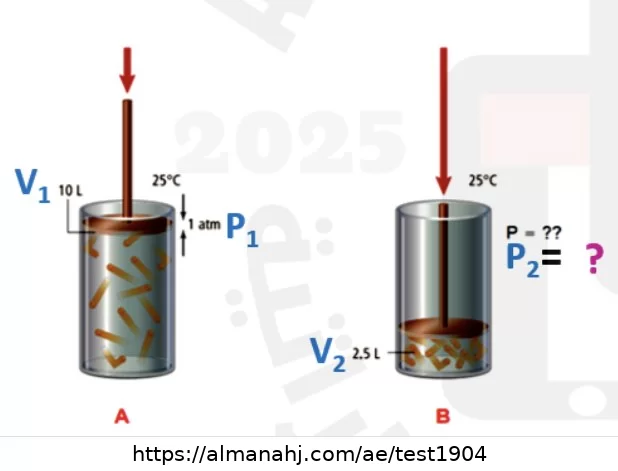
As the external pressure on a cylinder piston increases from 1.0 atm to 4.0 atm, the gas volume changes from 10 L to 2.5 L. What is the new pressure on the cylinder piston?
Question 58
58
Points: 1
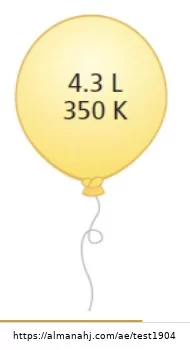
What volume will the gas in the balloon occupy at 250 K if its initial volume is 4.3 L at 350 K?
Question 59
59
Points: 1
A gas at 89°C occupies a volume of 0.67 L. At what Celsius temperature will the volume increase to 1.12 L?
Question 60
60
Points: 1
The Celsius temperature of a 3.00-L sample of gas is lowered from 80.0°C to 30.0°C. What will be the resulting volume of this gas?
Question 61
61
Points: 1
A gas occupies 0.67 L at 350 K. What temperature is required to reduce the volume by 45%?
Question 62
62
Points: 1
A sample of gas occupies 6.50 L at 95.0°C. What is the Celsius temperature when the volume becomes 1.63 L?
Question 63
63
Points: 1
A gas occupies a volume of 0.85 L at 375 K. What temperature is required to reduce the volume to 60% of the original volume?
Question 64
64
Points: 1
The pressure in an automobile tire is 1.88 atm at 25.0°C. What will be the pressure if the temperature increases to 37.0°C?
Question 65
65
Points: 1
Helium gas in a cylinder has a pressure of 1.12 atm. At 36.5°C, the same gas sample has a pressure of 2.56 atm. What was the initial temperature of the gas?
Question 66
66
Points: 1
If a gas sample has a pressure of 30.7 kPa at 0.00°C, by how many degrees Celsius must the temperature increase to cause the pressure to double?
Question 67
67
Points: 1
A sample of air in a syringe exerts a pressure of 1.02 atm at 22.0°C. The syringe is placed in a boiling-water bath at 100.0°C. The pressure is increased to 1.23 atm, which reduces the volume to 0.224 L. What was the initial volume?
Question 68
68
Points: 1
If the temperature in the gas cylinder increases to 30.0°C and the pressure increases to 1.20 atm, will the piston move up or down?
Question 69
69
Points: 1
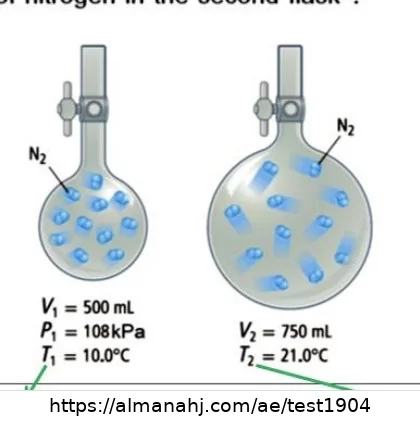
A sample of nitrogen gas is transferred to a larger flask. Given V1 = 500 mL, P1 = 108 kPa, T1 = 10.0°C, V2 = 750 mL, and T2 = 21.0°C, what is the pressure of nitrogen in the second flask?
Question 70
70
Points: 1
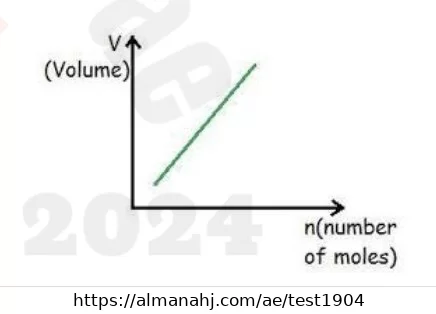
The following curve represents the relationship between volume and number of moles. Which principle does it show?
Question 71
71
Points: 1
Equal volumes of gases at the same pressure and temperature contain equal numbers of particles. This is the statement of...
Question 72
72
Points: 1
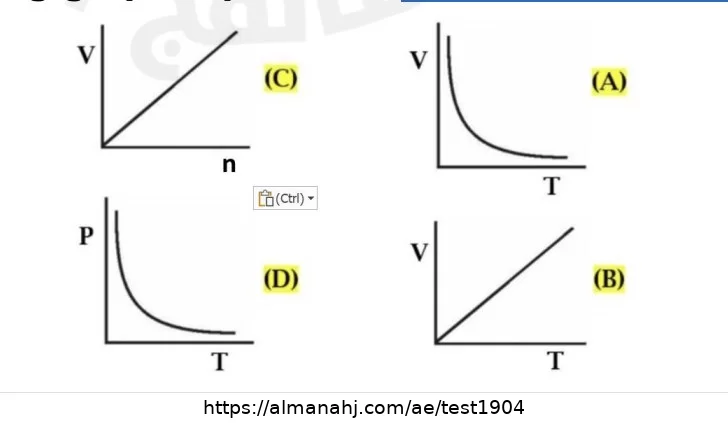
Which graph represents Avogadro’s principle?
Question 73
73
Points: 1
What size container is needed to hold 0.0459 mol of N2 gas at STP?
Question 74
74
Points: 1
How much carbon dioxide gas, in grams, is in a 1.0-L balloon at STP? Molar mass of CO2 = 44 g/mol.
Question 75
75
Points: 1
What volume in milliliters will 0.00922 g of H2 gas occupy at STP? Molar mass of H2 = 2 g/mol.
Question 76
76
Points: 1
What volume will 0.416 g of krypton gas occupy at STP? Molar mass of Kr = 83.8 g/mol.
Question 77
77
Points: 1
Calculate the volume that 4.5 kg of ethylene gas (C2H4) will occupy at STP. Molar mass of C2H4 = 28 g/mol.
Question 78
78
Points: 1
Calculate the volume of a 0.323-mol sample of a gas at 265 K and 0.900 atm.
Question 79
79
Points: 1
What is the pressure, in atmospheres, of a 0.108-mol sample of helium gas at 20.0°C if its volume is 0.505 L?
Question 80
80
Points: 1
If the pressure exerted by a gas at 25°C in a volume of 0.044 L is 3.81 atm, how many moles of gas are present?
Question 81
81
Points: 1
An ideal gas has a volume of 3.0 L. If the number of moles of gas and the temperature are doubled while pressure remains constant, what is the new volume?
Question 82
82
Points: 1
If the pressure exerted by a gas at 35°C in a volume of 0.044 L is 7.62 atm, how many moles of gas are present?
Question 83
83
Points: 1
How much carbon dioxide gas, in grams, is in a 2.75-L balloon at STP? Molar mass of CO2 = 44.0 g/mol.
Question 84
84
Points: 1
A 2.00-L flask is filled with propane gas (C3H8) at 1.00 atm and -15.0°C. What is the mass of propane in the flask? Molar mass of C3H8 = 44 g/mol.
Question 85
85
Points: 1
A 2.00-L flask is filled with ethane gas (C2H6). What is the mass of ethane in the flask? Molar mass of C2H6 = 30 g/mol.
Question 86
86
Points: 1
What is the density of a sample of nitrogen gas (N2) that exerts a pressure of 5.30 atm in a 3.50-L container at 125°C? Molar mass of N2 = 28 g/mol.
Question 87
87
Points: 1
Geraniol is a compound found in rose oil. What is the molar mass of geraniol if its vapor has a density of 0.480 g/L at 260.0°C and 0.140 atm?
Question 88
88
Points: 1
A 4.50-L flask is filled with butane gas (C4H10) at 1.20 atm and -10.0°C. What is the density of butane? Molar mass of butane = 58 g/mol.
Question 89
89
Points: 1
Which of the following is a characteristic of an ideal gas?
Question 90
90
Points: 1
When does a real gas behave like an ideal gas?
Question 91
91
Points: 1
Which of the following is true about colloid particles?
Question 92
92
Points: 1
Two liquids that can be mixed together but separate shortly after are said to be...
Question 93
93
Points: 1
Why do colloidal particles settle out in a mixture if it is heated?
Question 94
94
Points: 1
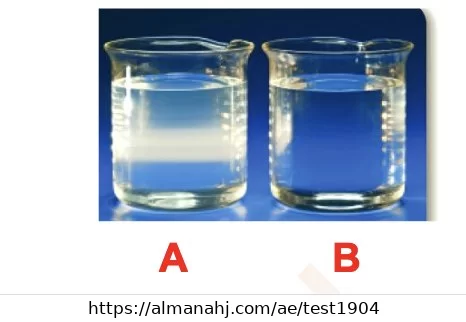
The corresponding figure shows the passage of light in two mixtures. What are A and B?
Question 95
95
Points: 1
What is the solvent of air?
Question 96
96
Points: 1
Which type of solution is represented by carbonated water?
Question 97
97
Points: 1
You have 1500.0 g of a bleach solution. The percent by mass of sodium hypochlorite (NaOCl) is 3.62%. How many grams of NaOCl are in the solution?
Question 98
98
Points: 1
The percent by mass of calcium chloride in a solution is 2.65%. If 50.0 g of calcium chloride is used, what is the mass of the solution?
Question 99
99
Points: 1
What is the percent by mass of sodium chloride (NaCl) in a solution containing 4.0 g of NaCl dissolved in 100.0 g of water?
Question 100
100
Points: 1
Calculate the molarity of 1.60 L of a solution containing 1.55 g of dissolved KBr. Molar mass of KBr = 119 g/mol.
Question 101
101
Points: 1
How many grams of calcium hydroxide Ca(OH)2 are needed to produce 1.5 L of a 0.25 M solution? Molar mass of Ca(OH)2 = 74 g/mol.
Question 102
102
Points: 1
How much Ba(OH)2, in grams, is needed to make a 1.00 m aqueous solution? Molar mass of Ba(OH)2 = 171.3 g/mol.
Question 103
103
Points: 1
What is the molality of a solution containing 5.0 g of sodium chloride (NaCl) dissolved in 100.0 g of water? Molar mass of NaCl = 58.44 g/mol.
Question 104
104
Points: 1
What is the mole fraction of NaOH in an aqueous solution that contains 22.8% NaOH by mass? Molar masses: NaOH = 40 g/mol, H2O = 18 g/mol.
Question 105
105
Points: 1
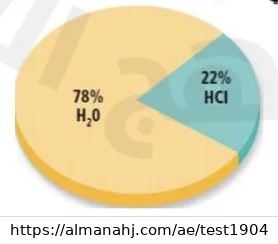
What is the mole fraction of hydrochloric acid (HCl) in a solution containing 22% HCl and 78% H2O by mass? Molar masses: HCl = 36.5 g/mol, H2O = 18 g/mol.
Question 106
106
Points: 1
What is the mole fraction of hydrochloric acid (HCl) if the figure shows a solution containing 22% HCl and 78% H2O?
Question 107
107
Points: 1
If 0.55 g of a gas dissolves in 1.0 L of water at 20.0 kPa of pressure, how much will dissolve at 110.0 kPa of pressure?
Question 108
108
Points: 1
A gas has a solubility of 0.66 g/L at 10.0 atm. What is the pressure on a 1.0-L sample that contains 1.5 g of gas?
Question 109
109
Points: 1
The solubility of a gas at 7 atm is 0.52 g/L. How many grams of the gas would dissolve per 1 L if the pressure is raised to 10 atm?
Question 110
110
Points: 1
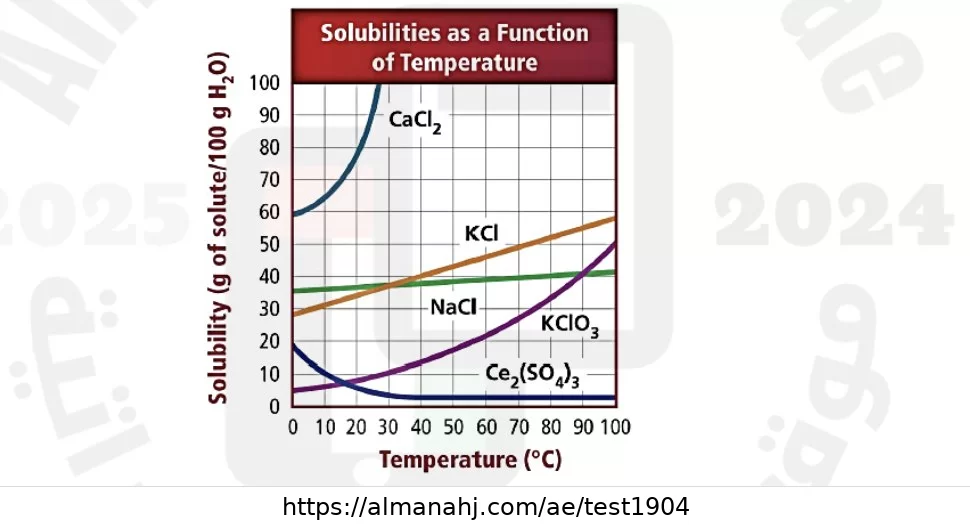
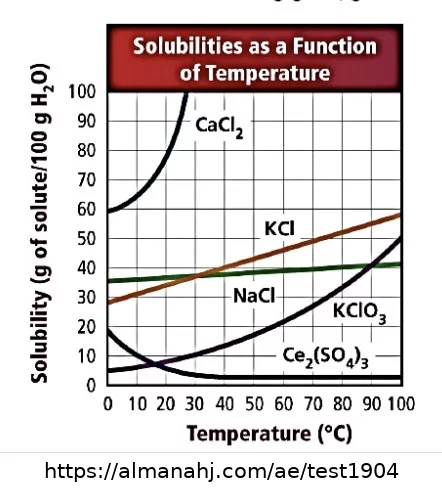
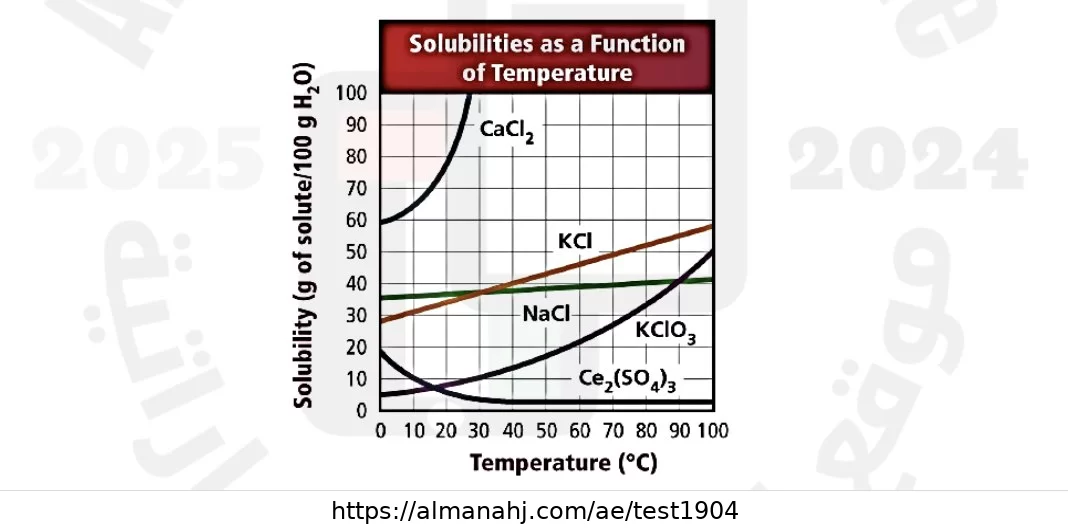
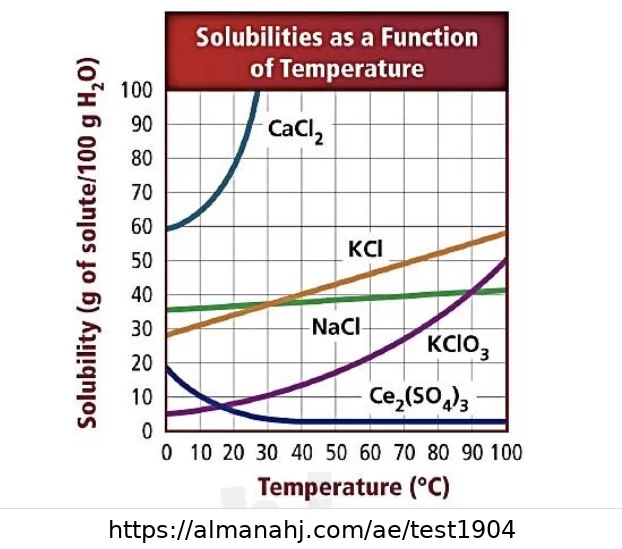
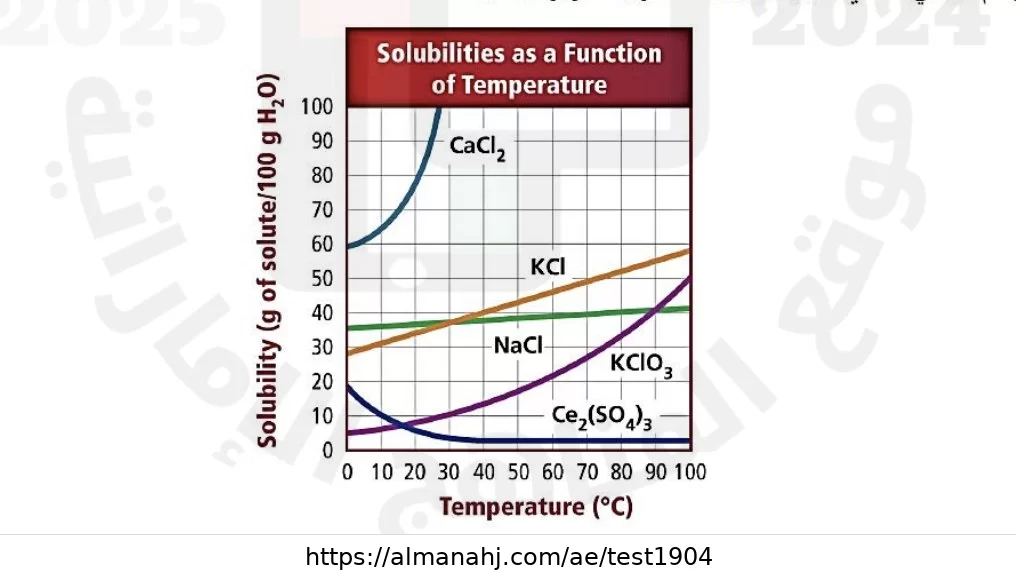
Using the solubility graph, which statement is NOT correct?
Question 111
111
Points: 1
From the graph, determine the solubility of KClO3 at 75°C.
Question 112
112
Points: 1
From the graph, determine the solubility of KCl at 40°C.
Question 113
113
Points: 1
From the graph, determine the solubility of KClO3 at 90°C.
Question 114
114
Points: 1
From the graph, determine the solubility of NaCl at 90°C.
Question 115
115
Points: 1
Which factors generally increase the rate at which a solid dissolves in a liquid? i. increasing pressure of solution; ii. shaking or stirring; iii. increasing surface area of solute; iv. increasing temperature of solvent.
Question 116
116
Points: 1
Which of the following is slowest to dissolve when using the same amount of tea and sugar?
Question 117
117
Points: 1
Regarding the effect of temperature on the rate of solvation, which statement is incorrect? 1) Most solid substances dissolve faster in hot solvents than in cold solvents. 2) The amount of solute increases in hot solvent than in cold solvent. 3) The solubility of gases increases by increasing temperature.
Question 118
118
Points: 1
Regarding the effect of temperature on the rate of solvation, which statements are correct? 1) Most solids dissolve more slowly in hot solvents than in cold solvents. 2) The amount of solute increases in hot solvent than in cold solvent. 3) The solubility of gases decreases by increasing temperature.
Question 119
119
Points: 1
Regarding the effect of temperature on the rate of solvation, which statements are correct? 1) Most solids dissolve faster in hot solvents than in cold solvents. 2) The amount of solute decreases in hot solvent than in cold solvent. 3) The solubility of gases increases by increasing temperature.
Question 120
120
Points: 1
Which statement is correct regarding the relationship between temperature and solubility of a gas?
Question 121
121
Points: 1
The effect of intermolecular forces in solvation is...
Question 122
122
Points: 1
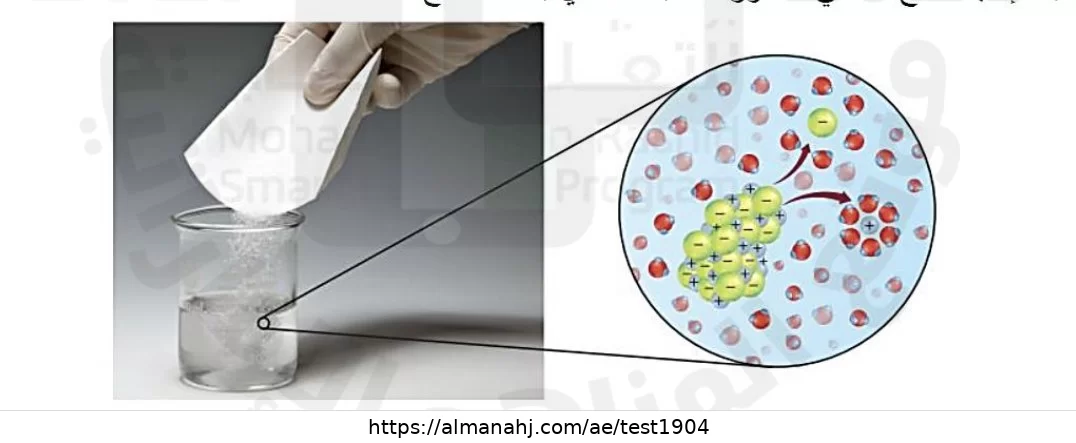
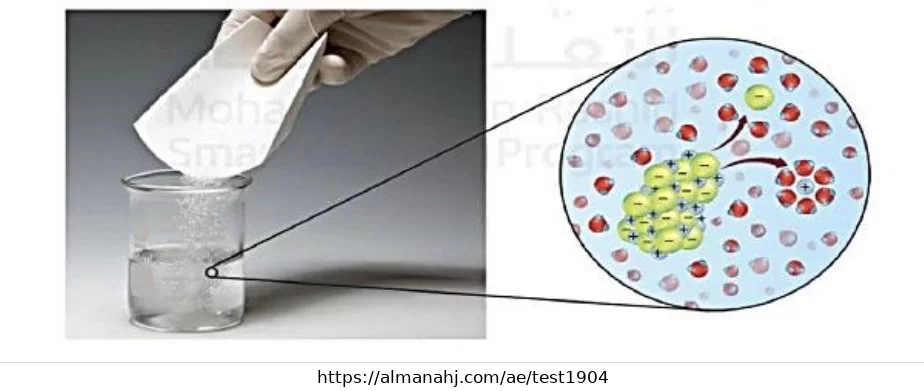
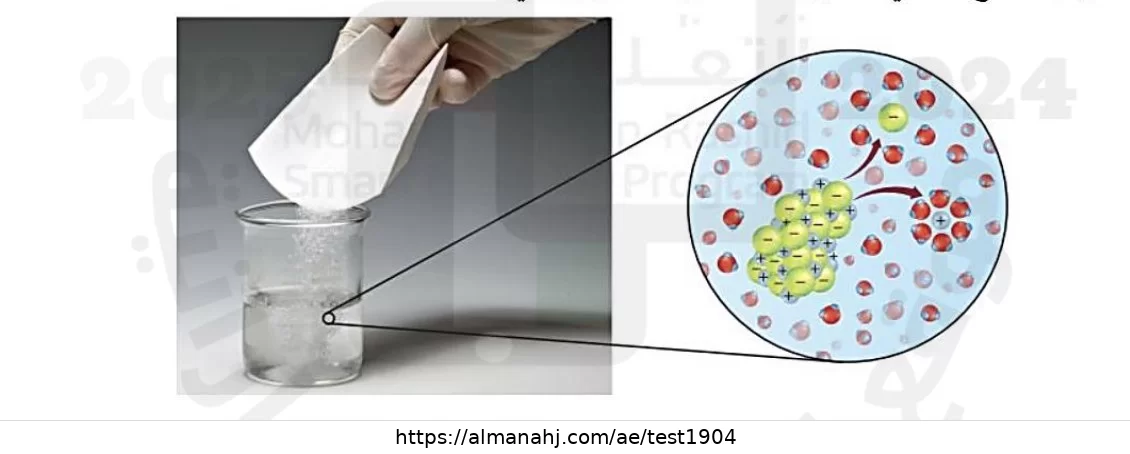
In the solvation process of salt shown in the figure, what happens to the salt?
Question 123
123
Points: 1
In the solvation process of salt shown in the figure, what is step 2?
Question 124
124
Points: 1
In the solvation process of salt shown in the figure, what is step 3?
Result Tracking
Answered0 / 124
Correct Answers0
Wrong Answers0
Current Percentage0%
Quiz Completed
This is your final result after answering all questions.
Final Result
0/1240%
Correct Answers0
Wrong Answers0
Answered Questions0 / 124
Total Possible Points124
You can reopen the page to start again.
يمكنك تسجيل الدخول لحفظ سجل محاولاتك، معرفة أخطائك المتكررة، والحصول على نصائح مخصصة. تسجيل الدخول باستخدام Google
Here are more quizzes for الصف العاشر المتقدم by الفصل الثالث and subject كيمياء
This section is rendered only when the user reaches it while scrolling.
...
🍪
إشعار ملفات تعريف الارتباط
يستخدم هذا الموقع ملفات تعريف الارتباط لتحسين تجربة التصفح وقياس الأداء وعرض المحتوى بشكل أفضل.
باستخدامك للموقع فإنك توافق على استخدامنا لها وفق
سياسة الخصوصية.