Interactive multiple-choice quiz: PHYSICS EOT EXAM FINAL GRADE 10 ADVANCED TERM 3
Comprehensive physics exam revision guide for Grade 10 Advanced students, focusing on the Term 3 curriculum. Topics covered include the refraction of light, Snell's law, thin lens equations, image formation by convex and concave lenses, and light interference patterns. This document provides detailed explanations, diagrams, and practice multiple-choice questions to ensure full coverage of learning outcomes. Prepared by Mr. Abdulrahman Esam Eid.
🏆 انضم إلى التحدي واحصل على ترتيبك
اختبار شهادة تدريبي مؤقت للصف والمادة والفصل نفسه.
اختر إجابة واحدة لكل سؤال. عند الاختيار ستظهر النتيجة فورًا: الأخضر صحيح، والأحمر خطأ، وسيظهر تفسير الإجابة مباشرة إن كان متوفرًا. وبعد آخر سؤال ستظهر الدرجة النهائية تلقائيًا.
When a pencil is placed in a cup containing water, the pencil appears broken at the surface of the water, as in the figure. What is the name of the phenomenon that explains this observation?
Explanation
Refraction is the bending of light as it passes from one medium to another (air to water), which makes objects appear displaced or broken.
Question 2
2
Points: 1
It is the phenomenon of a sudden change that occurs in the path of light rays when they pass at an angle through the surface separating two different transparent media. What is the name of this phenomenon?
Explanation
Refraction occurs when light changes direction due to a change in speed when entering a different medium at an angle.
Question 3
3
Points: 1
What happens to the refracted beam when light passes through air to glass and then back to air? Hint: nglass > nair
Explanation
When light enters a denser medium (glass), it slows down and bends toward the normal. When it re-enters air, it speeds up and bends away from the normal.
Question 4
4
Points: 1
What happens when a light ray travels from air (n=1.0) into water (n=1.33)?
Explanation
Moving from a lower refractive index to a higher one causes light to slow down and bend toward the normal.
Question 5
5
Points: 1
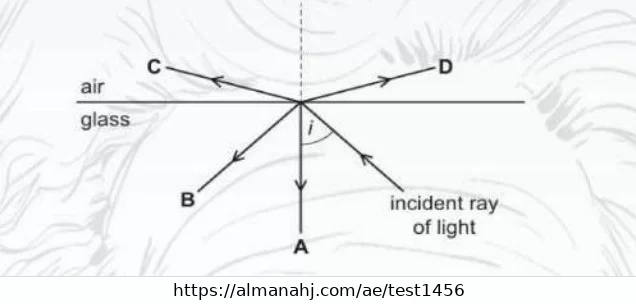
The diagram shows light incident at a glass–air boundary. The angle of incidence of the ray is less than the critical angle. Which line shows the path of the light after it meets the boundary?
Explanation
When light passes from glass (higher n) to air (lower n) at an angle less than the critical angle, it refracts and bends away from the normal (Line C).
Question 6
6
Points: 1
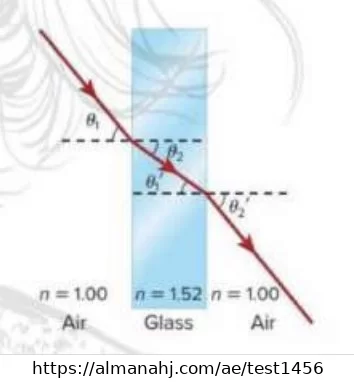
A light ray enters glass at angle $\theta_1$ and leaves at angle $\theta'_2$. What is true about $\theta_1$ and $\theta'_2$?
Explanation
For a parallel-sided glass slab, the emergent ray is parallel to the incident ray, so the initial angle of incidence equals the final angle of refraction.
Question 7
7
Points: 1
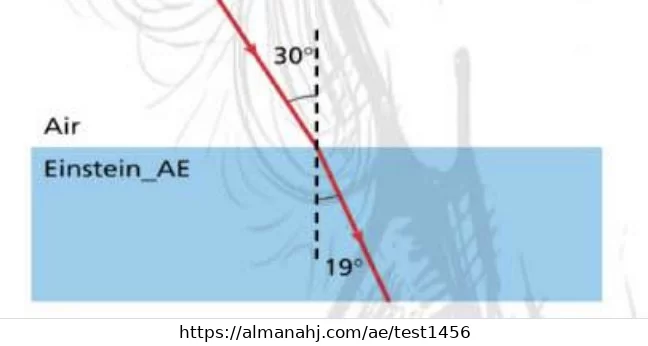
As shown in the figure, a light beam travels from air into a selected medium. Based on the angle of refraction and the refractive index values, what is the medium used?
Explanation
Using Snell's Law: $n_2 = \frac{n_1 \sin \theta_1}{\sin \theta_2} = \frac{1 \cdot \sin 30^\circ}{\sin 19^\circ} \approx \frac{0.5}{0.325} \approx 1.54$, which corresponds to Quartz.
Question 8
8
Points: 1
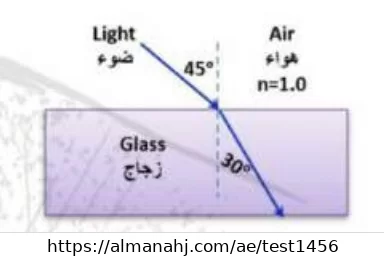
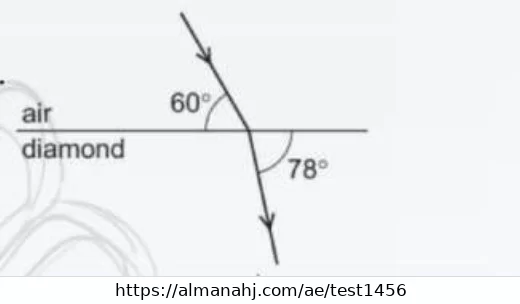
According to the figure, what is the velocity of light in the glass?
What quantity do we get when dividing the speed of light in a vacuum by the speed of light in a medium?
Explanation
The index of refraction n is defined as the ratio of the speed of light in vacuum c to the speed of light in the medium v.
Question 11
11
Points: 1
What is the speed of light in a medium with a refractive index of 2.0, if its speed in vacuum is C?
Explanation
Since n = c/v, then v = c/n. For n = 2.0, v = C/2.
Question 12
12
Points: 1
What happens to the light ray when it falls from water to air at an angle of $50.0^\circ$? (Given: nair = 1.0, nwater = 1.33)
Explanation
The critical angle for water is $\theta_c = \sin^{-1}(1/1.33) \approx 48.8^\circ$. Since $50^ > 48.8^\circ$, total internal reflection occurs.
Question 13
13
Points: 1
The critical angle for light passing from a glass block into another medium is $45.0^\circ$. What is the refractive index of the medium into which the light travels? (Assume the refractive index of glass is 1.41)
The diagram shows an optical fibre with a core refractive index of n1 = 1.50 and cladding refractive index of n2 = 1.47. Calculate the critical angle $\theta_c$ for total internal reflection at the core–cladding boundary.
Explanation
The critical angle is calculated as $\theta_c = \sin^{-1}(n_2 / n_1) = \sin^{-1}(1.47 / 1.50) \approx 78.52^\circ$.
Question 15
15
Points: 1
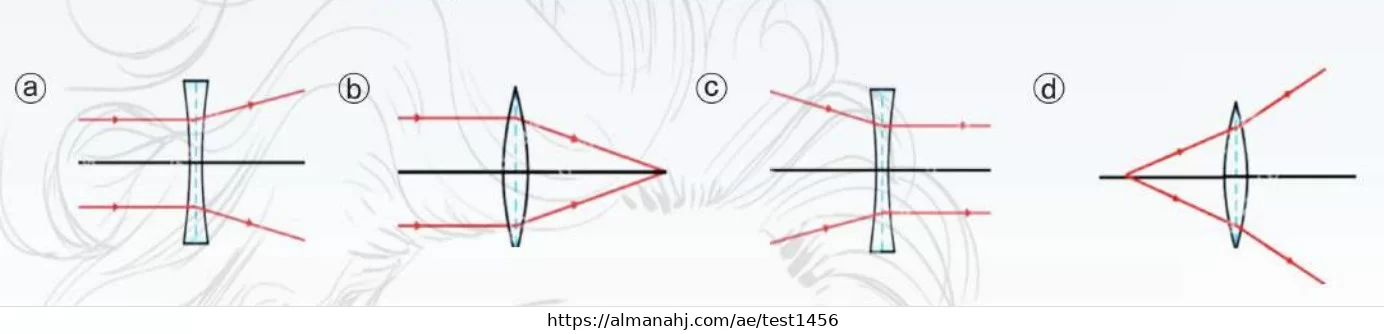
Which of the following ray diagrams for a concave lens is incorrect?
Explanation
In diagram (c), a parallel ray is shown converging in a concave lens, which is incorrect. Concave lenses are diverging; parallel rays should diverge as if coming from the focal point.
Question 16
16
Points: 1
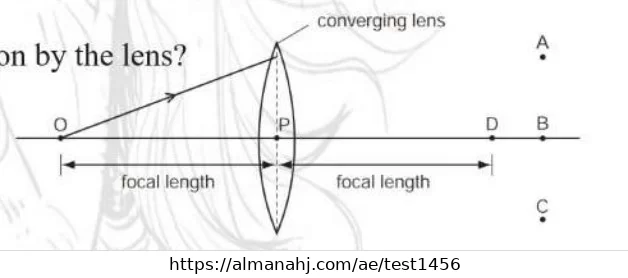
In the diagram, the distance OP is the focal length of the converging lens. One ray of light from O is shown. Through which point will this ray pass, after refraction by the lens?
Explanation
A ray passing through the focal point (O) of a converging lens emerges parallel to the principal axis. Line B is parallel to the axis.
Question 17
17
Points: 1
When does a convex lens act as a magnifying glass?
Explanation
A convex lens acts as a magnifier only when the object is placed between the lens and its focal point (x_o < f), producing a virtual, upright, and enlarged image.
Question 18
18
Points: 1
An object is placed at a distance of 90 cm from a convex lens with a focal length of 30 cm. Calculate the image distance x_i from the lens.
Explanation
Using the thin lens equation: $1/f = 1/x_o + 1/x_i \rightarrow 1/30 = 1/90 + 1/x_i$. 1/x_i = 1/30 - 1/90 = 3/90 - 1/90 = 2/90 = 1/45. So, x_i = 45 cm.
Question 19
19
Points: 1
Which of the following describes coherent light waves in terms of wavelength and phase?
Explanation
Coherent light consists of waves that have the same frequency (wavelength) and maintain a constant phase relationship.
Question 20
20
Points: 1
Which light source produces waves that are in phase and have the same wavelength?
Explanation
A laser is a source of monochromatic, coherent light, meaning all waves have the same wavelength and are in phase.
Question 21
21
Points: 1
In Young's double-slit experiment, the distance between bright fringes increases when:
Explanation
Fringe spacing is given by $x = \lambda L / d$. Therefore, increasing the wavelength $\lambda$ results in an increase in the distance x between fringes.
Result Tracking
Answered0 / 21
Correct Answers0
Wrong Answers0
Current Percentage0%
Quiz Completed
This is your final result after answering all questions.
Final Result
0/210%
Correct Answers0
Wrong Answers0
Answered Questions0 / 21
Total Possible Points21
You can reopen the page to start again.
يمكنك تسجيل الدخول لحفظ سجل محاولاتك، معرفة أخطائك المتكررة، والحصول على نصائح مخصصة. تسجيل الدخول باستخدام Google
Here are more quizzes for الصف العاشر المتقدم by الفصل الثالث and subject فيزياء
This section is rendered only when the user reaches it while scrolling.
...
🍪
إشعار ملفات تعريف الارتباط
يستخدم هذا الموقع ملفات تعريف الارتباط لتحسين تجربة التصفح وقياس الأداء وعرض المحتوى بشكل أفضل.
باستخدامك للموقع فإنك توافق على استخدامنا لها وفق
سياسة الخصوصية.