Interactive multiple-choice quiz: Quantum Physics and the Photoelectric Effect
Quantum Physics: Exploring the Photoelectric Effect, Compton Scattering, and Wave-Particle Duality. This document covers key concepts including the particle nature of light, energy of photons, and de Broglie's hypothesis. It examines how incident light frequency and intensity impact electron emission and kinetic energy, along with the conservation principles in Compton collisions and the calculated wavelengths of matter in motion.
🏆 انضم إلى التحدي واحصل على ترتيبك
اختبار شهادة تدريبي مؤقت للصف والمادة والفصل نفسه.
اختر إجابة واحدة لكل سؤال. عند الاختيار ستظهر النتيجة فورًا: الأخضر صحيح، والأحمر خطأ، وسيظهر تفسير الإجابة مباشرة إن كان متوفرًا. وبعد آخر سؤال ستظهر الدرجة النهائية تلقائيًا.
Which of the following best describes the photoelectric effect?
Explanation
The photoelectric effect is defined as the process where electrons (photoelectrons) are emitted from a material (usually a metal) when it absorbs electromagnetic radiation above a certain threshold frequency.
The photoelectric effect provided evidence for which of the following?
Explanation
The photoelectric effect cannot be explained by classical wave theory; it requires light to be treated as discrete packets of energy called photons, providing evidence for the particle nature of light.
Which of the following will decrease the energy of a photon? \nI. Increasing its wavelength \nII. Decreasing its wavelength \nIII. Increasing its frequency \nIV. Decreasing its frequency
Explanation
The energy of a photon is given by \(E = hf = \frac{hc}{\lambda}\). Thus, energy decreases if frequency f decreases (IV) or if wavelength \(\lambda\) increases (I).
The energy of a photon is inversely proportional to its _____ and directly proportional to its ______.
Explanation
According to the equation \(E = hf = \frac{hc}{\lambda}\), photon energy is directly proportional to frequency and inversely proportional to wavelength.
In the photoelectric effect, if the incident photons have a wavelength more than the threshold wavelength, _______.
Explanation
If the incident wavelength is greater than the threshold wavelength (\(\lambda > \lambda_0\)), the energy of the incident photons is less than the work function (E < W), so no electrons can be ejected.
Which feature of the photoelectric effect supports the quantum (photon) model of light?
Explanation
In the quantum model, each electron absorbs a single photon. Therefore, electron emission depends on the energy of individual photons (frequency), not the total number of photons (intensity), which contradicts classical wave theory.
Which of the following decreases if we decrease the brightness of the light received by the cathode of a photoelectric cell?
Explanation
Brightness or intensity is a measure of the number of photons per unit time per unit area. Decreasing brightness reduces the number of photons reaching the cathode per second.
A light beam falls on a metal surface and electrons are ejected. Which of the following is true regarding the photoelectrons if the intensity of the light is increased?
Explanation
Increasing light intensity increases the number of photons hitting the surface, which increases the number of ejected electrons. However, it does not change the energy per photon, so the maximum kinetic energy remains the same.
If a metal has a work function of 3.0 eV, which of the following photons can eject an electron? \nI. A photon with \(\lambda = 300\) nm \nII. A photon with \(\lambda = 400\) nm \nIII. A photon with \(\lambda = 700\) nm
Explanation
Using \(E(eV) = \frac{1240}{\lambda(nm)}\): I gives \(1240/300 \approx 4.13\) eV; II gives 1240/400 = 3.1 eV; III gives \(1240/700 \approx 1.77\) eV. Since only I and II have energies greater than the work function (3.0 eV), only they can eject electrons.
Two metal surfaces A and B have different work functions, such that the work function of A is greater than the work function of B. If the same light shines on both surfaces, which of the following best describes the difference between the electrons emitted from the two surfaces?
Explanation
From the Einstein equation Kmax = Ephoton - W, if surface A has a higher work function (W_A > W_B) and the incident energy E is the same, the resulting kinetic energy K will be lower for A.
A certain metal has a work function of \(\phi\). Which of the following is closest to the cutoff frequency of this surface?
Explanation
The work function \(\phi\) is equal to Planck's constant \times the threshold (cutoff) frequency: \(\phi = hf_0\). Solving for f0 gives \(f_0 = \phi/h\).
The number of photoelectrons per unit time (current) depends on the intensity (number of photons) of the light, not its frequency. Frequency determines the kinetic energy of individual electrons.
Photons are incident upon a metal surface with work function of 8.0 eV, and photoelectrons with maximum kinetic energy of 12.0 eV are emitted from the surface. What is the energy of an incident photon?
Explanation
According to Einstein's photoelectric equation Ephoton = W + Kmax. Substituting the values: E = 8.0 + 12.0 = 20.0 eV.
A light of wavelength 300 nm is incident on Beryllium metal which has a work function of 3.90 eV. Calculate the maximum kinetic energy of the photoelectrons.
Explanation
Energy of the photon \(E = \frac{1240}{300} = 4.13\) eV. Max kinetic energy Kmax = E - W = 4.13 - 3.90 = 0.23 eV.
A material with a threshold frequency of f0 is illuminated with light of frequency 2.5 f0. The maximum kinetic energy of the ejected photoelectrons is _____.
Explanation
Using Kmax = hf - hf0, where f = 2.5 f0: Kmax = h(2.5 f0) - hf0 = 1.5 hf0.
A photocell has the metal aluminum with a work function of 4.08 eV. What is its stopping potential if photons of energy 6.40 eV strike the surface of the metal?
Explanation
The maximum kinetic energy is Kmax = E - W = 6.40 - 4.08 = 2.32 eV. The stopping potential in volts is numerically equal to the kinetic energy in eV, so Vstop = 2.32 V.
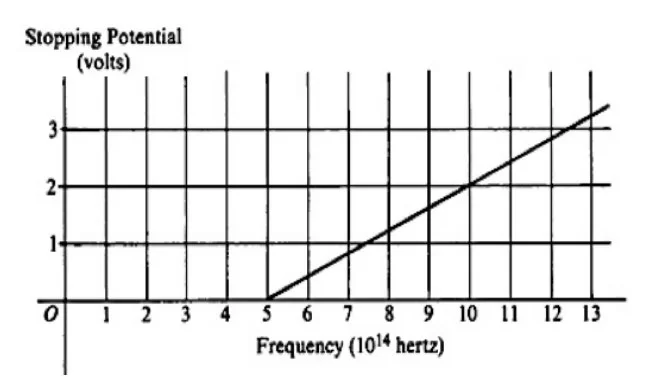
The graph below shows the variation of the stopping voltage Vstop in terms of the incident frequency f. What is the cutoff frequency?
Explanation
On a graph of stopping potential vs. frequency, the cutoff frequency (threshold frequency) is the x-intercept, which is clearly marked as 4.0 (scaled by 1014 Hz).
Using W = h f0 and the threshold frequency f0 = 4.0 × 10¹⁴ Hz. If we approximate \(h \approx 6.4 \times 10^{-34}\) Js (from the graph calculation), then W = 6.4 × 10-34 × 4.0 × 1014 = 2.56 × 10⁻¹⁹ J. Choice B is the closest available option based on standard visual interpretation.
Determine Planck's constant from the data provided in the graph.
Explanation
The slope of the Vstop vs. f graph is h/e. From the graph, points are (4,0) and (12,3). Slope = \(\frac{3-0}{(12-4) \times 10^{14}} = 0.375 \times 10^{-14}\). Then h = slope × e = 0.375 × 10-14 × 1.6 × 10-19 = 6.0 × 10⁻³⁴ Js. Choice C is the closest standard textbook approximation for such problems.
Which of the following particles exhibit wave-like behavior according to de Broglie's hypothesis?
Explanation
According to de Broglie's hypothesis, any particle with momentum has an associated wavelength; therefore, electrons, protons, and neutrons all exhibit wave-like behavior.
An electron and a proton are moving and have the same de Broglie wavelength. Which of the following are also the same for the two particles? (nonrelativistic particles)
Explanation
Since \(\lambda = h/p\), if two particles have the same de Broglie wavelength, they must have the same momentum p.
A proton, an ant, and a baseball each have the same kinetic energy. Rank their de Broglie wavelengths from smallest to largest.
Explanation
\(\lambda = \frac{h}{\sqrt{2mK}}\). For the same kinetic energy K, wavelength is inversely proportional to the square root of the mass (\(\lambda \propto 1/\sqrt{m}\)). Since mass of baseball > ant > proton, the wavelengths rank as baseball (smallest) < ant < proton (largest).
Here are more quizzes for الصف الثاني عشر المتقدم by الفصل الثالث and subject فيزياء
This section is rendered only when the user reaches it while scrolling.
...
🍪
إشعار ملفات تعريف الارتباط
يستخدم هذا الموقع ملفات تعريف الارتباط لتحسين تجربة التصفح وقياس الأداء وعرض المحتوى بشكل أفضل.
باستخدامك للموقع فإنك توافق على استخدامنا لها وفق
سياسة الخصوصية.