Interactive multiple-choice quiz: Atomic Physics and Spectral Analysis Quiz
This set of questions covers fundamental topics in atomic physics, including atomic models and spectroscopy. Topics include the Rutherford gold foil experiment, Bohr's model of the hydrogen atom, and the classification of spectral series. It also includes quantitative problems on energy levels, transition energies, and wavelength calculations.
🏆 انضم إلى التحدي واحصل على ترتيبك
اختبار شهادة تدريبي مؤقت للصف والمادة والفصل نفسه.
اختر إجابة واحدة لكل سؤال. عند الاختيار ستظهر النتيجة فورًا: الأخضر صحيح، والأحمر خطأ، وسيظهر تفسير الإجابة مباشرة إن كان متوفرًا. وبعد آخر سؤال ستظهر الدرجة النهائية تلقائيًا.
According to the Heisenberg uncertainty principle, what happens if the measurement of a particle's position is made more precise?
Explanation
The uncertainty principle states that the product of the uncertainties in position and momentum is at least a constant value; thus, decreasing one increases the other.
Question 2
2
Points: 1
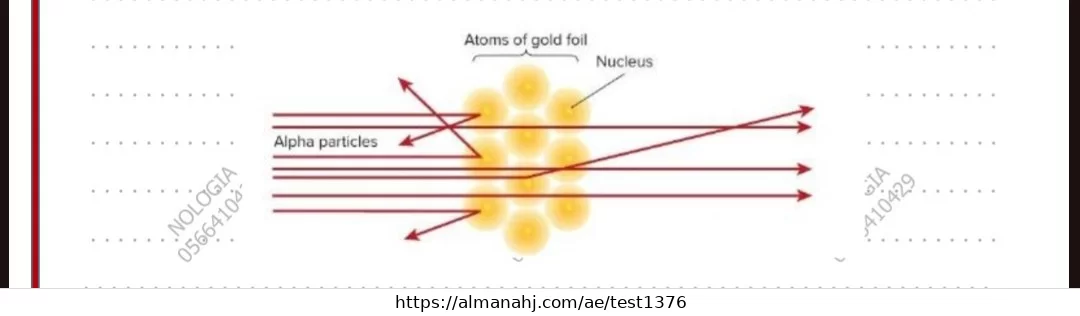
What was the major conclusion of Rutherford's alpha-scattering experiment regarding the structure of the atom?
Explanation
The scattering of alpha particles at large angles indicated a dense, positively charged core.
Question 3
3
Points: 1
In his experiment, Rutherford used alpha ($\alpha$) particles to bombard the gold foil. what are the primary characteristics of these particles?
Explanation
Alpha particles are helium nuclei consisting of two protons and two neutrons.
Question 4
4
Points: 1
Why did Rutherford choose an "extremely thin sheet" of gold foil for this experiment?
Explanation
Thinness is required to observe individual scattering events rather than multiple collisions.
Question 5
5
Points: 1
Looking at Figure, what does the fact that "most of the alpha particles passed through the foil without deflection" indicate about the atom?
Explanation
Since most particles passed through undeflected, they did not encounter a solid mass or strong charge.
Question 6
6
Points: 1
According to Rutherford's nuclear model, what percentage of an atom's mass is contained within its nucleus?
Explanation
The nucleus contains nearly all the mass of the atom while occupying a tiny fraction of its volume.
Question 7
7
Points: 1
Why is the emission spectrum of a gaseous element described as a "fingerprint" of that element?
Explanation
Every element has unique energy levels, leading to a unique set of emitted frequencies.
Question 8
8
Points: 1
If a sample contains a mixture of several different elements, how can an observer identify them using a photograph of their spectrum?
Explanation
Spectral analysis allows identification of elements even in mixtures by matching line patterns.
Question 9
9
Points: 1
How do the emission spectra of incandescent solids and atomic gases differ?
Explanation
Solids exhibit thermal radiation across a range of wavelengths, while low-pressure gases emit specific frequencies.
Question 10
10
Points: 1
An absorption spectrum is best described as:
Explanation
Absorption occurs when a gas absorbs specific frequencies from a background continuous light source.
Question 11
11
Points: 1
In industrial settings, like steel mills, why is spectroscopy considered an effective tool for analyzing materials?
Explanation
Spectroscopy provides rapid and accurate chemical analysis of materials.
Question 12
12
Points: 1
What is the primary reason for the appearance of dark lines in the absorption spectrum of a gas?
Explanation
Atoms absorb photons corresponding to transitions between their discrete energy levels.
Question 13
13
Points: 1
According to the Bohr model, what happens to an atom's energy when it absorbs a photon?
Explanation
Energy conservation requires the atom to gain the energy of the absorbed photon.
Question 14
14
Points: 1
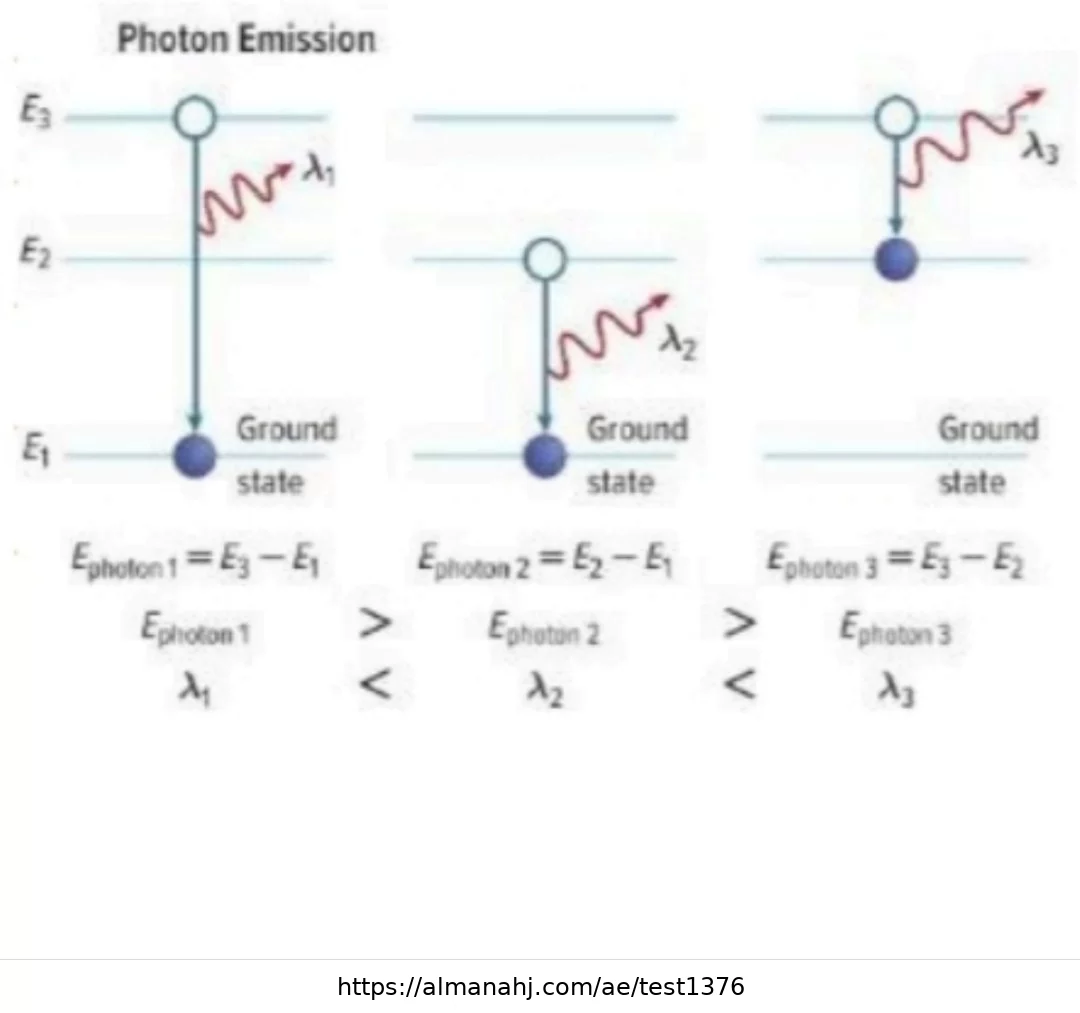
Look at Figure. Which of the following transitions in the diagram would produce a photon with the greatest frequency (f)?
Explanation
Frequency is proportional to energy change (E = hf). The transition with the largest energy gap (E3 to E1, denoted $\lambda_1$ in the diagram) produces the highest frequency.
Question 15
15
Points: 1
A mercury atom drops from an energy state of 8.82 eV to a state of 6.67 eV. What is the energy of the emitted photon?
Explanation
Photon energy E = Einitial - Efinal = 8.82 - 6.67 = 2.15 eV.
Question 16
16
Points: 1
Based on the "stairs" analogy in Figure, why can't an electron exist between energy levels?
Explanation
Quantization means energy comes in discrete 'steps', much like stairs where you can't stand between steps.
Question 17
17
Points: 1
Which of the following best describes Rutherford's nuclear model of the atom as proposed in the early 20th century?
Explanation
Rutherford discovered the nucleus through his scattering experiment, leading to the planetary model.
Question 18
18
Points: 1
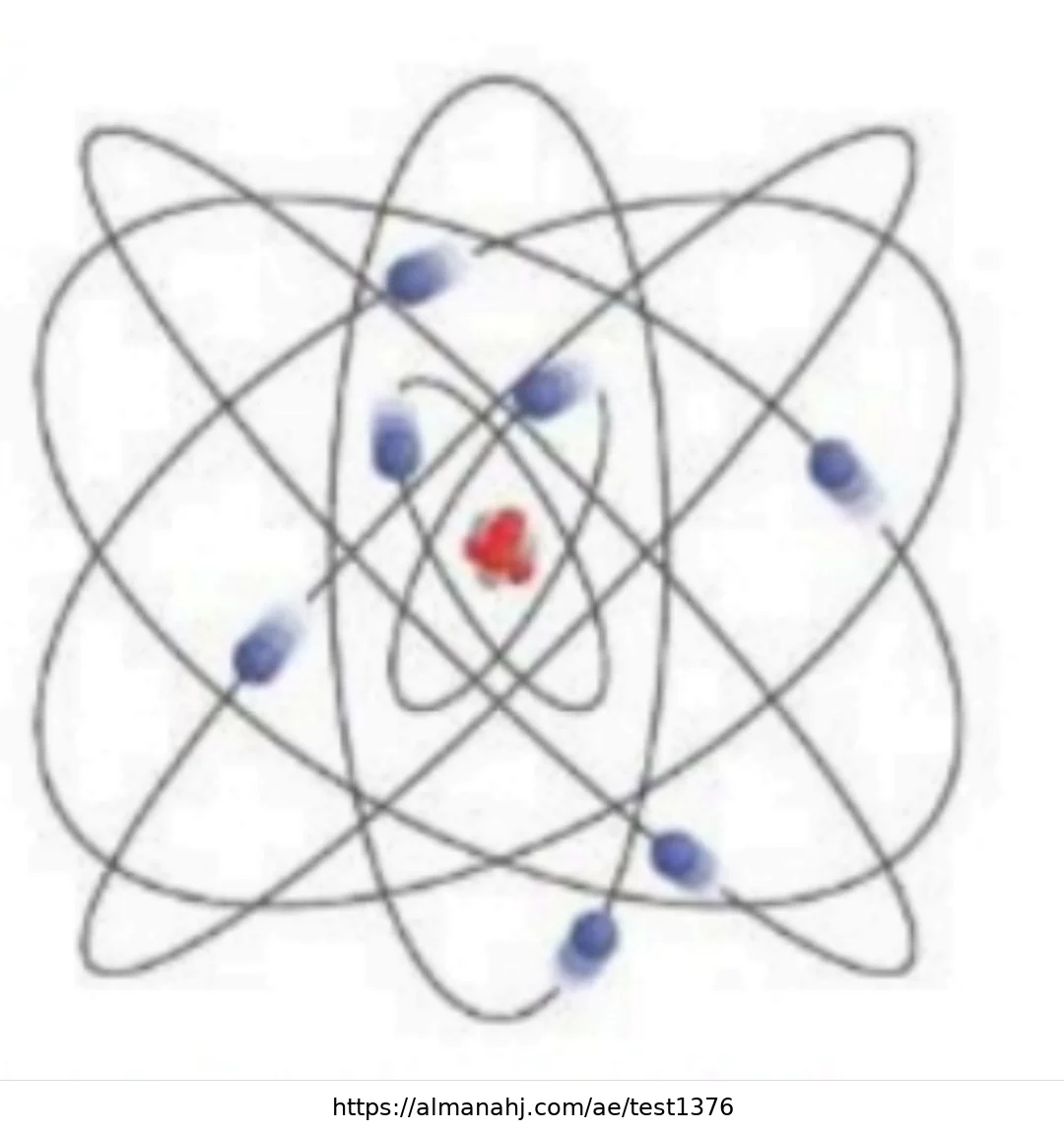
Look at Figure. Why is this representation of the atom often called the "planetary model"?
Explanation
The model visualizes electrons moving around the nucleus like planets around a star.
Question 19
19
Points: 1
According to the laws of classical electromagnetism, why was Rutherford's planetary model considered unstable?
Explanation
Classical physics predicts that any accelerating charge radiates energy, causing the electron to lose energy and fall into the nucleus.
Question 20
20
Points: 1
According to the Section Review in the Teacher's Guide, what are the two main problems with the planetary model?
Explanation
The planetary model failed to explain why atoms are stable and why they emit discrete rather than continuous spectra.
Question 21
21
Points: 1
Based on the energy formula $E_n = -13.6 eV \times (\frac{1}{n^2})$, what is the energy of a hydrogen atom in the third energy level (n = 3)?
Explanation
$E_3 = -13.6 / 3^2 = -13.6 / 9 \approx -1.51 eV$.
Question 22
22
Points: 1
If the innermost orbital radius (r1) of the hydrogen atom is 0.053 nm, what is the radius associated with the fourth energy level (n = 4)?
Calculate the energy difference ($\Delta E$) for a hydrogen atom when an electron transitions from the n = 2 level to the n = 3 level.
Explanation
$\Delta E = E_3 - E_2 = -1.51 eV - (-3.40 eV) = 1.89 eV$.
Question 24
24
Points: 1
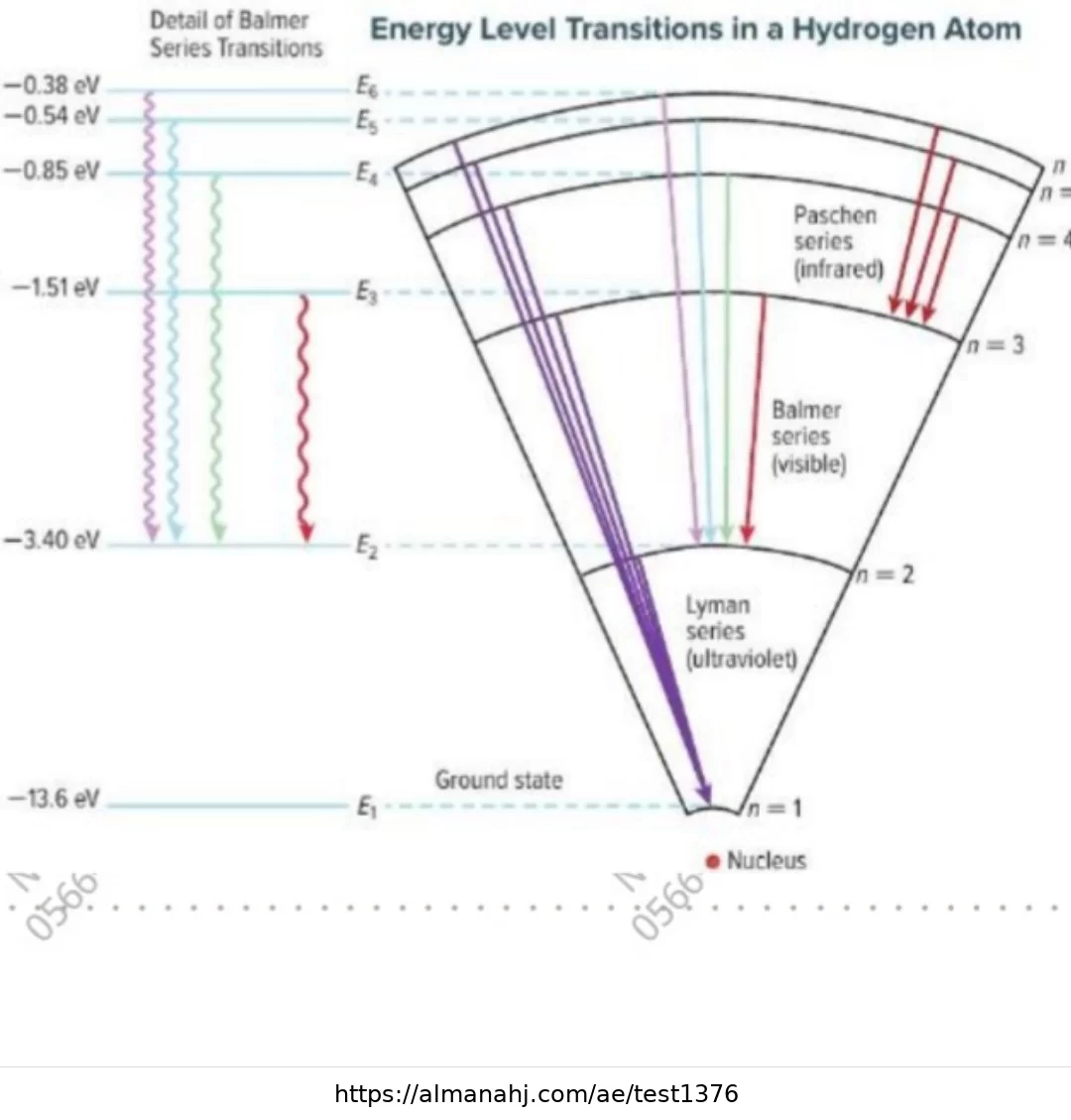
Which spectral series is produced when an electron in a hydrogen atom drops from higher energy levels directly to the ground state (n = 1)?
Explanation
Transitions to the n=1 level form the Lyman series, which is in the UV region.
Question 25
25
Points: 1
The only spectral lines of hydrogen that are visible to the human eye belong to the Balmer series. These lines occur when electrons transition to which energy level?
Explanation
The Balmer series consists of transitions ending at the second energy level (n=2).
Question 26
26
Points: 1
Look at Figure. Transitions from higher levels down to n=3 result in the emission of which type of electromagnetic radiation?
Explanation
Transitions to n=3 constitute the Paschen series, which lies in the infrared part of the spectrum.
Question 27
27
Points: 1
Match the series correctly with its destination level and region:
Explanation
Balmer transitions end at n=2 and produce visible light.
Question 28
28
Points: 1
An excited electron in a hydrogen atom drops from the n = 2 energy level (E2 = -3.40 eV) to the ground state (n = 1, E1 = -13.6 eV). What is the energy of the emitted photon?
Explanation
Energy E = E2 - E1 = -3.40 - (-13.6) = 10.2 eV.
Question 29
29
Points: 1
For a particular transition, a mercury atom drops from an energy state of 8.82 eV to 6.67 eV. What is the wavelength of the emitted photon? (Use hc = 1240 eV × nm)
Explanation
Energy change $\Delta E = 8.82 - 6.67 = 2.15 eV$. Wavelength $\lambda = hc / \Delta E = 1240 / 2.15 \approx 577 nm$, which corresponds closely to option C.
Result Tracking
Answered0 / 29
Correct Answers0
Wrong Answers0
Current Percentage0%
Quiz Completed
This is your final result after answering all questions.
Final Result
0/290%
Correct Answers0
Wrong Answers0
Answered Questions0 / 29
Total Possible Points29
You can reopen the page to start again.
يمكنك تسجيل الدخول لحفظ سجل محاولاتك، معرفة أخطائك المتكررة، والحصول على نصائح مخصصة. تسجيل الدخول باستخدام Google
Here are more quizzes for الصف الثاني عشر المتقدم by الفصل الثالث and subject فيزياء
This section is rendered only when the user reaches it while scrolling.
...
🍪
إشعار ملفات تعريف الارتباط
يستخدم هذا الموقع ملفات تعريف الارتباط لتحسين تجربة التصفح وقياس الأداء وعرض المحتوى بشكل أفضل.
باستخدامك للموقع فإنك توافق على استخدامنا لها وفق
سياسة الخصوصية.