Online Quiz: British Curriculum Primary 6 Biology Quiz: Classification and Naming of Organisms
Open Online Quiz: British Curriculum Primary 6 Biology Quiz: Classification and Naming of Organisms - 🧬 Biology - Level 6 - Term 1 as an interactive British curriculum quiz with instant marking and explanations.
Level 6🧬 BiologyTerm 12025/2026Teacher: Almanahj
Scan to open this quiz
https://almanahj.com/uk/quizzes/6biology1/122
Print Quiz
Choose the version to send to your printer or save as PDF.
Cambridge Primary 6 Biology: Classification and Naming of Organisms
A Cambridge Primary 6 Biology quiz on grouping organisms, using classification keys and understanding scientific names.
Result Tracking
0Answered
0Correct Answers
0Wrong Answers
0%Current Percentage
Quiz Completed
This is your final result after answering all questions. You can reopen the page to start again.
Question 1
1 point
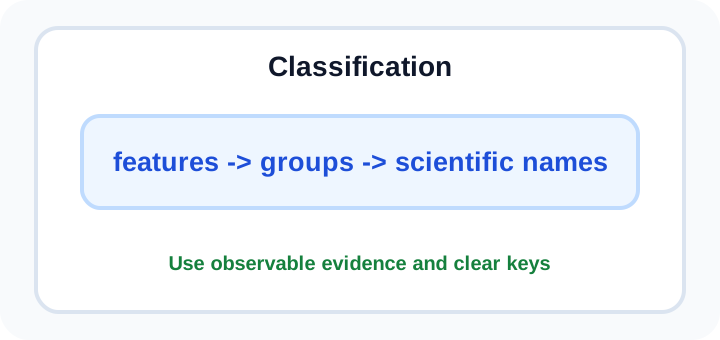
Use the model. What is the main purpose of classification?
Explanation
Classification organises living things by similarities and differences.
Question 2
1 point
Which feature is most useful for classifying animals into vertebrates and invertebrates?
Explanation
A backbone is a clear structural feature.
Question 3
1 point
Which animal is a vertebrate?
Explanation
Frogs have backbones.
Question 4
1 point
Which animal is an invertebrate?
Explanation
Butterflies do not have backbones.
Question 5
1 point
What is a classification key used for?
Explanation
Keys use choices based on observable features.
Question 6
1 point
Which question would be useful in a key for leaves?
Explanation
Useful key questions are objective and observable.
Question 7
1 point
Why do scientists use scientific names?
Explanation
Scientific names are internationally recognised.
Question 8
1 point
Which is the correct style for a binomial scientific name?
Explanation
Binomial names use genus then species.
Question 9
1 point
What does the first word in a binomial name show?
Explanation
The first word is the genus name.
Question 10
1 point
Which pair are more closely related?
Explanation
Same genus usually indicates close relationship.
Question 11
1 point
Which group contains only mammals?
Explanation
Mammals have features such as hair and feeding young with milk.
Question 12
1 point
Which group contains only flowering plants?
Explanation
These are flowering plants, even if grass flowers are small.
Question 13
1 point
Why can habitat alone mislead classification?
Explanation
A pond can contain plants, insects, fish and microbes.
Question 14
1 point
Which feature helps classify insects?
Explanation
Adult insects have six legs and head, thorax and abdomen.
Question 15
1 point
Which is a microorganism group?
Explanation
Bacteria are microscopic organisms.
Question 16
1 point
What should a good classification key avoid?
Explanation
Keys should use objective evidence.
Question 17
1 point
An animal has feathers and a beak. Which group is most likely?
Explanation
Feathers are a defining bird feature.
Question 18
1 point
An organism has roots, stems and leaves and makes seeds in cones. How is it best described?
Explanation
Conifers make seeds in cones, not flowers.
Question 19
1 point
Why may classification change when new evidence is found?
Explanation
New evidence such as cell or DNA evidence can refine classification.
Question 20
1 point
What is the main idea of this lesson?
Explanation
Classification depends on shared characteristics and clear naming.