Online Quiz: British Curriculum Primary 5 Science Quiz: Changes of State
Open Online Quiz: British Curriculum Primary 5 Science Quiz: Changes of State - 🔬 Science - Level 5 - Term 2 as an interactive British curriculum quiz with instant marking and explanations.
Level 5🔬 ScienceTerm 22025/2026Teacher: Almanahj
Scan to open this quiz
https://almanahj.com/uk/quizzes/5science2/111
Print Quiz
Choose the version to send to your printer or save as PDF.
Cambridge Primary 5 Science: Changes of State
This lesson quiz helps learners identify melting, freezing, evaporation and condensation and explain them using heating and cooling.
Result Tracking
0Answered
0Correct Answers
0Wrong Answers
0%Current Percentage
Quiz Completed
This is your final result after answering all questions. You can reopen the page to start again.
Question 1
1 point
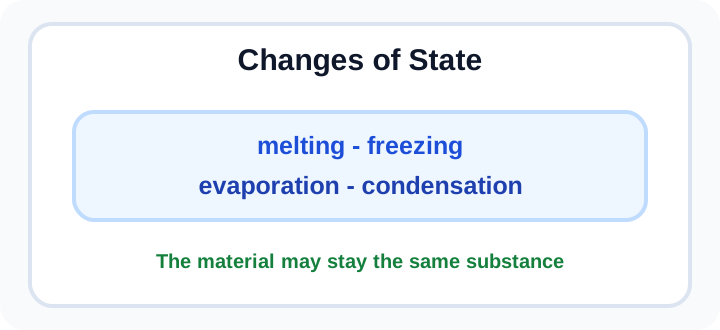
Use the model. What is melting?
Explanation
Melting happens when a solid gains enough thermal energy.
Question 2
1 point
What is freezing?
Explanation
Freezing happens when a liquid cools and becomes solid.
Question 3
1 point
What is evaporation?
Explanation
Evaporation can happen below boiling point.
Question 4
1 point
What is condensation?
Explanation
Condensation occurs when gas cools.
Question 5
1 point
Which change happens when ice is warmed?
Explanation
Ice changes from solid water to liquid water.
Question 6
1 point
Which change happens when water is cooled below 0 degrees Celsius?
Explanation
Liquid water becomes ice.
Question 7
1 point
Which change forms droplets on the outside of a cold glass?
Explanation
Water vapour in air cools and becomes liquid droplets.
Question 8
1 point
Why does a puddle slowly disappear on a warm day?
Explanation
Liquid water changes to water vapour.
Question 9
1 point
Which process requires cooling?
Explanation
Cooling water vapour can form liquid water.
Question 10
1 point
Which process requires heating?
Explanation
Heating can make a solid melt.
Question 11
1 point
What is boiling?
Explanation
Boiling occurs throughout the liquid at its boiling point.
Question 12
1 point
How is boiling different from evaporation?
Explanation
This is the key difference.
Question 13
1 point
Which change is reversible for water?
Explanation
Water can change state and change back.
Question 14
1 point
What stays the same when pure water freezes?
Explanation
Only the state changes.
Question 15
1 point
Which particle change happens during melting?
Explanation
The solid structure breaks down.
Question 16
1 point
Which particle change happens during freezing?
Explanation
Liquid particles arrange as a solid.
Question 17
1 point
Why does wet clothing dry faster in wind?
Explanation
This increases the rate of evaporation.
Question 18
1 point
Why does wet clothing dry faster when warm?
Explanation
Higher temperature speeds evaporation.
Question 19
1 point
Which instrument measures temperature during changes of state?
Explanation
Temperature can be monitored with a thermometer.
Question 20
1 point
Which summary is correct?
Explanation
Changes of state usually do not form new substances.