Online Quiz: British Curriculum Primary 5 Science Quiz: Solids, Liquids and Gases
Open Online Quiz: British Curriculum Primary 5 Science Quiz: Solids, Liquids and Gases - 🔬 Science - Level 5 - Term 2 as an interactive British curriculum quiz with instant marking and explanations.
Level 5🔬 ScienceTerm 22025/2026Teacher: Almanahj
Scan to open this quiz
https://almanahj.com/uk/quizzes/5science2/110
Print Quiz
Choose the version to send to your printer or save as PDF.
Cambridge Primary 5 Science: Solids, Liquids and Gases
This lesson quiz helps learners compare solids, liquids and gases using shape, volume, flow and particle ideas.
Result Tracking
0Answered
0Correct Answers
0Wrong Answers
0%Current Percentage
Quiz Completed
This is your final result after answering all questions. You can reopen the page to start again.
Question 1
1 point
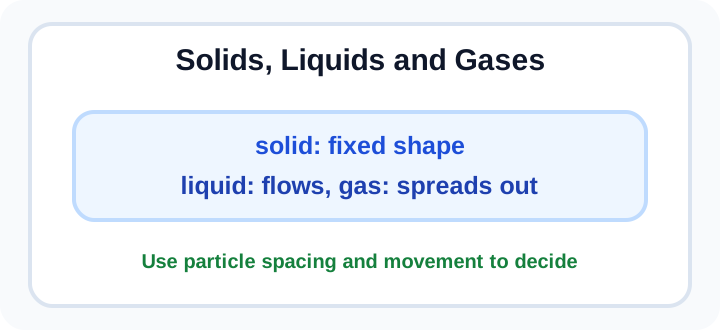
Use the model. Which state has a fixed shape and fixed volume?
Explanation
A solid keeps its own shape and volume.
Question 2
1 point
Which state has a fixed volume but takes the shape of its container?
Explanation
A liquid flows and takes the container shape while keeping volume.
Question 3
1 point
Which state spreads to fill all the available space?
Explanation
Gas particles move freely and spread out.
Question 4
1 point
Which material is most clearly a liquid at room temperature?
Explanation
Water is a liquid at ordinary room temperature.
Question 5
1 point
Which material is most clearly a gas at room temperature?
Explanation
Air is a mixture of gases.
Question 6
1 point
Which statement about particles in a solid is correct?
Explanation
Solid particles are closely packed.
Question 7
1 point
Which statement about liquid particles is correct?
Explanation
This explains why liquids flow.
Question 8
1 point
Which statement about gas particles is correct?
Explanation
Gas particles have large spaces between them.
Question 9
1 point
Why can a gas be compressed more easily than a liquid?
Explanation
Compression reduces the spaces between gas particles.
Question 10
1 point
A material can be poured and forms a level surface. What state is it likely to be?
Explanation
Liquids flow and settle with a level surface.
Question 11
1 point
A balloon becomes bigger as air is added. Which idea explains this?
Explanation
The added gas occupies space inside the balloon.
Question 12
1 point
Which property is shared by solids, liquids and gases?
Explanation
All matter is made of particles.
Question 13
1 point
Which is not a state of matter in this lesson?
Explanation
A shadow is an absence or blocking of light, not matter.
Question 14
1 point
Which item contains matter in all three states?
Explanation
Ice is solid, water is liquid and vapour is gas.
Question 15
1 point
Why does perfume smell spread through a room?
Explanation
Gas particles spread from high concentration to low concentration.
Question 16
1 point
What happens to the volume of a liquid when it is poured into a new container?
Explanation
A liquid has a fixed volume.
Question 17
1 point
Which state is easiest to describe by saying "no fixed shape and no fixed volume"?
Explanation
Gases take both the shape and volume of their container.
Question 18
1 point
Why is sand tricky to classify by observation?
Explanation
Granular solids can flow as many small solid pieces.
Question 19
1 point
Which test best distinguishes a gas from a liquid?