Interactive multiple-choice quiz: الوحدة الأولى: الطاقة والتغيرات الكيميائية
اختبار تقييمي حول طاقة التفاعلات الكيميائية ووحدات القياس. يساعد هذا السؤال الطلاب على إتقان مهارات التحويل بين الوحدات الحرارية المختلفة مثل الجول والسعر. يتطلب الحل معرفة العلاقة الثابتة بين السعر الحراري والجول والكيلو جول.
🏆 انضم إلى التحدي واحصل على ترتيبك
اختبار شهادة تدريبي مؤقت للصف والمادة والفصل نفسه.
اختر إجابة واحدة لكل سؤال. عند الاختيار ستظهر النتيجة فورًا: الأخضر صحيح، والأحمر خطأ، وسيظهر تفسير الإجابة مباشرة إن كان متوفرًا. وبعد آخر سؤال ستظهر الدرجة النهائية تلقائيًا.
Question 1
1
Points: 1
Which of the following contains the largest number of calories? أي مما يلي يحتوي على أكبر عدد من السعرات الحرارية؟
Explanation
للمقارنة نحول جميع القيم إلى وحدة الجول (J) كمرجع موحد: 1) 10 Cal = 10 × 4184 = 41840 J. 2) 9600 J تبقى كما هي. 3) 86.5 kJ = 86.5 × 1000 = 86500 J. 4) 1000 cal = 1000 × 4.184 = 4184 J. بالمقارنة نجد أن القيمة 86500 J (أي 86.5 kJ) هي الأكبر.
Question 2
2
Points: 1
A 355 g unknown sample warms from 22.4°C to 43.6°C and absorbs 6.75 kJ. Which substance is it? Specific heat values (J/g°C): iron 0.449; aluminium 0.897; silver 0.235; gold 0.129.
امتصت عينة مجهولة كتلتها 355 g طاقة 6.75 kJ وارتفعت حرارتها من 22.4 إلى 43.6°C. ما المادة إذا كانت الحرارات النوعية معطاة؟
Explanation
c = 6750 ÷ [355 × (43.6 − 22.4)] ≈ 0.897 J/g°C، وهي حرارة الألومنيوم النوعية.
Using q = mcΔT gives c ≈ 0.897 J/g°C, matching aluminium.
Question 3
3
Points: 1
A 360 g hot alloy cools by 205°C in 425 g of water that warms by 18.7°C. What is the alloy’s specific heat? Use c(water)=4.18 J/g°C.
تبرد سبيكة كتلتها 360 g بمقدار 205°C عند وضعها في ماء كتلته 425 g ترتفع حرارته 18.7°C. احسب الحرارة النوعية للسبيكة.
Explanation
حرارة الماء المكتسبة تساوي حرارة السبيكة المفقودة: c = (425×4.18×18.7)/(360×205) ≈ 0.450.
Set heat gained by water equal to heat lost by the alloy; solving gives about 0.450 J/g°C.
Question 4
4
Points: 1
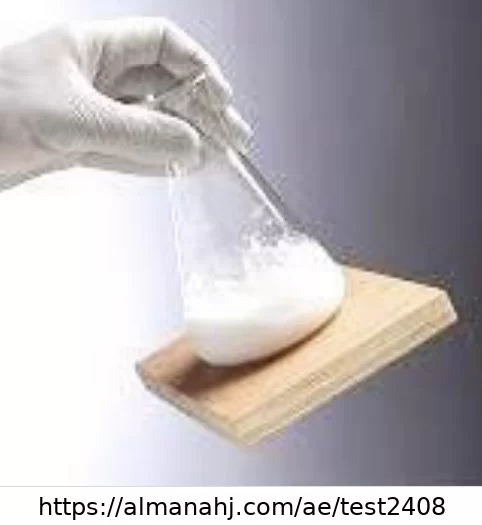
For the endothermic process in a cup resting on a damp plate, in which direction does heat flow?
في التفاعل الماص للحرارة داخل كوب على طبق مبلل، ما اتجاه انتقال الحرارة؟
Explanation
يمتص التفاعل الماص الحرارة من المحيط، أي من الماء والطبق إلى محتويات الكوب.
An endothermic reaction absorbs heat from its surroundings: the wet plate and water transfer heat to the cup contents.
Question 5
5
Points: 1
Which thermochemical equation describes dissolving ammonium nitrate in an instant cold pack?
أي معادلة حرارية تمثل ذوبان نترات الأمونيوم في كمادة باردة فورية؟
Explanation
الذوبان ماص للحرارة، لذا تُكتب الحرارة على جانب المتفاعلات وتكون ΔH موجبة.
Cold-pack dissolution is endothermic, so 27 kJ appears on the reactant side and ΔH is positive.
Question 6
6
Points: 1
How much methane must burn to release 10692 kJ? Methane combustion enthalpy = −891 kJ/mol; molar mass = 16.04 g/mol.
ما كتلة الميثان اللازمة لإطلاق 10692 kJ إذا كانت حرارة احتراقه −891 kJ/mol وكتلته المولية 16.04 g/mol؟
Explanation
عدد المولات = 10692/891 = 12 mol، والكتلة = 12×16.04 = 192.48 g ≈ 192 g.
Divide the heat by 891 kJ/mol to obtain 12 mol, then multiply by 16.04 g/mol.
Question 7
7
Points: 1
Which statement about a foam-cup calorimeter is incorrect?
أي عبارة عن المسعر المصنوع من كوب بلاستيكي رغوي غير صحيحة؟
Explanation
نقيس الكتلة ودرجات الحرارة مباشرةً، ثم نحسب الحرارة النوعية منها؛ ليست الحرارة النوعية قراءة مباشرة.
Mass and temperature changes are measured; specific heat is then calculated, not directly collected.
Question 8
8
Points: 1
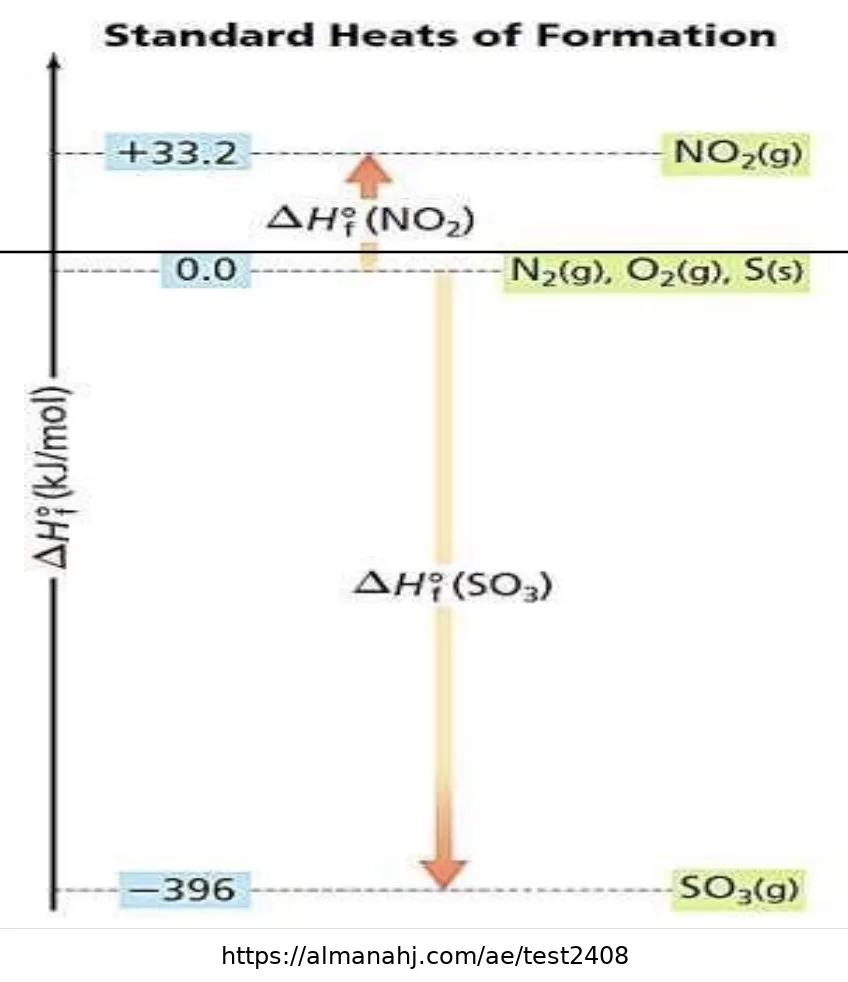
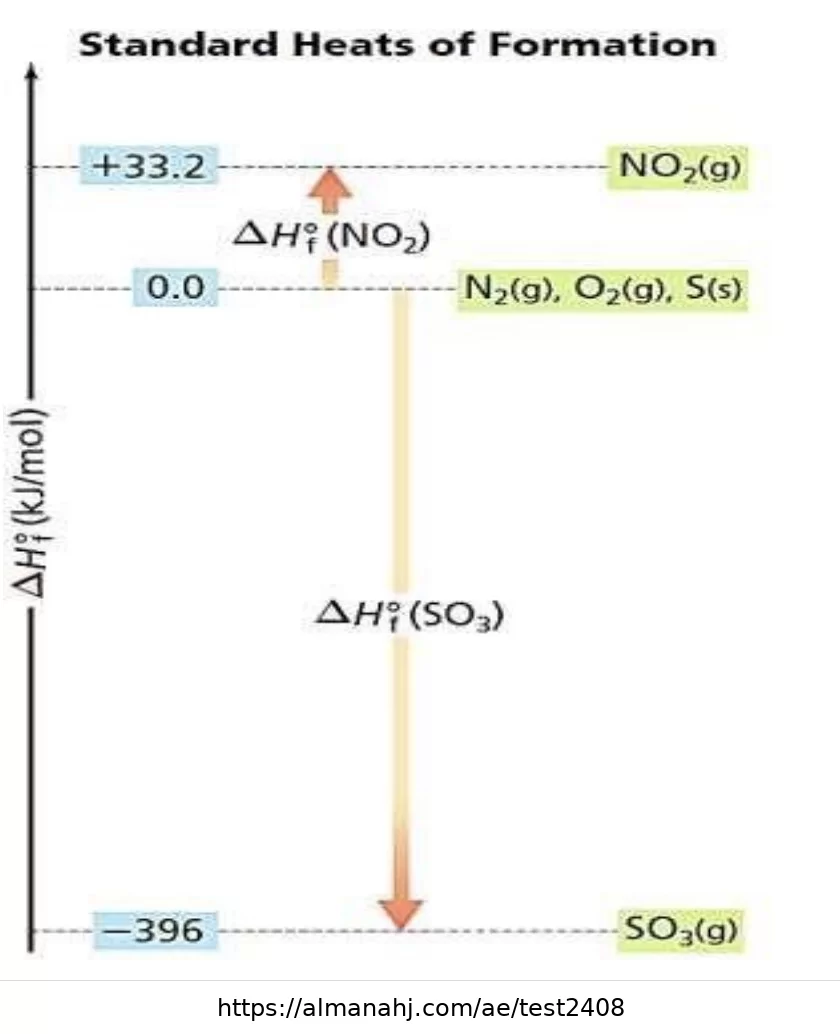
Standard formation enthalpies are ΔHf°(NO2)=+33.2 kJ/mol and ΔHf°(SO3)=−396 kJ/mol; ΔHf° of elements in standard states is zero. Which statement is incorrect? [Source graph: PDF p. 9]
حرارة تكوين NO2 القياسية +33.2، وSO3 تساوي −396 kJ/mol، وللعناصر القياسية صفر. أي عبارة غير صحيحة؟ [رسم ص9]
Explanation
الصفر أكبر من −396 وليس أصغر منه؛ لذا العبارة الثالثة خاطئة.
Zero is greater than −396, so the third statement reverses the correct comparison.
Question 9
9
Points: 1
For 3NO2(g) + H2O(l) → 2HNO3(aq) + NO(g), find ΔHrxn from ΔHf°: NO2=33.2, H2O=−285.8, HNO3=−207.4, NO=91.3 (kJ/mol).
احسب ΔH للتفاعل 3NO2 + H2O → 2HNO3 + NO، باستخدام قيم حرارة التكوين: 33.2، −285.8، −207.4، 91.3 kJ/mol بالترتيب.
Explanation
ΔH = [2(−207.4)+91.3] − [3(33.2)−285.8] = −137.3 kJ ≈ −137 kJ.
Subtract the sum of reactant formation enthalpies from the sum for products: −137.3 kJ.
Question 10
10
Points: 1
Which processes have positive ΔH? I: H2O(l)→H2O(g); II: H2O(s)→H2O(l); III: H2O(g)→H2O(l); IV: H2O(l)→H2O(s).
أي العمليات لها ΔH موجب؟ I تبخر الماء، II انصهار الجليد، III التكاثف، IV التجمد.
Explanation
التبخر والانصهار ماصّان للحرارة؛ أما التكاثف والتجمد فطاردان.
Vaporization and melting absorb heat and therefore have positive enthalpy changes.
Question 11
11
Points: 1
Which equation does not describe a standard enthalpy of formation?
أي معادلة لا تمثل حرارة تكوين قياسية لمول واحد من المركب؟
Explanation
حرارة التكوين القياسية تخص تكوين مول واحد من المركب من عناصره القياسية، بينما المعادلة الثالثة تنتج مولين من NO؛ وقيمة ΔH المذكورة فيها غير متسقة أيضًا.
Standard formation refers to producing one mole of a compound from its elements; option C produces two moles of NO and its quoted enthalpy is also inconsistent.
Question 12
12
Points: 1
Rusting: (1) 4Fe+3O2→2Fe2O3, ΔH=−1625 kJ; (2) 2Fe2O3→4Fe+3O2, ΔH=+1625 kJ. Which statement is correct?
تفاعل صدأ الحديد (1) طارد للحرارة ΔH=−1625 kJ، وعكسه (2) ماص ΔH=+1625 kJ. ما العبارة الصحيحة؟
Explanation
الصدأ تفاعل طارد للحرارة ويحدث تلقائيًا في الظروف المعتادة، في حين يتطلب عكسه طاقة.
Rust formation is exothermic and can occur spontaneously under ordinary conditions; reversing it requires energy.
Question 13
13
Points: 1
For propane fuel, identify the true statements: I potential energy depends on atomic arrangement and bonds; II much is released as heat; III total energy is conserved during conversion; IV energy is created in reactions.
بالنسبة إلى البروبان: I طاقة الوضع تتعلق بترتيب الذرات والروابط، II تتحول طاقة إلى حرارة، III الطاقة الكلية محفوظة عند التحول، IV الطاقة تُخلق خلال التفاعل. ما الصحيح؟
Explanation
العبارات I وII صحيحتان، وIII تتفق مع حفظ الطاقة إذا قصد بها الطاقة الكلية؛ الطاقة لا تُخلق كما في IV.
Statements I and II are true; III is understood as total-energy conservation. Energy is not created, so IV is false.
بمضاعفات قانون هس المناسبة نحصل على ΔH=102.8−266.7+24.7=−139.2 kJ ≈−139 kJ.
Hess’s law combination gives 102.8−266.7+24.7=−139.2 kJ, approximately −139 kJ.
Question 15
15
Points: 1
Which processes are exothermic? I water evaporation; II melting ice; III water vapor condensation; IV water freezing.
أي العمليات طاردة للحرارة؟ I التبخر، II الانصهار، III التكاثف، IV التجمد.
Explanation
التكاثف والتجمد يطلقان الحرارة إلى المحيط، لذا III وIV.
Condensation and freezing release heat to the surroundings: III and IV.
Question 16
16
Points: 1
By Hess’s law: 2A+3C2→A2C3, ΔH=−1874 kJ; 2B+C2→B2C3, ΔH=−285 kJ. What is ΔH for 2A+B2C3→2B+A2C3?
حسب قانون هس، إذا كانت ΔH للتفاعلين −1874 و−285 kJ، احسب ΔH للتفاعل 2A+B2C3→2B+A2C3.
Explanation
نطرح حرارة تكوين B2C3 من حرارة تكوين A2C3: −1874 − (−285) = −1589 kJ.
Subtract the B2C3 formation enthalpy from that of A2C3: −1589 kJ.
Question 17
17
Points: 1
Which statement about a hot pack is incorrect?
أي عبارة عن الكمادة الساخنة غير صحيحة؟
Explanation
الكمادة الساخنة تطلق الحرارة إلى المحيط، وليس العكس.
A hot pack releases heat to its surroundings rather than absorbing it from them.
Question 18
18
Points: 1
An exothermic reaction releases 146.4 kJ. Convert this heat magnitude to small calories (cal).
يطلق تفاعل طارد للحرارة 146.4 kJ. كم تساوي هذه القيمة بوحدة cal الصغيرة؟
Explanation
146400 J ÷ 4.184 J/cal ≈ 35000 cal = 3.500×10⁴ cal.
Divide 146,400 J by 4.184 J/cal to get about 35,000 cal.
Question 19
19
Points: 1
A diagram gives ΔHf°(NO2)=+33.2 and ΔHf°(SO3)=−396 kJ/mol. Which statement is correct? [Graph: PDF p.20]
يبين الرسم أن حرارة تكوين NO2 موجبة (+33.2)، وتكوين SO3 سالبة (−396). أي عبارة صحيحة؟ [ص20]
Explanation
ΔHf° الموجبة لـNO2 تعني امتصاص الحرارة، والسالبة لـSO3 تعني إطلاقها.
Positive formation enthalpy means endothermic formation of NO2; negative means exothermic formation of SO3.
Question 20
20
Points: 1
A cold-pack reaction has ΔH=+27 kJ. Which relationship between reactant and product enthalpies is correct?
تفاعل كمادة باردة ΔH=+27 kJ؛ ما العلاقة الصحيحة بين إنثالبي المتفاعلات والنواتج؟
Explanation
ΔH = Hالنواتج − Hالمتفاعلات > 0، إذن إنثالبي النواتج أكبر.
Because ΔH is positive, product enthalpy is greater than reactant enthalpy.
Question 21
21
Points: 1
Calculate ΔH° for 4NH3+7O2→4NO2+6H2O(l). ΔHf°: NH3=−46.2; H2O=−285.8; NO2=+33.9 kJ/mol.
احسب حرارة التفاعل 4NH3+7O2→4NO2+6H2O، إذا كانت قيم ΔHf°: −46.2، −285.8، +33.9 kJ/mol.
Explanation
حساب القيم المكتوبة يعطي −1394.4 kJ، وأقرب خيار −1397 kJ. توجد فجوة تقريب/خطأ طفيف في أرقام المصدر.
The stated values give −1394.4 kJ; option A (−1397 kJ) is the nearest. The source numbers and listed choice do not match exactly.
Question 22
22
Points: 1
A 155 g sample absorbs 5696 J while warming from 25.0°C to 40.0°C. Find its specific heat.
عينة كتلتها 155 g امتصت 5696 J وارتفعت حرارتها من 25 إلى 40°C. احسب حرارتها النوعية.
Explanation
c = 5696 ÷ [155×(40−25)] = 2.45 J/g°C.
Using c=q/(mΔT) gives 2.45 J/g°C.
Question 23
23
Points: 1
How much heat melts 25.7 g of methanol at its melting point? ΔHfus=3.22 kJ/mol; M=32.04 g/mol.
ما الحرارة اللازمة لصهر 25.7 g ميثانول عند درجة انصهاره، إذا كانت ΔHfus=3.22 kJ/mol والكتلة المولية 32.04 g/mol؟
Explanation
Q=(25.7/32.04)×3.22≈2.58 kJ.
Convert 25.7 g into moles and multiply by the molar enthalpy of fusion.
Question 24
24
Points: 1
Why is a low-friction stirrer used in a combustion calorimeter?
لماذا يوجد مقلب منخفض الاحتكاك في مسعر الاحتراق؟
Explanation
يقلب الماء لتوزيع الحرارة بالتساوي مع الحد من التسخين الناتج عن الاحتكاك.
The stirrer distributes heat uniformly while minimizing frictional heating.
Question 25
25
Points: 1
What does the superscript ° in ΔH°comb mean?
إلى ماذا يشير الرمز ° العلوي في ΔH°comb؟
Explanation
تشير العلامة ° إلى الحالة القياسية، وعادة عند ضغط معياري ودرجة حرارة 298 K في القيم الجدولية.
The degree symbol marks a standard-state enthalpy, commonly tabulated at 298 K and standard pressure.
Question 26
26
Points: 1
Which reaction forms one mole SO3 from its elements in their standard states?
أي معادلة تمثل تكوين مول واحد من SO3 من عناصره في حالاتها القياسية؟
Explanation
يجب أن تتكون كمية مول واحد من SO3 مباشرة من الكبريت الصلب والأكسجين الجزيئي؛ وهذا يتحقق في الخيار الثاني.
A standard formation reaction forms exactly one mole of product directly from its elemental standard states.
Question 27
27
Points: 1
Which of the following is NOT a combustion reaction?
أي معادلة مما يلي لا تمثل تفاعل احتراق؟
Explanation
الخيار الرابع ذوبان ماص للحرارة لنترات الأمونيوم وليس احتراقًا بالأكسجين.
Option D describes endothermic dissolution of ammonium nitrate, not combustion.
Question 28
28
Points: 1
Which equation represents formation of one mole NO2 from its elements in standard states?
أي معادلة تمثل تكوين مول واحد من NO2 من عناصره في الحالة القياسية؟
Explanation
يتكون مول واحد من NO2 من نصف مول N2 ومول O2 في حالتهما القياسية.
One mole of NO2 must be formed from ½ mol N2 and 1 mol O2 in their standard states.
Question 29
29
Points: 1
In which cases is calorimetry for ΔH impossible or impractical? I very slow reactions; II unwanted by-products; III conditions hard to reproduce in a laboratory.
متى يصبح قياس ΔH بالمسعر غير عملي؟ I التفاعل بطيء جدًا، II ينتج مواد غير مرغوبة، III تتطلب ظروفًا يصعب توفيرها في المختبر.
Explanation
قد تجعل الحالات الثلاث القياس المباشر باستخدام مسعر غير عملي، لذا نلجأ أحيانًا إلى قانون هس.
All three limitations can make direct calorimetry impractical; indirect approaches such as Hess’s law may help.
Question 30
30
Points: 1
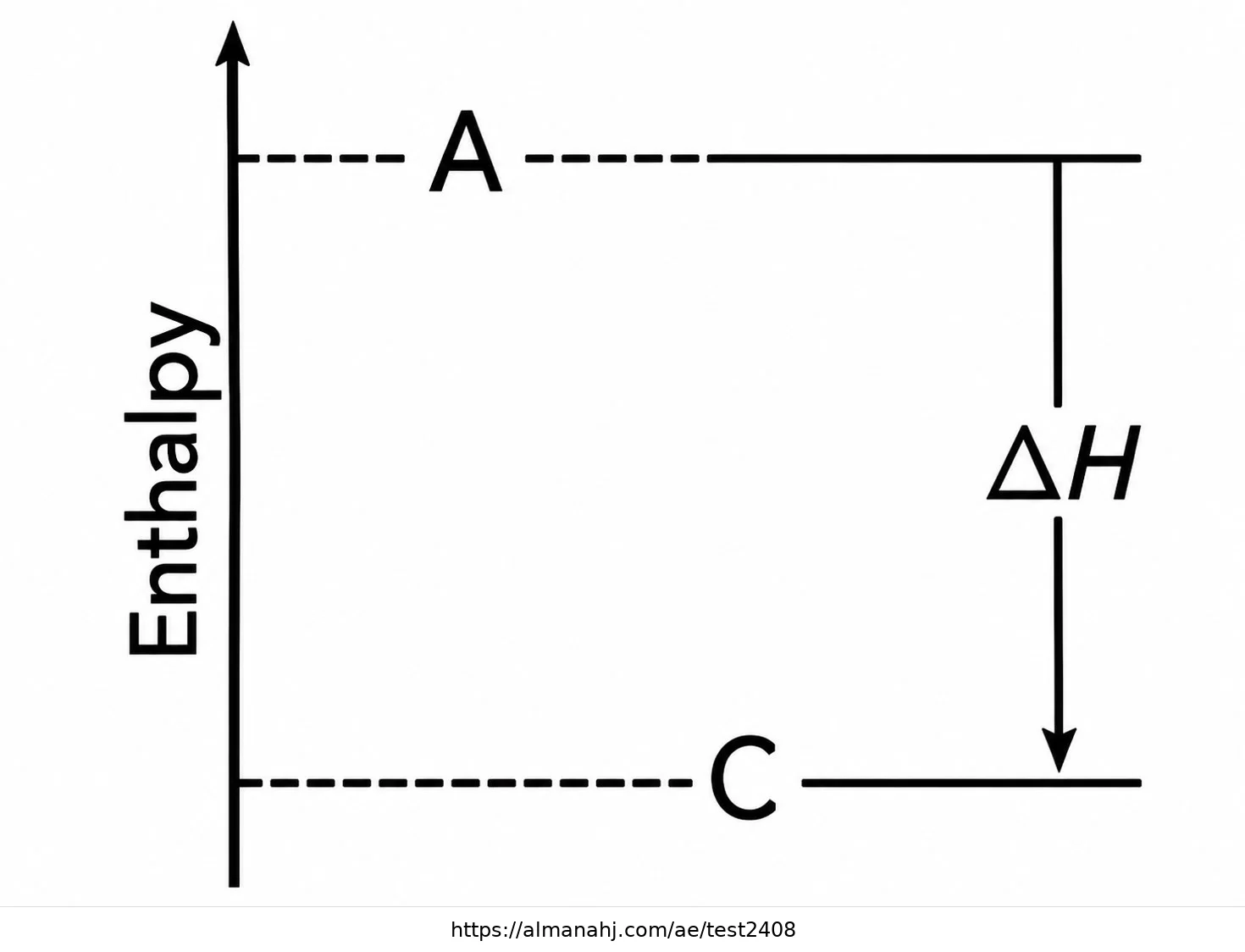
In an enthalpy graph, reactant A is higher than product C for A→C. Which relationship is correct? [Diagram: PDF p.31]
في مخطط إنثالبي التفاعل A→C، يقع مستوى المتفاعلات A أعلى من النواتج C. أي علاقة صحيحة؟ [رسم ص31]
Explanation
انخفاض مستوى المحتوى الحراري يعني أن Hالمتفاعلات > Hالنواتج والتفاعل طارد.
Since the reactant enthalpy is higher, Hreactants > Hproducts and ΔH is negative.
Question 31
31
Points: 1
How much heat is released by condensing 275 g NH3 at its boiling point? ΔHvap=23.3 kJ/mol and M=17.03 g/mol.
ما مقدار الحرارة المنبعثة عند تكاثف 275 g أمونيا إذا كانت ΔHvap=23.3 kJ/mol وكتلتها المولية 17.03 g/mol؟
Explanation
عدد المولات =275/17.03≈16.15؛ الحرارة المنطلقة =16.15×23.3≈376 kJ.
The sample contains about 16.15 mol; multiply by 23.3 kJ/mol to obtain 376 kJ released.
Question 32
32
Points: 1
Which statement about an instant cold pack is NOT true?
أي عبارة عن الكمادة الباردة غير صحيحة؟
Explanation
التفاعل داخل الكمادة الباردة ماص للحرارة لا طارد، لذا ΔH>0.
Cold packs operate through an endothermic process, not an exothermic one.
Question 33
33
Points: 1
A red apple contains 125 food Calories (Cal). Convert this energy to joules.
تفاحة حمراء تحتوي 125 سعرة غذائية كبيرة (Cal)، كم تعادل بالجول؟
Explanation
كل Cal تساوي 4184 J، لذا 125×4184=523000 J.
A food Calorie is 4184 J; multiplying 125 by 4184 gives 5.23×10⁵ J.
Question 34
34
Points: 1
A 4650 g granite block cools from 45.5°C to 7.50°C. Find heat lost; c=0.803 J/g°C.
كتلة جرانيت 4650 g تبرد من 45.5 إلى 7.50°C، والحرارة النوعية 0.803 J/g°C. ما مقدار الحرارة المفقودة؟
Explanation
مقدار الحرارة =4650×0.803×38.0≈1.42×10⁵ J، وإشارة q سالبة للمادة لأنها تبرد.
Magnitude of heat loss is mc|ΔT| ≈1.42×10⁵ J; signed heat for the cooling block is negative.
Question 35
35
Points: 1
Which symbol indicates enthalpy change at standard conditions?
أي رمز يدل على التغير في الإنثالبي في الظروف القياسية؟
Explanation
نستخدم ΔH° للدلالة على تغير الإنثالبي القياسي.
The superscript degree symbol indicates the standard-state enthalpy change.
Question 36
36
Points: 1
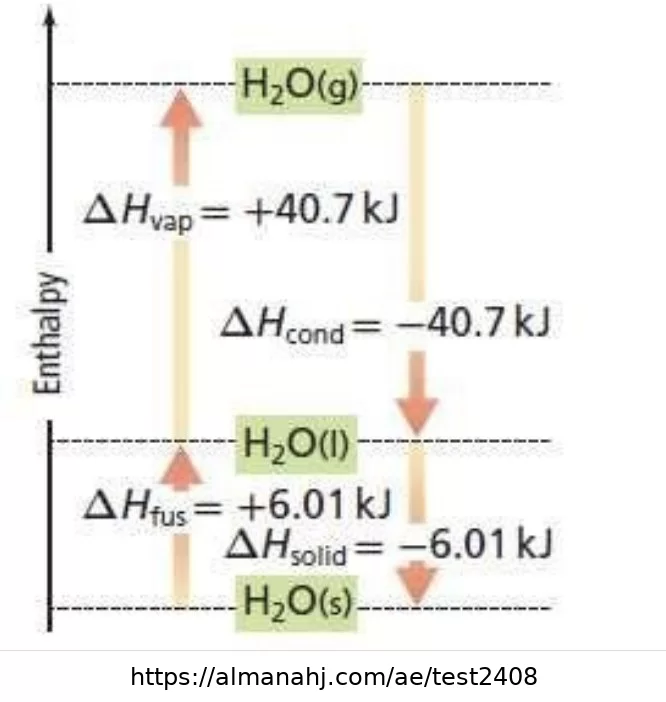
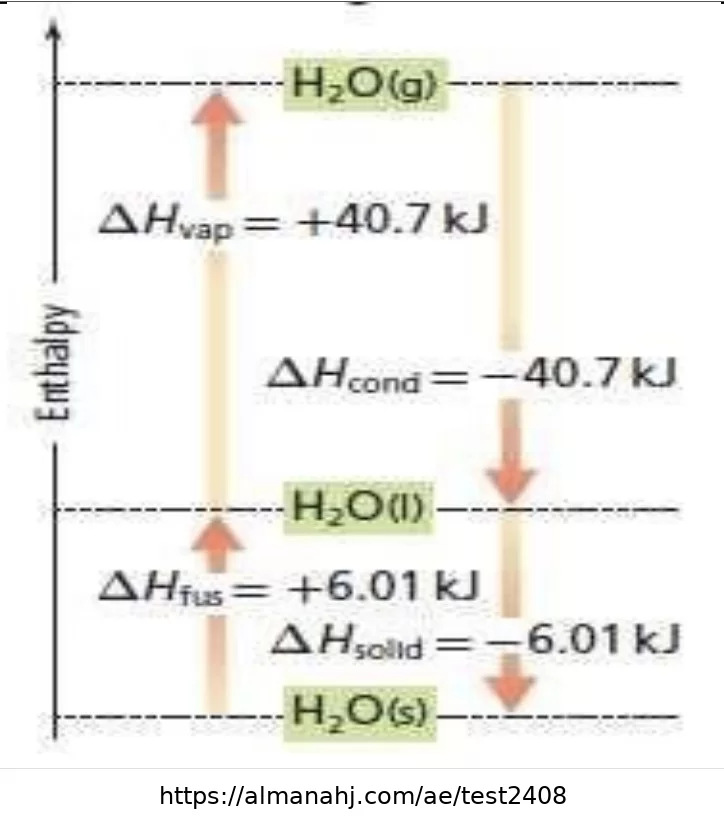
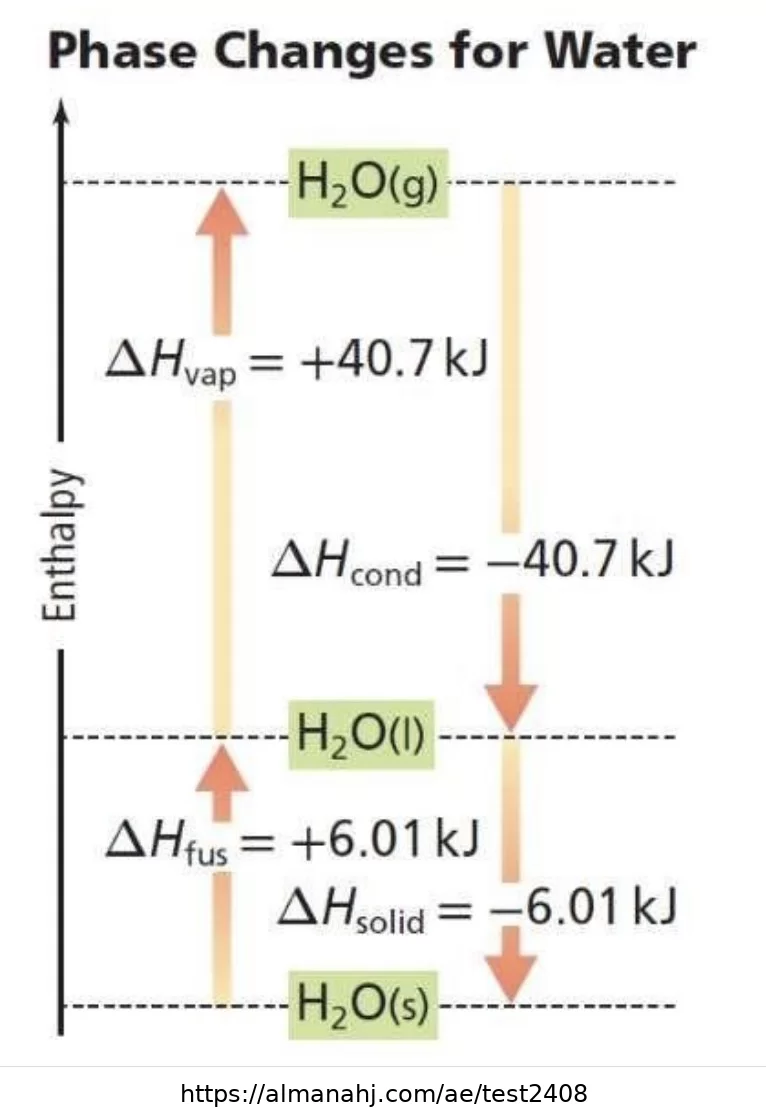
After a hot bath, wet skin cools as water evaporates. Which phase-change enthalpy symbol represents this process? [Phase-change diagram: PDF p.37]
بعد الحمام الساخن يبرد الجلد المبلل بسبب تبخر الماء. ما رمز تغير الإنثالبي الذي يمثل هذه العملية؟ [مخطط ص37]
Explanation
تبخر الماء من الجلد يمتص الحرارة من الجسم؛ يمثله ΔHvap ذو الإشارة الموجبة.
Water evaporating from wet skin absorbs body heat. This is vaporization, represented by positive ΔHvap.
Question 37
37
Points: 1
Four equations show combustion of methane, octane, glucose and hydrogen. Which statement is incorrect? Hydrogen combustion is H2+½O2→H2O(l)+286 kJ.
تعرض معادلات احتراق الميثان والأوكتان والجلوكوز والهيدروجين. أي عبارة خاطئة إذا كانت حرارة احتراق الهيدروجين تُطلق 286 kJ/mol؟
Explanation
الاحتراق طارد للحرارة، ولذلك ΔHcomb للهيدروجين يساوي −286 kJ/mol وليس +286.
The combustion enthalpy is negative for an exothermic reaction: −286 kJ/mol, not +286.
Question 38
38
Points: 1
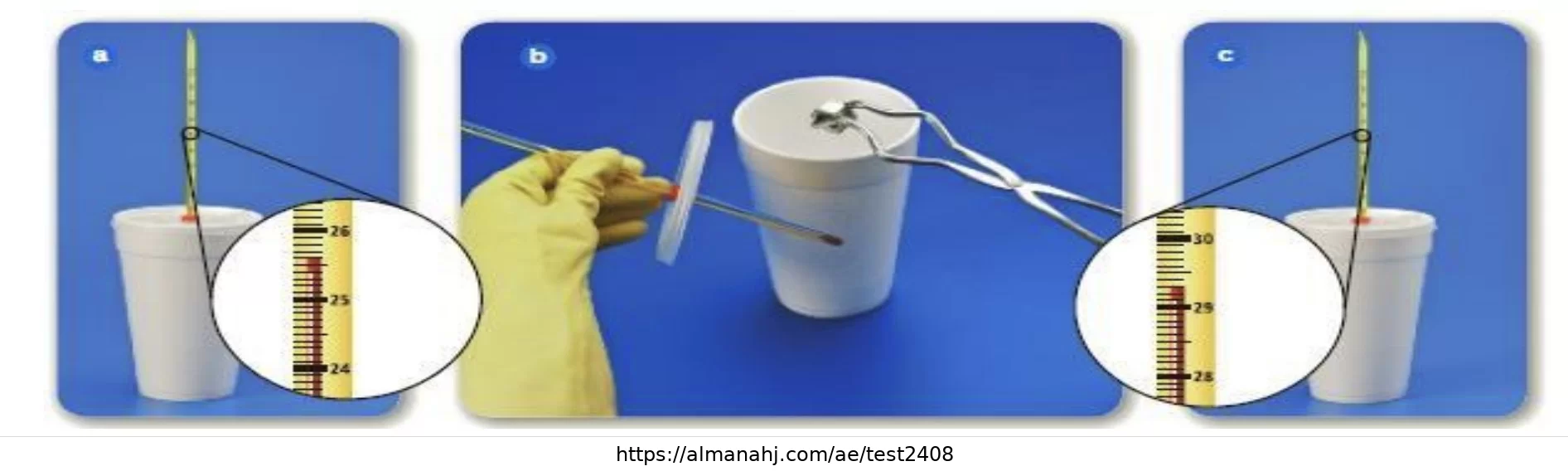
For a foam-cup calorimeter with initial and final thermometer readings, which statement is NOT correct? [Images: PDF p.40]
في مسعر الكوب الرغوي الذي يُقاس فيه تغير درجة حرارة الماء، أي عبارة غير صحيحة؟ [صور ص40]
Explanation
الحرارة النوعية تُحسب من بيانات الكتل والحرارة وليست من القراءات المباشرة للترمومتر.
Specific heat is calculated from measured masses and temperature changes; it is not a direct reading.
Question 39
39
Points: 1
Find ΔHrxn for NaOH(s)+HCl(g)→NaCl(s)+H2O(g). ΔHf°: NaOH=−425.6, HCl=−92.3, NaCl=−411.2, H2O(g)=−241.8 kJ/mol.
احسب حرارة التفاعل NaOH(s)+HCl(g)→NaCl(s)+H2O(g) باستخدام حرارة التكوين −425.6 و−92.3 و−411.2 و−241.8 kJ/mol.
Explanation
ΔH=[−411.2−241.8]−[−425.6−92.3]=−135.1 kJ.
Products minus reactants: −653.0−(−517.9)=−135.1 kJ.
Question 40
40
Points: 1
Which statement about chemical potential energy is NOT correct?
أي عبارة عن طاقة الوضع الكيميائية غير صحيحة؟
Explanation
الحركة العشوائية ترتبط بالطاقة الحركية الحرارية، لا بطاقة الوضع الكيميائية الناتجة من الروابط والتركيب.
Random microscopic motion is associated with thermal kinetic energy, not chemical potential energy.
Question 41
41
Points: 1
Hess’s law: A+B→C (−35 kJ); A+D→E+F (+20 kJ); F→C+E (+15 kJ). Find ΔH for 2A+B+D→2F.
قانون هس: A+B→C (−35)، A+D→E+F (+20)، F→C+E (+15) kJ. ما ΔH للتفاعل 2A+B+D→2F؟
Explanation
نجمع المعادلتين الأولى والثانية ونعكس الثالثة: ΔH=−35+20−15=−30 kJ.
Add equations 1 and 2 and reverse equation 3; the enthalpies sum to −30 kJ.
Question 42
42
Points: 1
A 250 g ethanol sample at 75°C loses 4655 J. Find its final temperature; c=2.441 J/g°C.
عينة إيثانول كتلتها 250 g عند 75°C فقدت 4655 J. احسب حرارتها النهائية إذا كانت الحرارة النوعية 2.441 J/g°C.
Explanation
ΔT=−4655/(250×2.441)=−7.63°C، والنهائية =75−7.63≈67.4°C.
The sample cools by about 7.63°C, giving a final temperature of 67.4°C.
Question 43
43
Points: 1
The table shows X contains 5.0×10⁵ J and Y contains 150 Cal. Which comparison is true?
الجدول يبين أن طاقة X تساوي 5.0×10⁵ J وطاقة Y تساوي 150 Cal. أي عبارة صحيحة؟
Explanation
طاقة Y =150×4184=627600 J، وهي أكبر من 500000 J لطاقة X.
Y has 627,600 J, greater than X’s 500,000 J.
Question 44
44
Points: 1
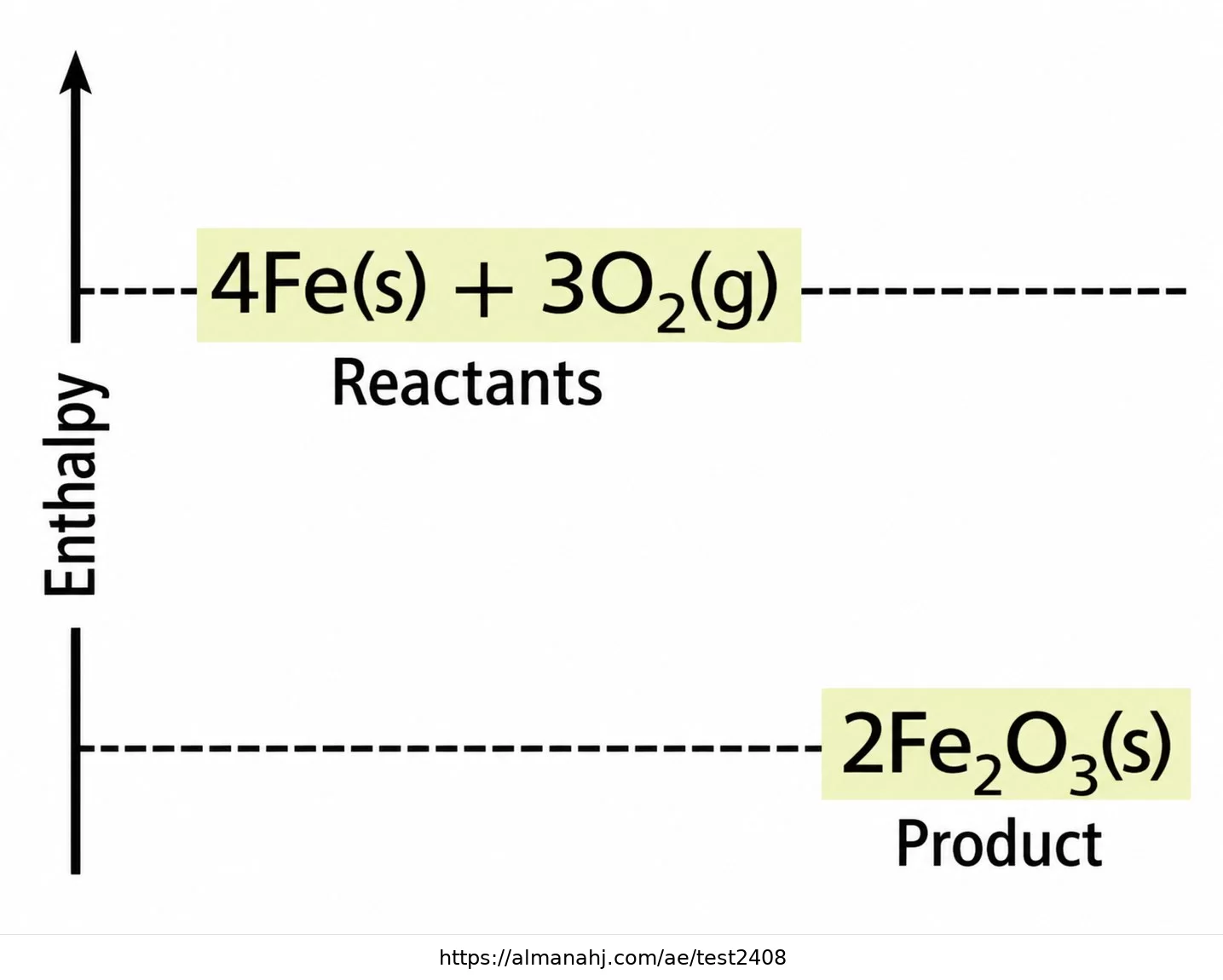
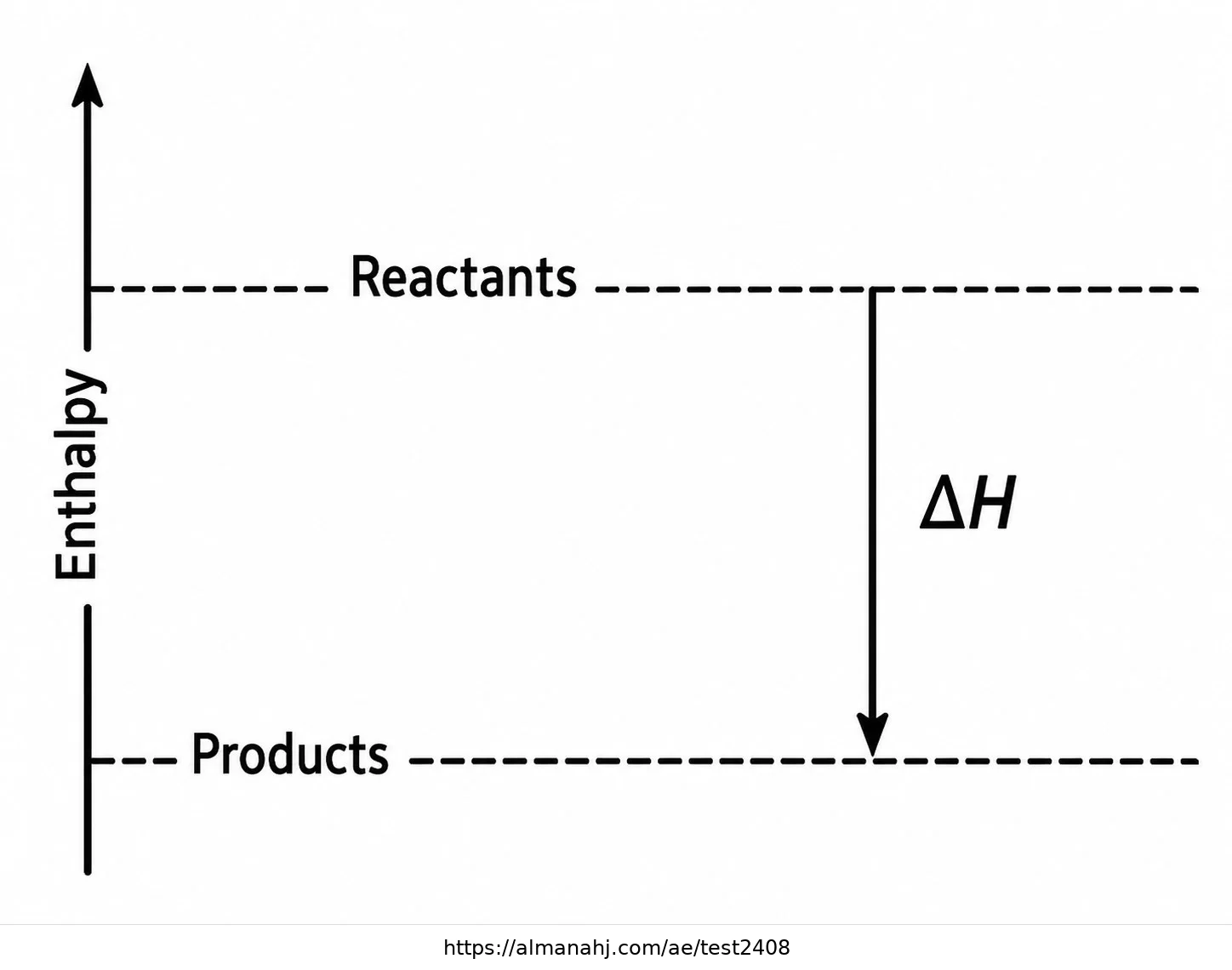
A reaction-energy graph shows reactants 4Fe+3O2 above product 2Fe2O3. Which statement is true? [Graph: PDF p.46]
في الرسم يقع إنثالبي المتفاعلات 4Fe+3O2 أعلى من إنثالبي الناتج 2Fe2O3. أي عبارة صحيحة؟ [رسم ص46]
Explanation
النواتج أقل إنثالبيًا من المتفاعلات، لذلك ΔH سالب والتفاعل طارد للحرارة.
Products have lower enthalpy; ΔH is negative, so this is an exothermic reaction.
Question 45
45
Points: 1
Equal heating is applied to aluminium (47.09 g, c=0.897 J/g°C) and iron (c=0.449 J/g°C), both warming by 30°C. Find iron mass.
عند تساوي الحرارة المكتسبة وارتفاع الحرارة 30°C، إذا كانت كتلة الألومنيوم 47.09 g وحرارته النوعية 0.897 والحديد 0.449 J/g°C، فما كتلة الحديد؟
Explanation
mFe×0.449=47.09×0.897، لذا mFe≈94.1 g وأقرب خيار 93.9 g.
With equal heat and temperature change, mFe≈47.09×0.897/0.449≈94.1 g, nearest option A.
Question 46
46
Points: 1
Compute ΔH for 2H2S+3O2→2H2O(l)+2SO2. Formation enthalpies: SO2=−296.8, H2O(l)=−285.8, H2S=−20.6 kJ/mol.
احسب ΔH للتفاعل 2H2S+3O2→2H2O+2SO2 إذا كانت قيم ΔHf° لـSO2 وH2O(l) وH2S هي −296.8 و−285.8 و−20.6.
Explanation
ΔH=2(−285.8)+2(−296.8)−2(−20.6)=−1124 kJ.
Using formation enthalpies gives −1124 kJ for the reaction.
Question 47
47
Points: 1
How much heat vaporizes 156.1 g water at 100°C? M(H2O)=18.02 g/mol, and the source diagram gives ΔHvap=40.7 kJ/mol.
ما الحرارة اللازمة لتبخير 156.1 g ماء عند 100°C، إذا كانت كتلته المولية 18.02 g/mol وΔHvap=40.7 kJ/mol؟ [الرسم ص51]
Explanation
n=156.1/18.02≈8.66 mol؛ Q=8.66×40.7≈353 kJ.
Calculate moles and multiply by 40.7 kJ/mol to get about 353 kJ.
Question 48
48
Points: 1
How much heat is released by burning 27 g glucose? C6H12O6 molar mass=180.18 g/mol; ΔHcomb=−2808 kJ/mol.
ما الحرارة المنطلقة من احتراق 27 g جلوكوز إذا كانت الكتلة المولية 180.18 g/mol وحرارة الاحتراق −2808 kJ/mol؟
Explanation
الحرارة المنطلقة = (27/180.18)×2808≈421 kJ.
Moles of glucose multiplied by 2808 kJ/mol yields about 421 kJ released.
Question 49
49
Points: 1
How many joules are provided by a 170 Cal breakfast?
كم جولًا توفر وجبة فطور ذات 170 سعرة غذائية (Cal)؟
Explanation
170 Cal×4184 J/Cal=711280 J≈7.1×10⁵ J.
170 food Calories correspond to approximately 711,000 J.
Question 50
50
Points: 1
An energy diagram shows reactants at higher enthalpy than products. Which statement is incorrect? [Graph: PDF p.54]
في الرسم، إنثالبي المتفاعلات أكبر من النواتج. ما العبارة غير الصحيحة؟ [رسم ص54]
Explanation
وجود المتفاعلات أعلى طاقة يجعل Hالمتفاعلات > Hالنواتج، لذلك العبارة الرابعة خاطئة.
Since reactants lie higher than products, their enthalpy is greater, not lower.
Question 51
51
Points: 1
An alloy of mass 25.0 g absorbs 250 J while warming from 25.0°C to 78.0°C. Find its specific heat.
امتصت سبيكة كتلتها 25.0 g حرارة 250 J وارتفعت حرارتها من 25 إلى 78°C. احسب حرارتها النوعية.
Explanation
c=250/[25×(78−25)]≈0.189 J/g°C.
Specific heat equals heat divided by mass and temperature change: 0.189 J/g°C.
Question 52
52
Points: 1
Hess’s law: SO3+H2O→H2SO4 (ΔH=−133 kJ), and Pb+PbO2+2H2SO4→2PbSO4+2H2O (ΔH=−509 kJ). Find ΔH for Pb+PbO2+2SO3→2PbSO4.
حسب قانون هس: SO3+H2O→H2SO4 (−133)، وPb+PbO2+2H2SO4→2PbSO4+2H2O (−509) kJ؛ احسب حرارة تفاعل Pb+PbO2+2SO3→2PbSO4.
Explanation
نضاعف معادلة تكوين حمض الكبريتيك ثم نجمع: ΔH=2(−133)−509=−775 kJ.
Double the first equation and add the second: −266−509=−775 kJ.
Question 53
53
Points: 1
The same heat is supplied to 10 g each of Be, Ca, Cu and Au, starting at 20°C. Specific heats (J/g°C): Be 1.82, Ca 0.653, Cu 0.385, Au 0.129. Which reaches the highest temperature?
أُضيفت حرارة متساوية لكتل متساوية 10 g من البيريليوم والكالسيوم والنحاس والذهب عند 20°C. حراراتها النوعية 1.82، 0.653، 0.385، 0.129 بالترتيب. أيها ترتفع حرارته أكثر؟
Explanation
عند ثبات q والكتلة، ΔT تتناسب عكسيًا مع c؛ الذهب أقل حرارة نوعية.
For equal heat and mass, temperature change is inversely proportional to specific heat; gold has the smallest value.
Question 54
54
Points: 1
In the illustrated bomb calorimeter, which label identifies the sample holder? [Diagram on PDF page 58: A–F]
في رسم مسعر القنبلة الحرارية، ما الحرف الذي يشير إلى موضع العينة؟ [الصورة بالصفحة 58 من PDF]
Explanation
يشير الحرف F في الرسم إلى موضع العينة داخل حجرة الاحتراق.
In the source diagram, F points to the sample position inside the combustion chamber.
Question 55
55
Points: 1
Which changes are endothermic? I water evaporation; II ice melting; III water freezing; IV water condensation.
أي تغيرات ماصة للحرارة؟ I تبخر الماء، II انصهار الجليد، III تجمد الماء، IV تكاثف الماء.
Explanation
التبخر والانصهار يمتصان حرارة، بينما التجمد والتكاثف يطلقان حرارة.
Evaporation and melting absorb heat; freezing and condensation release it.
Question 56
56
Points: 1
Calculate ΔH for 4NH3(g)+7O2(g)→4NO2(g)+6H2O(l), with ΔHf°(NH3)=−45.90, ΔHf°(NO2)=+33.20 and ΔHf°(H2O)=−286.0 kJ/mol.
احسب حرارة التفاعل 4NH3+7O2→4NO2+6H2O إذا كانت حرارة التكوين للأمونيا −45.90، ولثاني أكسيد النيتروجين +33.20، وللماء −286.0 kJ/mol.
Explanation
ΔH = [4(33.2)+6(−286)]−4(−45.90)=−1399.6 kJ≈−1400 kJ.
Summing product formation enthalpies minus those of reactants gives approximately −1400 kJ.
Question 57
57
Points: 1
58.8 g hot alloy cools from 606.1°C to 500.0°C in 125 g water whose temperature rises 10.5°C. Find c(alloy); c(water)=4.18 J/g°C.
تبرد سبيكة 58.8 g من 606.1 إلى 500°C في ماء كتلته 125 g ترتفع حرارته 10.5°C. احسب الحرارة النوعية للسبيكة.
Explanation
c = (125×4.18×10.5)/[58.8×(606.1−500)] ≈0.880 J/g°C.
Equate heat gained by water to heat lost by the alloy to obtain 0.880 J/g°C.
Question 58
58
Points: 1
How much energy in joules does a 170 Cal breakfast provide?
ما مقدار الطاقة بالجول في إفطار يحتوي على 170 Cal؟
Explanation
170×4184=711280 J≈7.11×10⁵ J.
A food Calorie equals 4184 J, yielding about 7.11×10⁵ J.
Question 59
59
Points: 1
A reaction graph shows reactants A above products C. Decide which assertions are true: I ΔH>0; II Hproducts
Explanation
بما أن النواتج أقل طاقة فـΔH<0 ويخرج الحرارة إلى المحيط؛ II وIII صحيحتان فقط.
Products are lower in enthalpy, making ΔH negative and the reaction exothermic; statements II and III are true.
Question 60
60
Points: 1
Heat needed to vaporize 63.07 g H2O at 100°C, given M=18.02 g/mol and ΔHvap=+40.7 kJ/mol?
ما الحرارة اللازمة لتبخير 63.07 g ماء عند 100°C إذا كانت M=18.02 g/mol وΔHvap=+40.7 kJ/mol؟
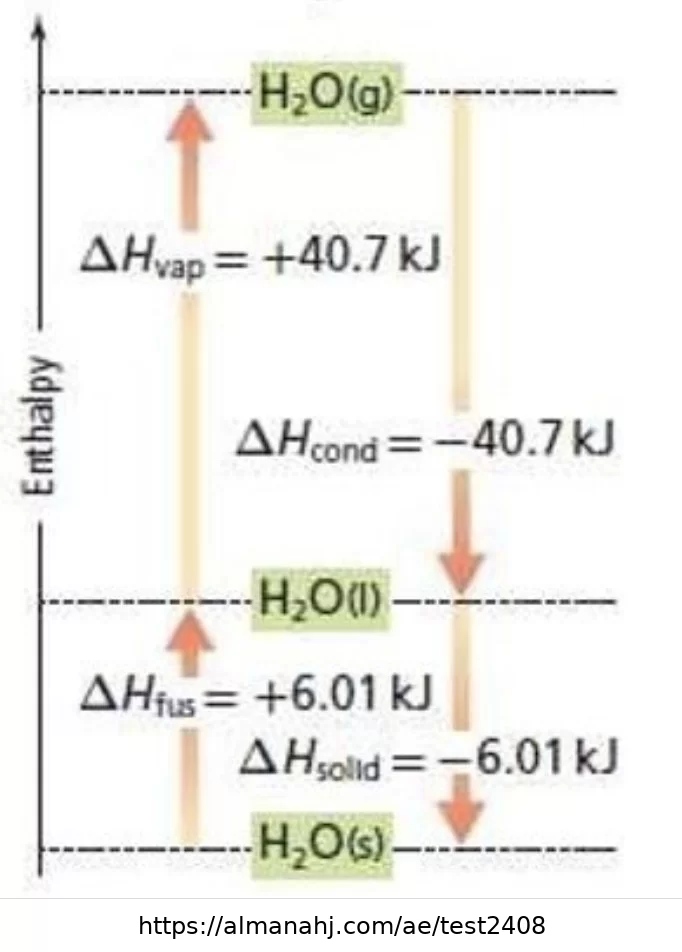
Which statement about phase-change enthalpies is incorrect? [Phase-change diagram: PDF p.65]
أي عبارة عن إنثالبيات تغير الحالة غير صحيحة؟ [مخطط تغير حالة الماء ص65]
Explanation
التكاثف عكس التبخر، لذلك لهما مقدار حرارة متساوٍ وإشارتان متعاكستان.
Condensation reverses vaporization; their enthalpies have equal magnitudes but opposite signs.
Question 62
62
Points: 1
Equal masses of Ca, Sr, Fe and Pb receive the same heat. Their specific heats are Ca 0.647, Sr 0.301, Fe 0.449, Pb 0.235 J/g°C. Select ascending order of temperature rise.
كتل متساوية من Ca وSr وFe وPb تمتص حرارة متساوية؛ حراراتها النوعية 0.647 و0.301 و0.449 و0.235. رتبها تصاعديًا بحسب ارتفاع درجة الحرارة.
Explanation
عند ثبات الكتلة والحرارة، الأقل ارتفاعًا هو الأعلى حرارة نوعية: Ca ثم Fe ثم Sr ثم Pb.
Temperature rise increases as specific heat decreases: calcium, iron, strontium, lead.
Question 63
63
Points: 1
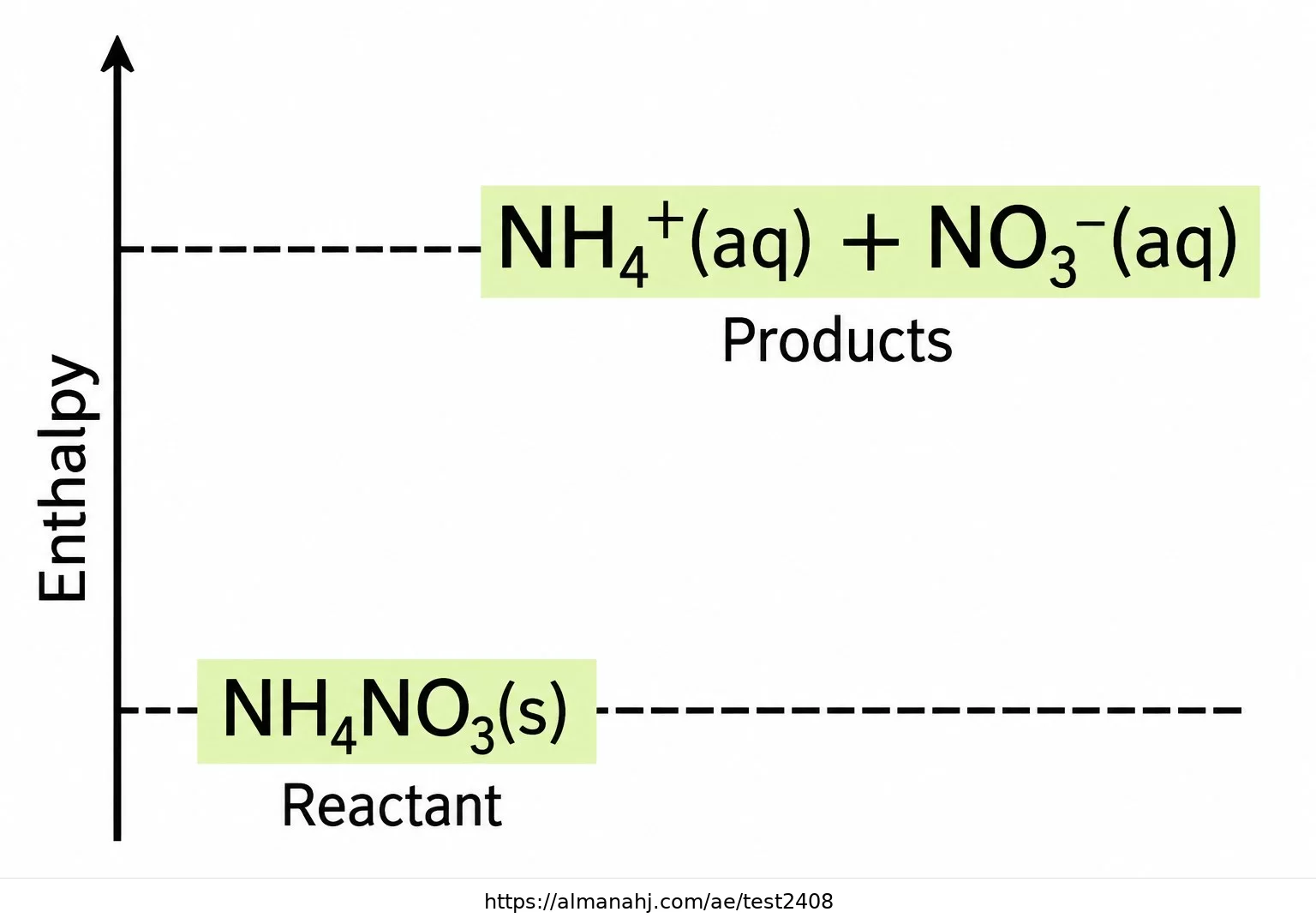
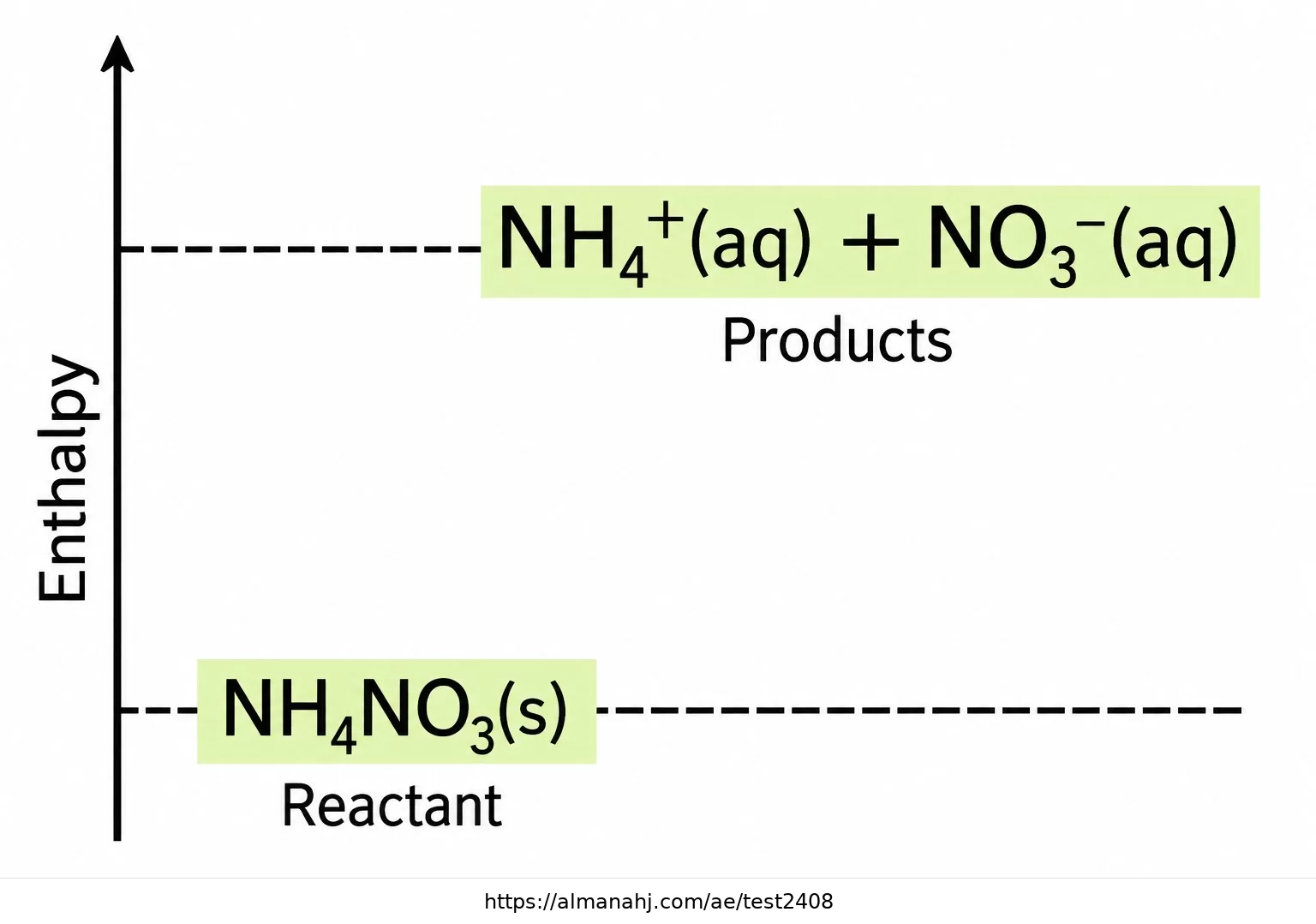
The enthalpy diagram for dissolving NH4NO3 shows products above reactants. Which statement is correct? [Graph PDF p.69]
في مخطط ذوبان NH4NO3 يقع إنثالبي النواتج أعلى من المتفاعلات. أي عبارة صحيحة؟ [رسم ص69]
Explanation
ارتفاع إنثالبي النواتج يعني أن عملية الذوبان تمتص الحرارة ويكون ΔH موجبًا.
Products at higher enthalpy indicate an endothermic process and positive ΔH.
Question 64
64
Points: 1
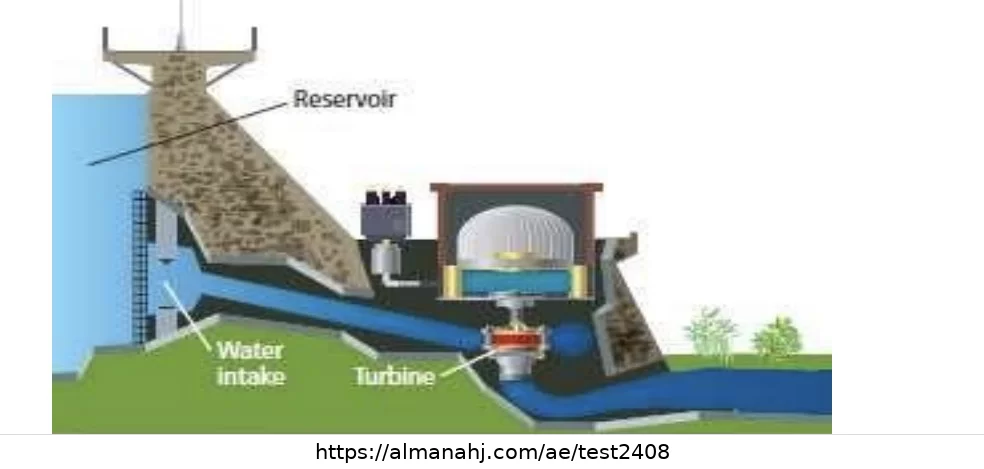
Water is stored behind a dam and flows down to a turbine. Which statement about its energy is correct? [Diagram PDF p.71]
الماء مخزن خلف سد ثم يندفع إلى توربين. أي عبارة عن تحول الطاقة صحيحة؟ [الصورة ص71]
Explanation
يخزن الماء المرتفع طاقة وضع ثقالية تتحول إلى طاقة حركية أثناء هبوطه، مع بقاء الطاقة الكلية محفوظة.
Elevated water has gravitational potential energy, which converts to kinetic energy during descent.
Question 65
65
Points: 1
An ethanol sample warms from 30°C to 75°C after absorbing 1098 J. Its specific heat is 2.441 J/g°C. Find its mass.
عينة إيثانول ارتفعت حرارتها من 30 إلى 75°C بعد امتصاص 1098 J؛ حرارتها النوعية 2.441 J/g°C. ما كتلتها؟
Explanation
m=1098/[2.441×(75−30)]≈10.0 g.
Solving q=mcΔT for mass gives about 10 g.
Question 66
66
Points: 1
When barium hydroxide and ammonium thiocyanate mix in a cup on wet wood, the cup freezes to the wood. Why?
عند خلط هيدروكسيد الباريوم وثيوسيانات الأمونيوم في كوب فوق خشب رطب يلتصق الكوب بالخشب. لماذا؟
Explanation
يمتص التفاعل طاقة حرارية من المحيط فيبرد الماء بين الكوب والخشب إلى درجة التجمد.
The strongly endothermic reaction absorbs surrounding heat, freezing moisture beneath the cup.
Question 67
67
Points: 1
How much enthalpy change occurs when 0.750 mol H2O freezes? The diagram gives ΔHfus=+6.01 kJ/mol.
ما التغير في الإنثالبي عند تجمد 0.750 mol ماء إذا كانت حرارة انصهار الماء +6.01 kJ/mol؟ [مخطط ص74]
Explanation
التجمد عكس الانصهار: ΔH=−0.750×6.01≈−4.51 kJ.
Freezing reverses fusion, so ΔH=−0.750×6.01≈−4.51 kJ.
Question 68
68
Points: 1
Which phase change/reaction is endothermic?
أي عملية من العمليات الآتية ماصة للحرارة؟
Explanation
التبخر يحتاج امتصاص حرارة لكسر التجاذب بين الجزيئات؛ التكاثف والاحتراق طاردان.
Vaporization absorbs heat, whereas condensation and combustion release heat.
Question 69
69
Points: 1
Heat required to vaporize 4.33 mol water at 100°C, ΔHvap=40.7 kJ/mol?
ما الحرارة اللازمة لتبخير 4.33 mol ماء عند 100°C، إذا كانت ΔHvap=40.7 kJ/mol؟
Explanation
Q=4.33×40.7=176.2 kJ≈176 kJ.
Moles multiplied by molar vaporization enthalpy gives about 176 kJ.
Question 70
70
Points: 1
How much heat is released when 0.300 mol of glucose combusts? ΔHcomb=−2808 kJ/mol.
ما مقدار الحرارة المنطلقة عند احتراق 0.300 mol جلوكوز، إذا كانت حرارة احتراقه −2808 kJ/mol؟
Explanation
الحرارة المنطلقة بالمقدار =0.300×2808=842.4 kJ.
The reaction releases 0.300×2808≈842 kJ.
Question 71
71
Points: 1
A breakfast gives 95.0 Cal. Convert to joules (1 Cal=4184 J).
وجبة فطور توفر 95.0 Cal. كم تعادل من الجول إذا كانت 1 Cal=4184 J؟
Explanation
95×4184=397480 J≈3.97×10⁵ J.
95 food Calories equal approximately 3.97×10⁵ joules.
Question 72
72
Points: 1
Find methane ΔHf° from CH4+2O2→CO2+2H2O(l), ΔHcomb=−891 kJ; ΔHf°(CO2)=−394 and ΔHf°(H2O)=−286 kJ/mol.
احسب حرارة التكوين القياسية للميثان إذا كانت حرارة احتراقه −891، وحرارة تكوين CO2=−394 وH2O(l)=−286 kJ/mol.
Explanation
−891=[−394+2(−286)]−ΔHf(CH4)، لذلك ΔHf(CH4)=−75 kJ/mol.
Use the products-minus-reactants equation and solve for methane formation enthalpy: −75 kJ/mol.
Question 73
73
Points: 1
An enthalpy diagram for NH4NO3 dissolving has products above reactants. Which comparison is correct? [Graph PDF p.82]
في رسم ذوبان NH4NO3 يقع إنثالبي النواتج فوق المتفاعلات. ما العبارة الصحيحة؟ [رسم ص82]
Explanation
عندما تقع النواتج أعلى فإن Hالنواتج > Hالمتفاعلات، وΔH موجبة.
Higher product enthalpy means reactants have lower enthalpy and ΔH is positive.
Question 74
74
Points: 1
How many moles of ethanol vaporize if vaporization takes 200.72 kJ? ΔHvap=38.6 kJ/mol.
ما عدد مولات الإيثانول التي تتبخر إذا كانت الحرارة اللازمة 200.72 kJ، وΔHvap=38.6 kJ/mol؟
Explanation
n=200.72/38.6=5.20 mol.
Divide the total heat by molar vaporization enthalpy to get 5.20 mol.
Question 75
75
Points: 1
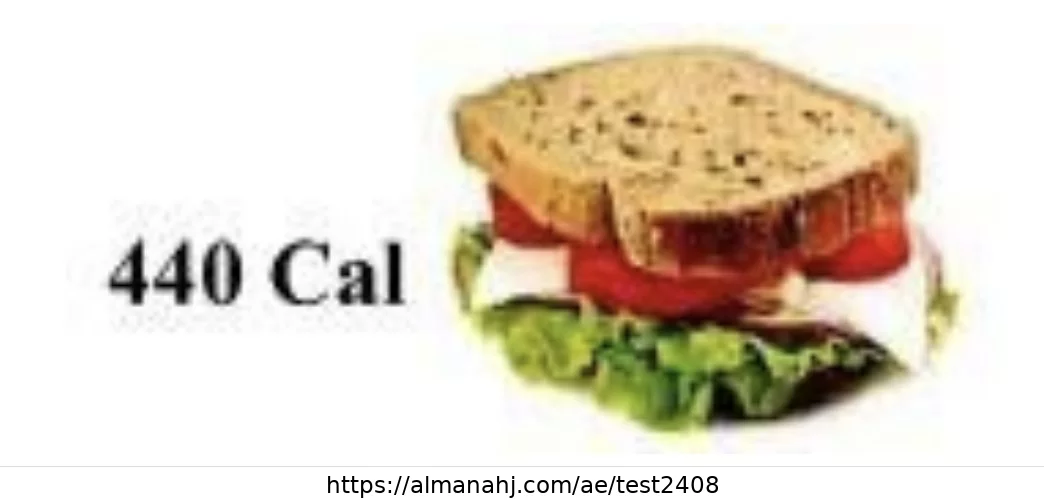
A sandwich in the figure provides 440 food Calories. What energy is that in joules? [Image PDF p.84]
تحتوي الشطيرة في الصورة على 440 سعرة حرارية غذائية Cal. كم تعادل بالجول؟
Explanation
440×4184=1840960 J≈1.84×10⁶ J.
Multiply 440 Cal by 4184 J/Cal to obtain about 1.84×10⁶ J.
Question 76
76
Points: 1
What mass of hydrogen must burn to release 42900 kJ? H2 combustion gives −286 kJ/mol, and M(H2)=2.02 g/mol.
ما كتلة الهيدروجين التي يجب أن تحترق لإطلاق 42900 kJ إذا كانت حرارة الاحتراق −286 kJ/mol وكتلته المولية 2.02 g/mol؟
Explanation
المولات =42900/286=150، والكتلة =150×2.02=303 g.
42900/286=150 moles; multiply by 2.02 g/mol to get 303 g.
Question 77
77
Points: 1
Which process is endothermic?
أي عملية من الآتية ماصة للحرارة؟
Explanation
تبخر الماء يمتص حرارة؛ أما التكاثف والاحتراق فيطلقان حرارة.
Evaporation absorbs heat while condensation and combustion release heat.
Question 78
78
Points: 1
An ethanol sample warms from 30°C to 75°C and absorbs 1098 J. With c=2.44 J/g°C, what is its mass?
عينة إيثانول ارتفعت حرارتها من 30°C إلى 75°C وامتصت 1098 J. إذا كانت الحرارة النوعية 2.44 J/g°C فما كتلتها؟
Explanation
m=1098/(2.44×45)=10.0 g.
Rearrange q=mcΔT and calculate mass ≈10 g.
Question 79
79
Points: 1
Which row correctly matches process, endothermic/exothermic nature, and ΔH sign? Row 1 C2H5OH(s)→C2H5OH(l): exothermic,+; row 2 NH3(l)→NH3(s): endothermic,+; row 3 CH3OH(l)→CH3OH(g): endothermic,−; row 4 H2O(g)→H2O(l): exothermic,−.
أي صف في الجدول صحيح بخصوص العملية وإشارتها؟ 1 انصهار الإيثانول طارد وموجب؛ 2 تجمد الأمونيا ماص وموجب؛ 3 تبخر الميثانول ماص وسالب؛ 4 تكاثف الماء طارد وسالب.
Explanation
التكاثف طارد للحرارة وتغير الإنثالبي فيه سالب، لذا الصف الرابع صحيح وحده.
Condensation is exothermic and has negative ΔH; only row 4 is correct.
Result Tracking
Answered0 / 79
Correct Answers0
Wrong Answers0
Current Percentage0%
Quiz Completed
This is your final result after answering all questions.
Final Result
0/790%
Correct Answers0
Wrong Answers0
Answered Questions0 / 79
Total Possible Points79
You can reopen the page to start again.
يمكنك تسجيل الدخول لحفظ سجل محاولاتك، معرفة أخطائك المتكررة، والحصول على نصائح مخصصة. تسجيل الدخول باستخدام Google
Report a question
Here are more quizzes for الصف الحادي عشر المتقدم by الفصل الأول and subject كيمياء
This section is rendered only when the user reaches it while scrolling.
...
🍪
إشعار ملفات تعريف الارتباط
يستخدم هذا الموقع ملفات تعريف الارتباط لتحسين تجربة التصفح وقياس الأداء وعرض المحتوى بشكل أفضل.
باستخدامك للموقع فإنك توافق على استخدامنا لها وفق
سياسة الخصوصية.