Interactive multiple-choice quiz: Inspire: Properties of Matter, Mixtures & Solutions, Physical & Chemical Changes, and States of Matter
This quiz evaluates the basic understanding of physical properties used to describe and measure matter. It focuses on concepts such as mass, volume, and weight.
🏆 انضم إلى التحدي واحصل على ترتيبك
اختبار شهادة تدريبي مؤقت للصف والمادة والفصل نفسه.
اختر إجابة لكل سؤال لتظهر النتيجة والتفسير فورًا، وتظهر درجتك بعد الانتهاء. الأسئلة من إعداد المدرس، أما الإجابات فحُدّدت بالذكاء الاصطناعي وقد تحتمل الخطأ؛ يمكنك الإبلاغ عبر أيقونة العلم بجانب السؤال.
Which property measures the space taken up by an object?
Explanation
Volume is defined as the amount of three-dimensional space an object or substance occupies.
Question 2
2
Points: 10
Which mixture is most likely a solution?
Explanation
Cranberry juice is the most likely homogeneous solution; muddy water and soil are heterogeneous, while milk is a colloid.
Question 3
3
Points: 10
You combine 500 g of one material and 200 g of another in a closed container. A chemical reaction occurs. What can you say about the mass of the materials after the reaction? Choose the equation that supports your answer.
Explanation
Mass is conserved in a closed container, so the total mass after the reaction remains 500 g + 200 g = 700 g.
Question 4
4
Points: 10
Which action can cause matter to change into a higher-energy state?
Explanation
Adding energy can move matter to a higher-energy state, such as from solid to liquid or from liquid to gas.
Question 5
5
Points: 10
Which statement correctly describes the volume of a liquid?
Explanation
A liquid has a definite volume but takes the shape of its container.
Question 6
6
Points: 10
Based on what you know about gravity, what causes Earth’s changing tides?
Explanation
The Moon’s gravitational pull is the main cause of Earth’s changing ocean tides.
Question 7
7
Points: 10
What causes the tide to bulge on the side of Earth facing the Moon?
Explanation
The Moon’s gravity pulls ocean water toward it, producing a tidal bulge on the side of Earth facing the Moon.
Question 8
8
Points: 10
The Moon looks completely dark as seen from Earth. What causes a new moon?
Explanation
During a new moon, the illuminated side faces away from Earth, so it cannot be seen from Earth.
Question 9
9
Points: 10
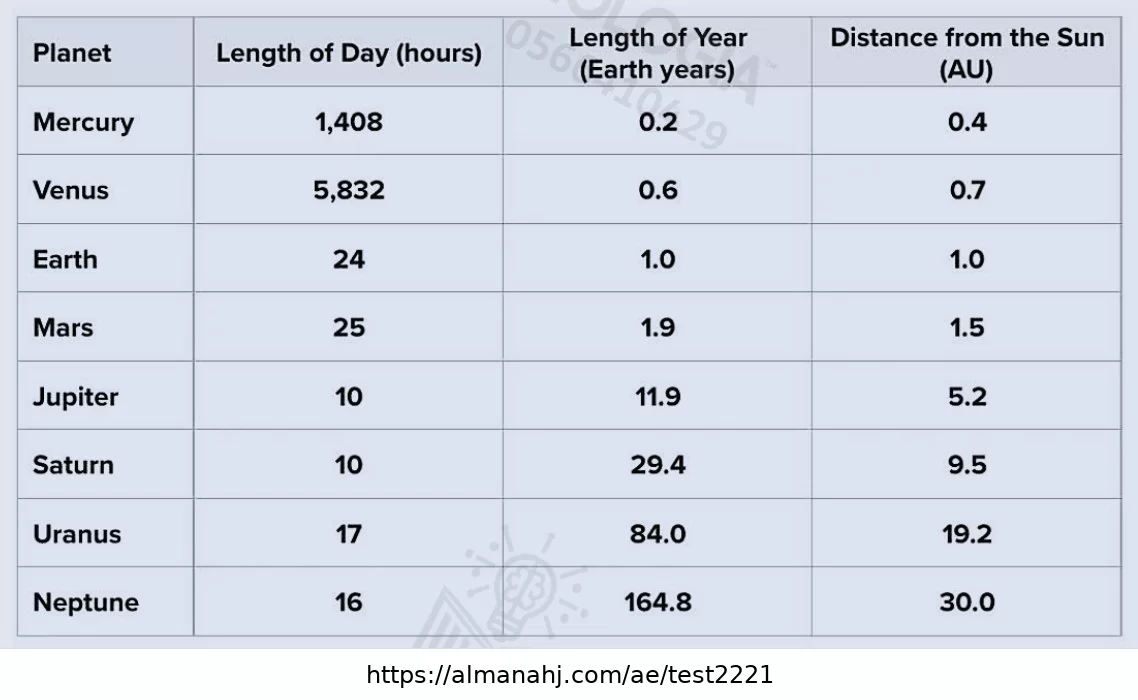
Based on the data table shown in the image, what conclusion can you draw?
Explanation
The table shows that orbital periods generally increase as distance from the Sun increases, so more distant planets have longer years.
Question 10
10
Points: 10
A planet is a large, round space object that ________ the Sun.
Explanation
A planet is a large, nearly round object that orbits the Sun.
Question 11
11
Points: 10
Stars appear to move in the sky because of Earth’s ________.
Explanation
Earth’s rotation makes stars appear to move across the sky during the night.
Question 12
12
Points: 10
Which statement explains why scientists use a unit called a light-year when writing about the large distances between Earth and distant stars?
Explanation
A light-year is useful because interstellar distances are extremely large and are cumbersome to express in kilometers.
Question 13
13
Points: 10
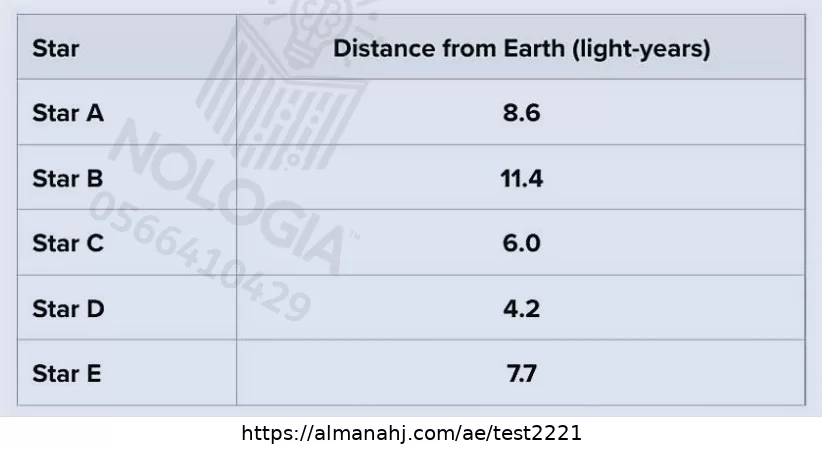
The table shows the distance of five different stars from Earth. Based on distance alone, which order lists the stars from brightest to dimmest?
Explanation
Using distance alone, the nearest star is expected to appear brightest. The distances increase in the order D, C, E, A, B.
📚
ALMANAHJ APP
Discover more on the Almanahj app
Explore educational resources, files and quizzes in the Almanahj app, available on Google Play and the App Store.
يستخدم هذا الموقع ملفات تعريف الارتباط لتحسين تجربة التصفح وقياس الأداء وعرض المحتوى بشكل أفضل.
باستخدامك للموقع فإنك توافق على استخدامنا لها وفق
سياسة الخصوصية.