أسئلة اختيار من متعدد مع الإجابات في مادة الفيزياء لطلبة الصف الثاني عشر المتقدم. تغطي هذه الأسئلة موضوعات نماذج الذرة، الأطياف الذرية، نموذج بور، ومستويات الطاقة في ذرة الهيدروجين. تم استخراج 45 سؤالاً اختيارياً من ملف المراجعة الأصلي لتدريب الطلاب على نمط الاختبار النهائي للفصل الدراسي الثالث.
🏆 انضم إلى التحدي واحصل على ترتيبك
اختبار شهادة تدريبي مؤقت للصف والمادة والفصل نفسه.
اختر إجابة واحدة لكل سؤال. عند الاختيار ستظهر النتيجة فورًا: الأخضر صحيح، والأحمر خطأ، وسيظهر تفسير الإجابة مباشرة إن كان متوفرًا. وبعد آخر سؤال ستظهر الدرجة النهائية تلقائيًا.
Thomson's 'plum pudding' model proposed that the atom is a uniform sphere of positive charge with electrons embedded in it.
Question 2
2
Points: 1
According to J.J. Thomson's model of the atom, which of the following best describes the distribution of electrical charge and mass?
Explanation
Thomson's model assumed mass and positive charge were distributed uniformly throughout the atom's volume.
Question 3
3
Points: 1
In the Gold Foil Experiment, alpha particles are:
Explanation
Alpha particles are helium nuclei, consisting of two protons and two neutrons, giving them a positive charge.
Question 4
4
Points: 1
The conclusion that the atom is mostly empty space came from:
Explanation
In Rutherford's experiment, the fact that the vast majority of alpha particles passed through the gold foil without deflection suggested the atom is mostly empty space.
Question 5
5
Points: 1
Why does Rutherford's planetary model fail to explain the stability of atoms?
Explanation
According to classical electromagnetism, an accelerating charge radiates energy. Thus, an orbiting electron would lose energy and collapse into the nucleus.
Question 6
6
Points: 1
According to the planetary model, accelerating electrons would radiate energy at all wavelengths. Why does this contradict experimental evidence?
Explanation
Experiments showed that atomic emission spectra consist of discrete lines (specific wavelengths), not a continuous range.
Question 7
7
Points: 1
What is the primary reason an emission spectrum can be used to identify an unknown gaseous element?
Explanation
Each element has a unique set of energy levels, resulting in a unique set of emitted wavelengths.
Question 8
8
Points: 1
How does the absorption spectrum of a specific cool gas compare to its emission spectrum when excited?
Explanation
Atoms absorb the same specific wavelengths of light that they are capable of emitting.
Question 9
9
Points: 1
Which of the following statements is correct about emission line spectra?
Explanation
The discrete lines in a spectrum correspond directly to the energy differences between quantized electronic states.
Question 10
10
Points: 1
An emission spectrum appears as:
Explanation
Emission spectra are formed by light emitted at specific frequencies, appearing as bright lines against a dark backdrop.
Question 11
11
Points: 1
An absorption spectrum appears as:
Explanation
Absorption spectra occur when specific frequencies are removed from continuous light, leaving dark lines on the rainbow background.
Question 12
12
Points: 1
Which condition produces an absorption spectrum?
Explanation
A cool gas absorbs specific wavelengths from a continuous white light source passing through it.
Question 13
13
Points: 1
A student observes dark lines in a star's spectrum. What can be concluded?
Explanation
Stellar spectra are absorption spectra because the cooler outer atmosphere of the star absorbs specific wavelengths from the hotter core.
Question 14
14
Points: 1
Which of the following diagrams represents the linear absorption spectrum?
Explanation
A linear absorption spectrum is characterized by dark lines superimposed on a continuous spectrum.
Question 15
15
Points: 1
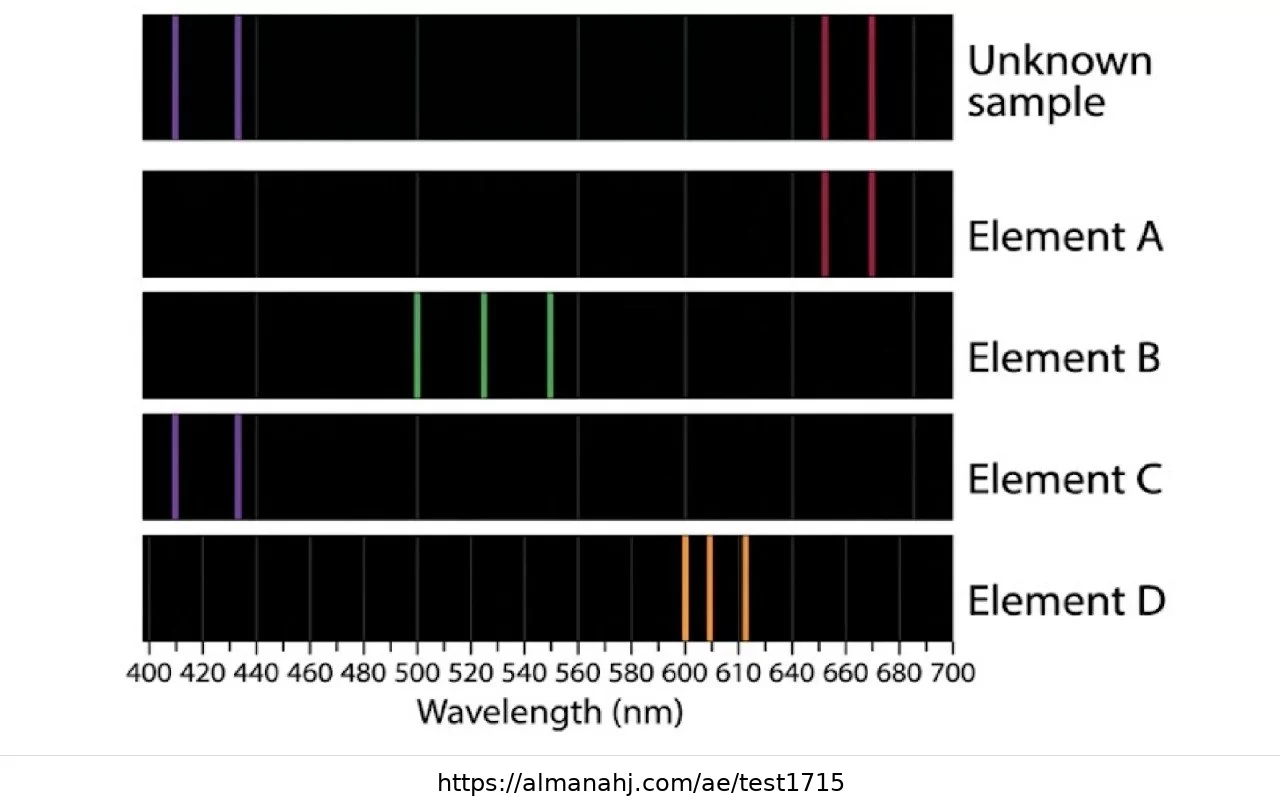
The diagram represents the bright-line spectra for elements A, B, C, and D, and the spectrum of an unknown gaseous sample. Based on comparison, which two elements are found in the unknown sample?
Explanation
By matching the positions of all lines in the sample spectrum to the known elements, elements A and C align with the sample's pattern.
Question 16
16
Points: 1
What are Fraunhofer lines, and how are they utilized in astronomy?
Explanation
Fraunhofer lines are the set of absorption lines in the solar spectrum, identifying the elements present in the solar atmosphere.
Question 17
17
Points: 1
According to the Bohr model, electrons in a stationary state:
Explanation
Bohr postulated that while in a 'stationary state' or stable orbit, an electron does not radiate energy despite its acceleration.
Question 18
18
Points: 1
The lowest energy state of an atom is called:
Explanation
The ground state is the most stable state where the electron occupies the lowest available energy level.
Question 19
19
Points: 1
Which transition produces the highest frequency photon?
Explanation
The frequency of the photon is proportional to the energy difference (E = hf). The transition from E4 to E1 represents the largest energy drop.
Question 20
20
Points: 1
An electron in the ground state of a hydrogen atom can absorb a photon with any of the following energies except:
Explanation
Absorption must match the exact difference between energy levels (n=1 to n=2 is 10.2 eV, n=1 to n=3 is 12.1 eV). 12.5 eV does not correspond to a specific transition in Hydrogen.
Question 21
21
Points: 1
An electron in a hydrogen atom moved from one energy level to another as a result of absorbing a photon. Which shape represents this transition?
Explanation
Photon absorption provides energy to the electron, causing it to move to a higher (outer) energy level.
Question 22
22
Points: 1
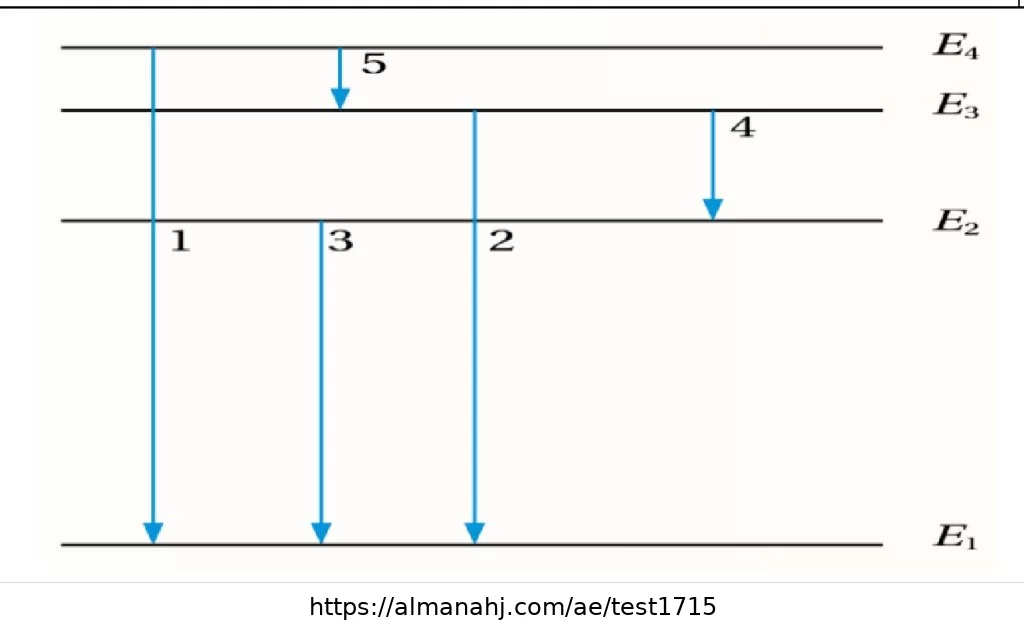
The figure represents the allowed energy levels and electron transitions between energy levels numbered 1 to 5. Which transition results in the emission of a photon with the longest wavelength?
Explanation
Longest wavelength corresponds to the smallest energy difference ($E = hc/\lambda$). Transition 5 represents the smallest energy gap among the emission options.
Question 23
23
Points: 1
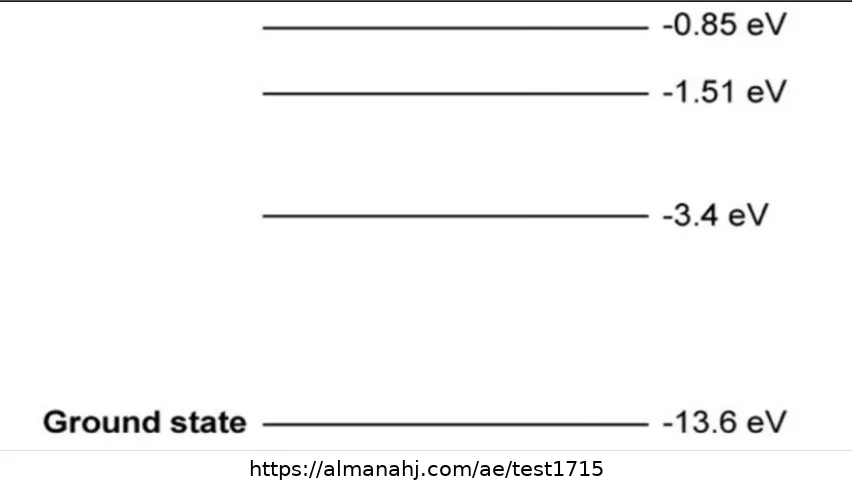
Based on the energy-level diagram of the hydrogen atom, an electron in a stable energy level is struck by a photon with energy 12.1 eV. What happens?
Explanation
For Hydrogen, the difference between n=1 and n=3 is exactly 12.1 eV ($-1.51 - (-13.6) = 12.09 \approx 12.1$ eV).
Question 24
24
Points: 1
Based on the energy-level diagram of the hydrogen atom, a dark line appears in the absorption spectrum of hydrogen at frequency 6.16 × 10¹⁴ Hz. The energy levels between which the electron transitioned to create the dark line are:
Explanation
$E = hf / 1.6 \times 10^{-19} \approx 2.55$ eV. This energy corresponds to the transition from n=2 (-3.4 eV) to n=4 (-0.85 eV), where $\Delta E = 2.55$ eV.
Question 25
25
Points: 1
The diagram shows an energy-level diagram for a hydrogen atom. How many discrete photon energies could be produced from the energy levels?
Explanation
With 4 energy levels, the number of possible transitions is n(n-1)/2 = 4(3)/2 = 6.
Question 26
26
Points: 1
What is the ratio between the longest wavelength in the Lyman series and the longest wavelength in the Balmer series for a hydrogen atom?
Hydrogen atoms feature the energy levels shown. Which photon energy will not cause an electron to be excited or ionized in a ground-state hydrogen atom?
Explanation
An incident photon must either match a transition energy exactly (10.2 eV, 12.1 eV, etc.) or be high enough to ionize (> 13.6 eV). 12.29 eV matches no transition.
Question 28
28
Points: 1
Which type of photon is emitted when an electron in a hydrogen atom drops from the n = 2 to the n = 1 energy level?
Explanation
Transitions ending at n=1 (Lyman series) produce high-energy photons in the ultraviolet range.
Question 29
29
Points: 1
Which type of photon is emitted when an electron in a hydrogen atom drops from the n = 3 to the n = 2 energy level?
Explanation
Transitions ending at n=2 (Balmer series) correspond to the visible light spectrum.
Question 30
30
Points: 1
Which type of photon is emitted when an electron in a hydrogen atom drops from the n = 5 to the n = 3 energy level?
Explanation
Transitions ending at n=3 (Paschen series) result in lower-energy photons in the infrared range.
Question 31
31
Points: 1
The four visible lines in the hydrogen emission spectrum are produced when an atom drops from a higher energy state into which energy state?
Explanation
The Balmer series, which contains the visible lines for hydrogen, involves transitions that terminate at the n=2 energy level.
Question 32
32
Points: 1
Which of the following hydrogen electron transitions would emit a photon in the infrared range?
Explanation
Transitions to n=3 (Paschen series) are infrared. Transitions to n=1 are UV, and to n=2 are visible.
Question 33
33
Points: 1
What is the energy of a hydrogen atom in the second energy level (n = 2)?
Explanation
Using E_n = -13.6 / n2, for n=2, E2 = -13.6 / 4 = -3.40 eV.
The ground state of a helium ion is -54.4 eV. A transition to the ground state emits a 30.4 nm photon. What is the energy of the excited state?
Explanation
$E_{photon} = 1240 / 30.4 \approx 40.8$ eV. Since $\Delta E = E_{excited} - E_{ground}$, then $40.8 = E_{excited} - (-54.4) \Rightarrow E_{excited} = -13.6$ eV.
Question 36
36
Points: 1
The adjacent figure shows the waves associated with an electron in a certain orbit. The orbital number of this electron is:
Explanation
The number of full wavelengths (peaks/troughs pairs) in the standing wave corresponds to the principal quantum number n. There are 4 wavelengths shown.
Question 37
37
Points: 1
The figure shows a standing wave associated with an electron orbiting a stable orbit of a hydrogen atom. What is the de Broglie wavelength associated with the electron in terms of the orbit radius r?
Explanation
From the standing wave condition $n \lambda = 2\pi r$. Here n=4, so $4\lambda = 2\pi r \Rightarrow \lambda = \frac{2\pi r}{4} = \frac{\pi r}{2}$.
Question 38
38
Points: 1
What is the physical significance of the quantum number in the de Broglie standing wave condition?
Explanation
De Broglie's hypothesis explains Bohr's quantization by stating that the circumference must be an integer multiple of the electron's wavelength.
Question 39
39
Points: 1
An atom drops from an energy level of -7.64 eV to a lower level and emits a photon with a wavelength of 273 nm. What is the energy of the lower level?
An electron in an atom transitions from the higher energy level E2 to the lower energy level E1. The wavelength of the emitted photon is:
Explanation
The relationship between energy difference and wavelength is given by $\Delta E = hf = hc/\lambda$. Solving for wavelength: $\lambda = hc / \Delta E$.
Question 41
41
Points: 1
Four photons with energies of 10.0 eV, 10.2 eV, 11.0 eV, and 12.5 eV are incident on a group of hydrogen atoms in their ground state (n = 1). Which of these photons can the atom absorb?
Explanation
Only the 10.2 eV photon matches the energy difference between the ground state (n=1) and the first excited state (n=2).
Question 42
42
Points: 1
What happens if a photon with an energy of 15.0 eV is incident on a hydrogen atom in its ground state?
Explanation
Ionization energy is 13.6 eV. A 15.0 eV photon will ionize the atom; the excess energy (15.0 - 13.6 = 1.4 eV) becomes kinetic energy of the free electron.
Question 43
43
Points: 1
A hydrogen atom in its ground state absorbs a photon, and the electron transitions to an energy level where the orbital radius is 9 times the first Bohr radius. What is the energy of the absorbed photon?
Explanation
Radius r_n = n2 r1. If r_n = 9 r1, then n2 = 9, so n=3. The energy required to reach n=3 from n=1 is -1.51 - (-13.6) = 12.09 eV.
Question 44
44
Points: 1
An excited hydrogen atom in an upper energy level absorbs a photon of 0.97 eV and transitions to the fifth level (n = 5). In which level was the atom before absorption?
Explanation
E5 = -13.6 / 25 = -0.544 eV. If it absorbed 0.97 eV to get there, its initial energy was -0.544 - 0.97 = -1.514 eV, which corresponds to n=3.
Question 45
45
Points: 1
According to the Bohr model, what is the correct mathematical formula to calculate the energy of an absorbed photon E when an electron transitions from level n1 to level n2? Given that n2 > n1.
Explanation
Energy difference $\Delta E = E_{n2} - E_{n1} = (-13.6/n_2^2) - (-13.6/n_1^2) = 13.6(1/n_1^2 - 1/n_2^2)$.
Result Tracking
Answered0 / 45
Correct Answers0
Wrong Answers0
Current Percentage0%
Quiz Completed
This is your final result after answering all questions.
Final Result
0/450%
Correct Answers0
Wrong Answers0
Answered Questions0 / 45
Total Possible Points45
You can reopen the page to start again.
يمكنك تسجيل الدخول لحفظ سجل محاولاتك، معرفة أخطائك المتكررة، والحصول على نصائح مخصصة. تسجيل الدخول باستخدام Google
Here are more quizzes for الصف التاسع العام by الفصل الثالث and subject فيزياء
This section is rendered only when the user reaches it while scrolling.
...
🍪
إشعار ملفات تعريف الارتباط
يستخدم هذا الموقع ملفات تعريف الارتباط لتحسين تجربة التصفح وقياس الأداء وعرض المحتوى بشكل أفضل.
باستخدامك للموقع فإنك توافق على استخدامنا لها وفق
سياسة الخصوصية.