موقع المناهج
>>
المناهج الإماراتية
المناهج السعودية
المناهج الكويتية
المناهج القطرية
المناهج العمانية
المناهج البحرينية
المناهج السورية
>>
اختر صفًا
الصف الأول
الصف الثاني
الصف الثالث
الصف الرابع
الصف الخامس
الصف السادس
الصف السابع
الصف الثامن
الصف التاسع العام
الصف العاشر العام
الصف الحادي عشر العام
الصف الثاني عشر العام
الصف العاشر المتقدم
الصف الحادي عشر المتقدم
الصف الثاني عشر المتقدم
الصف التاسع المتقدم
الصف العاشر
الصف الحادي عشر
الصف الثاني عشر
الصف التاسع
KG1
KG2
مرحلة ابتدائية
مرحلة متوسطة
مرحلة ثانوية
ملفات جامعية
أخبار
ملفات مدرسية
Interactive multiple-choice quiz: Geometry Concepts: Points, Lines, and Planes
This comprehensive quiz covers the fundamental concepts of Euclidean geometry, specifically focusing on identifying and naming points, lines, and planes.
🏆 انضم إلى التحدي واحصل على ترتيبك
اختبار شهادة تدريبي مؤقت للصف والمادة والفصل نفسه.
ابدأ السباق ✨
اختر إجابة واحدة لكل سؤال. عند الاختيار ستظهر النتيجة فورًا: الأخضر صحيح، والأحمر خطأ، وسيظهر تفسير الإجابة مباشرة إن كان متوفرًا. وبعد آخر سؤال ستظهر الدرجة النهائية تلقائيًا.
🚩 Report
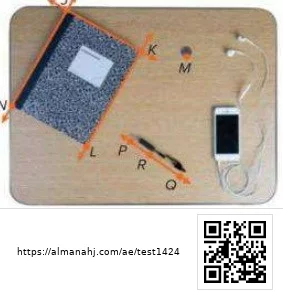
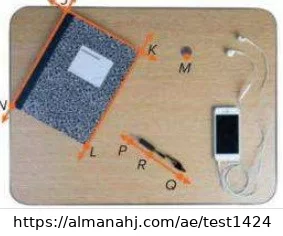
Which statement correctly describes the geometric model of the notebook in the picture?
A
The notebook models line JK .
B
The notebook models plane JKL .
C
The notebook models point M in space.
D
The notebook models collinear points.
Explanation
A notebook surface represents a flat, two-dimensional surface, which is the definition of a plane.
🚩 Report
What do the edges of the notebook represent in this geometric model?
A
The edges of the notebook model plane JKL .
B
The edges of the notebook model point N and point L .
C
The edges of the notebook model line JK and line KL .
D
The edges of the notebook model collinear points P , Q , and R .
Explanation
The edges of a flat surface like a notebook are represented by lines (or line segments) in geometry.
🚩 Report
Which of the following describes the geometric term modeled by the quarter?
A
The quarter models line KL .
B
The quarter models plane JKL .
C
The quarter models coplanar lines.
D
The quarter models point M in space.
Explanation
In geometric modeling, a small object like a quarter or a specific location on it can be represented as a point.
🚩 Report
Based on the provided geometric model, which relationship is true for points
N ,
L , and
K ?
A
Points N , L , and K are collinear.
B
Points N , L , and K are coplanar.
C
Points N , L , and K form a straight line.
D
Points N , L , and K are non-coplanar.
Explanation
Points N, L, and K all lie on the same surface of the notebook, meaning they are coplanar.
🚩 Report
Which statement is correct regarding the points
P ,
Q , and
R on the pen?
A
Points P , Q , and R are collinear.
B
Points P , Q , and R are non-collinear.
C
Points P , Q , and R are non-coplanar.
D
Points P , Q , and R model a single plane.
Explanation
The pen models a line, and since points P, Q, and R all lie along the pen, they are collinear.
🚩 Report
Name the geometric term modeled by: roof of a house
A
Line
B
Plane
C
Point
D
Segment
Explanation
A flat section of a roof models a two-dimensional surface, which is a plane.
🚩 Report
Name the geometric term modeled by: a tabletop
A
Point
B
Line
C
Plane
D
Ray
Explanation
A tabletop is a flat surface that represents a plane.
🚩 Report
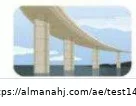
Name the geometric term modeled by: bridge support beam
A
Point
B
Line
C
Plane
D
Ray
Explanation
A support beam is long and narrow, modeling a line or a line segment.
🚩 Report
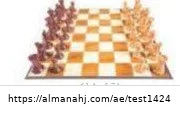
Name the geometric term modeled by: a chessboard
A
Point
B
Line
C
Plane
D
Ray
Explanation
A chessboard is a flat surface, hence it models a plane.
🚩 Report
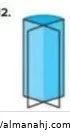
Describe the geometric relationship shown by the arrow in the figure.
A
A line containing a point
B
Two planes intersecting in a line
C
Parallel planes
D
A single flat plane
Explanation
The arrow points to the edge of the prism where two flat faces (planes) meet, forming a line of intersection.
🚩 Report
Describe the geometric relationship shown in the figure.
A
A plane containing a line
B
A line containing a point
C
Two intersecting planes
D
Non-coplanar points
Explanation
The figure illustrates two distinct planes that pass through each other.
🚩 Report
Name the geometric term modeled by: a wall and the floor
A
A line containing a point
B
Two planes intersecting in a line
C
Parallel planes
D
A single flat plane
Explanation
The wall and the floor are two perpendicular planes that meet at a straight line.
🚩 Report
Name the geometric term modeled by: the edge of a table
A
Plane
B
Point
C
Line
D
Intersection of three planes
Explanation
The edge of a table is a straight boundary which models a line.
🚩 Report
Name the geometric term modeled by: two connected walls
A
A line containing a point
B
Two planes intersecting in a line
C
Parallel planes
D
A single flat plane
Explanation
Two walls meet at a corner, which is the intersection of two planes forming a line.
🚩 Report
Name the geometric term modeled by: a blanket
A
Point
B
Line
C
Plane
D
Ray
Explanation
A blanket, when laid out, represents a flat surface or a plane.
🚩 Report
Name the geometric term modeled by: a telephone pole
A
Point
B
Line
C
Plane
D
Ray
Explanation
A tall, straight pole models a line in geometry.
🚩 Report
Name the geometric term modeled by: a tablet computer
A
Point
B
Line
C
Plane
D
Ray
Explanation
The screen or the body of a tablet is a flat surface, modeling a plane.
🚩 Report
Use the figure to name a line containing point
Q . Which of the following are additional correct names for line
c ?
A
$\overleftrightarrow{TR}, \overleftrightarrow{RV}, \overleftrightarrow{TQ}, \overleftrightarrow{VT}, \overleftrightarrow{RQ}, \overleftrightarrow{QR}$
B
$\overleftrightarrow{TR}, \overleftrightarrow{RT}, \overleftrightarrow{TQ}, \overleftrightarrow{QT}, \overleftrightarrow{RQ}, \overleftrightarrow{QR}$
C
$\overleftrightarrow{RV}, \overleftrightarrow{VR}, \overleftrightarrow{TR}, \overleftrightarrow{RT}, \overleftrightarrow{TS}, \overleftrightarrow{QT}$
D
$\overleftrightarrow{TQ}, \overleftrightarrow{QT}, \overleftrightarrow{TS}, \overleftrightarrow{ST}, \overleftrightarrow{RQ}, \overleftrightarrow{QR}$
Explanation
Line c contains points T , R , and Q . A line can be named by any two points on it in any order.
🚩 Report
Use the figure to find another correct name for plane
A which contains point
S and point
T .
A
plane STV
B
plane QVS
C
plane QST
D
plane VST
Explanation
A plane can be named by three non-collinear points that lie within it. Q , S , and T are all points in plane A and are not on the same line.
🚩 Report
Refer to the figure. Name the lines that are only in plane
Q .
A
Line p and line q
B
Line m and line t
C
Line n and line q
D
Line n and line p
Explanation
According to the diagram, lines n and q lie completely within the bottom plane labeled Q .
🚩 Report
How many planes are labeled in the figure?
Explanation
The figure shows two planes explicitly labeled with capital letters in their corners: plane M and plane Q .
🚩 Report
Name the plane containing the lines
m and
t .
A
Plane Q
B
Plane R
C
Plane p
D
Plane M
Explanation
Lines m and t are both located within the top horizontal plane labeled M .
🚩 Report
Name the intersection of lines
m and
t .
A
Point H
B
Point B
C
Point E
D
Point C
Explanation
Lines m and t cross at a single location, which is labeled as point C .
Result Tracking
Answered
0 / 23
Correct Answers
0
Wrong Answers
0
Current Percentage
0%
Quiz Completed
This is your final result after answering all questions.
Final Result
0/23
0%
Correct Answers
0
Wrong Answers
0
Answered Questions
0 / 23
Total Possible Points
23
You can reopen the page to start again.