اختبار اختيار من متعدد تفاعلي: Quadrilaterals: Properties and Classification
This worksheet covers the classification of quadrilaterals, including trapezoids, parallelograms, rhombuses, rectangles, and squares. Students will learn how to identify these shapes based on their properties and represent their relationships using Venn diagrams and hierarchical charts. The exercises involve analyzing statements for truthfulness and identifying specific shapes from a given set based on their geometric characteristics.
🏆 انضم إلى التحدي واحصل على ترتيبك
اختبار شهادة تدريبي مؤقت للصف والمادة والفصل نفسه.
اختر إجابة واحدة لكل سؤال. عند الاختيار ستظهر النتيجة فورًا: الأخضر صحيح، والأحمر خطأ، وسيظهر تفسير الإجابة مباشرة إن كان متوفرًا. وبعد آخر سؤال ستظهر الدرجة النهائية تلقائيًا.
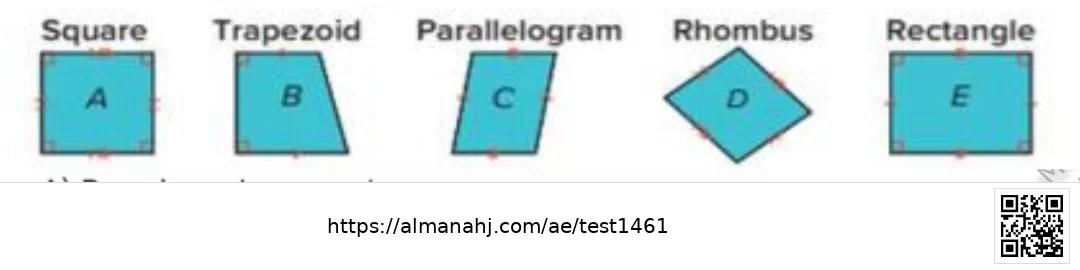
How can you represent the different categories and subcategories of quadrilaterals?
Explanation
Venn diagrams are the standard mathematical tool for representing overlapping sets and hierarchical relationships among geometric shapes.
Question 2
Points: 1
According to the diagram, which of the following statements about Trapezoids is true?
Explanation
In many classifications, a trapezoid is defined as having exactly one pair of parallel sides, which makes it distinct from a parallelogram (which has two).
Question 3
Points: 1
Which statement correctly describes the relationship between Rectangles and Parallelograms?
Explanation
A rectangle is a specific type of parallelogram that contains four right angles.
Question 4
Points: 1
Which statement correctly describes Rhombuses based on the Venn diagram?
Explanation
Every rhombus has two pairs of parallel sides, making every rhombus a parallelogram.
Question 5
Points: 1
Based on the diagram, a Square can be classified as:
Explanation
A square has four equal sides (rhombus property) and four right angles (rectangle property).
Question 6
Points: 1
Are the following statements always true, sometimes true, or never true?
A trapezoid is a parallelogram.
Explanation
Under the definition where a trapezoid has exactly one pair of parallel sides, it cannot be a parallelogram, which must have two pairs.
Question 7
Points: 1
Are the following statements always true, sometimes true, or never true?
A square is a rhombus.
Explanation
A square meets all the requirements of a rhombus (it is a quadrilateral with four equal sides).
Question 8
Points: 1
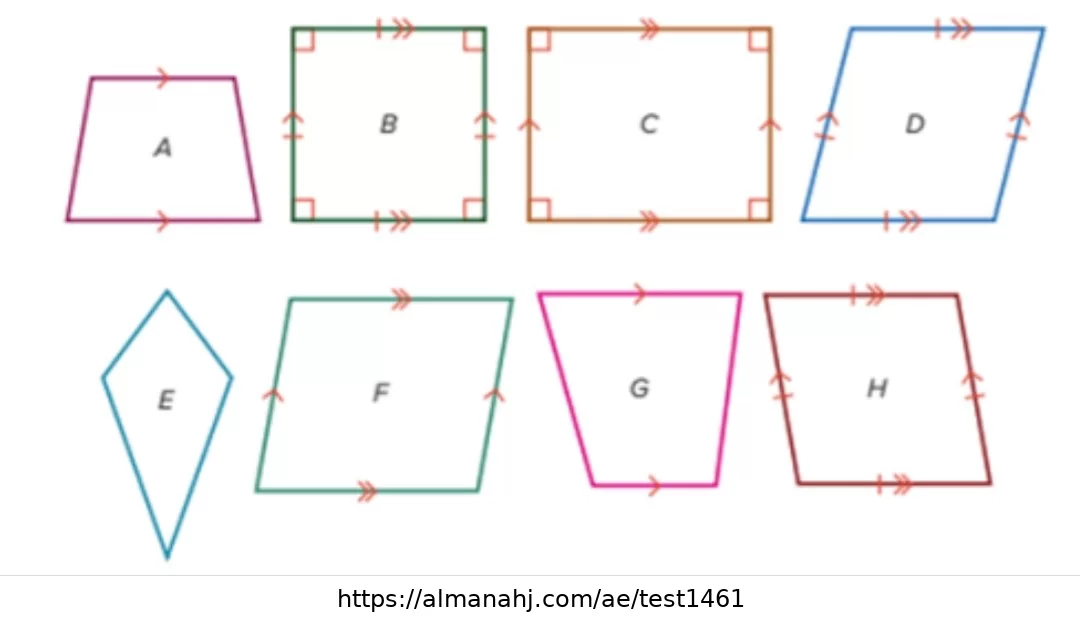
Identify the figures that could be classified as: quadrilaterals.
Explanation
A quadrilateral is any polygon with four sides; all the provided figures satisfy this definition.
Question 9
Points: 1
Identify the figures that could be classified as: trapezoids.
Explanation
Figures A and G are the only shapes shown with exactly one pair of parallel sides.
Question 10
Points: 1
Identify the figures that could be classified as: parallelograms.
Explanation
These figures all contain two pairs of parallel sides, meeting the definition of a parallelogram.
Question 11
Points: 1
Identify the figures that could be classified as: rectangles.
Explanation
Figures B and C are the only parallelograms in the set that contain four right angles.
Result Tracking
Answered0 / 11
Correct Answers0
Wrong Answers0
Current Percentage0%
Quiz Completed
This is your final result after answering all questions.
Final Result
0/110%
Correct Answers0
Wrong Answers0
Answered Questions0 / 11
Total Possible Points11
You can reopen the page to start again.
يمكنك تسجيل الدخول لحفظ سجل محاولاتك، معرفة أخطائك المتكررة، والحصول على نصائح مخصصة. تسجيل الدخول باستخدام Google
Here are more quizzes for الصف الخامس by الفصل الثالث and subject رياضيات
This section is rendered only when the user reaches it while scrolling.
...
🍪
إشعار ملفات تعريف الارتباط
يستخدم هذا الموقع ملفات تعريف الارتباط لتحسين تجربة التصفح وقياس الأداء وعرض المحتوى بشكل أفضل.
باستخدامك للموقع فإنك توافق على استخدامنا لها وفق
سياسة الخصوصية.