Interactive multiple-choice quiz: Geometry Assessment: Triangle Congruence and Angle Measures
This assessment focuses on proving triangle congruence using SSS and SAS postulates. It also includes exercises on calculating unknown interior and exterior angles of triangles using the Triangle Angle Sum Theorem and Vertical Angle Theorem. Students are expected to analyze geometric diagrams to identify congruent parts and apply algebraic reasoning to find angle measures.
🏆 انضم إلى التحدي واحصل على ترتيبك
اختبار شهادة تدريبي مؤقت للصف والمادة والفصل نفسه.
اختر إجابة واحدة لكل سؤال. عند الاختيار ستظهر النتيجة فورًا: الأخضر صحيح، والأحمر خطأ، وسيظهر تفسير الإجابة مباشرة إن كان متوفرًا. وبعد آخر سؤال ستظهر الدرجة النهائية تلقائيًا.
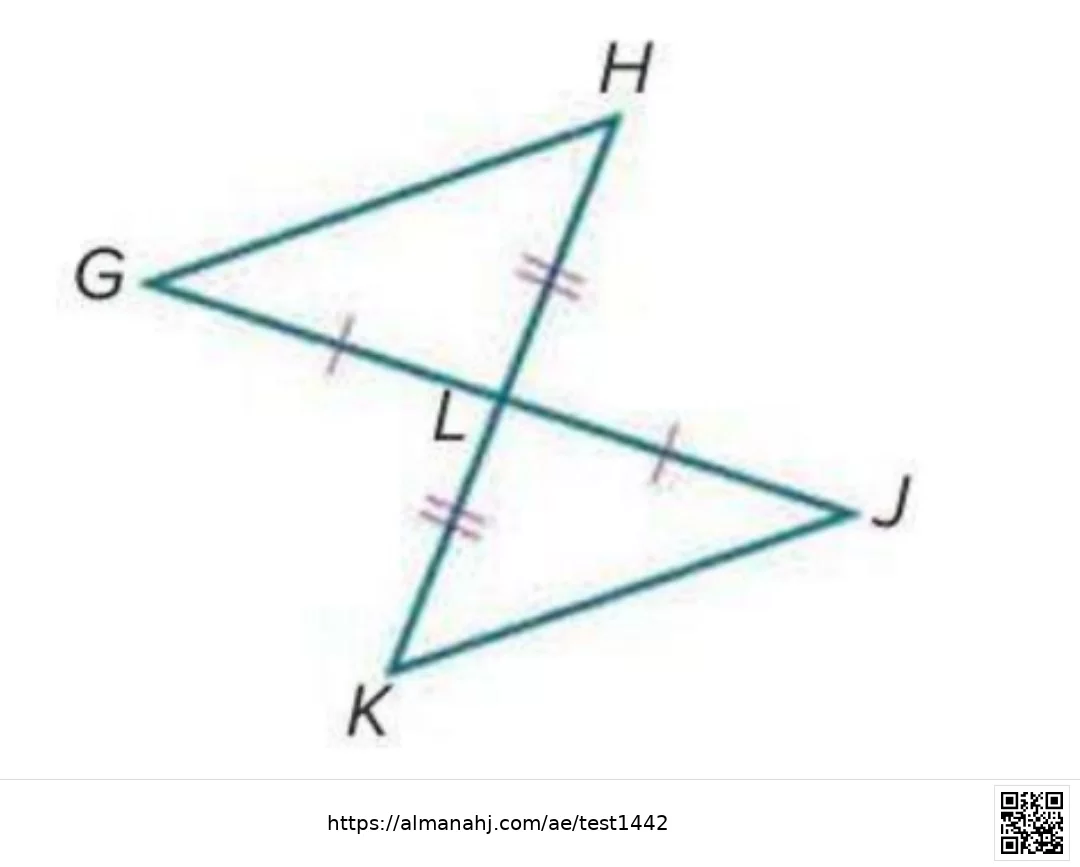
Explain whether there is enough information given in the figure to prove that the triangles are congruent using SSS or SAS.
Explanation
The figure shows two pairs of congruent sides ($GL \cong JL$ and $HL \cong KL$) and the included angles are vertical angles, which are always congruent. Therefore, the triangles are congruent by SAS.
Question 2
2
Points: 1
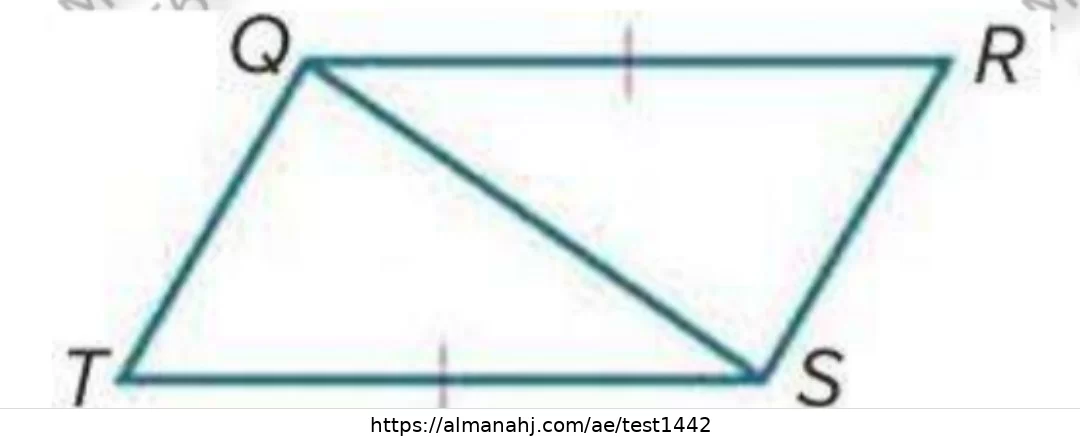
Explain whether there is enough information given in the figure to prove that the triangles are congruent using SSS or SAS.
Explanation
Only one pair of congruent sides is marked ($QR \cong TS$). There is no information provided about the other sides or the angles, so neither SSS nor SAS can be used.
Question 3
3
Points: 1
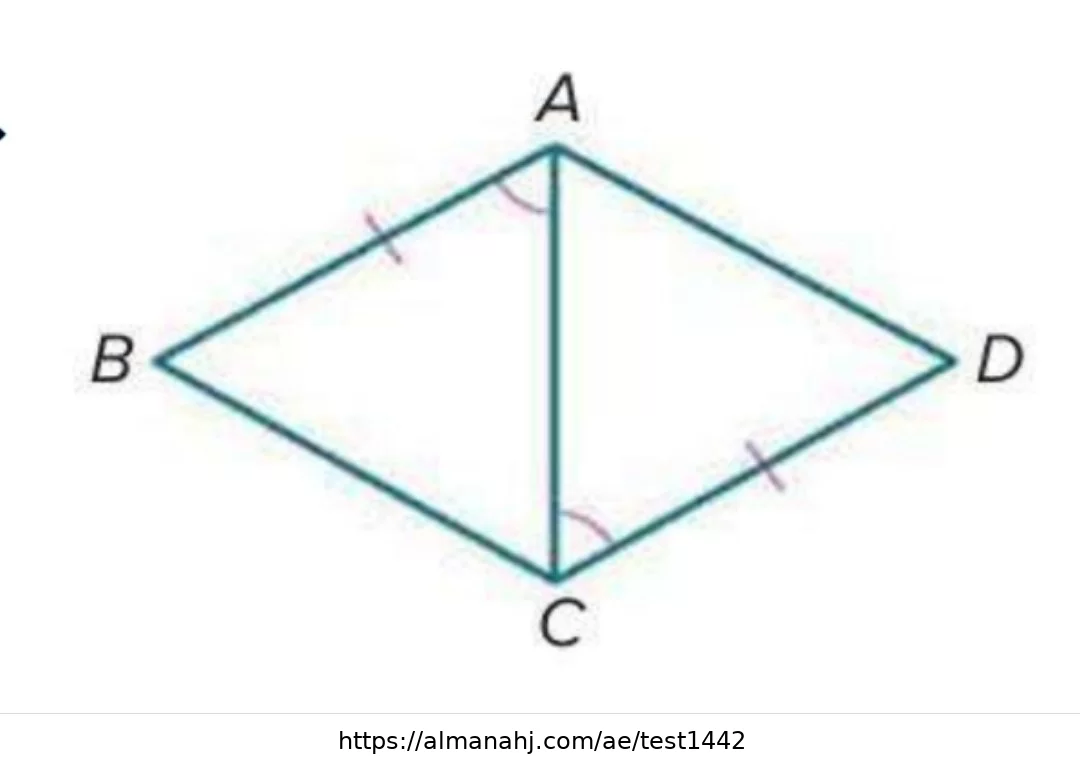
Explain whether there is enough information given in the figure to prove that the triangles are congruent using SSS or SAS.
Explanation
The triangles share a side ($\overline{AC}$) and are given two pairs of congruent sides with congruent included angles, thus satisfying the SAS Congruence Postulate.
Question 4
4
Points: 1
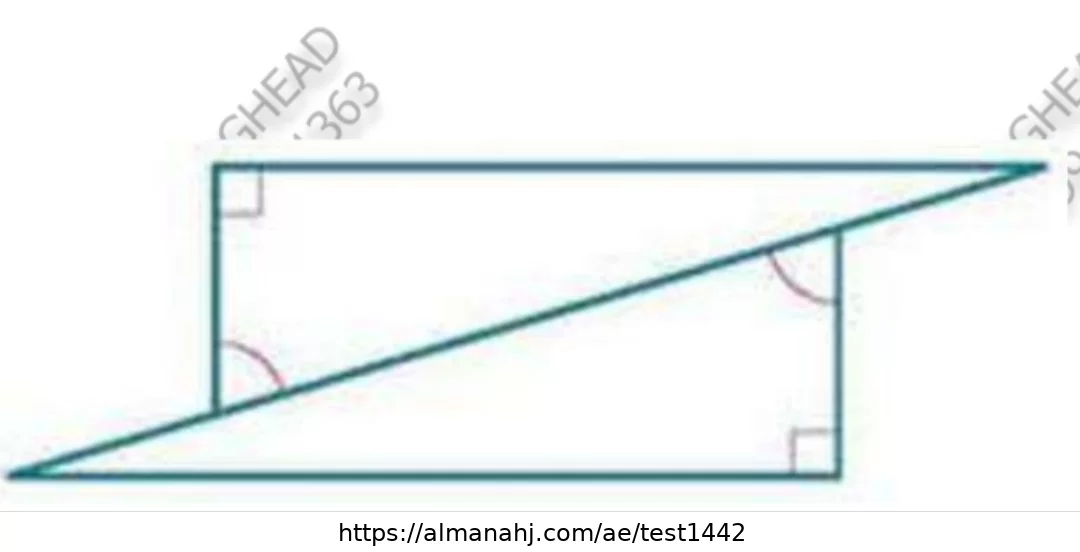
Explain whether there is enough information given in the figure to prove that the triangles are congruent using SSS or SAS.
Explanation
Although the triangles have congruent angles, no information about the side lengths or their congruency is provided, meaning SSS or SAS cannot be applied.
Question 5
5
Points: 1
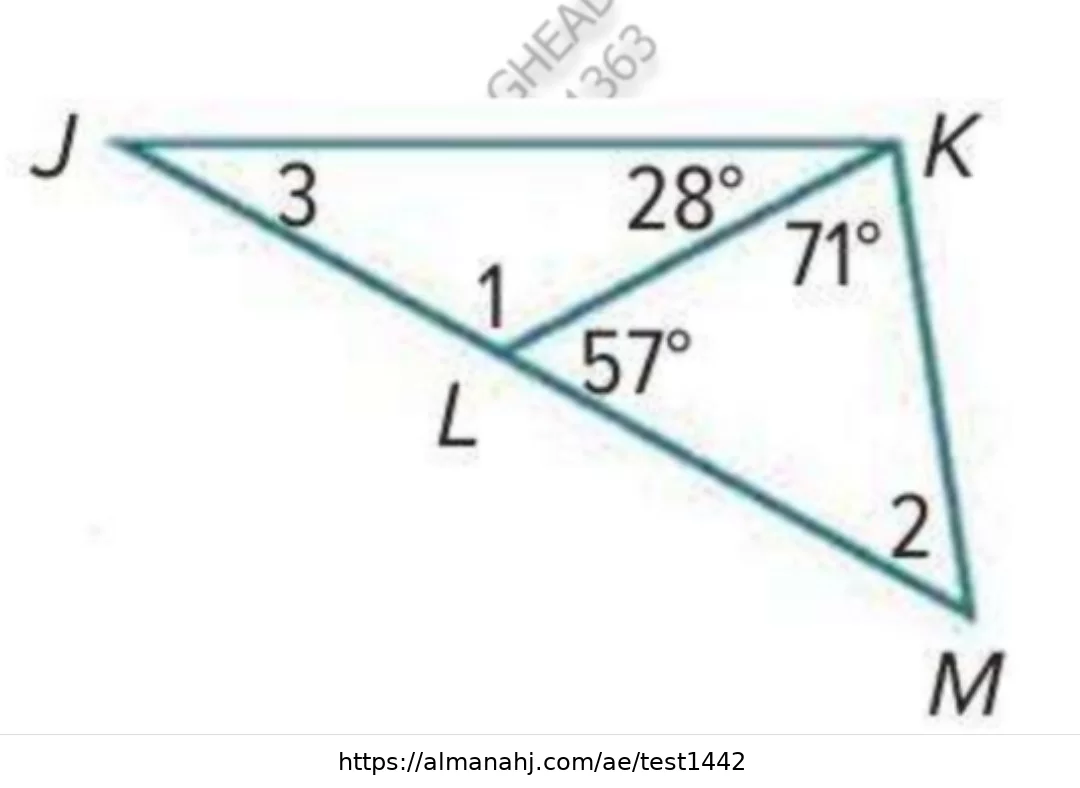
Find the measure of each numbered angle ($m\angle 1, m\angle 2, m\angle 3$) in the given figure.
Explanation
For $\triangle LKM$: $m\angle 2 = 180^\circ - (57^\circ + 71^\circ) = 52^\circ$. Angle 1 and $57^\circ$ form a linear pair, so $m\angle 1 = 180^\circ - 57^\circ = 123^\circ$. For $\triangle JLK$: $m\angle 3 = 180^\circ - (123^\circ + 28^\circ) = 29^\circ$.
Question 6
6
Points: 1
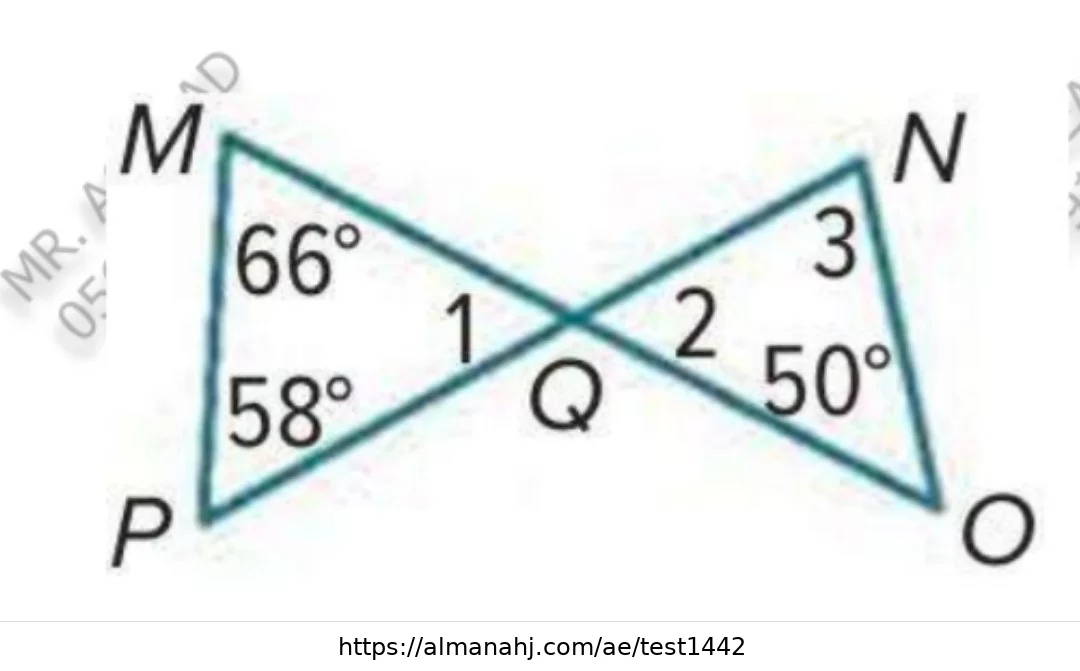
Find the measure of each numbered angle ($m\angle 1, m\angle 2$) in the figure.
Find the measure of each numbered angle ($m\angle 1, m\angle 2, m\angle 3$) in the figure.
Explanation
In $\triangle MPQ$: $m\angle 1 = 180^\circ - (66^\circ + 58^\circ) = 56^\circ$. $\angle 2$ is a vertical angle to $\angle 1$, so $m\angle 2 = 56^\circ$. In $\triangle NQO$: $m\angle 3 = 180^\circ - (56^\circ + 50^\circ) = 74^\circ$.
Question 8
8
Points: 1
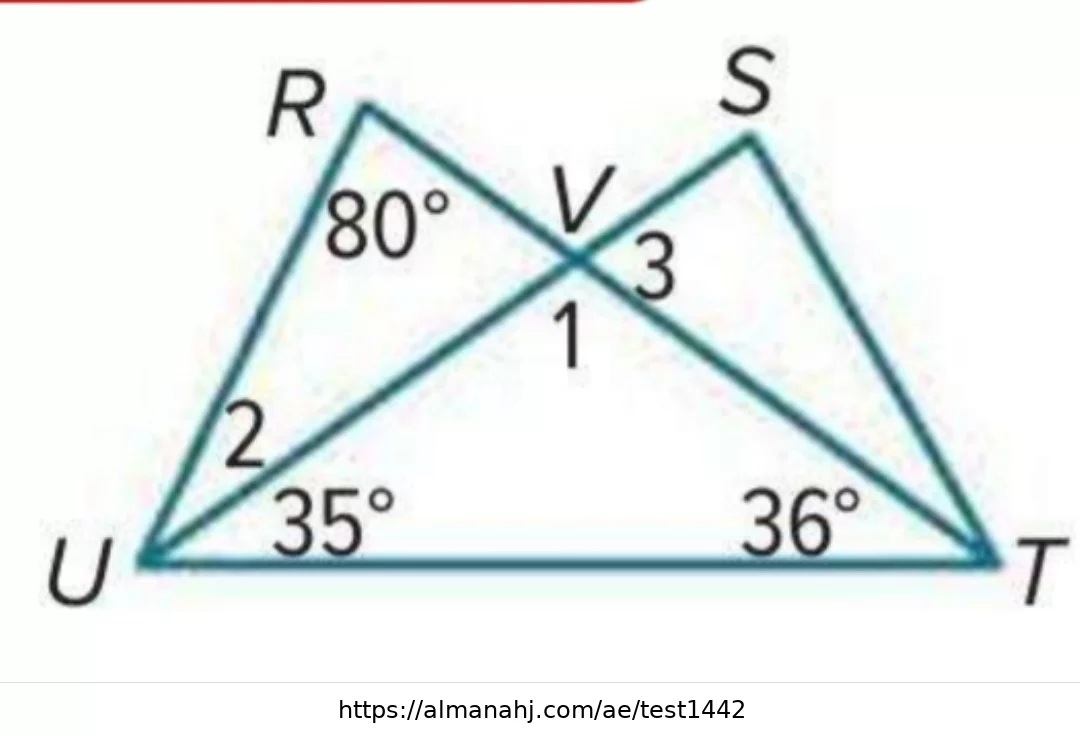
Find the measure of each numbered angle ($m\angle 1, m\angle 2, m\angle 3$) in the given figure.
Explanation
Based on the internal angles provided in the diagram, vertical angles and the triangle sum theorem are used. Specifically, if $m\angle 3 = 71^\circ$, then its vertical angle is also $71^\circ$. In the triangle with $80^\circ$, we find $m\angle 2 = 180^\circ - (80^\circ + 71^\circ) = 29^\circ$. Then $m\angle 1 = 180^\circ - 71^\circ = 109^\circ$ as they are supplementary.
Question 9
9
Points: 1
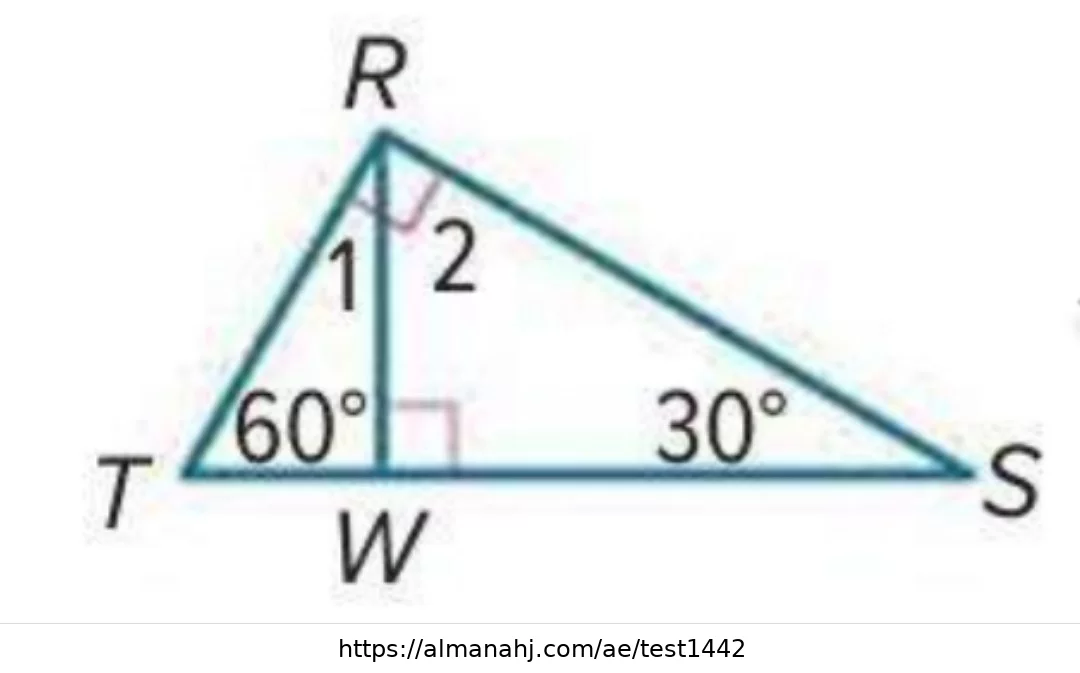
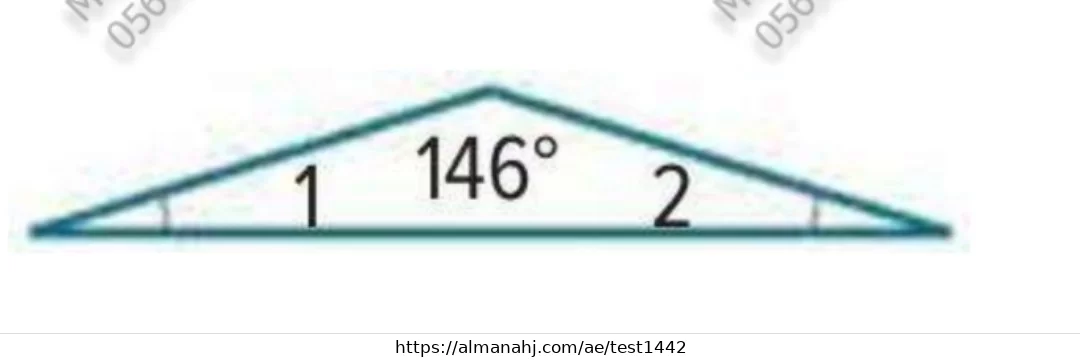
Find the measure of the base angles ($m\angle 1, m\angle 2$) in the triangle shown.
Explanation
Assuming the triangle is isosceles based on the diagram, the sum of angles is $180^\circ$. Therefore, the base angles are calculated as: $(180^\circ - 146^\circ) / 2 = 34^\circ / 2 = 17^\circ$.
Result Tracking
Answered0 / 9
Correct Answers0
Wrong Answers0
Current Percentage0%
Quiz Completed
This is your final result after answering all questions.
Final Result
0/90%
Correct Answers0
Wrong Answers0
Answered Questions0 / 9
Total Possible Points9
You can reopen the page to start again.
يمكنك تسجيل الدخول لحفظ سجل محاولاتك، معرفة أخطائك المتكررة، والحصول على نصائح مخصصة. تسجيل الدخول باستخدام Google
Here are more quizzes for الصف التاسع المتقدم by الفصل الثالث and subject رياضيات
This section is rendered only when the user reaches it while scrolling.
...
🍪
إشعار ملفات تعريف الارتباط
يستخدم هذا الموقع ملفات تعريف الارتباط لتحسين تجربة التصفح وقياس الأداء وعرض المحتوى بشكل أفضل.
باستخدامك للموقع فإنك توافق على استخدامنا لها وفق
سياسة الخصوصية.