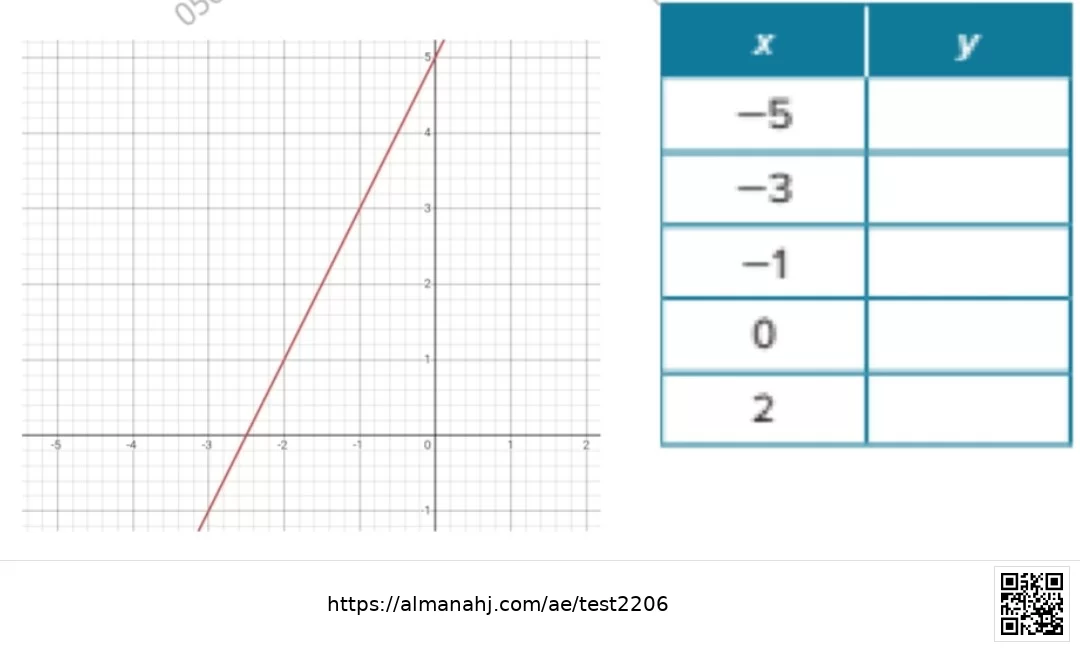
يتناول هذا التدريب مهارة تمثيل المعادلات الخطية بيانياً من خلال إكمال جداول القيم. يطلب السؤال من الطالب تعويض قيمة معينة للمتغير المستقل $x$ في المعادلة $y = 2x + 5$ لإيجاد القيمة المقابلة للمتغير التابع $y$. يساعد هذا التمرين في الربط بين التمثيل الجبري والتمثيل البياني للدوال.
🏆 انضم إلى التحدي واحصل على ترتيبك
اختبار شهادة تدريبي مؤقت للصف والمادة والفصل نفسه.
اختر إجابة واحدة لكل سؤال. عند الاختيار ستظهر النتيجة فورًا: الأخضر صحيح، والأحمر خطأ، وسيظهر تفسير الإجابة مباشرة إن كان متوفرًا. وبعد آخر سؤال ستظهر الدرجة النهائية تلقائيًا.
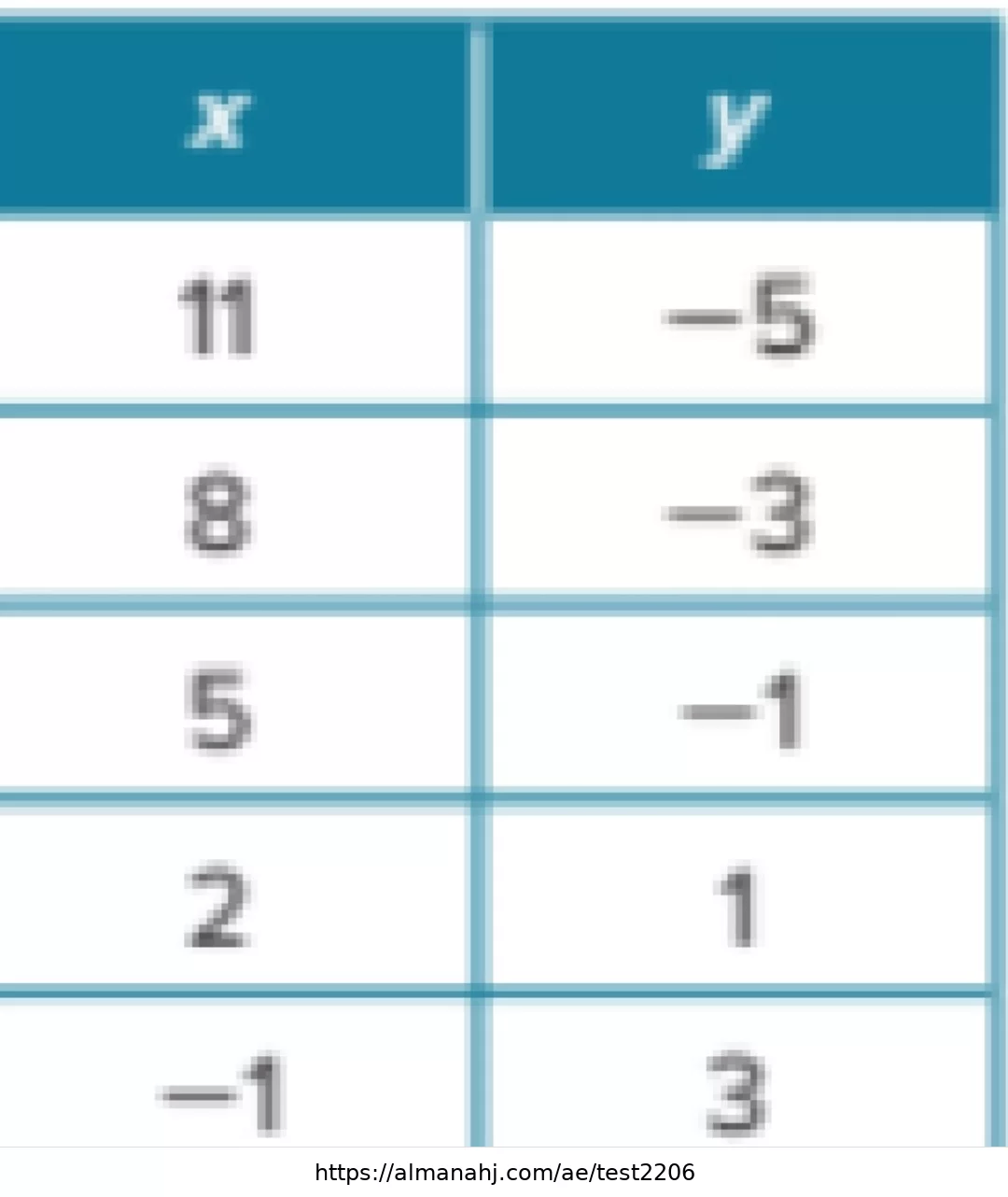
Graph y = 2x + 5 by using a table. Copy and complete the table. What is the missing value of y when x = -1?
Explanation
To find the missing value of y, substitute x = -1 into the given equation y = 2x + 5. This results in y = 2(-1) + 5 = -2 + 5 = 3.
Question 2
Points: 10
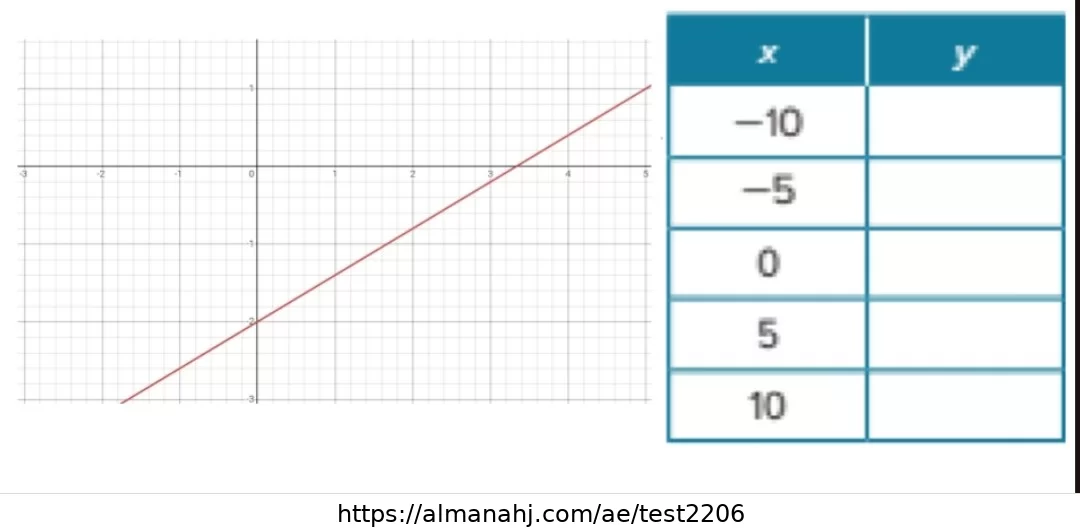
Graph y = (3/5)x - 2 by making a table. What is the value of y when x = 5?
Explanation
Substitute x = 5: y = (3/5)(5) - 2 = 3 - 2 = 1.
Question 3
Points: 10
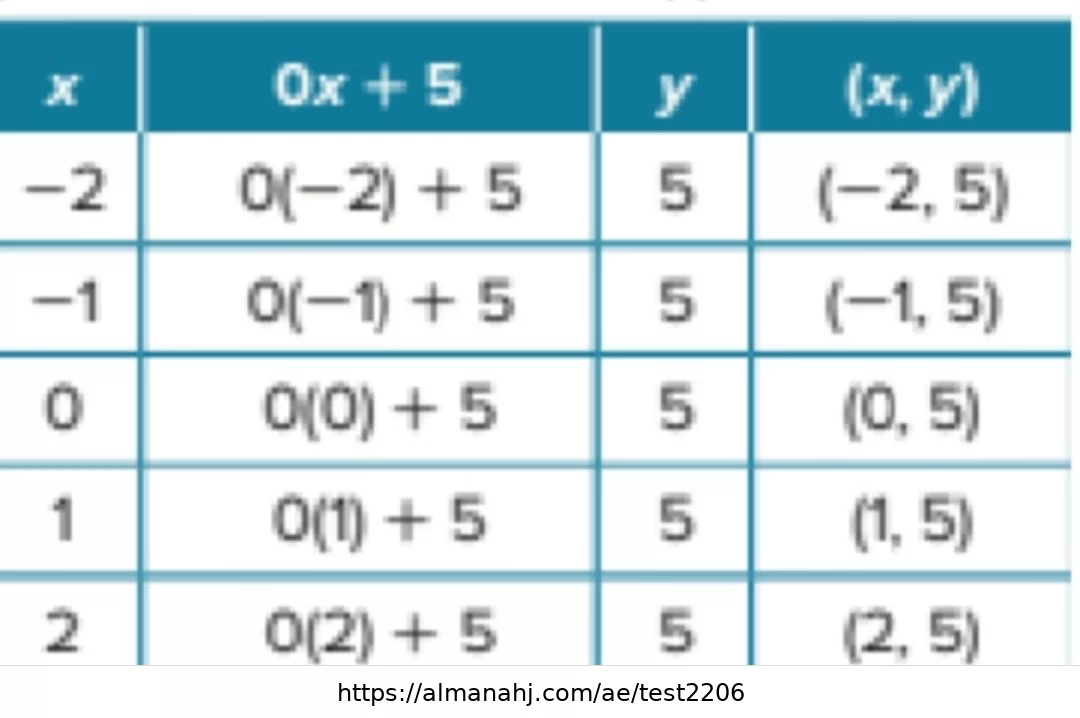
Graph y = 5 by making a table. What is the value of y when x = -1?
Explanation
The equation y = 5 is constant, so y equals 5 for every x.
Question 4
Points: 10
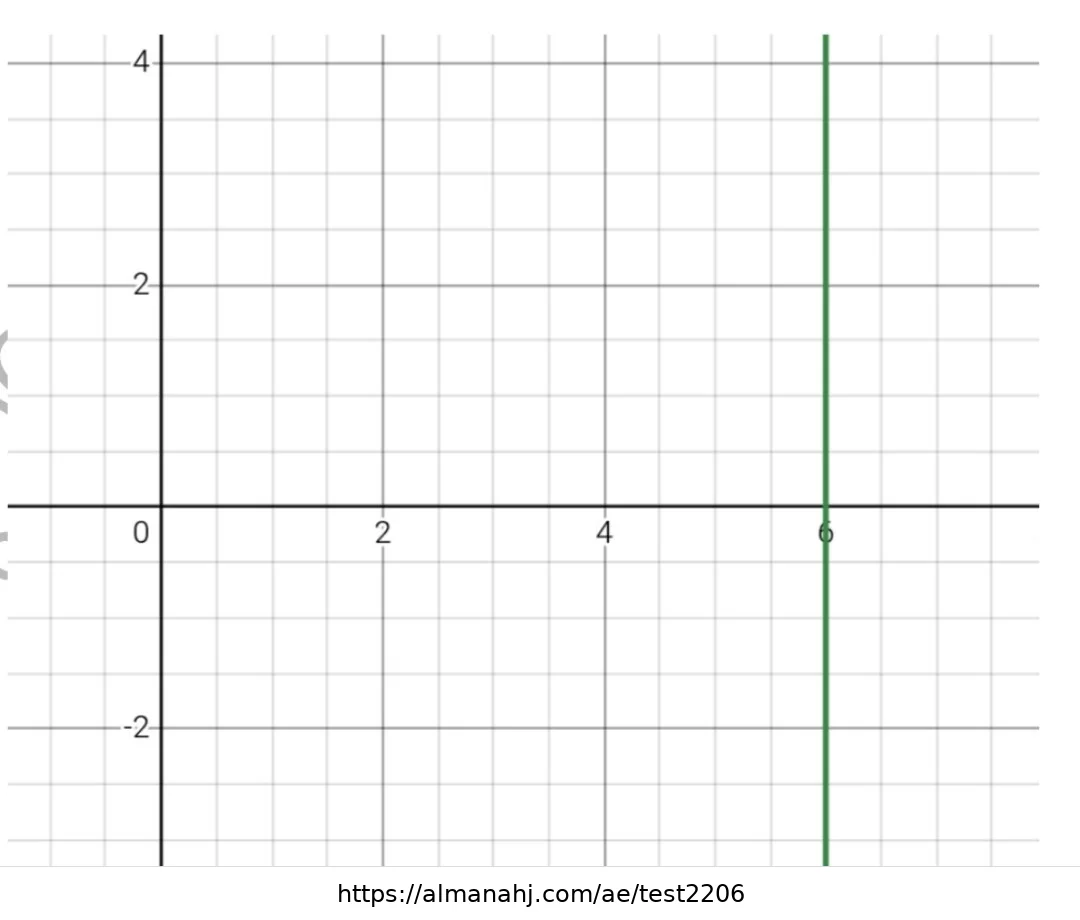
Which description represents the graph of the vertical line x = 6?
Explanation
Every point on x = 6 has x-coordinate 6, so the graph is a vertical line.
Question 5
Points: 10
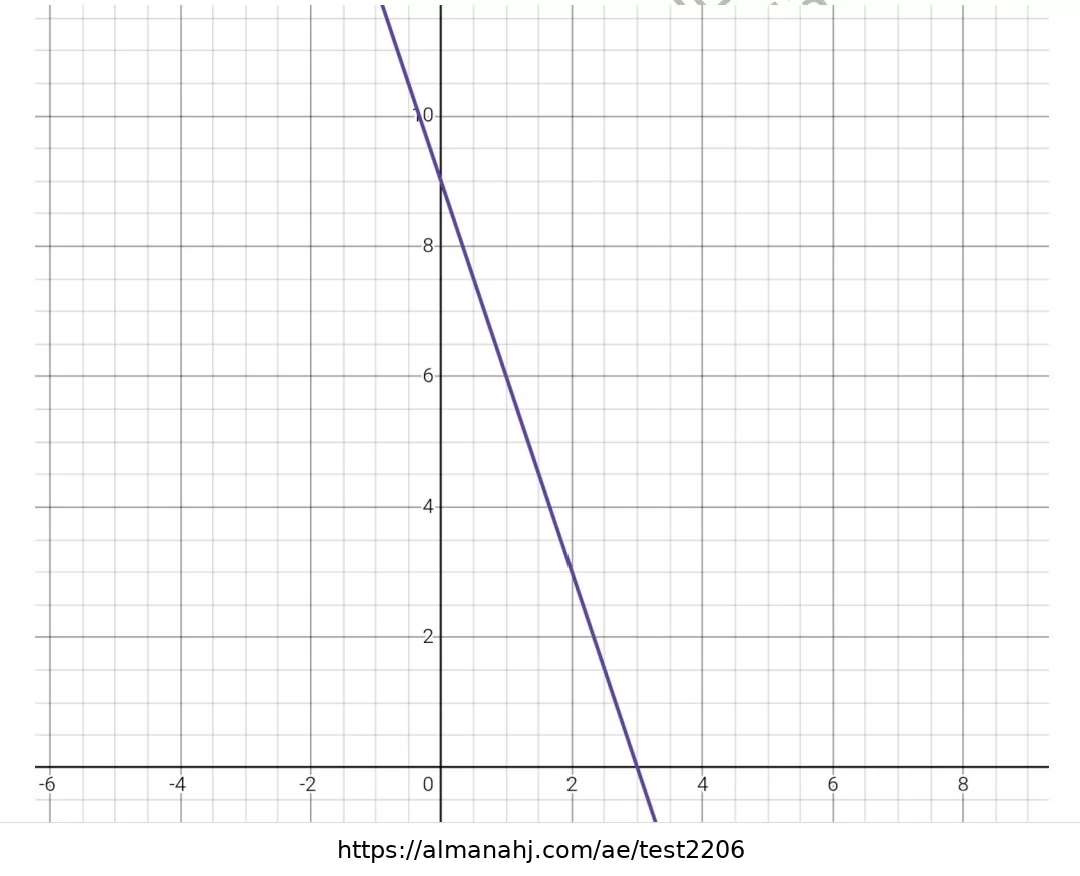
Graph 4y = -12x + 36 using the x- and y-intercepts. What are the intercepts?
Explanation
Set y = 0 to get x = 3. Set x = 0 to get y = 9.
Question 6
Points: 10
PEANUTS: A farm produces about 4362 pounds of peanuts per acre. One cup of peanut butter requires about 2/3 pound of peanuts. If one acre is harvested to make peanut butter, y = -(2/3)x + 4362 represents the pounds of peanuts remaining after x cups are made. Find the x- and y-intercepts.
Explanation
When x = 0, y = 4362. When y = 0, x = 4362 × 3/2 = 6543.
Question 7
Points: 10
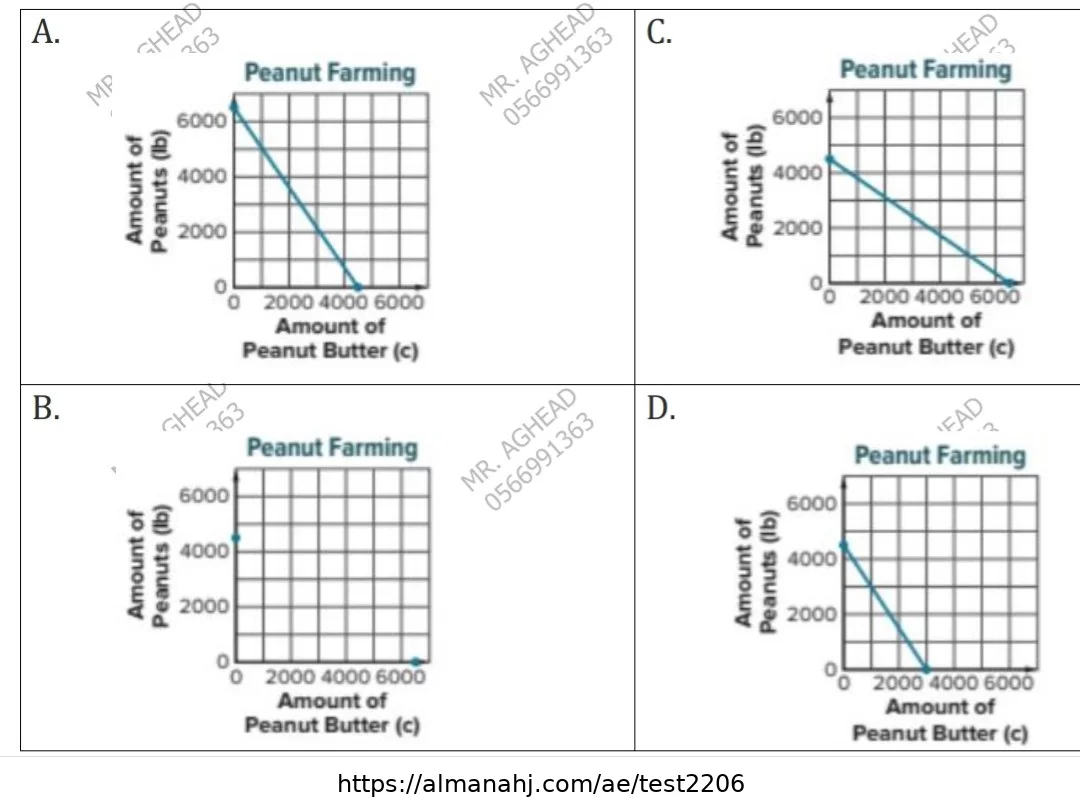
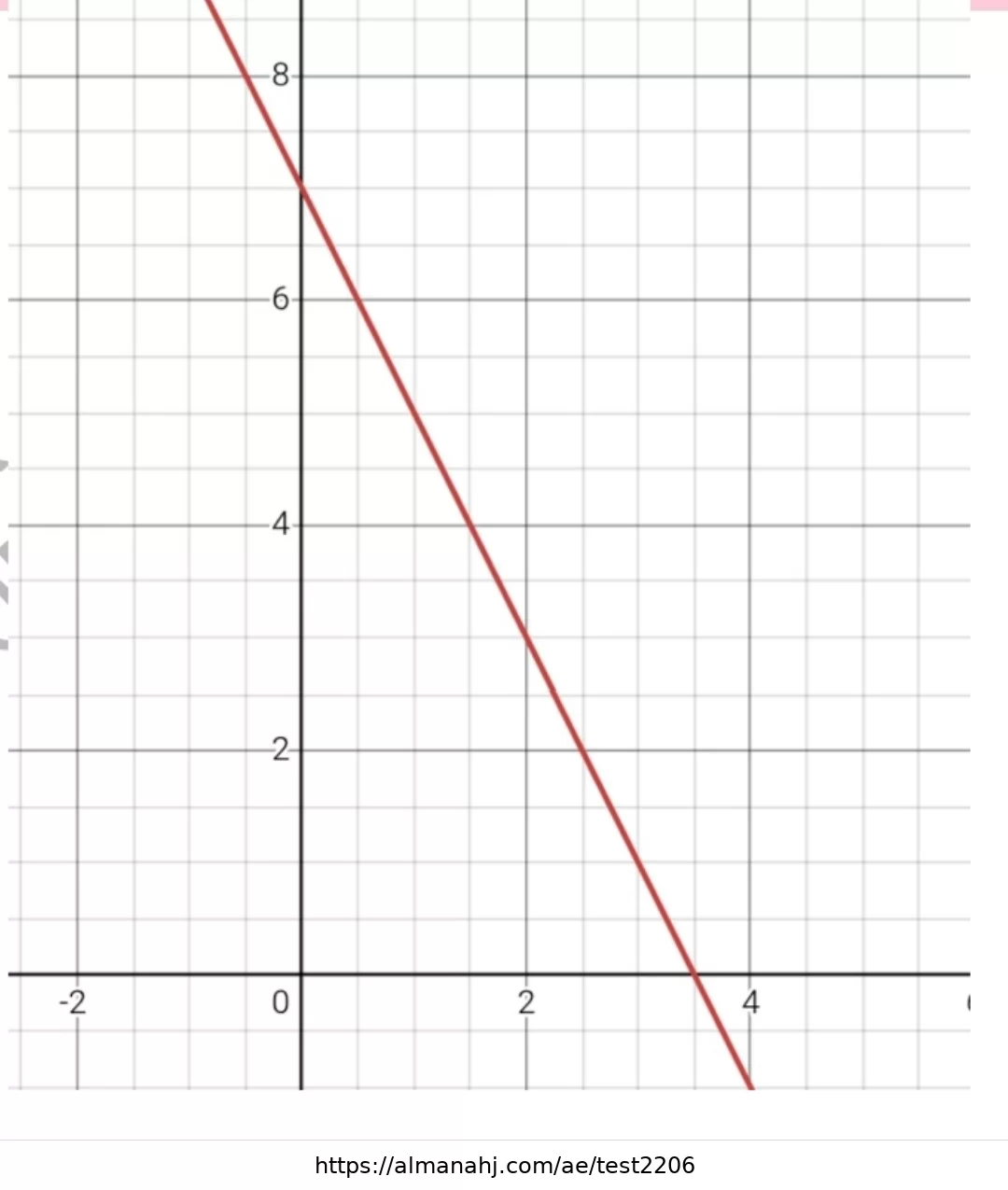
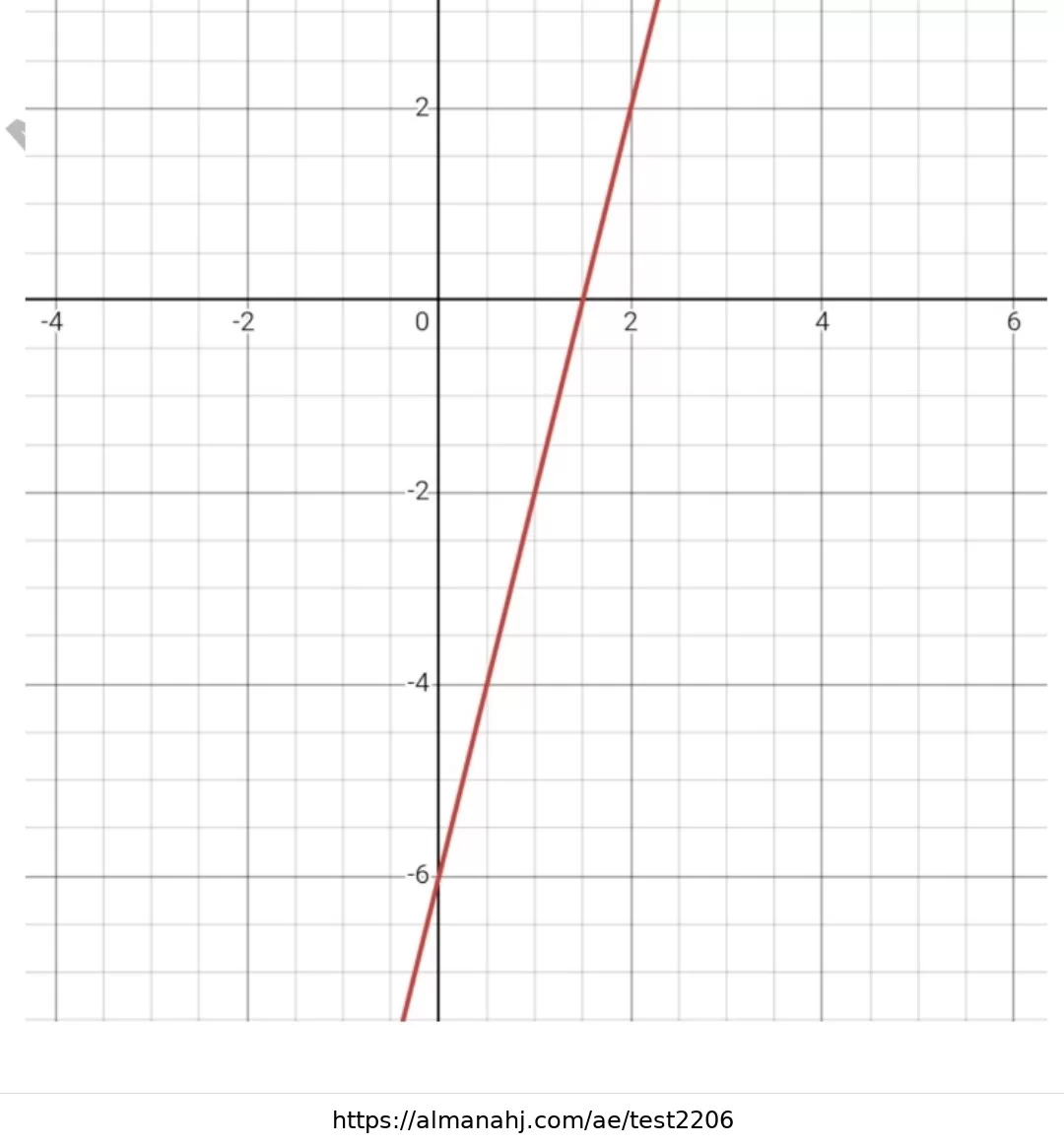
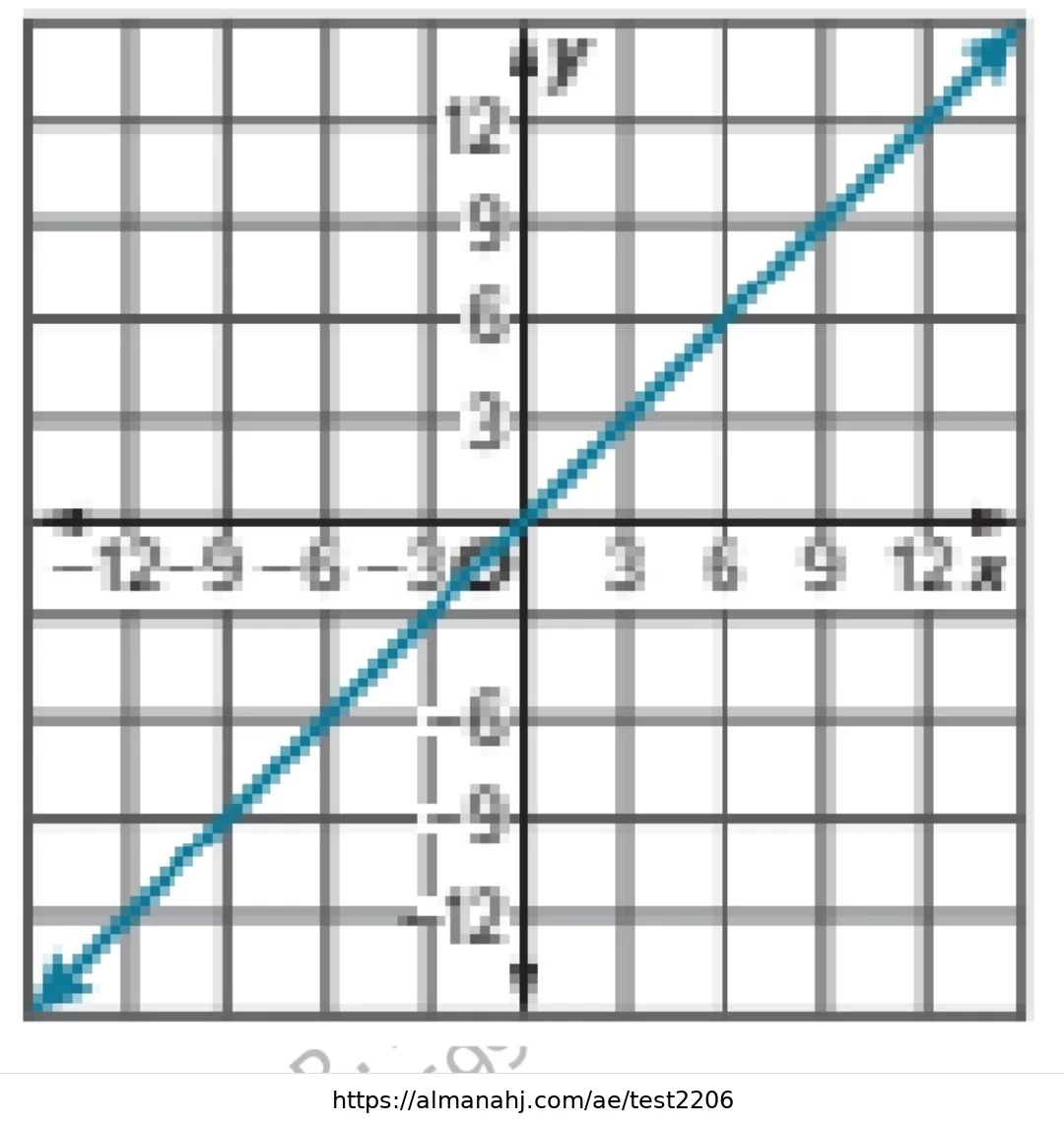
Which of the graphs A-D uses the x- and y-intercepts to correctly graph y = -(2/3)x + 4362?
Explanation
The correct graph joins the intercepts (0, 4362) and (6543, 0) with a decreasing straight line. This is graph C.
Question 8
Points: 10
Graph 1.25x + 7.5 = y. What are the x- and y-intercepts?
Explanation
Set y = 0: x = -7.5/1.25 = -6. Set x = 0: y = 7.5.
Question 9
Points: 10
Graph 2x - 3 = 4y + 6. What are the x- and y-intercepts?
Explanation
Rewrite as 4y = 2x - 9. Setting y = 0 gives x = 4.5; setting x = 0 gives y = -2.25.
Question 10
Points: 10
Graph 3y - 7 = 4x + 1. What are the x- and y-intercepts?
Explanation
Rewrite as 3y = 4x + 8. Setting y = 0 gives x = -2; setting x = 0 gives y = 8/3.
Question 11
Points: 10
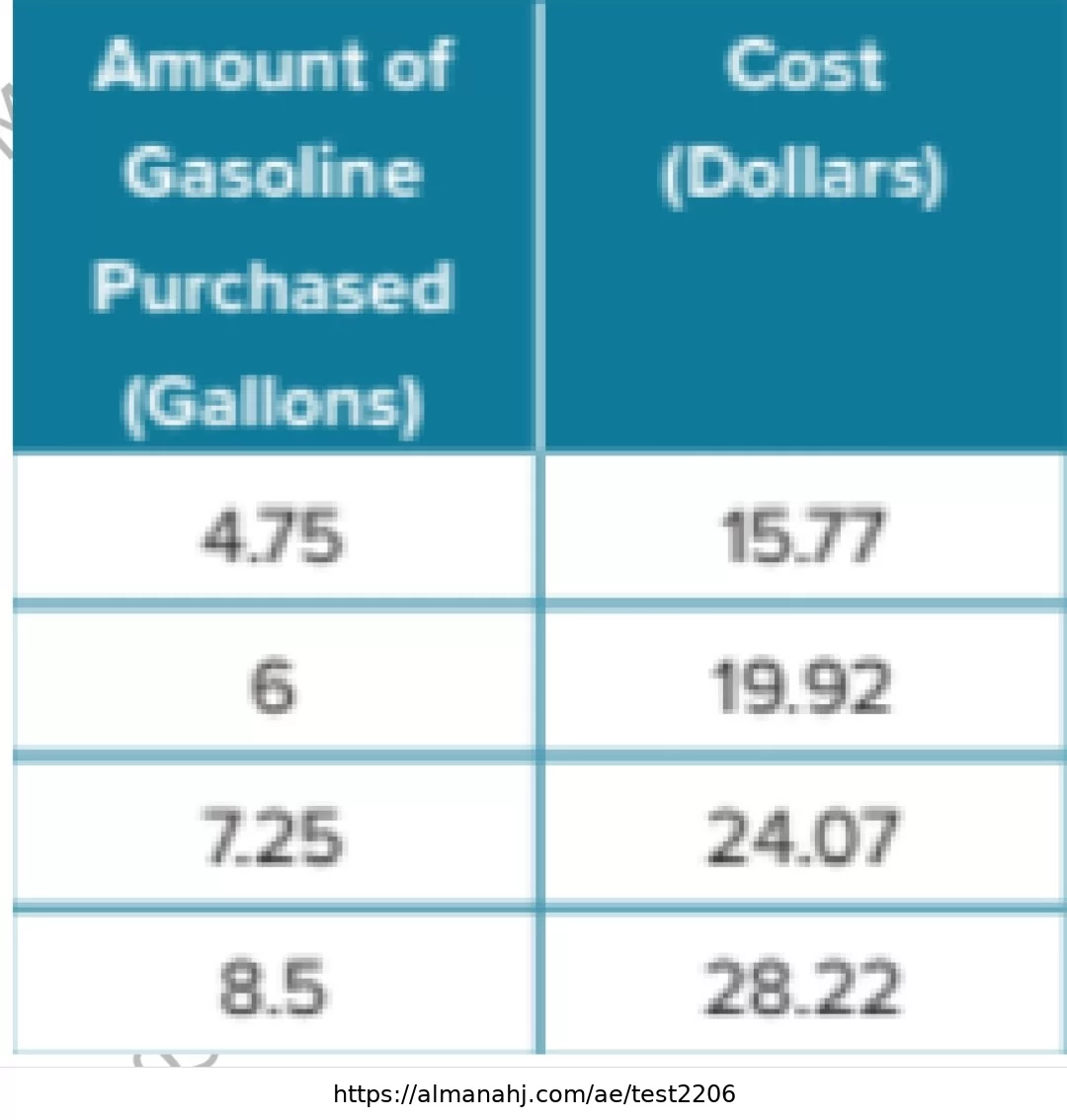
Find the rate of change of cost with respect to the amount of gasoline purchased, in dollars per gallon. Gasoline (gallons)Cost (dollars)4.7515.77619.927.2524.078.528.22
Explanation
Rate of change = (19.92 - 15.77)/(6 - 4.75) = 4.15/1.25 = 3.32 dollars per gallon.
Question 12
Points: 10
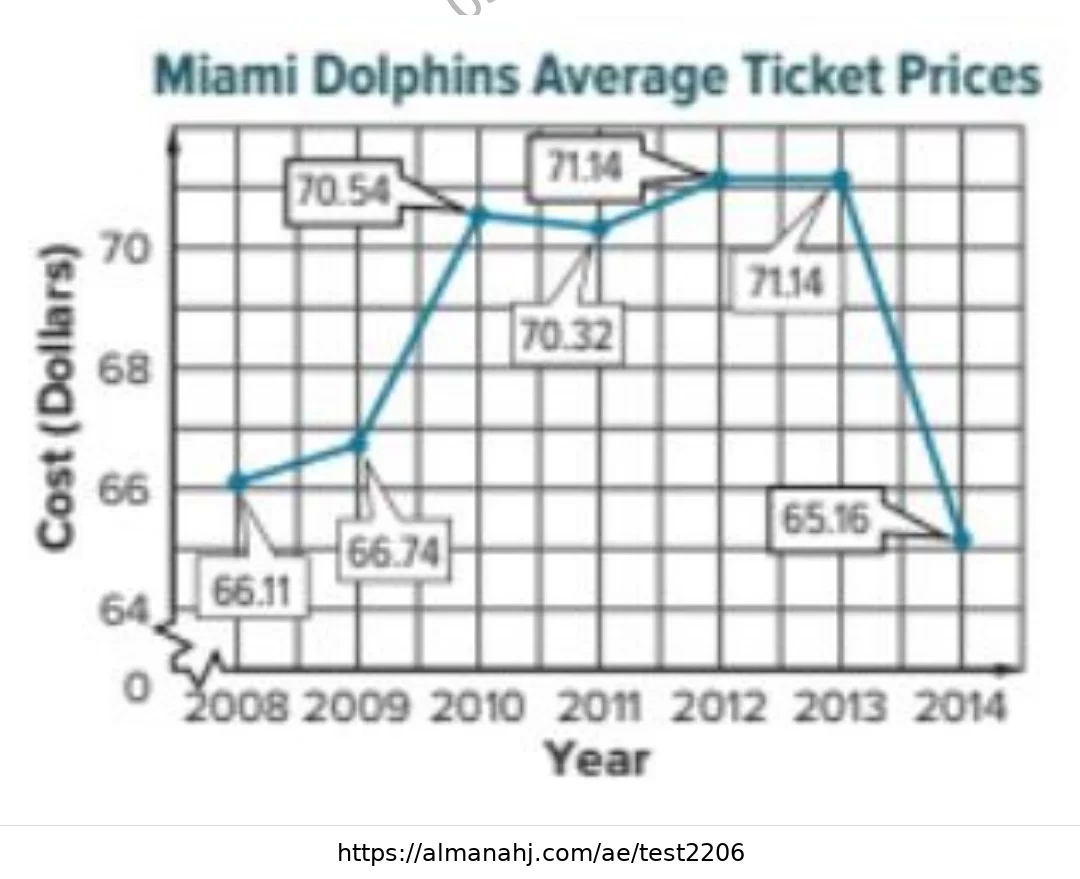
TICKETS: The graph shows the average ticket prices for the Miami Dolphins football team. Find the rate of change in ticket prices between 2009 and 2010, in dollars per year.
Explanation
The graph gives 66.74 in 2009 and70.54 in 2010. The rate is (70.54 - 66.74)/(2010 - 2009) = 3.80 dollars per year.
Question 13
Points: 10
TICKETS: Using the Miami Dolphins average ticket price graph, between which two consecutive years is the rate of change greatest (the largest increase, not the largest absolute change)?
Explanation
The listed rates are +0.63, +3.80, +0.82 and -5.98 dollars per year. The greatest signed rate is +3.80, between 2009 and 2010.
Question 14
Points: 10
TICKETS: Using the Miami Dolphins average ticket price graph, which of these intervals has a negative rate of change?
Explanation
Among the listed intervals, only 2013-2014 shows a decrease: from 71.14 to65.16.
Question 15
Points: 10
Determine whether the function represented by the table is linear. If it is, state the rate of change. xy11-58-35-121-13
Explanation
Each change of -3 in x produces a change of +2 in y, so the constant rate is 2/(-3) = -2/3.
Question 16
Points: 10
Complete the table so that the function is linear. Give the missing x-values from top to bottom, then the missing y-values from top to bottom. xy?-2.25?111?10.57.51010.759.5?
Explanation
The slope is (10.75 - 7.5)/(10 - 10.5) = -6.5. The rule is y = -6.5x + 75.75, giving x = 12, 11.5 and y = 4.25, 14.
Question 17
Points: 10
Determine the slope of a line through (-1, 8) and (7, 10). Write your answer as a decimal if necessary.
Explanation
Slope = (10 - 8)/(7 - (-1)) = 2/8 = 0.25.
Question 18
Points: 10
Determine the slope of a line through (5, -4) and (0, 1).
Explanation
Slope = (1 - (-4))/(0 - 5) = 5/(-5) = -1.
Question 19
Points: 10
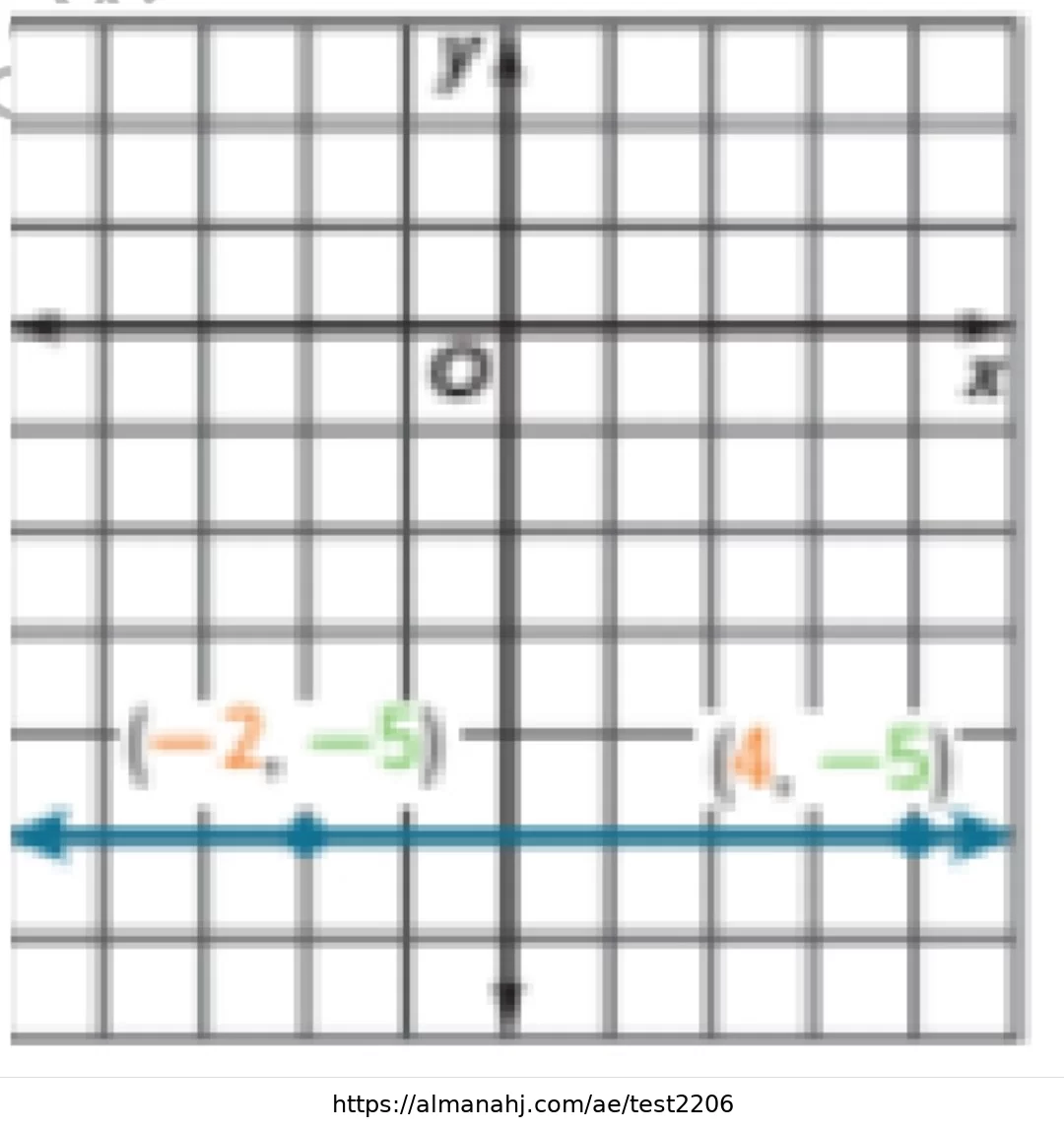
Find the slope of a line through (-2, -5) and (4, -5).
Explanation
The y-coordinates are equal, so the line is horizontal and its slope is 0.
Question 20
Points: 10
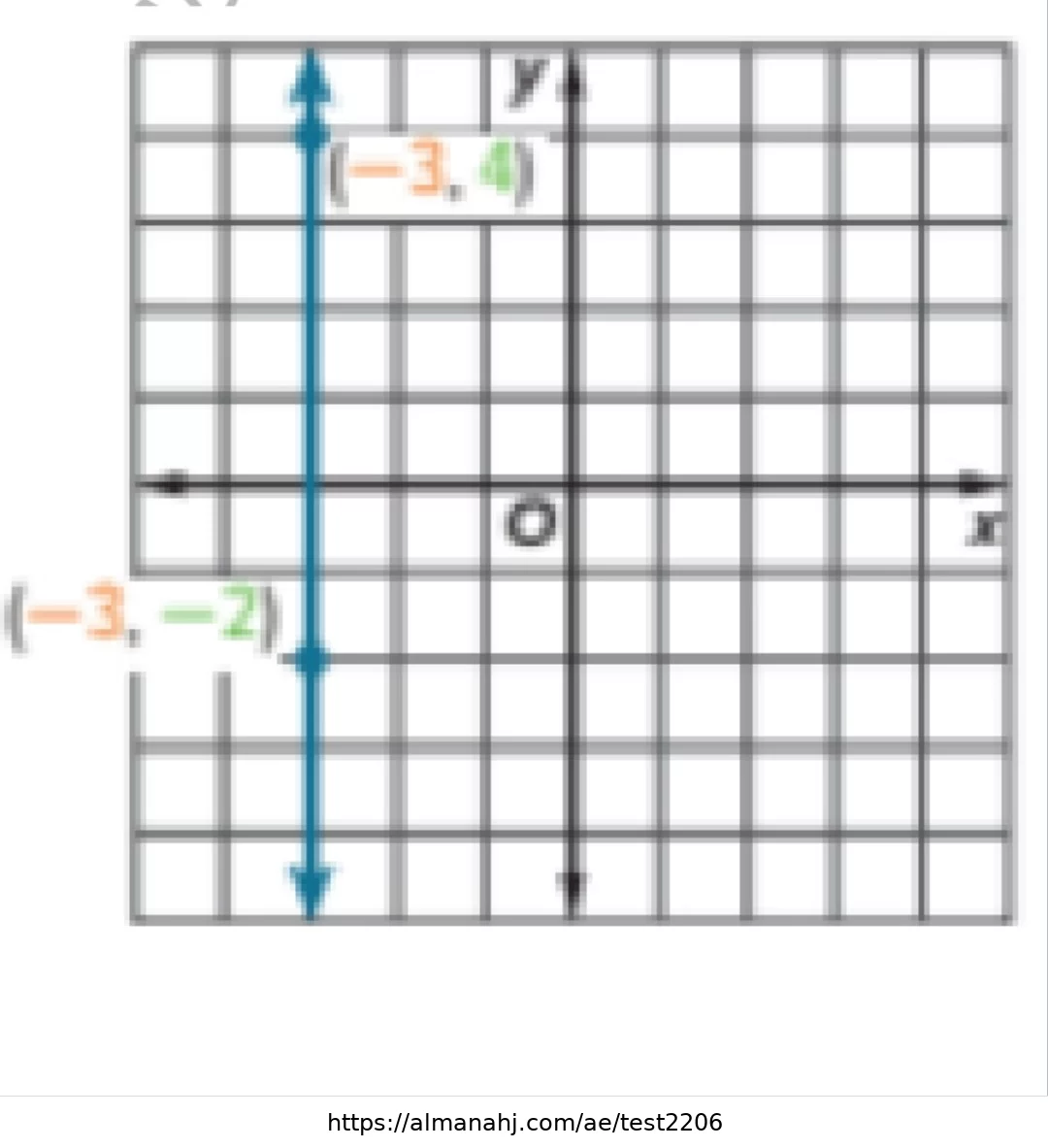
Find the slope of a line through (-3, 4) and (-3, -2). If the slope is undefined, choose Undefined.
Explanation
Both points have x-coordinate -3, so the line is vertical. The slope denominator is 0 and the slope is undefined.
Question 21
Points: 10
Find r so that the line through (-3, r) and (7, -6) has a slope of 2 2/5 (that is, 12/5).
Explanation
(-6 - r)/(7 - (-3)) = 12/5, so -6 - r = 24 and r = -30.
Question 22
Points: 10
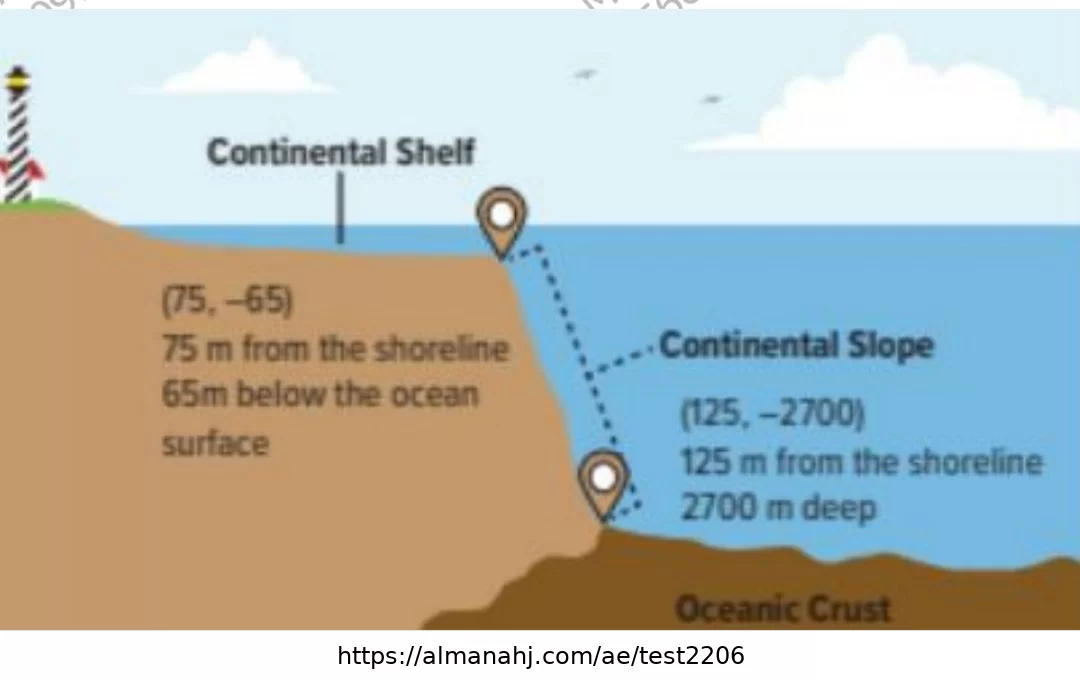
OCEANS: What is the slope of the continental slope at Cape Hatteras, given the points (75, -65) and (125, -2700)?
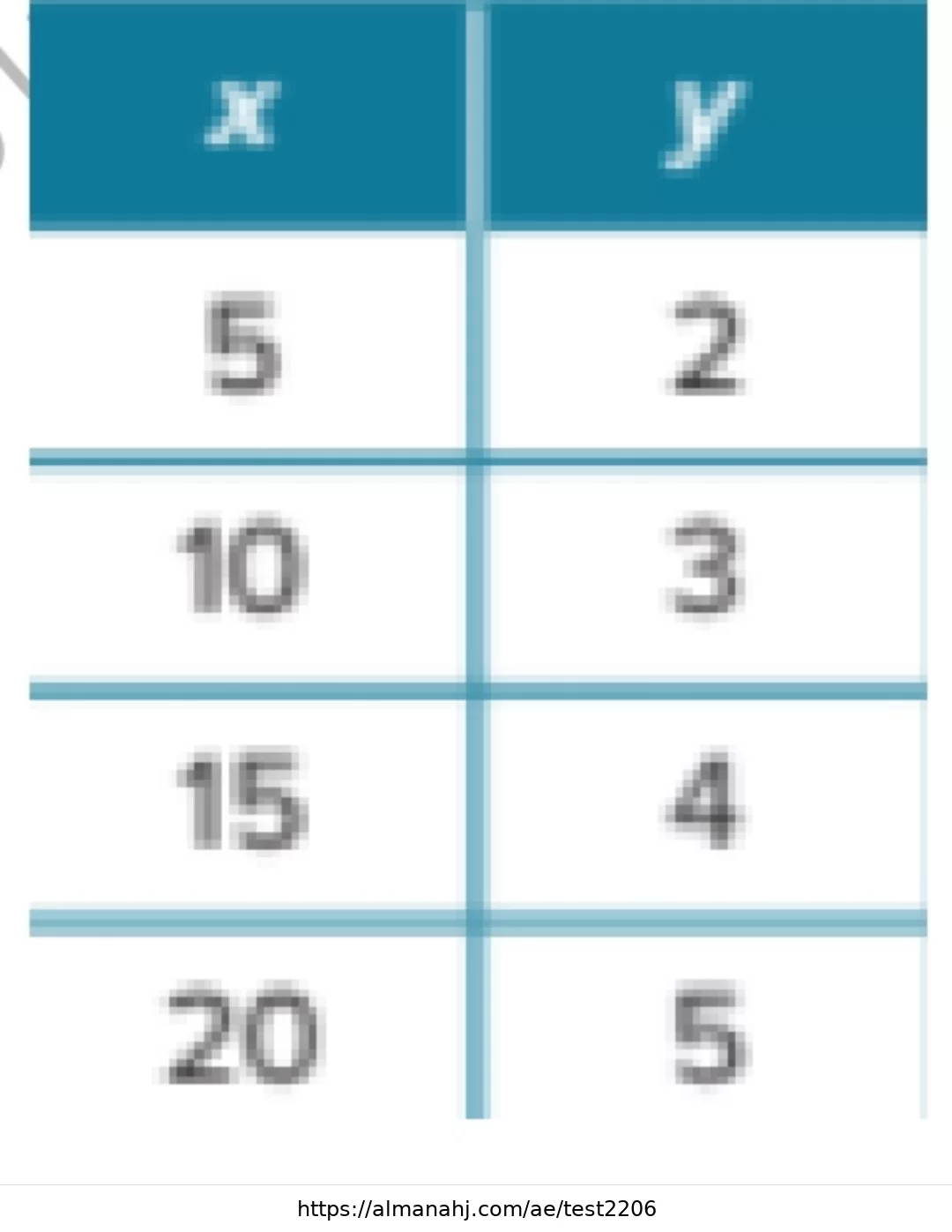
Find the rate of change of the function using two points from the table. xy52103154205
Explanation
Rate of change = (3 - 2)/(10 - 5) = 1/5 = 0.2.
Question 24
Points: 10
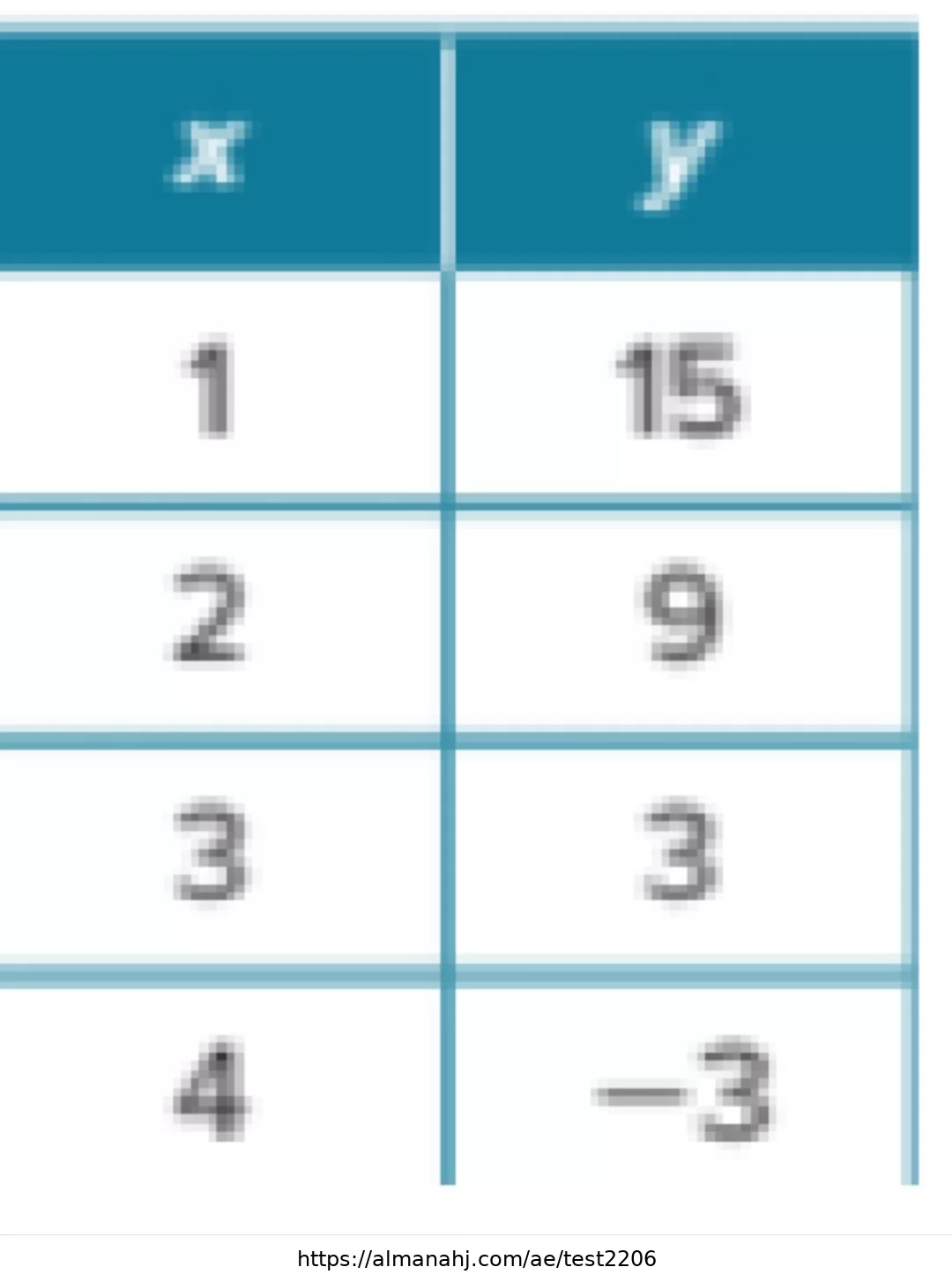
Find the rate of change of the function using two points from the table. xy11529334-3
Explanation
Rate of change = (9 - 15)/(2 - 1) = -6.
Question 25
Points: 10
Find the slope of the line through (4, 3) and (-1, 6).
Explanation
Slope = (6 - 3)/(-1 - 4) = 3/(-5) = -0.6.
Question 26
Points: 10
Write an equation for the line with slope -5 and y-intercept 12.
Explanation
Use y = mx + b with m = -5 and b = 12.
Question 27
Points: 10
What is the slope-intercept form of -16x - 4y = -56?
Explanation
Add 16x: -4y = 16x - 56. Divide by -4: y = -4x + 14.
Question 28
Points: 10
SOCIAL MEDIA: In the first quarter of 2012, a social media site had 183 million users in North America. The number increased by an average of 9 million per year after 2012. Write an equation for y, the number of users in millions, x years after 2012.
Explanation
The initial value is 183 million and the yearly increase is 9 million, so y = 9x + 183.
Question 29
Points: 10
A linear function has slope -2 and y-intercept 7. Which equation represents this function?
Explanation
Substitute m = -2 and b = 7 into y = mx + b.
Question 30
Points: 10
Graph the linear function 12x - 3y = 18. Which equation is its slope-intercept form?
Explanation
Subtract 12x and divide by -3: y = 4x - 6.
Question 31
Points: 10
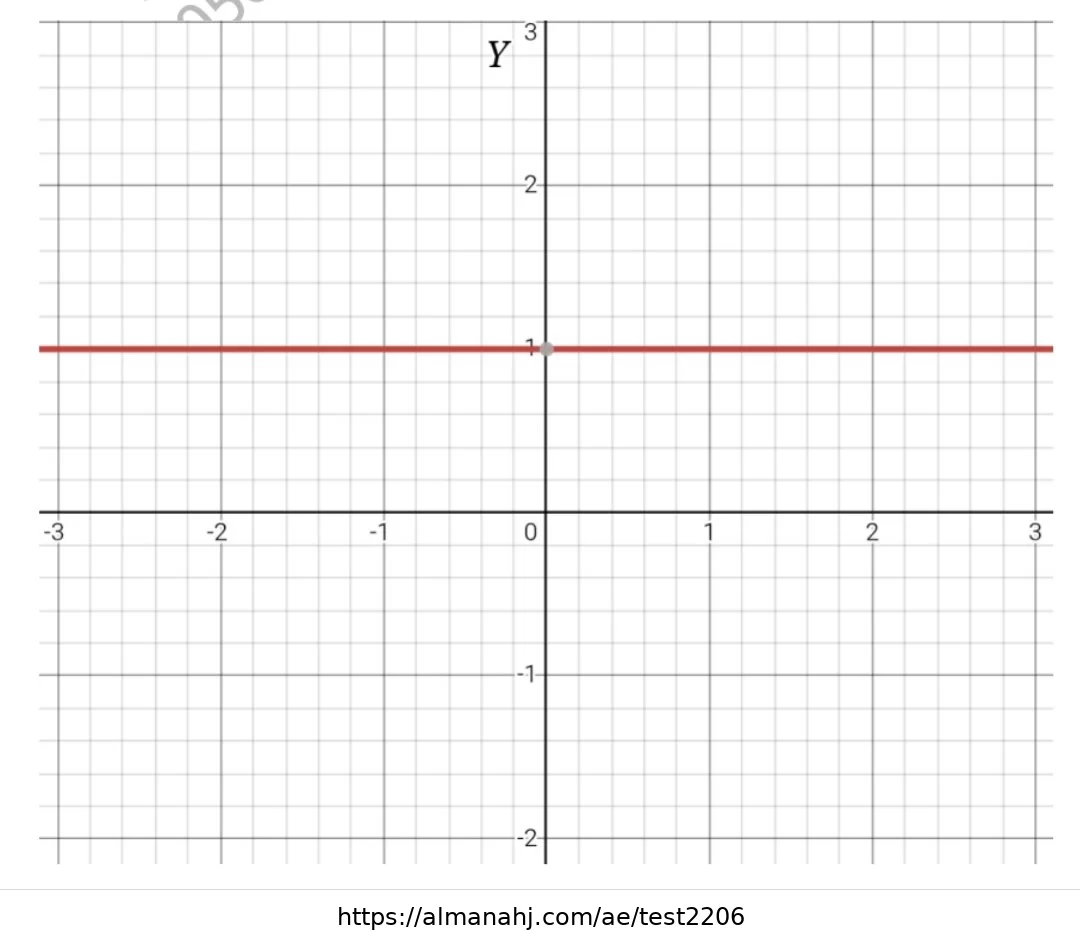
Graph y = 1. Which description best represents its graph?
Explanation
The y-coordinate is always 1, so the graph is a horizontal line.
Question 32
Points: 10
Write an equation in slope-intercept form for a line with slope 5 and y-intercept -3.
Explanation
Use y = mx + b with m = 5 and b = -3.
Question 33
Points: 10
Write an equation in slope-intercept form for a line with slope -2 and y-intercept 7.
Explanation
Use y = mx + b with m = -2 and b = 7.
Question 34
Points: 10
Write -10x + 2y = 12 in slope-intercept form.
Explanation
Add 10x and divide by 2: y = 5x + 6.
Question 35
Points: 10
Write 4y + 12x = 16 in slope-intercept form.
Explanation
Subtract 12x and divide by 4: y = -3x + 4.
Question 36
Points: 10
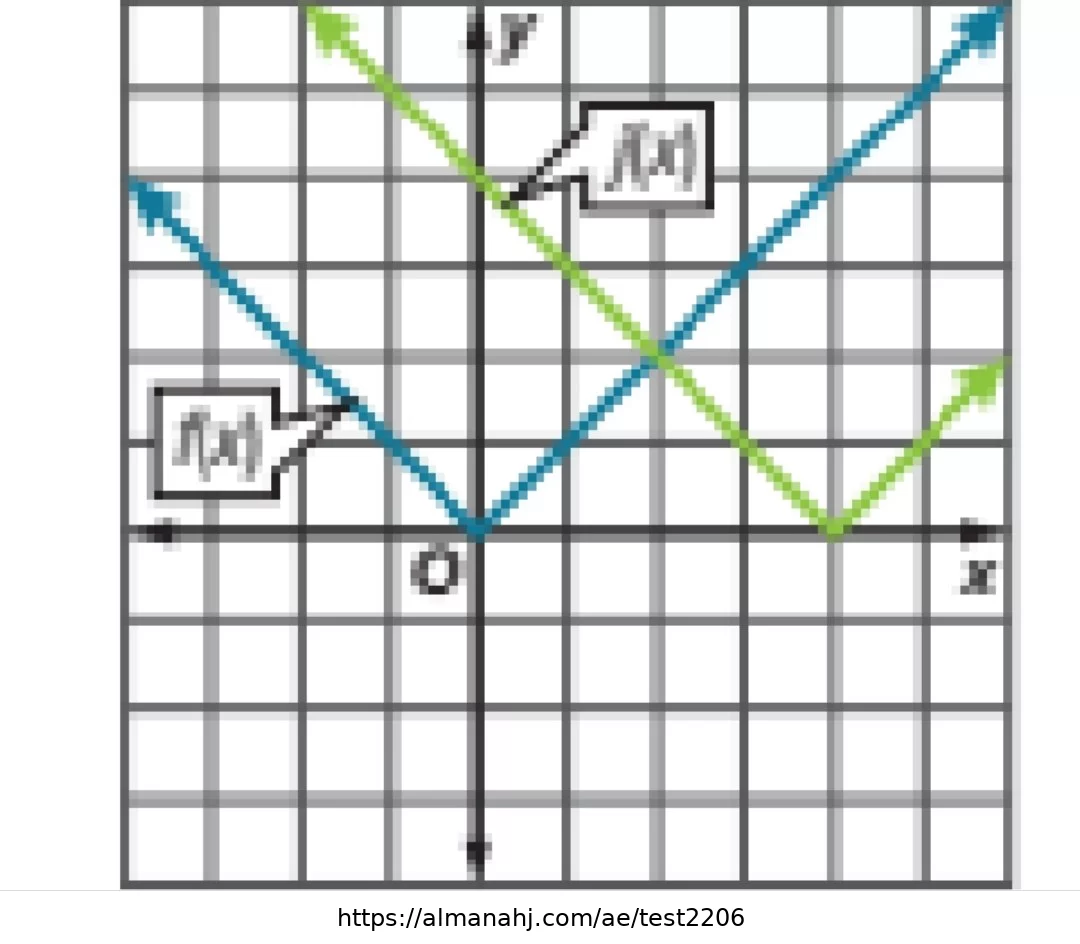
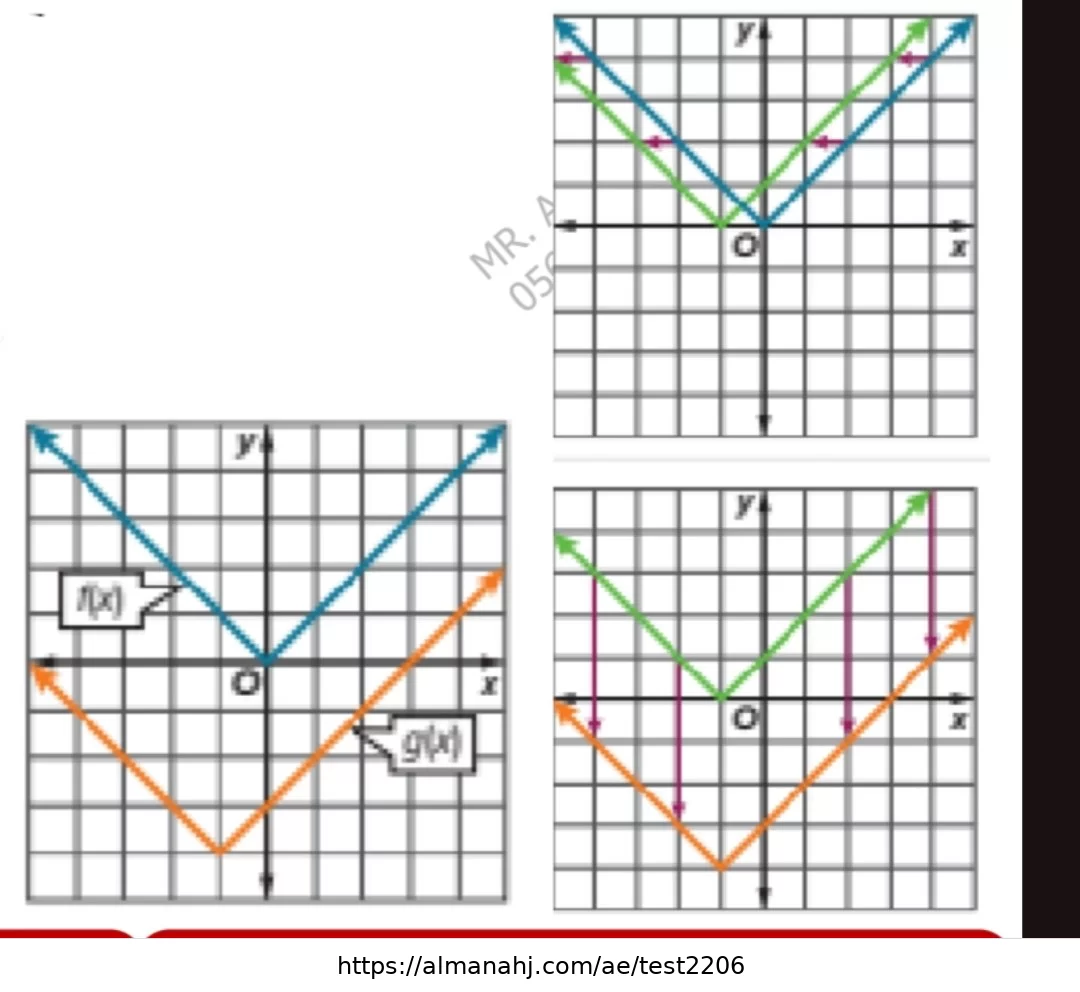
For the parent function f(x) = x, use the displayed form g(x) = f(x) - 1 = x - 1. The change to the output translates the graph 1 unit in which direction?
Explanation
Subtracting 1 outside f lowers every output by 1, giving the stated vertical translation down.
Question 37
Points: 10
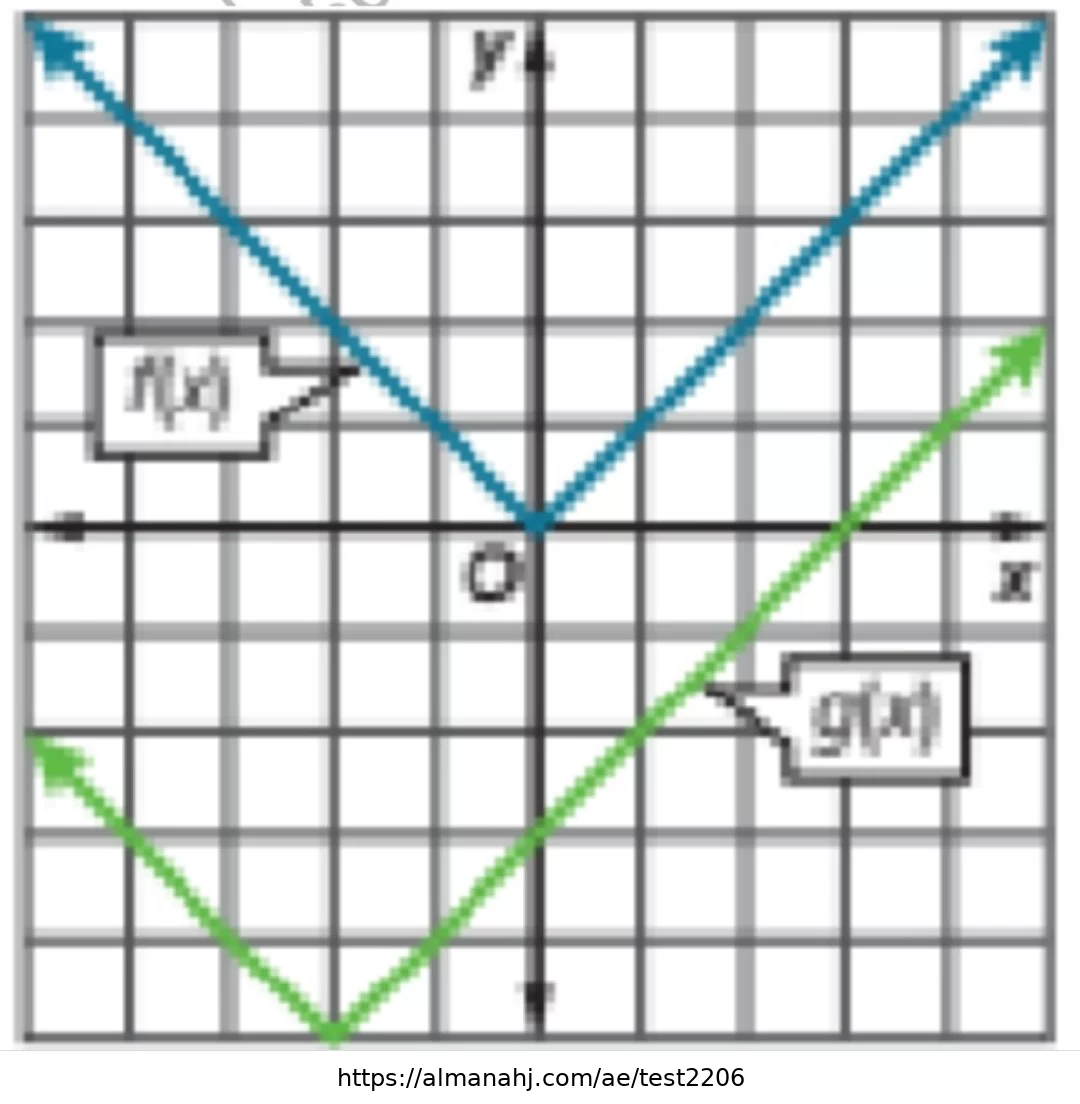
For the parent function f(x) = x, use the displayed form g(x) = f(x + 12). The change to the input translates the graph 12 units in which direction?
Explanation
Replacing x by x + 12 shifts input locations 12 units left.
Question 38
Points: 10
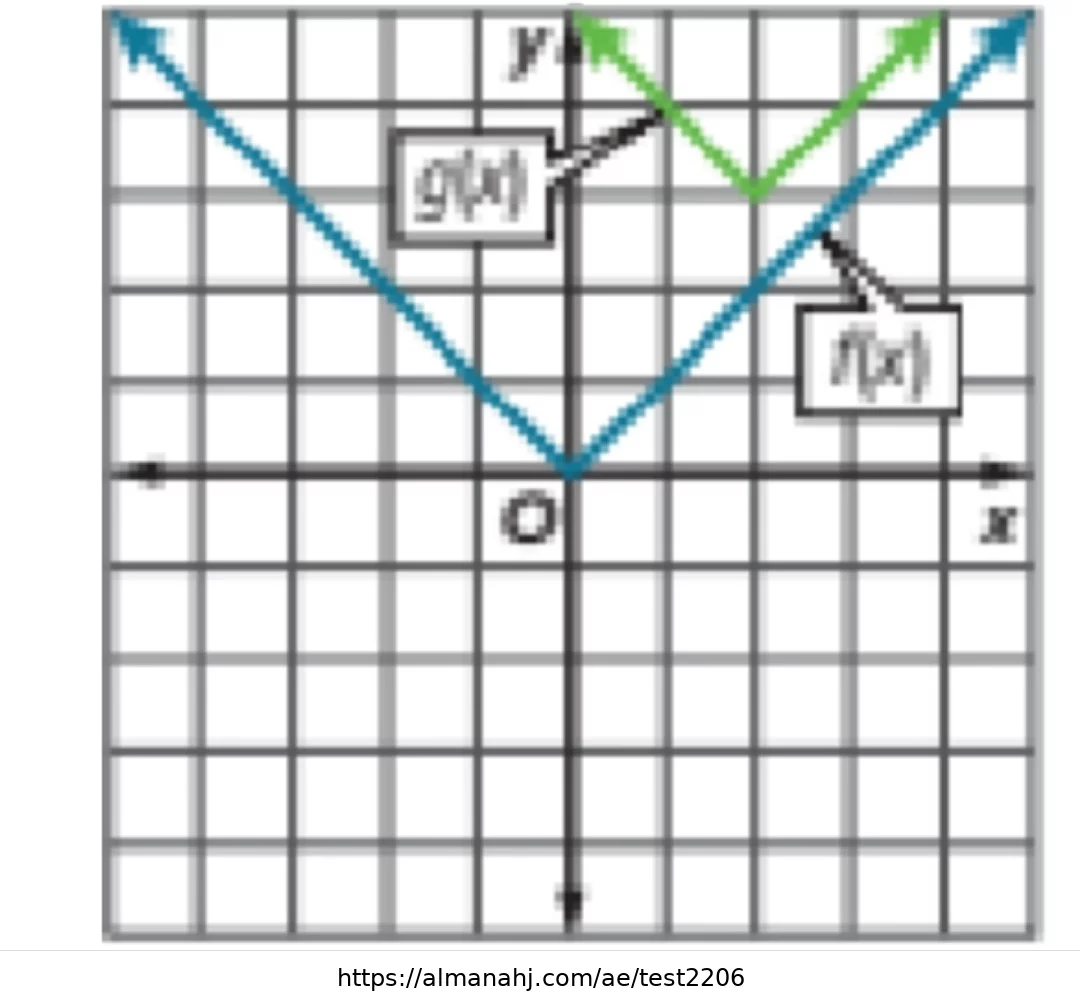
Describe the translation shown in g(x) = f(x - 6) + 3 = (x - 6) + 3 relative to f(x) = x.
Explanation
The input x - 6 gives a shift right 6, and the outside +3 gives a shift up 3.
Question 39
Points: 10
RETAIL: Jerome is buying paint for a mural. The total cost is modeled by f(p) = 6.99p. He has a coupon for $5.95 off his purchase, so the final cost is g(p) = 6.99p - 5.95. Describe the translation from f(p) to g(p).
Explanation
The coupon subtracts 5.95 from every output, translating the graph down by 5.95.
Question 40
Points: 10
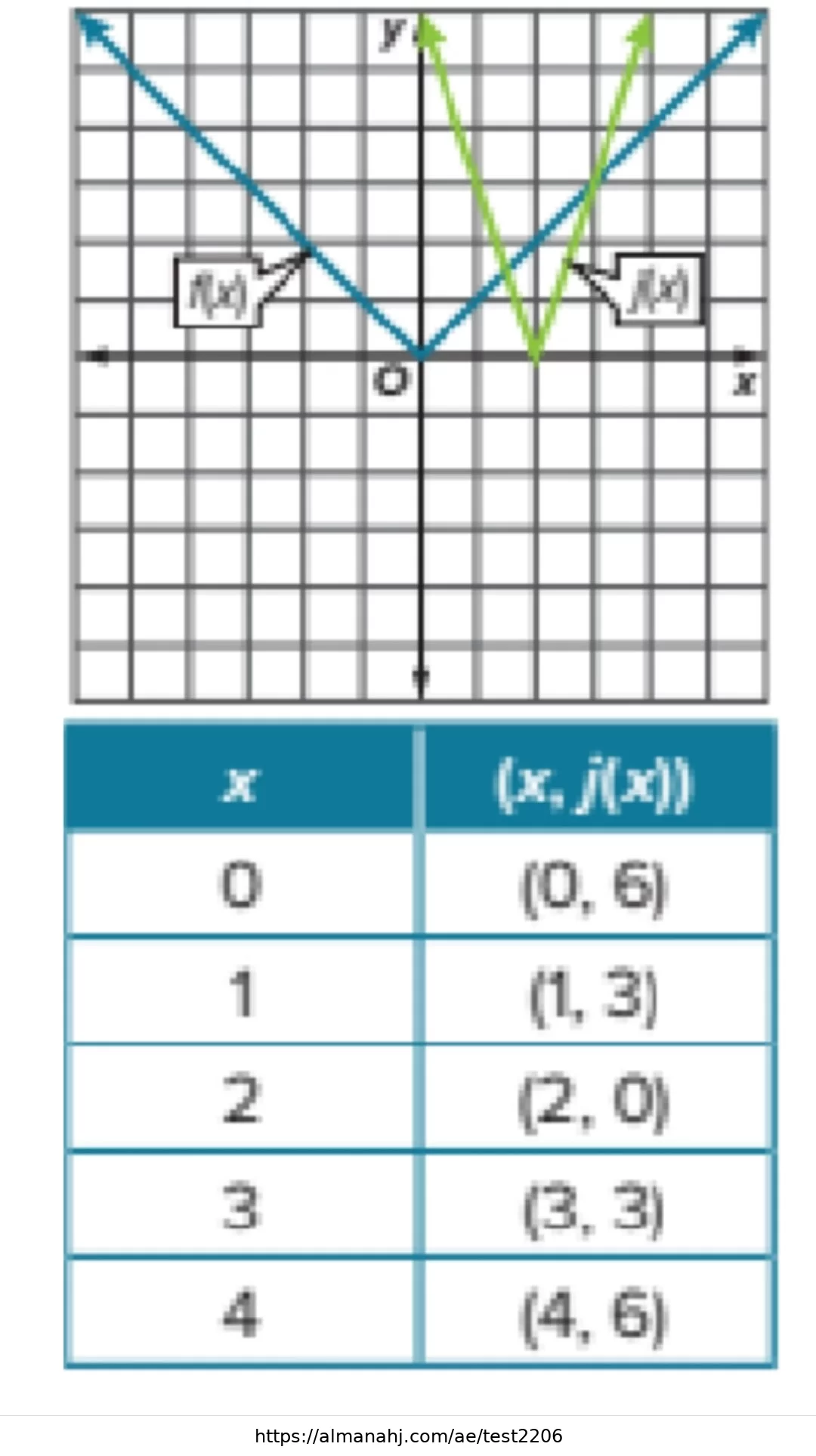
Describe g(x) = 6f(x) = 6x relative to the parent function f(x) = x. The graph is a _____, and it is _____ than the parent graph.
Explanation
Multiplying outputs by 6 stretches the graph vertically and increases the slope from 1 to 6.
Question 41
Points: 10
For f(x) = x, classify the transformation of the input in g(x) = f(x/4). Use this displayed form, not an equivalent output transformation.
Explanation
In f(bx), horizontal distances are multiplied by 1/b. Here b = 1/4, so the horizontal stretch factor is 4.
Question 42
Points: 10
Which statement correctly specifies the placement of a factor of -1 for the standard reflection of a parent function f across the x-axis, rather than the reflection produced by changing its input?
Explanation
An x-axis reflection changes (x, y) to (x, -y), so the factor -1 multiplies the output: -f(x). In contrast, f(-x) is the standard input reflection across the y-axis.
Question 43
Points: 10
For the parent function f(x) = x, interpret g(x) = f(-10x) as a transformation of the input. Its graph is compressed horizontally and reflected across the _____.
Explanation
In f(-10x), 10 compresses horizontal distances by 1/10 and the negative input gives the standard y-axis reflection.
Question 44
Points: 10
For f(x) = x, describe the output translation in g(x) = f(x) + 11 = x + 11.
Explanation
Adding 11 outside f raises every output by 11.
Question 45
Points: 10
For f(x) = x, describe the output translation in g(x) = f(x) - 8 = x - 8.
Explanation
Subtracting 8 outside f lowers every output by 8.
Question 46
Points: 10
For f(x) = x, describe the input translation in g(x) = f(x - 7).
Explanation
Replacing x by x - 7 shifts the graph right by 7.
Question 47
Points: 10
Determine whether 82, 73, 64, 55, ... is an arithmetic sequence and justify your answer.
Explanation
73 - 82 = 64 - 73 = 55 - 64 = -9, so the sequence is arithmetic.
Question 48
Points: 10
Determine the next three terms in 31, 18, 5, ...
Explanation
The common difference is -13. Subtract 13 successively from 5.
Question 49
Points: 10
Randi is training for a marathon at a constant pace. Her recorded times are 10 minutes 30 seconds at 1 mile, 21 minutes at 2 miles, 31 minutes 30 seconds at 3 miles, and 42 minutes at 4 miles. Write a function f(n) for her time in minutes after n miles.
Explanation
Her constant pace is 10.5 minutes per mile, so the total time after n miles is 10.5n.
Question 50
Points: 10
Randi runs at a constant pace of 10 minutes 30 seconds per mile. How long will it take her to run a 26.2-mile marathon? Round to the nearest thousandth if necessary.
Explanation
10 minutes 30 seconds is 10.5 minutes. Total time = 10.5 × 26.2 = 275.1 minutes.
Question 51
Points: 10
Determine whether -3, 1, 5, 9, ... is an arithmetic sequence and justify your answer.
Explanation
Each term is obtained by adding 4, so the common difference is 4.
Question 52
Points: 10
Determine whether 1/2, 3/4, 5/8, 7/16, ... is an arithmetic sequence and justify your answer.
Explanation
The successive differences are 1/4, -1/8 and -3/16, which are not equal.
Question 53
Points: 10
Determine whether -10, -7, -4, -1, ... is an arithmetic sequence and justify your answer.
Explanation
Each successive term increases by 3, so the common difference is 3.
Question 54
Points: 10
Determine whether -12.3, -9.7, -7.1, -4.5, ... is an arithmetic sequence and justify your answer.
Explanation
The difference between every adjacent pair is +2.6.
Question 55
Points: 10
For 0.02, 1.08, 2.14, 3.2, ..., find the common difference and the next three terms.
Explanation
The common difference is 1.08 - 0.02 = 1.06. Adding 1.06 repeatedly to 3.2 gives 4.26, 5.32 and 6.38.
Question 56
Points: 10
For 6, 12, 18, 24, ..., find the common difference and the next three terms.
Explanation
The common difference is 6. The next three terms are 30, 36 and 42.
Question 57
Points: 10
For 21, 19, 17, 15, ..., find the common difference and the next three terms.
Explanation
Subtract 2 from each term; after 15 come 13, 11 and 9.
Question 58
Points: 10
For -1/2, 0, 1/2, 1, ..., find the common difference and the next three terms.
Explanation
The common difference is 1/2. Adding it successively to 1 gives 3/2, 2 and 5/2.
Question 59
Points: 10
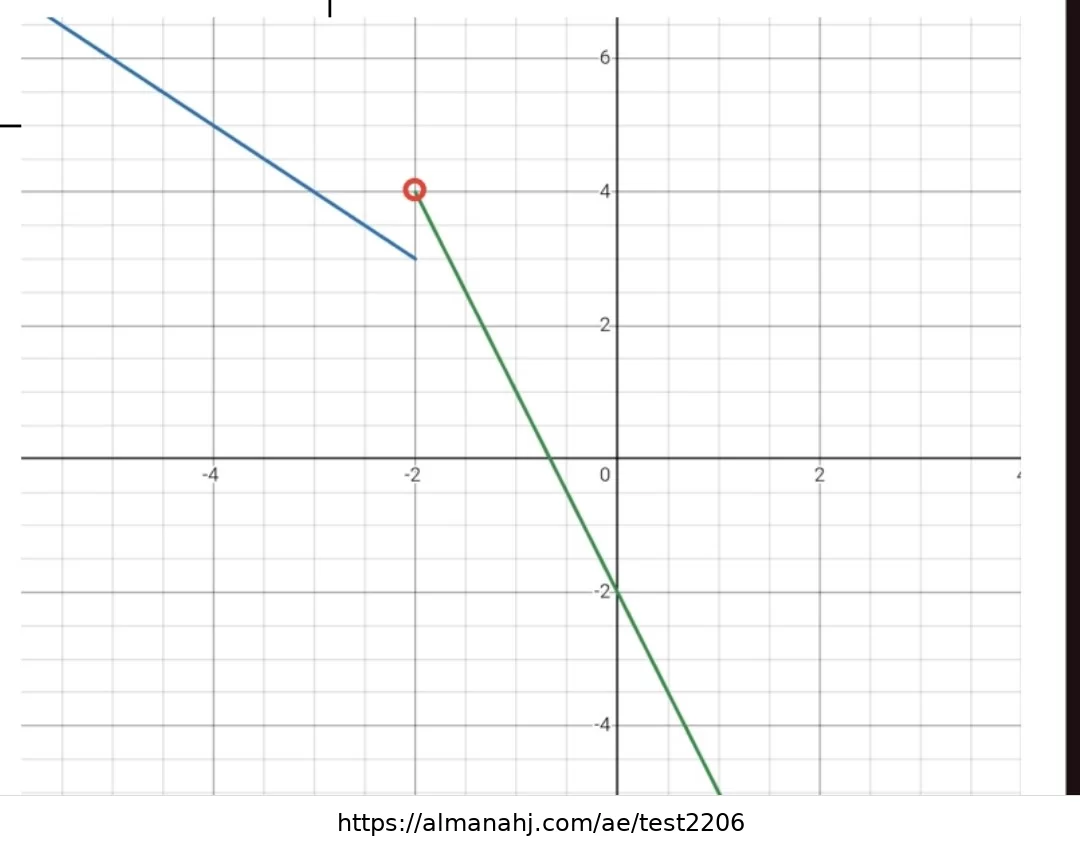
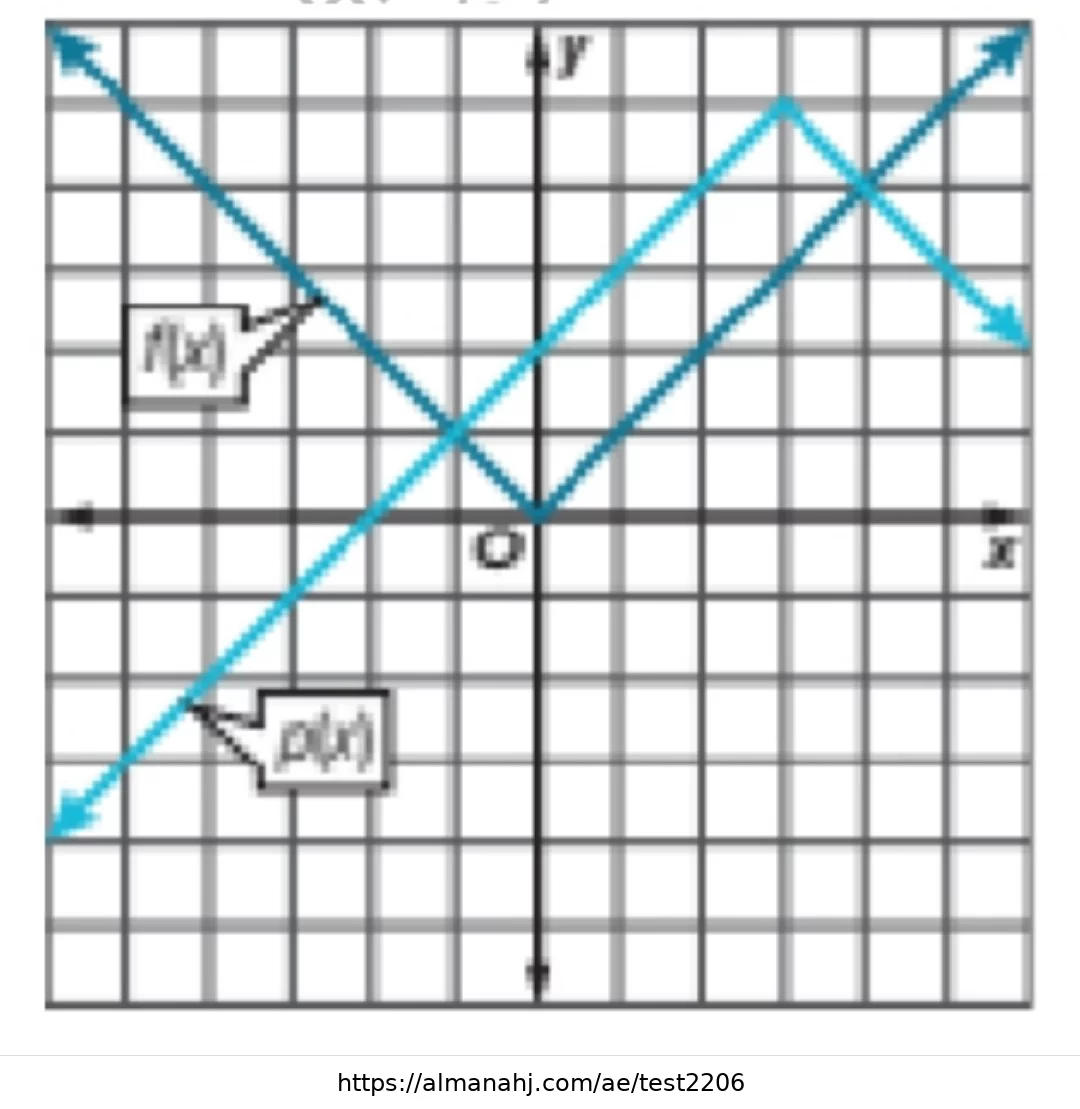
Which description correctly represents the graph of this piecewise function? f(x) = -x + 1 for x ≤ -2; f(x) = -3x - 2 for x > -2.
Explanation
The first branch includes x = -2 and gives y = 3. The second branch excludes x = -2 and approaches y = 4. Their slopes are -1 and -3.
Question 60
Points: 10
Find the domain and range of this piecewise function. f(x) = -x + 1 for x ≤ -2; f(x) = -3x - 2 for x > -2.
Explanation
The branches cover x ≤ -2 and x > -2, so the domain is all real numbers. Their ranges are [3, infinity) and (-infinity, 4); their union is all real numbers.
Question 61
Points: 10
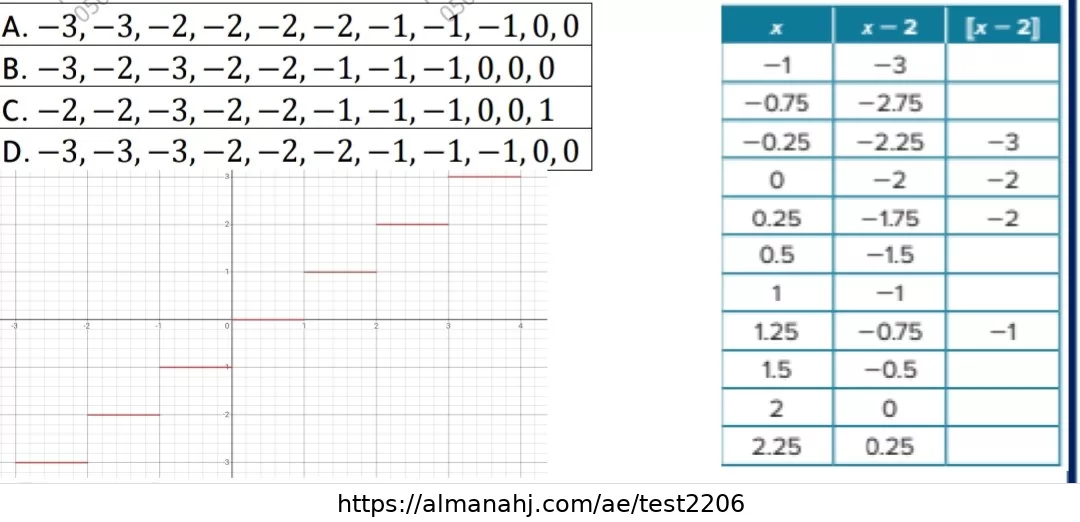
For the greatest integer function f(x) = floor(x - 2), complete the table. Here floor(t) means the greatest integer less than or equal to t. Which choice gives all 11 values of f(x), from top to bottom? xx - 2floor(x - 2)-1-3?-0.75-2.75?-0.25-2.25-30-2-20.25-1.75-20.5-1.5?1-1?1.25-0.75-11.5-0.5?20?2.250.25?
Explanation
Apply the floor function to each x - 2 value. For example, floor(-2.75) = -3 and floor(-1.5) = -2. The resulting list is choice D.
Question 62
Points: 10
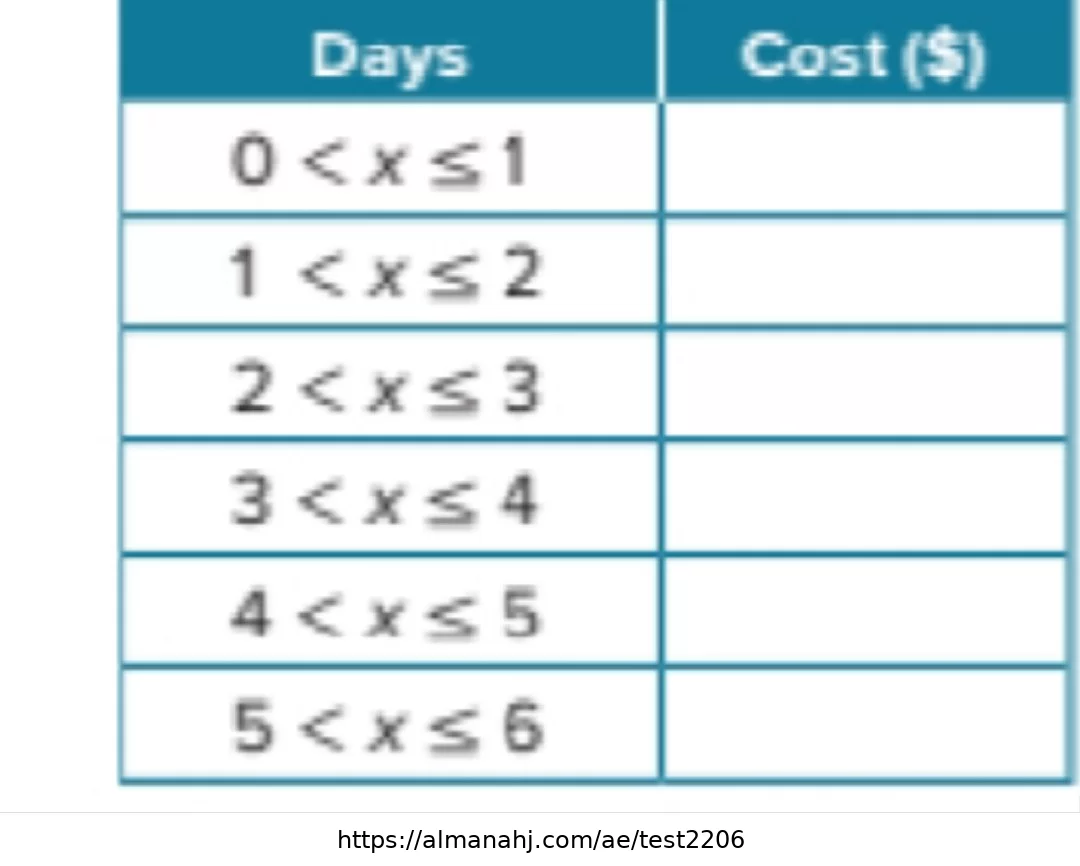
PETS: At Luciana's pet boarding facility, boarding a dog costs $35 per day. Every fraction of a day is rounded up to the next day. Which choice gives the costs in dollars for these intervals, from top to bottom? DaysCost ($)0 < x ≤ 1?1 < x ≤ 2?2 < x ≤ 3?3 < x ≤ 4?4 < x ≤ 5?5 < x ≤ 6?
Explanation
The costs are 35 times the number of days rounded up: 35 × 1 through 35 × 6.
Question 63
Points: 10
State the domain and range of this piecewise function. f(x) = (1/2)x - 1 for x > 3; f(x) = -2x + 3 for x ≤ 3.
Explanation
Both branches together cover all real x. The second branch has minimum -3 at x = 3 and extends upwards without bound; the first branch gives y > 1/2. The union is y ≥ -3.
Question 64
Points: 10
State the domain and range of this piecewise function. f(x) = 2x - 5 for x > 1; f(x) = 4x - 3 for x ≤ 1.
Explanation
The domain is all real numbers. The branch ranges are (-3, infinity) and (-infinity, 1], whose union is all real numbers.
Question 65
Points: 10
State the domain and range of this piecewise function. f(x) = 2x + 3 for x ≥ -3; f(x) = -(1/3)x + 1 for x < -3.
Explanation
The first branch has range [-3, infinity), and the second has range (2, infinity). Their union is [-3, infinity); the domain is all real numbers.
Question 66
Points: 10
Describe the translation of g(x) = |x| - 3 relative to the parent function f(x) = |x|.
Explanation
Subtracting 3 outside the absolute value moves the graph down 3 units.
Question 67
Points: 10
Describe the translation of j(x) = |x - 4| relative to the parent function f(x) = |x|.
Explanation
Replacing x by x - 4 moves the vertex from (0, 0) to (4, 0): 4 units right.
Question 68
Points: 10
Describe the translation of g(x) = |x - 2| + 3 relative to the parent function f(x) = |x|.
Explanation
The x - 2 shifts right 2, and the outside +3 shifts up 3.
Question 69
Points: 10
The graph of g is a translation of the parent graph f(x) = |x| one unit to the right. Which is its equation?
Explanation
A translation right by 1 replaces x with x - 1.
Question 70
Points: 10
The graph of g is a translation of the parent graph f(x) = |x| two units left and five units down. Which is its equation?
Explanation
Two units left gives |x + 2|; five units down gives |x + 2| - 5.
Question 71
Points: 10
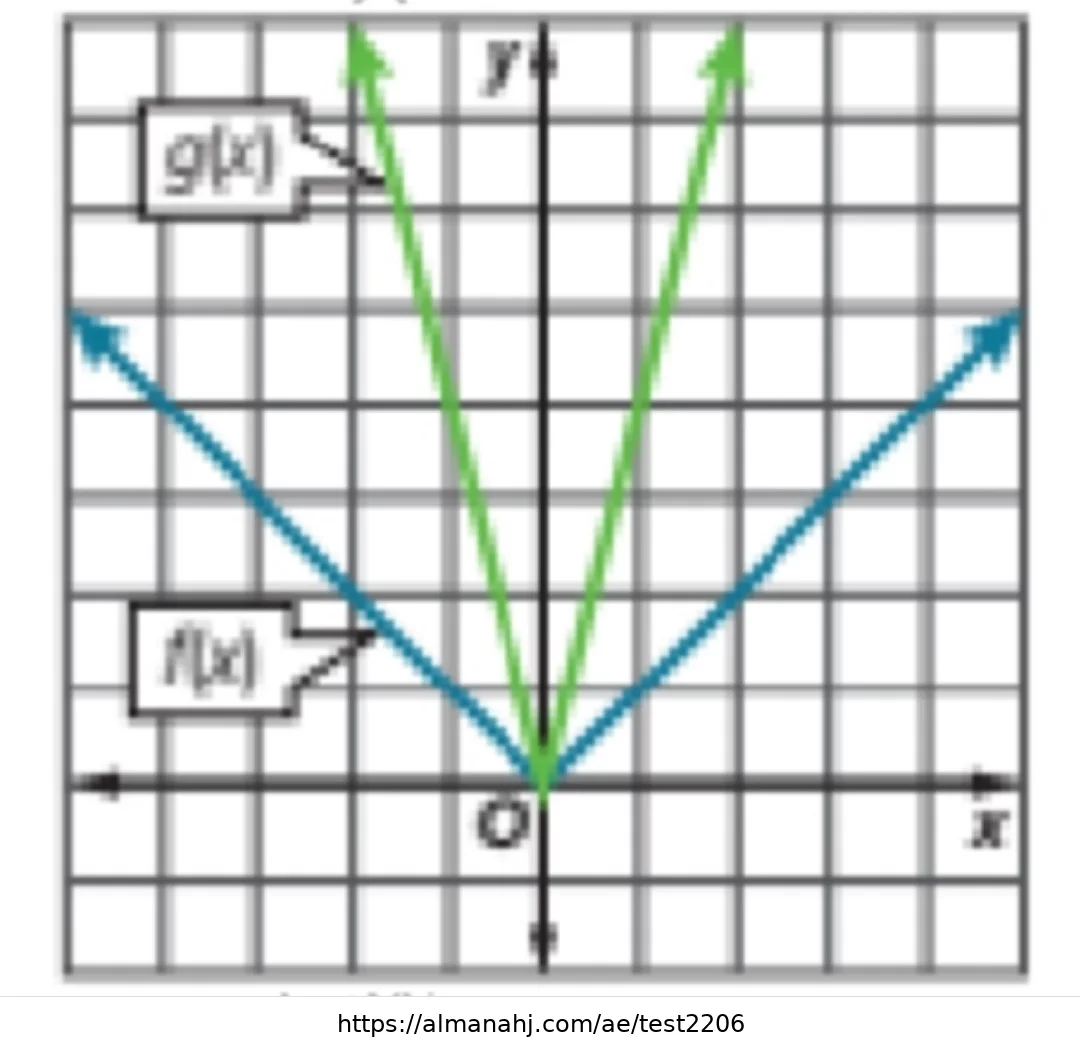
Describe the dilation shown by the outside multiplier in g(x) = (5/2)|x| relative to f(x) = |x|.
Explanation
The multiplier 5/2 acts on the output and is greater than 1, so it gives a vertical stretch by 5/2.
Question 72
Points: 10
For f(x) = |x|, classify the transformation of the input in j(x) = f((4/3)x) = |(4/3)x|. Use the displayed input form, not an equivalent output transformation.
Explanation
The input multiplier is 4/3, so horizontal distances are multiplied by its reciprocal, 3/4.
Question 73
Points: 10
For f(x) = |x|, classify the transformation of the input in q(x) = f(x/5) = |x/5|. Use the displayed input form, not an equivalent output transformation.
Explanation
The input multiplier is 1/5, so horizontal distances are multiplied by 5.
Question 74
Points: 10
For f(x) = |x|, classify the transformation of the output in P(x) = 6f(x) = 6|x|. Use the displayed output form, not an equivalent input transformation.
Explanation
Multiplying the whole function by 6 multiplies every y-coordinate by 6, giving a vertical stretch.
Question 75
Points: 10
Classify the dilation shown by the outside multiplier in g(x) = (5/7)|x| relative to f(x) = |x|.
Explanation
The outside factor 5/7 lies between 0 and 1, so it compresses the graph vertically.
Question 76
Points: 10
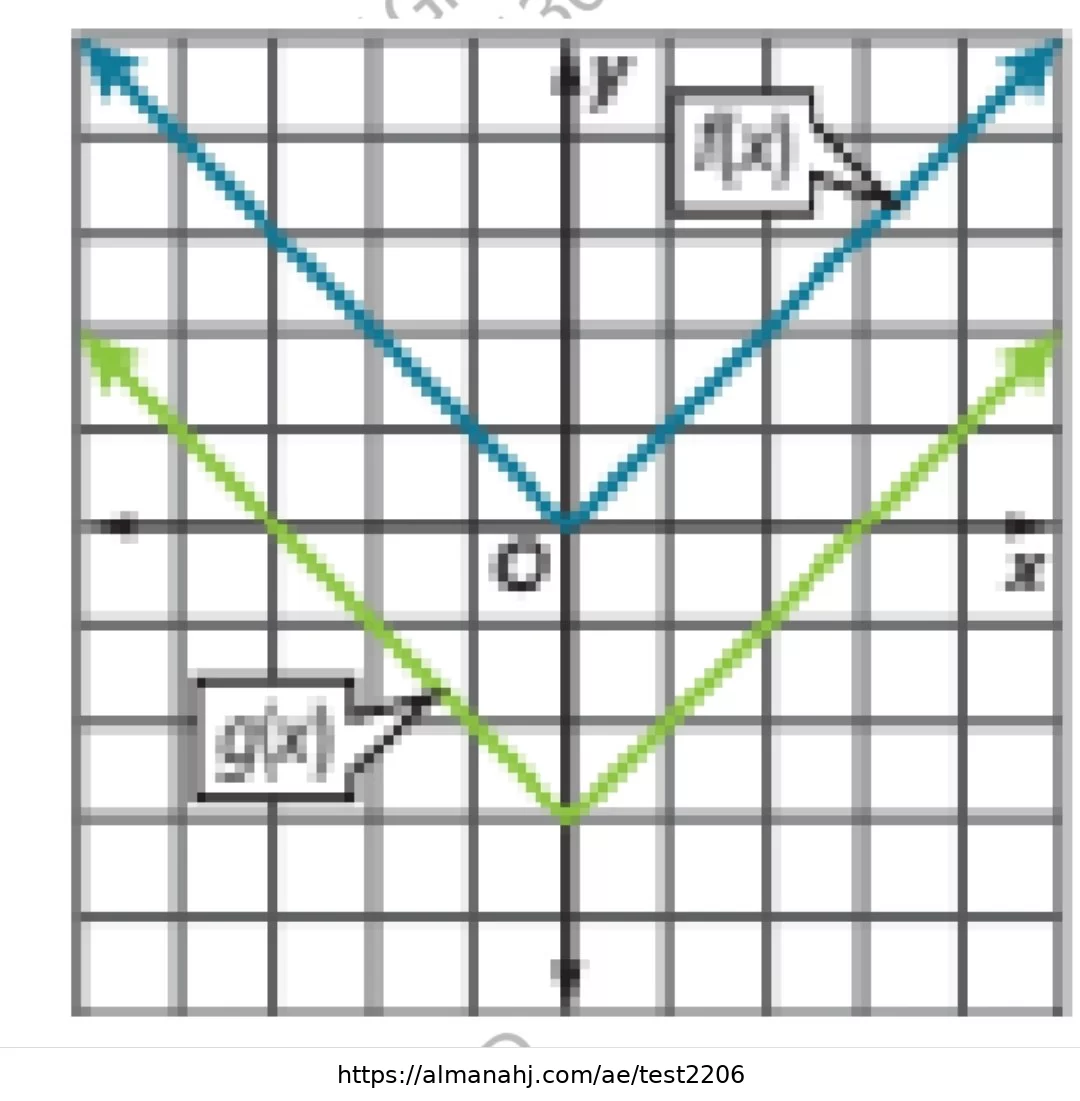
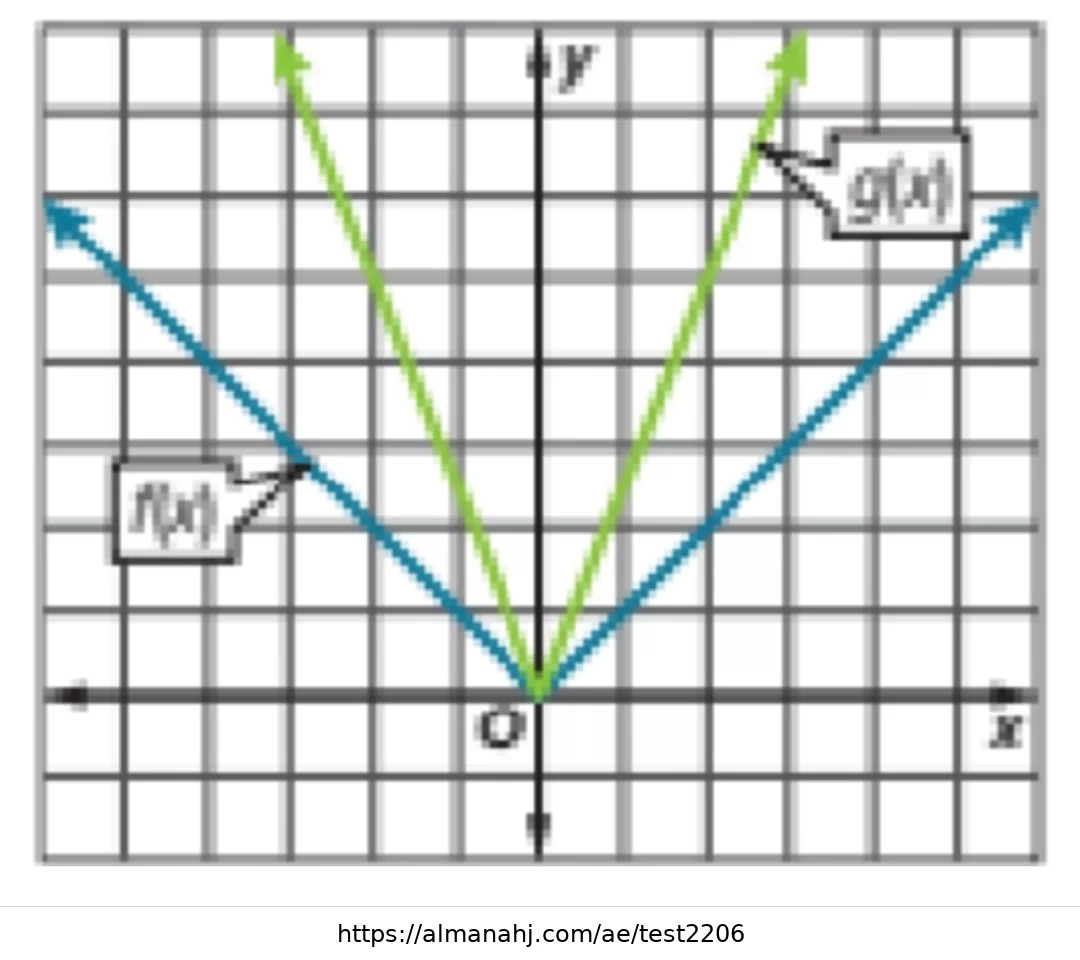
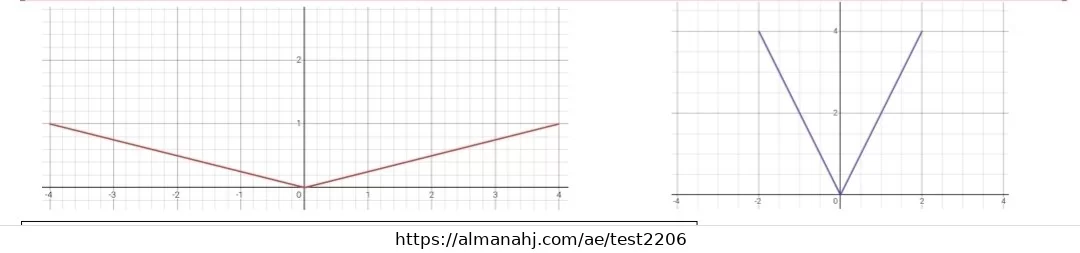
Write an equation for each of the two graphs shown, from left to right.
Explanation
Both vertices are at (0, 0). The left graph passes through (4, 1), giving a = 1/4; the right passes through (2, 4), giving a = 2.
Question 77
Points: 10
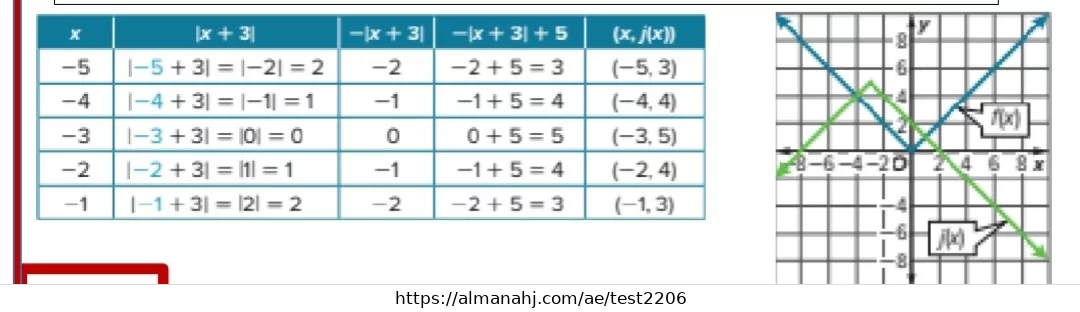
Describe j(x) = -|x + 3| + 5 relative to the parent function f(x) = |x|.
Explanation
The outside negative sign reflects across the x-axis, x + 3 shifts left 3, and +5 shifts up 5.
Question 78
Points: 10
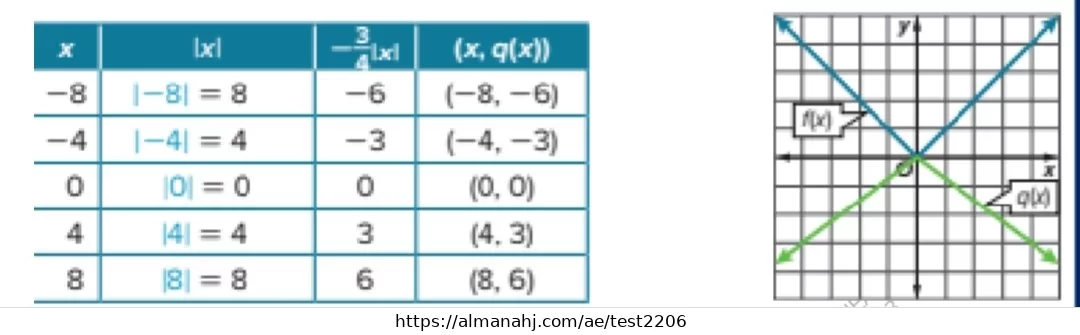
Describe q(x) = -(3/4)|x| relative to the parent function f(x) = |x|.
Explanation
The negative output factor reflects across the x-axis; its magnitude 3/4 compresses vertically.
Question 79
Points: 10
For f(x) = |x|, describe the transformations of the input displayed in q(x) = f(-4x) = |-4x|. Classify the change using this input form, not an equivalent output form.
Explanation
For f(-4x), the standard input transformations are a y-axis reflection and a horizontal compression by 1/4. Because |x| is even, the reflection alone does not visibly change its graph.
Question 80
Points: 10
Graph g(x) = |x + 1| - 4. Which choice gives its domain and range?
Explanation
The absolute value is defined for every real x. Its minimum is 0 at x = -1, so g has minimum -4.
Question 81
Points: 10
Graph j(x) = |3x - 6|. Which choice gives its domain and range?
Explanation
The expression is defined for all real x. Absolute values are nonnegative, and j(2) = 0.
Question 82
Points: 10
Graph p(x) = -|x - 3| + 5. Which choice gives its domain and range?
Explanation
The domain is all real numbers. Since -|x - 3| ≤ 0, the maximum is 5 at x = 3.
Question 83
Points: 10
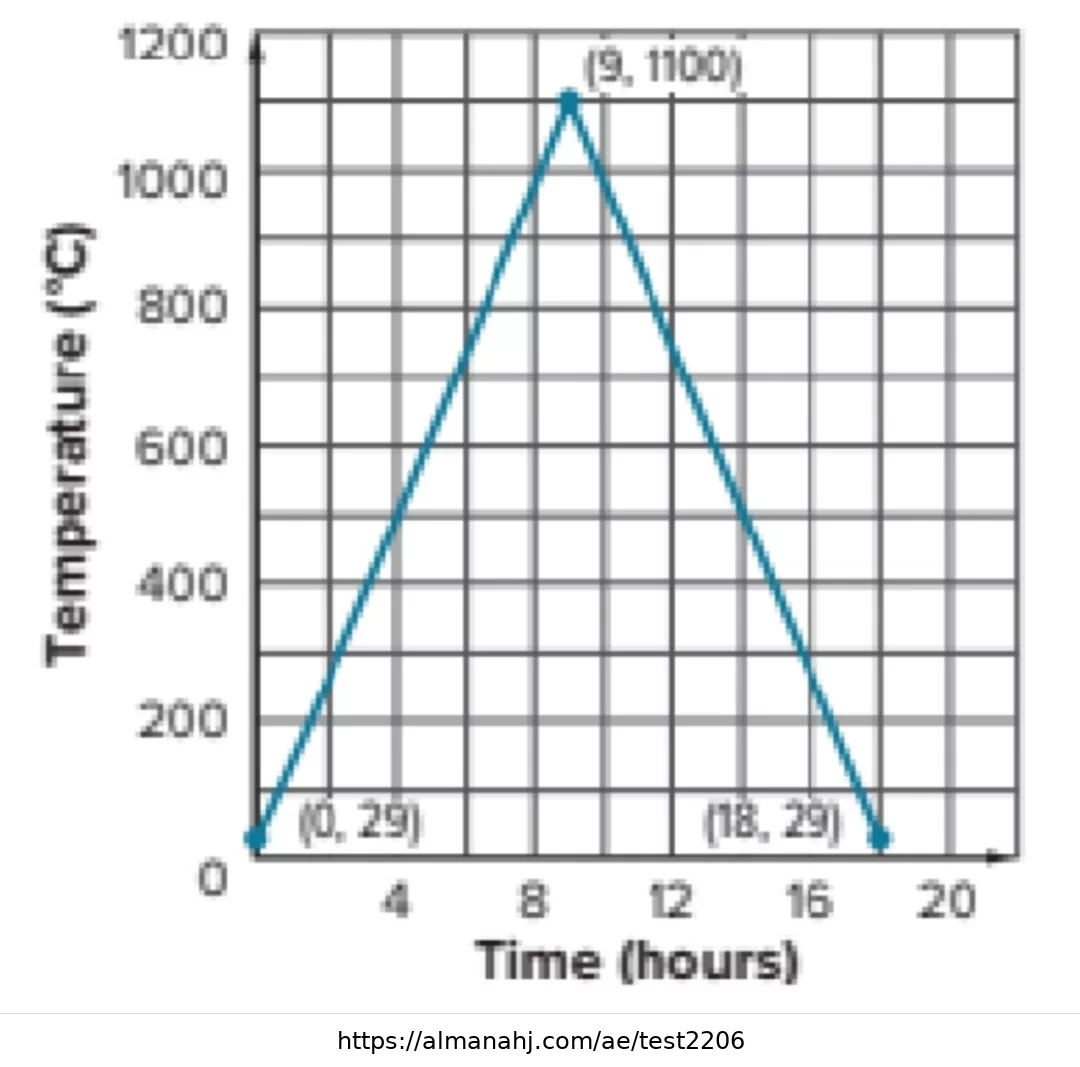
Certain types of glass heat and cool at a nearly constant rate when they are melted to create new products. Use the graph to find the equation representing the process in the form y = a|x - h| + k.
Explanation
The vertex is (9, 1100), so h = 9 and k = 1100. Using (0, 29), 29 = 9a + 1100, giving a = -119. Thus y = -119|x - 9| + 1100.
Result Tracking
Answered0 / 83
Correct Answers0
Wrong Answers0
Current Percentage0%
Quiz Completed
This is your final result after answering all questions.
Final Result
0/830%
Correct Answers0
Wrong Answers0
Answered Questions0 / 83
Total Possible Points821
You can reopen the page to start again.
يمكنك تسجيل الدخول لحفظ سجل محاولاتك، معرفة أخطائك المتكررة، والحصول على نصائح مخصصة. تسجيل الدخول باستخدام Google
Here are more quizzes for الصف التاسع المتقدم by الفصل الأول and subject رياضيات
This section is rendered only when the user reaches it while scrolling.
...
🍪
إشعار ملفات تعريف الارتباط
يستخدم هذا الموقع ملفات تعريف الارتباط لتحسين تجربة التصفح وقياس الأداء وعرض المحتوى بشكل أفضل.
باستخدامك للموقع فإنك توافق على استخدامنا لها وفق
سياسة الخصوصية.