Interactive multiple-choice quiz: Mendelian Genetics Question Bank
This document provides a comprehensive question bank on Mendelian Genetics (Part 1). The questions are categorized into three levels: Understanding & Application, Application & Analysis, and Higher-Order Thinking Skills. Topics covered include monohybrid and dihybrid crosses, Punnett squares, Mendel's laws of inheritance, and genotypic/phenotypic ratio calculations.
🏆 انضم إلى التحدي واحصل على ترتيبك
اختبار شهادة تدريبي مؤقت للصف والمادة والفصل نفسه.
اختر إجابة واحدة لكل سؤال. عند الاختيار ستظهر النتيجة فورًا: الأخضر صحيح، والأحمر خطأ، وسيظهر تفسير الإجابة مباشرة إن كان متوفرًا. وبعد آخر سؤال ستظهر الدرجة النهائية تلقائيًا.
The scientist in the picture is known as the father of genetics. Which characteristic of pea plants helped him most to interpret his results accurately?
Explanation
Mendel chose pea plants because they were true-breeding and allowed for controlled pollination between different varieties.
Question 2
2
Points: 1
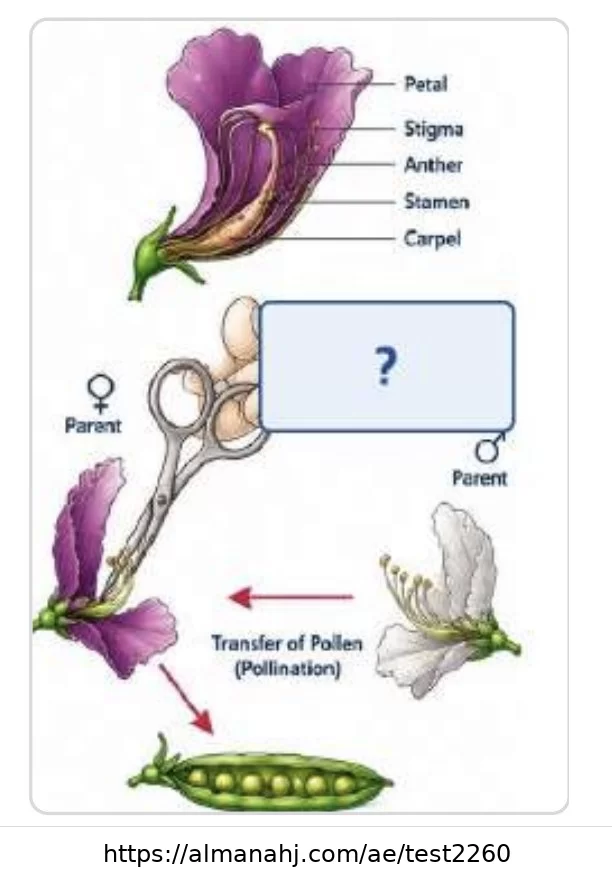
The figure shows the steps of an experiment performed by Mendel. What is the purpose of the step hidden by the (?) before transferring the pollen?
Explanation
The step involves removing the stamens (anthers) to prevent the flower from self-pollinating, ensuring controlled cross-pollination.
Question 3
3
Points: 1
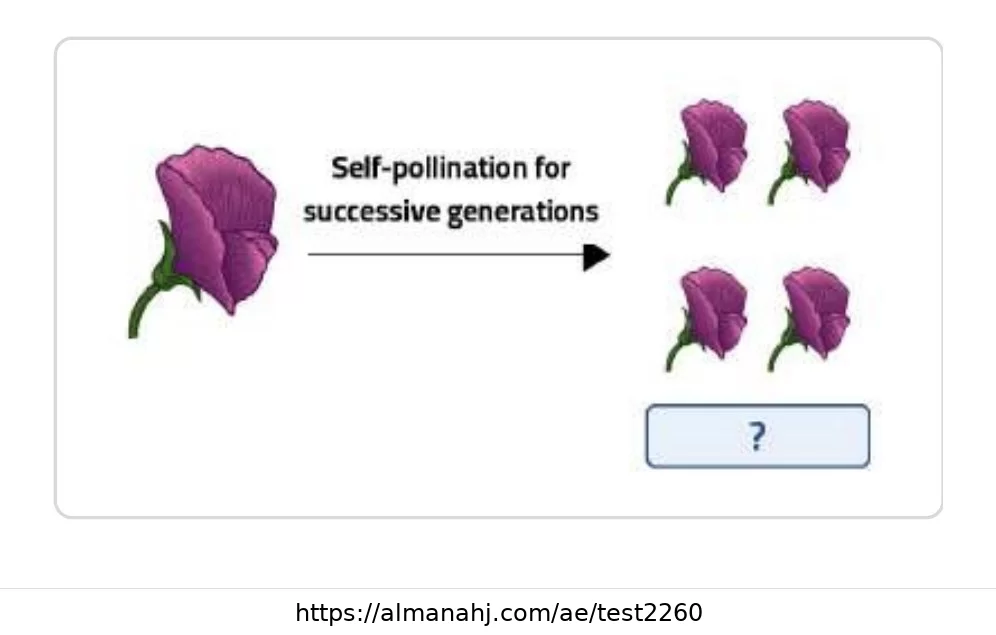
The figure shows a purple-flowered pea plant that was allowed to self-pollinate for several generations, and all offspring were purple. What can be concluded about this plant? (Purple P is dominant)
Explanation
A plant that produces only offspring with the same trait over several generations of self-pollination is homozygous (true-breeding).
Question 4
4
Points: 1
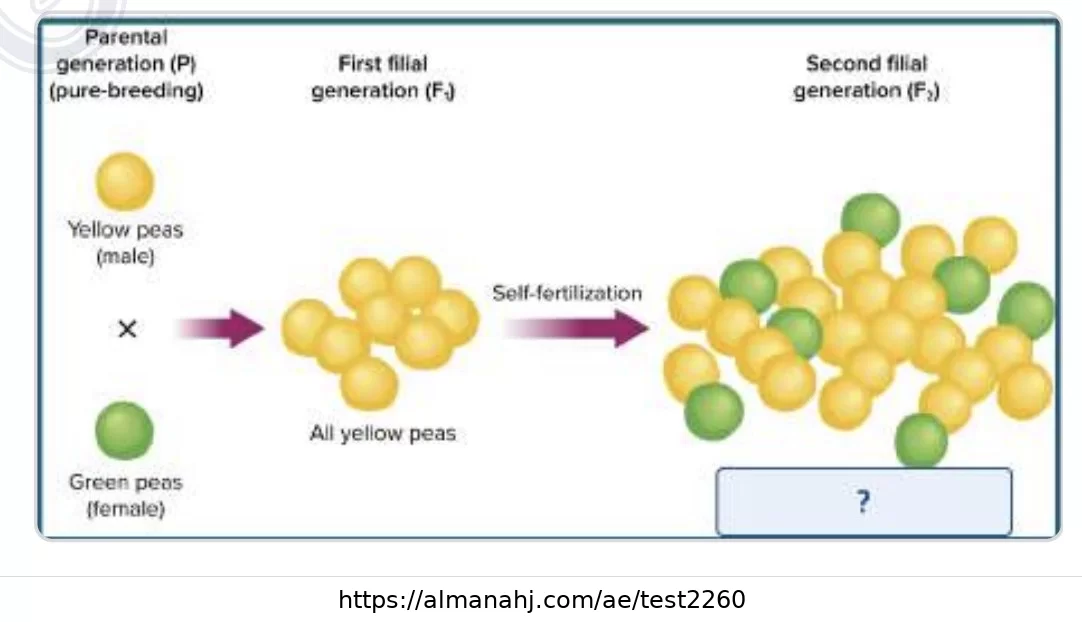
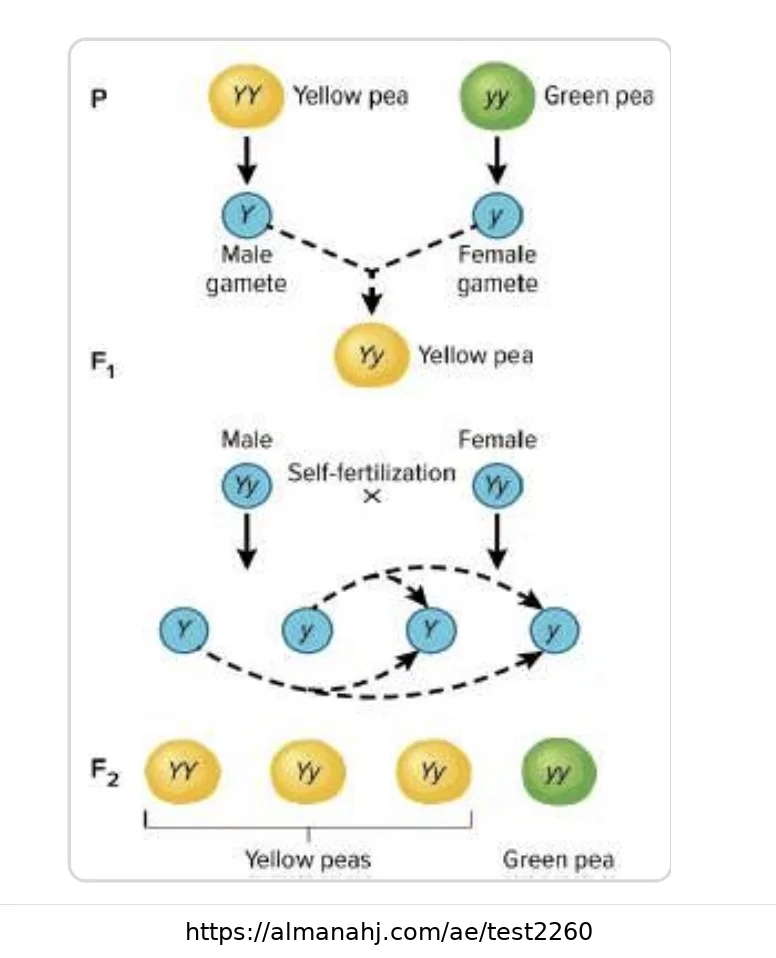
The figure represents Mendel’s cross involving seed color. How do you explain the reappearance of green seeds in the F2 generation although they disappeared in the F1 generation?
Explanation
The green allele is recessive; it is masked in the heterozygous F1 generation and only expressed in the F2 generation when two recessive alleles come together (yy).
Question 5
5
Points: 1
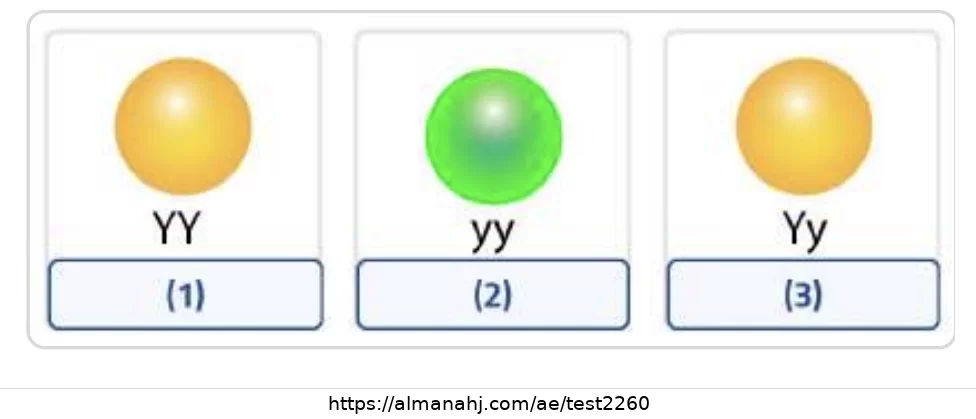
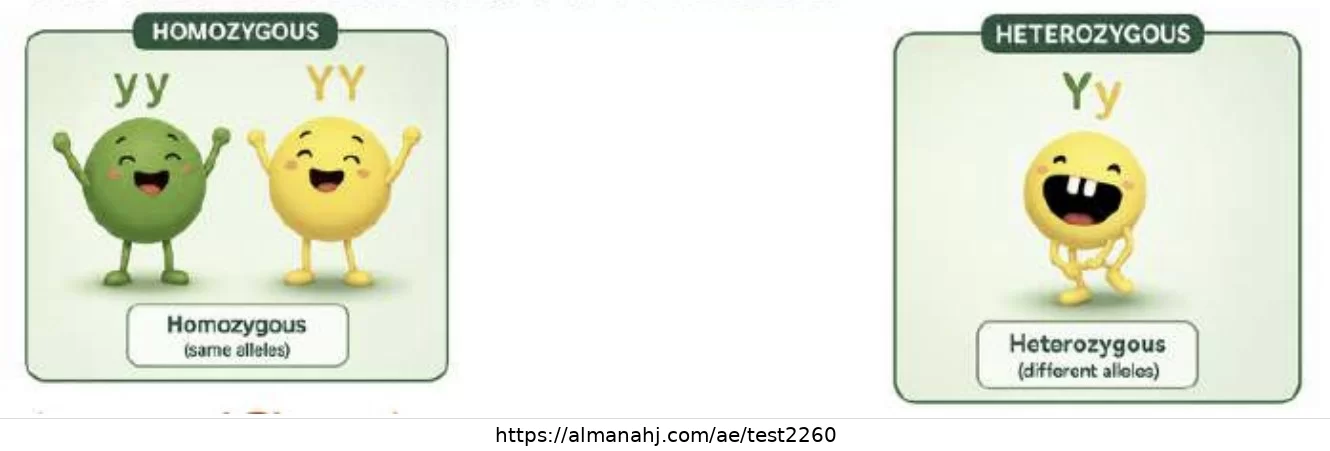
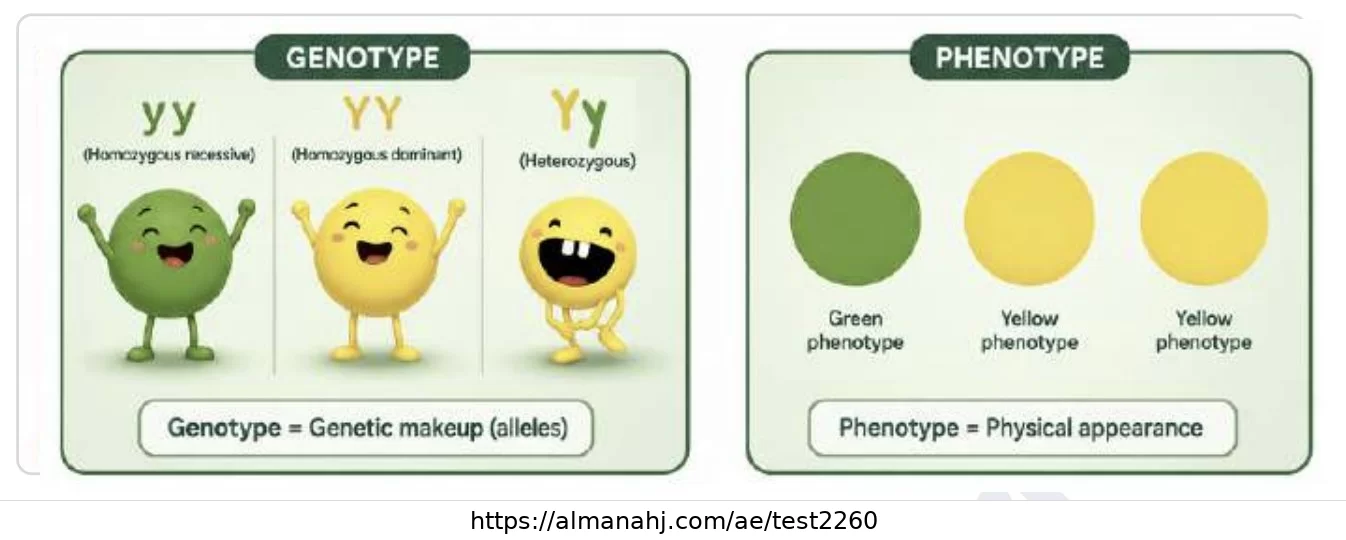
Shapes (1), (2) and (3) represent pea seeds and their genotypes. Which of the following statements is correct?
Explanation
YY and Yy both result in the yellow phenotype, but they represent different genotypic compositions (homozygous vs. heterozygous).
Question 6
6
Points: 1
A tall pea plant (T is dominant) has an unknown genotype. Which piece of information is enough by itself to prove that it is heterozygous?
Explanation
If a plant produces offspring with a recessive phenotype upon selfing, it must carry the recessive allele and thus be heterozygous (Tt).
Question 7
7
Points: 1
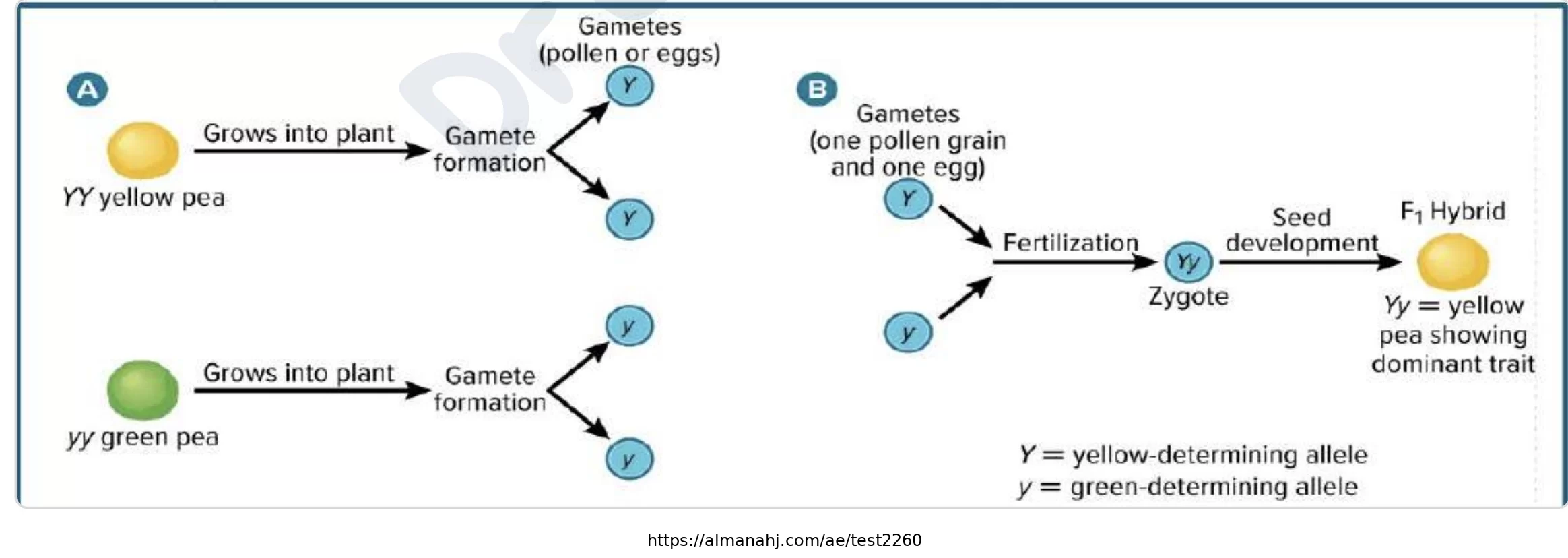
The figure shows two stages (A) and (B) in the inheritance of seed color. Which choice correctly links Mendel’s law of segregation to the stage and the cellular process?
Explanation
The Law of Segregation states that alleles separate during gamete formation, which occurs during meiosis (Stage A).
Question 8
8
Points: 1
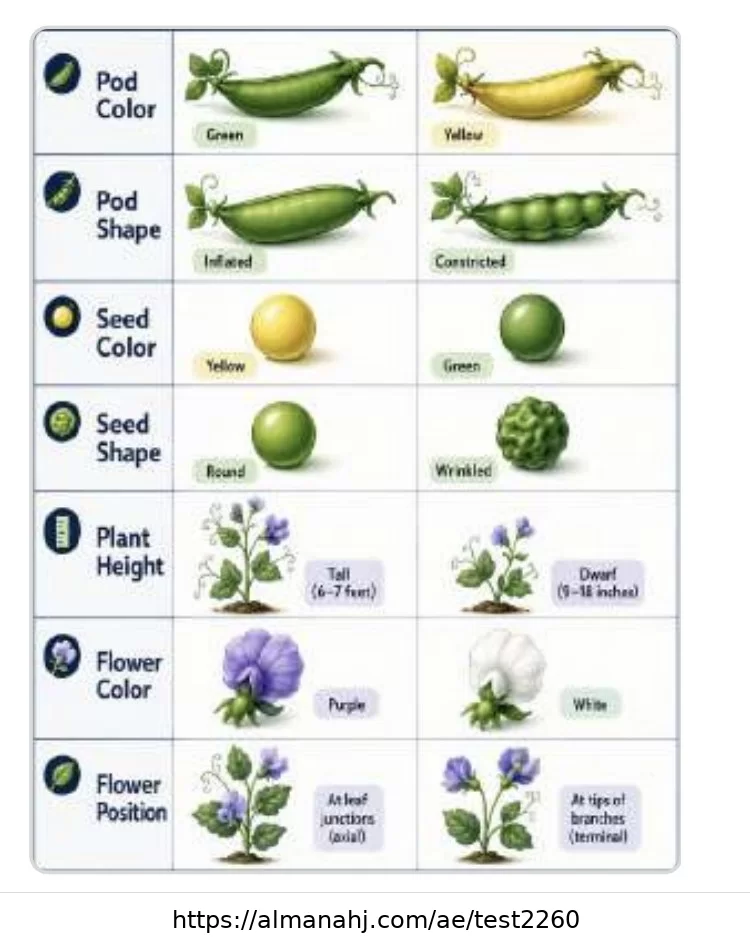
The table shows the seven traits Mendel studied, and the left column represents the dominant traits. A plant is heterozygous for pod color and homozygous recessive for seed shape. What is its phenotype?
Explanation
Heterozygous pod color (Gg) expresses the dominant green color. Homozygous recessive seed shape (rr) expresses the recessive wrinkled shape.
Question 9
9
Points: 1
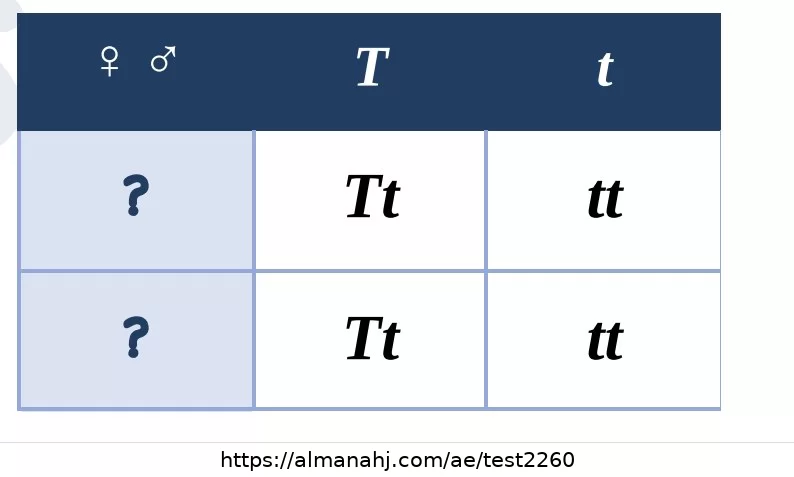
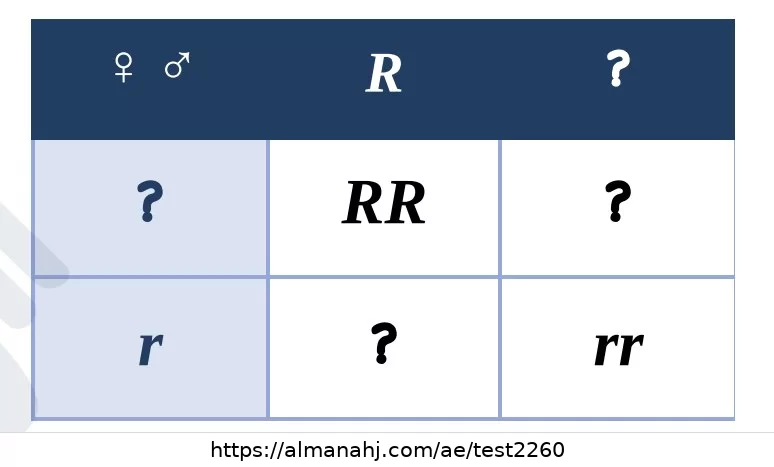
The Punnett square below represents a cross for stem length in pea plants (T tall is dominant). What are the genotype and phenotype of the parent whose gametes are hidden?
Explanation
Each offspring in the square has received a 't' from the \left parent to result in Tt and tt. Thus, the \left parent's gametes are both 't', making its genotype tt (short).
Question 10
10
Points: 1
Mendel crossed a true-breeding tall plant with a true-breeding short plant, then planted 400 seeds from the resulting generation. How many short plants are expected?
Explanation
A cross between TT and tt results in $100\%$ Tt (tall) offspring in the F1 generation.
Question 11
11
Points: 1
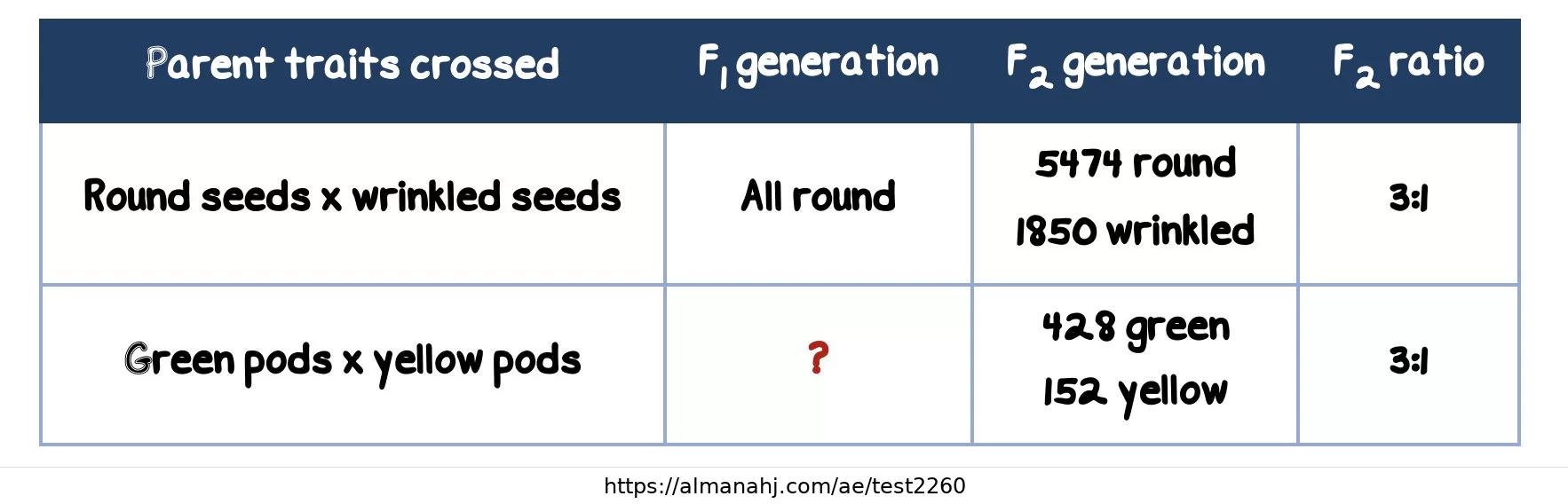
The table shows results of some of Mendel’s crosses. What should be written in place of the (?) in the F1 generation for the cross between green pods and yellow pods?
Explanation
Since green is dominant over yellow, the F1 generation of true-breeding parents will all express the dominant green phenotype.
Question 12
12
Points: 1
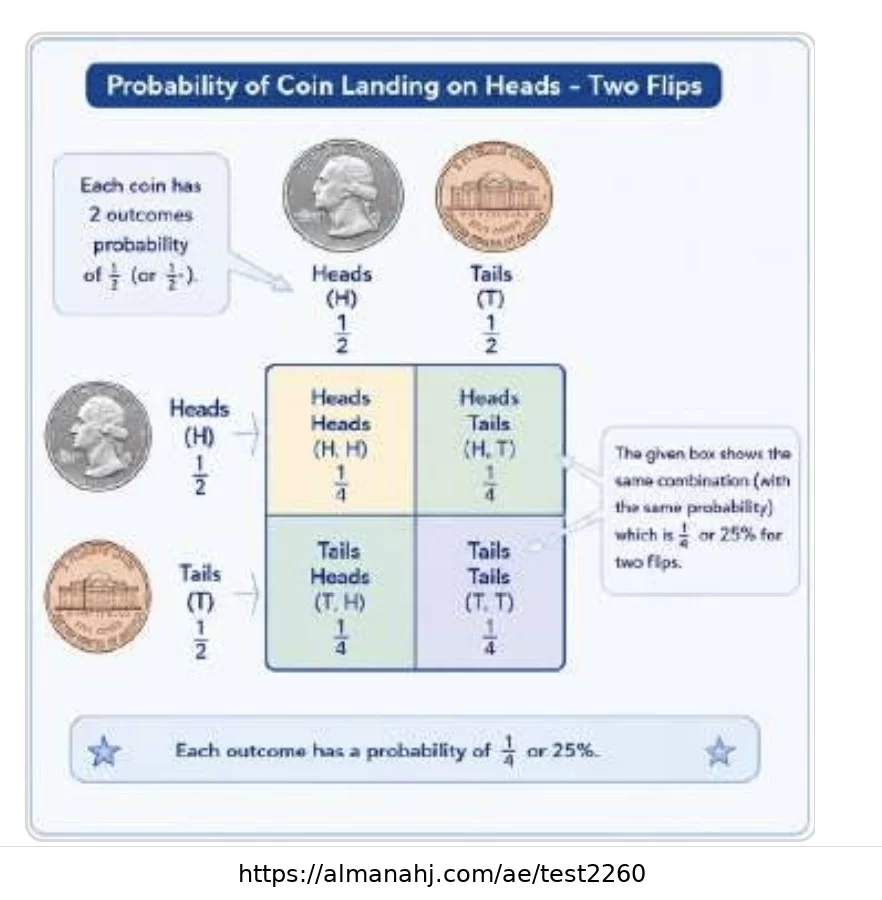
The figure shows the probability of flipping a coin twice. In the same way, what is the probability that two heterozygous parents (Aa) have two children in a row with the genotype aa?
Explanation
The probability of one child being aa is 1/4. The probability of two such events in a row is (1/4) × (1/4) = 1/16.
Question 13
13
Points: 1
Two yellow-seed pea plants were each crossed with a green-seed plant. The first produced only yellow offspring, while the second produced yellow and green offspring. What can you conclude?
Explanation
Both parents are yellow (same phenotype). The first parent is homozygous (YY) because it produced only yellow offspring. The second is heterozygous (Yy) because it produced green offspring when crossed with yy.
Question 14
14
Points: 1
In the figure, if a yellow pea is chosen randomly from the F2 generation, what is the probability that it is heterozygous?
Explanation
In F2, the yellow peas are YY and Yy in a 1:2 ratio. Thus, 2 out of 3 yellow peas are heterozygous (Yy).
Question 15
15
Points: 1
Tongue rolling (T) is a dominant trait. A man who can roll his tongue, whose mother cannot, married a woman who cannot roll her tongue. What is the probability that they have a child who cannot roll the tongue?
Explanation
The man is Tt (can roll but inherited t from mother). The woman is tt. A cross of Tt × tt yields a $50\%$ probability of tt (cannot roll).
Question 16
16
Points: 1
The Punnett square below represents a cross for flower color (R red is dominant over r white). Some of its contents are hidden. What percentage of the offspring have red flowers?
Explanation
The square indicates a cross between two heterozygotes (Rr × Rr). This results in 3/4 ($75\%$) expressing the dominant red phenotype.
Question 17
17
Points: 1
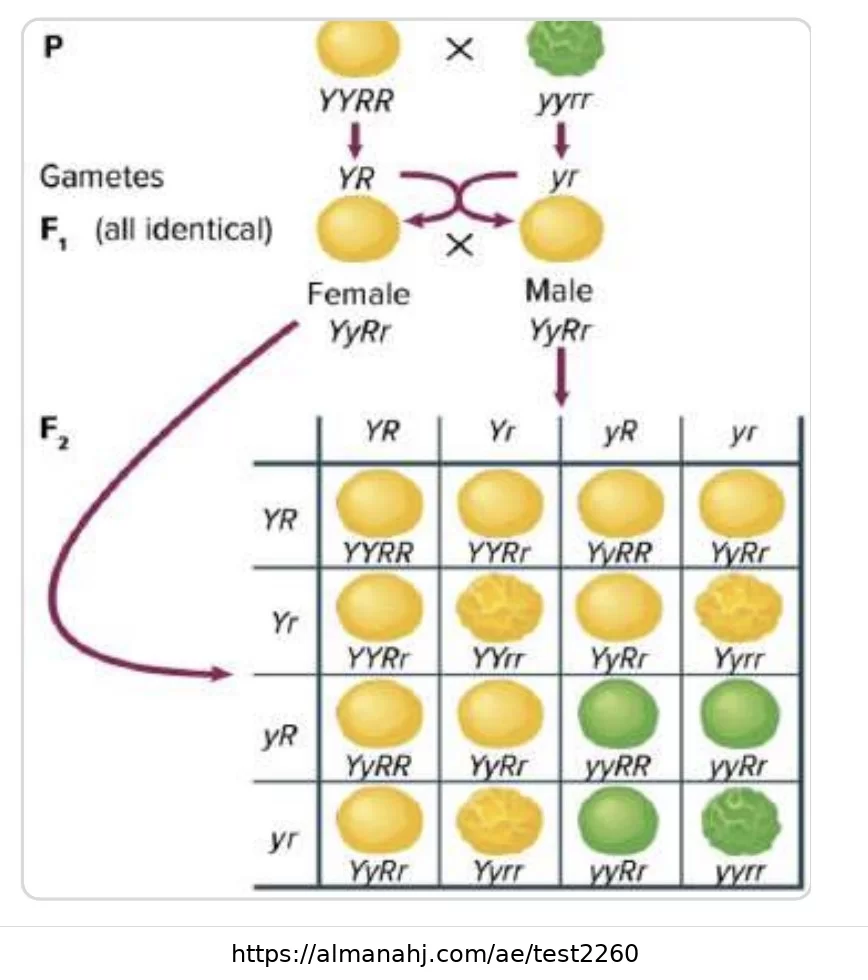
Using the Punnett square in the figure, how many different genotypes give the phenotype (yellow, round)?
Explanation
The yellow round phenotype ($Y\_R\_$) can be produced by four genotypes: YYRR, YYRr, YyRR, and YyRr.
Question 18
18
Points: 1
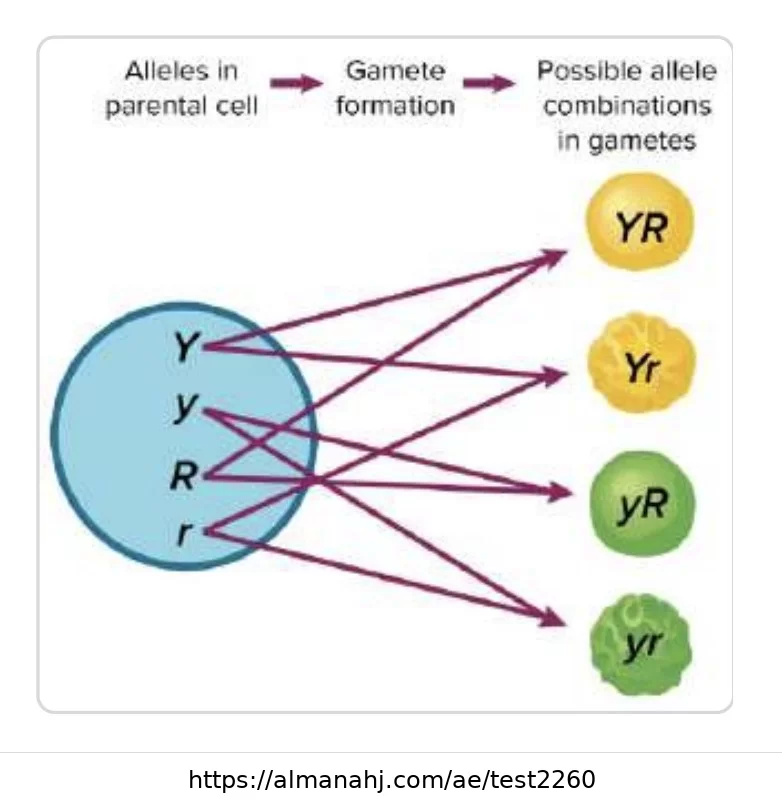
The figure shows the possible gametes of a YyRr plant according to the law of independent assortment. How many types of gametes does a plant with the genotype YyRRTt produce?
Explanation
Number of gamete types = 2^n where n is the number of heterozygous pairs. Here, n = 2 (Yy and Tt). 22 = 4.
Question 19
19
Points: 1
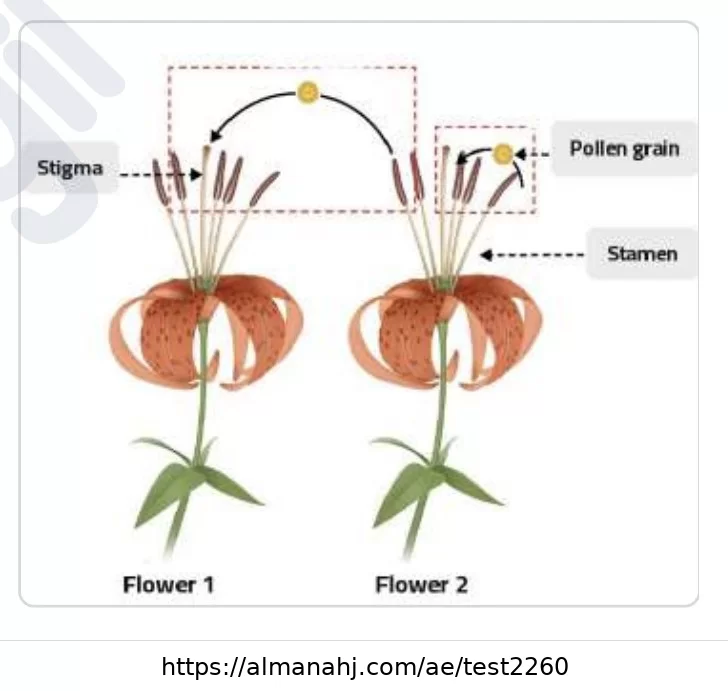
The figure shows two types of pollination inside the dashed frames. Which choice correctly describes what Mendel used to obtain each generation?
Explanation
Mendel used cross-pollination (large frame) between true-breeding parents to get F1, and allowed F1 to self-pollinate (small frame) to get F2.
Question 20
20
Points: 1
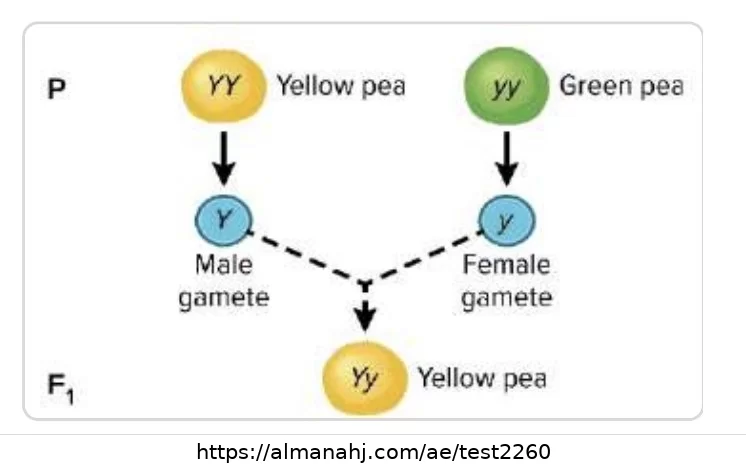
In the figure, if the green pea parent (yy) were replaced by a yellow pea plant with the genotype Yy, what percentage of the F1 would have the same genotype shown in the figure?
Explanation
Original genotype is Yy. If parents are YY × Yy, the offspring will be $50\%$ YY and $50\%$ Yy.
Question 21
21
Points: 1
The pictures show pea seeds and their genotypes. The plant grown from the heterozygous seed was crossed with the plant grown from the green seed, producing 60 seeds. How many green seeds are expected?
Explanation
A cross between Yy and yy results in $50\%$ green (yy) offspring. $50\%$ of 60 is 30.
Question 22
22
Points: 1
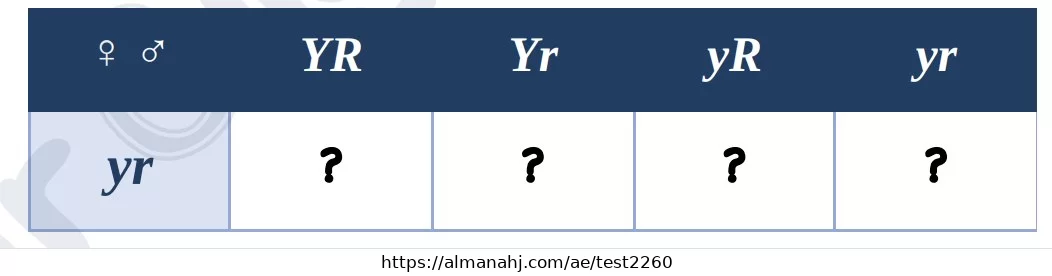
The Punnett square represents a cross between a YyRr plant and a green, wrinkled yyrr plant. What is the expected phenotypic ratio of the offspring?
Explanation
A test cross between a dihybrid (YyRr) and a homozygous recessive (yyrr) produces a phenotypic ratio of 1:1:1:1.
Question 23
23
Points: 1
In pea plants, purple flowers (P) are dominant over white flowers. Two purple plants were crossed, producing 75 purple and 25 white plants. If one of the white offspring is crossed with one of the parents, what is the expected ratio?
Explanation
The parents are Pp × Pp (since they produced white). White offspring is pp. Crossing pp × Pp yields a 1:1 ratio of purple (Pp) to white (pp).
Question 24
24
Points: 1
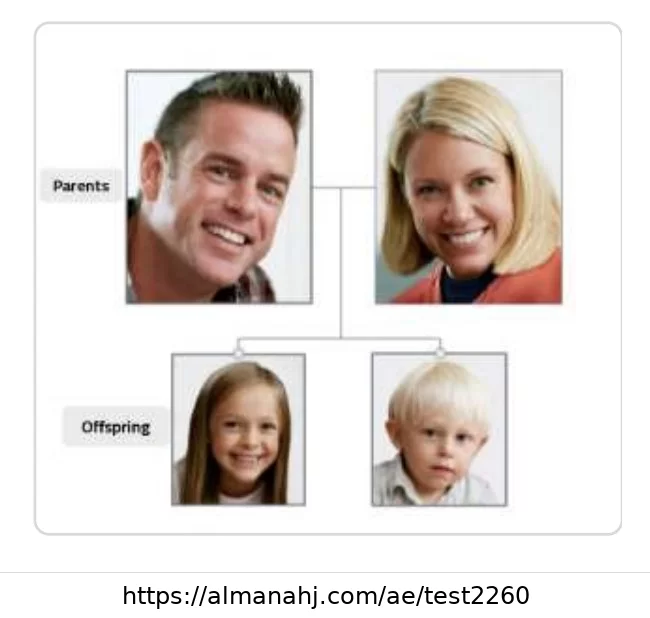
The figure shows two parents and their offspring. What is the most accurate explanation for why the son differs from his sister in some traits although they have the same parents?
Explanation
Inheritance involves the random sorting of alleles, ensuring genetic variation among siblings.
Question 25
25
Points: 1
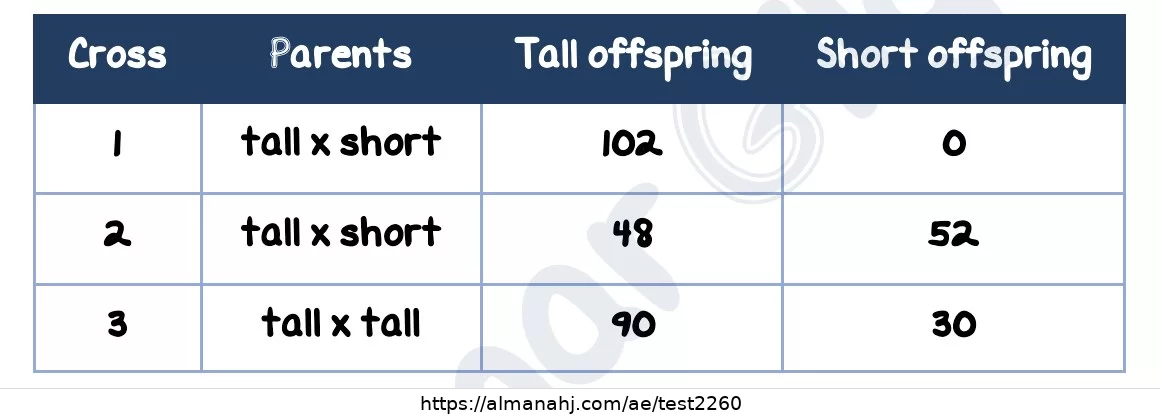
The table shows the results of three crosses for stem length (T tall is dominant). In which cross was the tall parent homozygous?
Explanation
In Cross 1, tall crossed with short produced only tall offspring, indicating the tall parent was homozygous dominant (TT).
Question 26
26
Points: 1
Curled ears in cats (C) are dominant over normal ears (c). A curled-ear female was crossed with a normal-ear male and had four kittens, one of which had normal ears. What is the mother’s genotype, and what is the probability that the next kitten has curled ears?
Explanation
Since one kitten had normal ears (cc), the mother must be heterozygous (Cc). A cross of Cc × cc gives a $50\%$ chance for curled ears.
Question 27
27
Points: 1
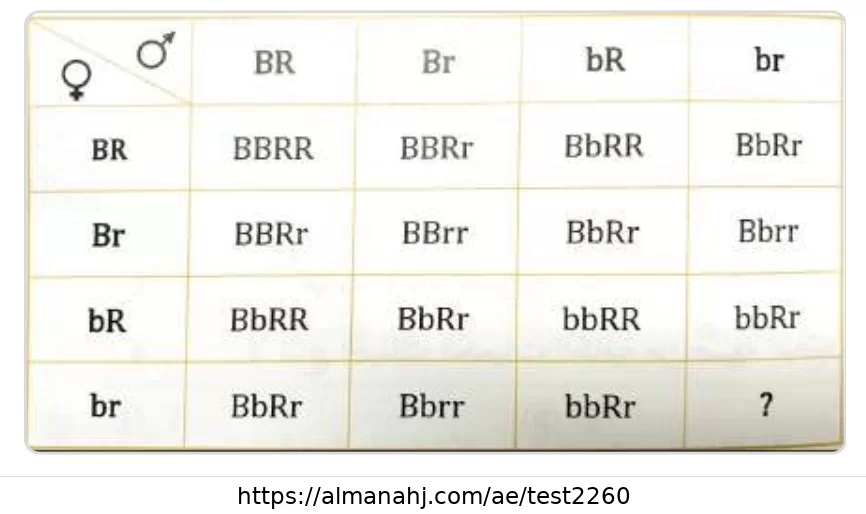
In the Punnett square below, light seed color (B) is dominant over dark, and round seeds (R) are dominant over wrinkled. How many boxes show the phenotype (dark, round)?
Explanation
Dark round phenotype corresponds to bbRR or $bbR\_$. In a dihybrid cross square, these genotypes occur in 3/16 of the total.
Question 28
28
Points: 1
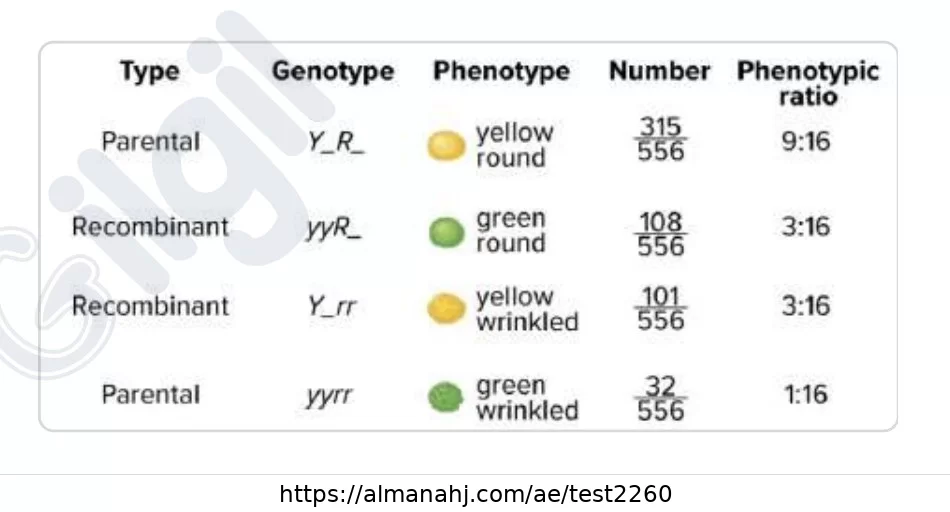
The table shows Mendel’s F2 results for a dihybrid cross. Out of 315 yellow, round plants, how many are expected to be homozygous for both traits?
Explanation
Yellow round plants represent 9/16 of the total. Only 1/16 are homozygous for both (YYRR). Thus, 1 out of every 9 yellow round plants is homozygous for both: 315 / 9 = 35.
Question 29
29
Points: 1
A student planted 12 seeds produced by self-fertilization of a Yy plant and got 6 yellow and 6 green plants. What is the most suitable scientific explanation for this result?
Explanation
Small sample sizes often deviate from expected theoretical ratios due to the random nature of fertilization.
Question 30
30
Points: 1
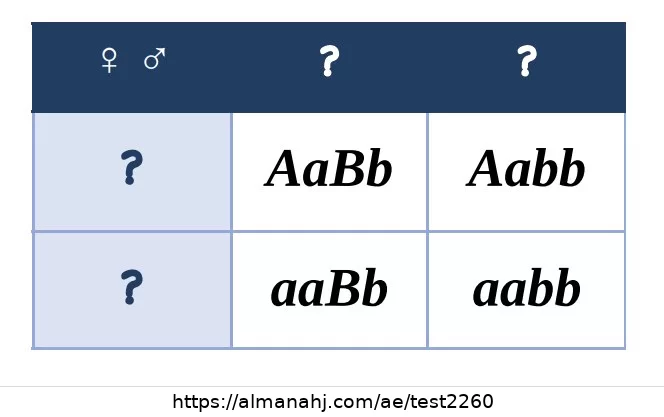
The Punnett square below represents a cross in which the parents’ gametes are hidden. Each parent produces only two types of gametes. What are the genotypes of the parents?
Explanation
To get AaBb, Aabb, aaBb, and aabb, the parents must be aaBb (gametes aB, ab) and Aabb (gametes Ab, ab), each providing two types of gametes.
Question 31
31
Points: 1
The figure shows the difference between genotype and phenotype. You have a yellow-seed pea plant with an unknown genotype. What is the best cross to determine its genotype, and which result proves it is heterozygous?
Explanation
A test cross with a homozygous recessive (yy) is used to determine an unknown genotype. If green offspring appear, the unknown plant must be heterozygous.
Question 32
32
Points: 1
A student wants to repeat the experiments to prove that stem length follows the law of segregation. Which sequence represents a correct design and expected results?
Explanation
Mendel's experimental design involved crossing opposite true-breeding varieties, followed by selfing the F1 generation to see the 3:1 ratio in F2.
Result Tracking
Answered0 / 32
Correct Answers0
Wrong Answers0
Current Percentage0%
Quiz Completed
This is your final result after answering all questions.
Final Result
0/320%
Correct Answers0
Wrong Answers0
Answered Questions0 / 32
Total Possible Points32
You can reopen the page to start again.
يمكنك تسجيل الدخول لحفظ سجل محاولاتك، معرفة أخطائك المتكررة، والحصول على نصائح مخصصة. تسجيل الدخول باستخدام Google
Here are more quizzes for الصف الثاني عشر المتقدم by الفصل الأول and subject اجتماعيات
This section is rendered only when the user reaches it while scrolling.
...
🍪
إشعار ملفات تعريف الارتباط
يستخدم هذا الموقع ملفات تعريف الارتباط لتحسين تجربة التصفح وقياس الأداء وعرض المحتوى بشكل أفضل.
باستخدامك للموقع فإنك توافق على استخدامنا لها وفق
سياسة الخصوصية.