Interactive multiple-choice quiz: إعادة التركيب الجيني والارتباط الجيني - Genetic Recombination and Gene Linkage انسباير
Genetic recombination is a fundamental biological process that occurs during meiosis. It plays a crucial role in evolution by shuffling genetic material to produce offspring with unique genetic makeups.
🏆 انضم إلى التحدي واحصل على ترتيبك
اختبار شهادة تدريبي مؤقت للصف والمادة والفصل نفسه.
اختر إجابة واحدة لكل سؤال. عند الاختيار ستظهر النتيجة فورًا: الأخضر صحيح، والأحمر خطأ، وسيظهر تفسير الإجابة مباشرة إن كان متوفرًا. وبعد آخر سؤال ستظهر الدرجة النهائية تلقائيًا.
Why is genetic recombination considered an evolutionary advantage?
Explanation
Genetic recombination during meiosis allows for the shuffling of genes, which produces new combinations of alleles in the offspring, thereby increasing the overall genetic diversity of a population.
Question 2
2
Points: 1
The number of possible gamete combinations produced by independent assortment is calculated by:
Explanation
Independent assortment produces 2ⁿ possible gamete combinations, where n is the number of chromosome pairs.
Question 3
3
Points: 1
A plant has 5 pairs of chromosomes. How many genetically different gamete combinations can independent assortment alone produce?
Explanation
The number of possible gametes is 2ⁿ. With 5 chromosome pairs: 2⁵ = 32.
Question 4
4
Points: 1
If an organism has 7 pairs of chromosomes, the number of possible gamete combinations produced by independent assortment is:
Explanation
Using 2ⁿ, where n = 7: 2⁷ = 128 possible gamete combinations.
Question 5
5
Points: 1
Pea plants have 7 chromosome pairs. Assuming independent assortment only, how many possible combinations may result after fertilization between male and female gametes?
Explanation
Each parent can produce 2⁷ = 128 gametes. Therefore, 128 × 128 = 16,384 possible fertilization combinations.
Question 6
6
Points: 1
A housefly has 6 pairs of chromosomes. How many possible gamete combinations can be formed by independent assortment?
Explanation
The number of gamete combinations is 2⁶ = 64.
Question 7
7
Points: 1
Two houseflies, each with 6 pairs of chromosomes, reproduce sexually. The number of possible fertilization combinations is:
Explanation
Each housefly can produce 2⁶ = 64 gamete combinations. Therefore, 64 × 64 = 4096 possible fertilization combinations.
Question 8
8
Points: 1
Which statement describes linked genes?
Explanation
Linked genes are genes located close together on the same chromosome and therefore tend to be inherited together.
Question 9
9
Points: 1
Linked genes are considered an exception to Mendel’s law of independent assortment because they:
Explanation
Linked genes are located on the same chromosome and tend to be inherited together. Crossing over can separate them.
Question 10
10
Points: 1
Which meiotic process can separate linked genes and produce new allele combinations?
Explanation
Crossing over between homologous chromosomes can exchange chromosome segments and separate linked alleles.
Question 11
11
Points: 1
Experiments in Drosophila melanogaster showed that linked genes:
Explanation
Linked genes tend to be inherited together, but crossing over can separate them and create recombinant combinations.
Question 12
12
Points: 1
Which statement is most accurate about genes with a low recombination frequency?
Explanation
A low recombination frequency indicates that the genes are close together on the same chromosome.
Question 13
13
Points: 1
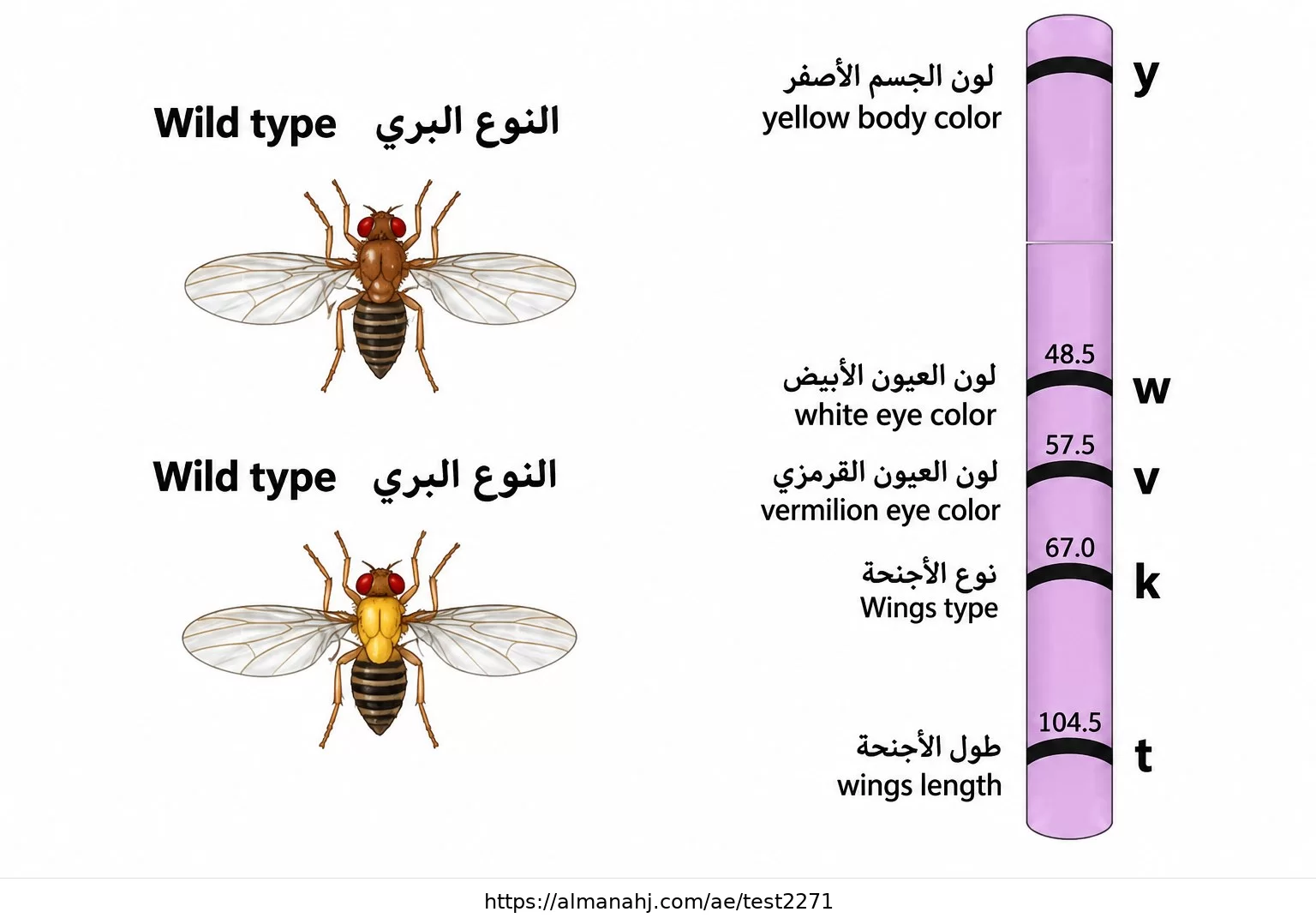
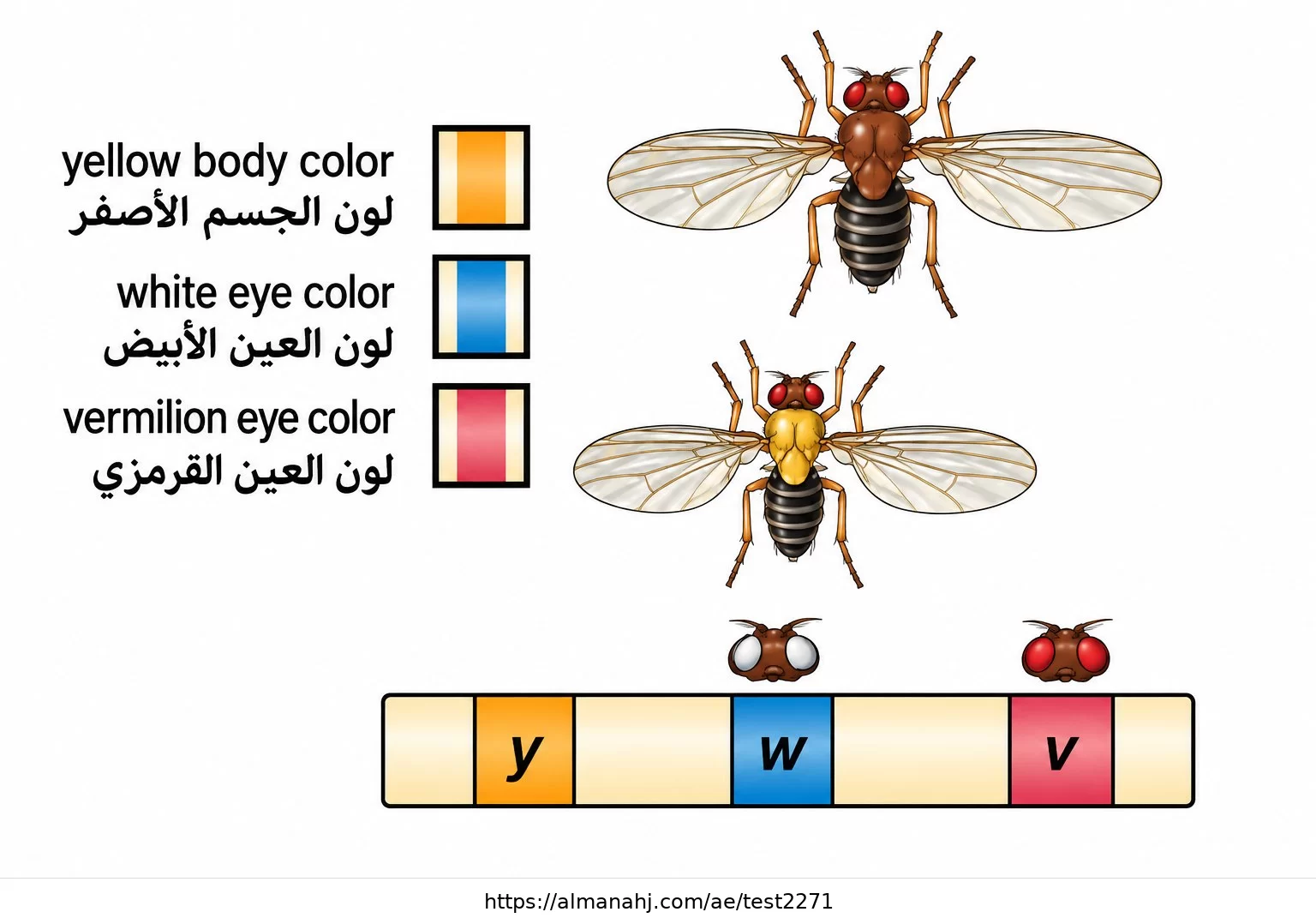
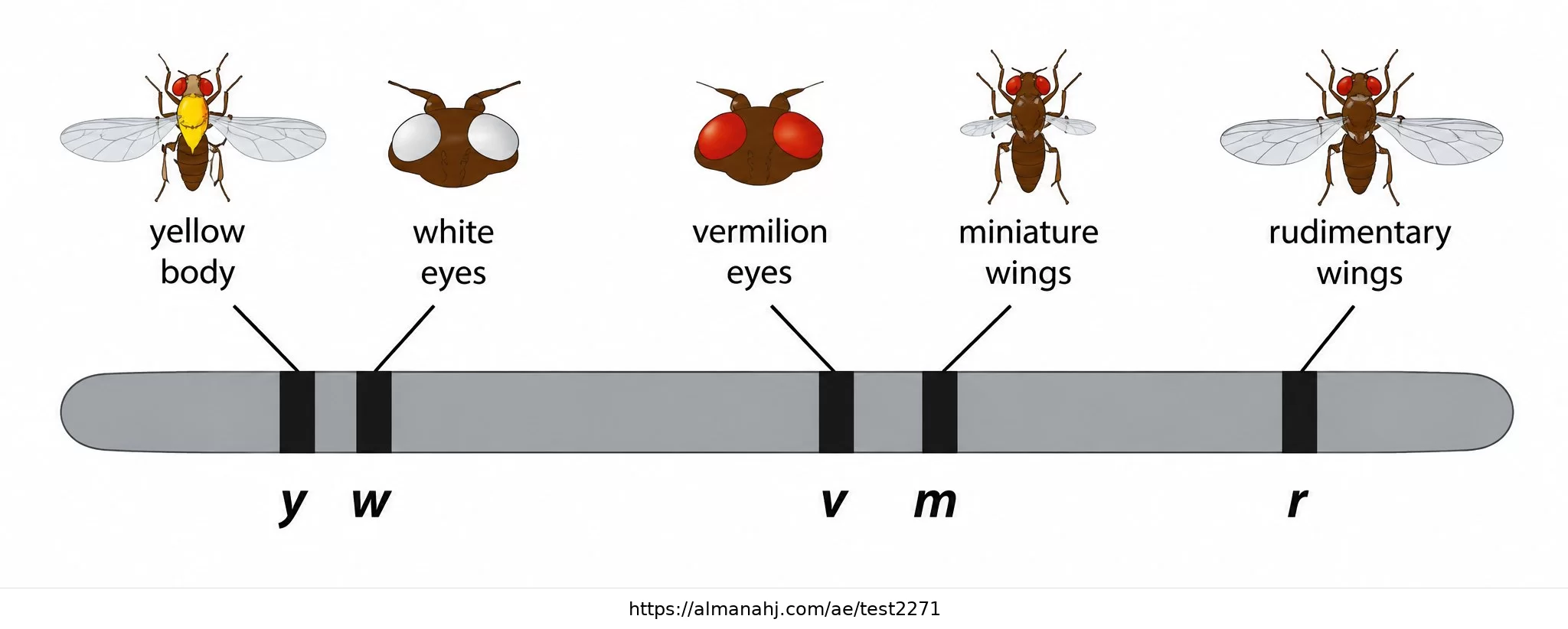
In fruit flies, the genes for yellow body and white eyes are placed close together on the chromosome map because:
Explanation
Genes that are close together have a lower probability of crossing over occurring between them, so they show a low crossover frequency.
Question 14
14
Points: 1
A recombination frequency of 10% between two genes indicates that they are approximately:
Explanation
One percent recombination frequency corresponds approximately to one map unit, so 10% corresponds to 10 map units.
Question 15
15
Points: 1
If gene A and gene B show a 5% recombination frequency, while gene B and gene C show a 35% recombination frequency, which conclusion is best supported?
Explanation
A higher recombination frequency generally indicates a greater distance between genes. Therefore B and C are farther apart than A and B.
Question 16
16
Points: 1
Three genes are arranged on a chromosome in the order X–Y–Z. If the recombination frequency between X and Y = 6% and between Y and Z = 12%, then the recombination frequency between X and Z is:
Explanation
Because Y lies between X and Z, the distances are added: 6% + 12% = 18%.
Question 17
17
Points: 1
Three genes are arranged in the order A–B–C. If A–B = 4 map units and B–C = 9 map units, what is the distance between A and C?
Explanation
Since B lies between A and C, the distances are added: 4 + 9 = 13 map units.
Question 18
18
Points: 1
Which statement best explains why Mendel did not detect linkage in his pea plant experiments?
Explanation
The genes Mendel studied behaved largely as independently assorting genes, so linkage was not apparent in his experimental results.
Question 19
19
Points: 1
Which statement best explains the relationship between crossing over and genetic variation?
Explanation
Crossing over exchanges chromosome segments and creates new combinations of existing alleles, increasing genetic variation.
Question 20
20
Points: 1
Which of the following concepts is most directly responsible for the formula 2ⁿ in gamete formation?
Explanation
The formula 2ⁿ describes the number of chromosome combinations possible in gametes due to independent assortment.
Question 21
21
Points: 1
Polyploidy means having:
Explanation
Polyploidy is the condition of having more than two complete sets of chromosomes.
Question 22
22
Points: 1
A triploid organism would be correctly represented as:
Explanation
Triploid means having three complete sets of chromosomes, represented as 3n.
Question 23
23
Points: 1
Which statement about polyploidy in animals and humans is correct?
Explanation
According to the lesson, polyploidy is rare in animals and is generally lethal in humans.
Question 24
24
Points: 1
Which crop is NOT correctly matched with its ploidy level?
Explanation
Maize is the incorrectly matched example in the supplied material.
Question 25
25
Points: 1
Polyploid plants are often selected by growers because they commonly show:
Explanation
Polyploid plants commonly exhibit increased vigor and larger organs, which can be advantageous in agriculture.
Question 26
26
Points: 1
A pea plant has seven pairs of chromosomes. If two such plants are crossed, how many possible types of fertilized eggs could result from the random lining up of the chromosome pairs?
Explanation
Each plant produces 2⁷ = 128 possible gamete combinations. Therefore 128 × 128 = 16,384 possible fertilized egg combinations.
Question 27
27
Points: 1
A common housefly has 6 pairs of chromosomes. If two houseflies are crossed, how many possible types of fertilized eggs could result from the random lining up of the chromosome pairs?
Explanation
Each housefly produces 2⁶ = 64 possible gametes. Therefore 64 × 64 = 4096 possible fertilized egg combinations.
Question 28
28
Points: 1
Pea plants have seven pairs of chromosomes. What are the possible genotypes of gametes?
Explanation
Independent assortment gives 2⁷ = 128 possible chromosome combinations in the gametes.
Question 29
29
Points: 1
Which of the following does not contribute to genetic variation?
Explanation
Chromosome number itself does not generate genetic variation in the way random mating, crossing over, and meiosis do.
Question 30
30
Points: 1
Which of the following concepts does NOT follow Mendel’s Assortment?
Explanation
Gene linkage is an exception to independent assortment because genes located close together on the same chromosome tend to be inherited together.
Question 31
31
Points: 1
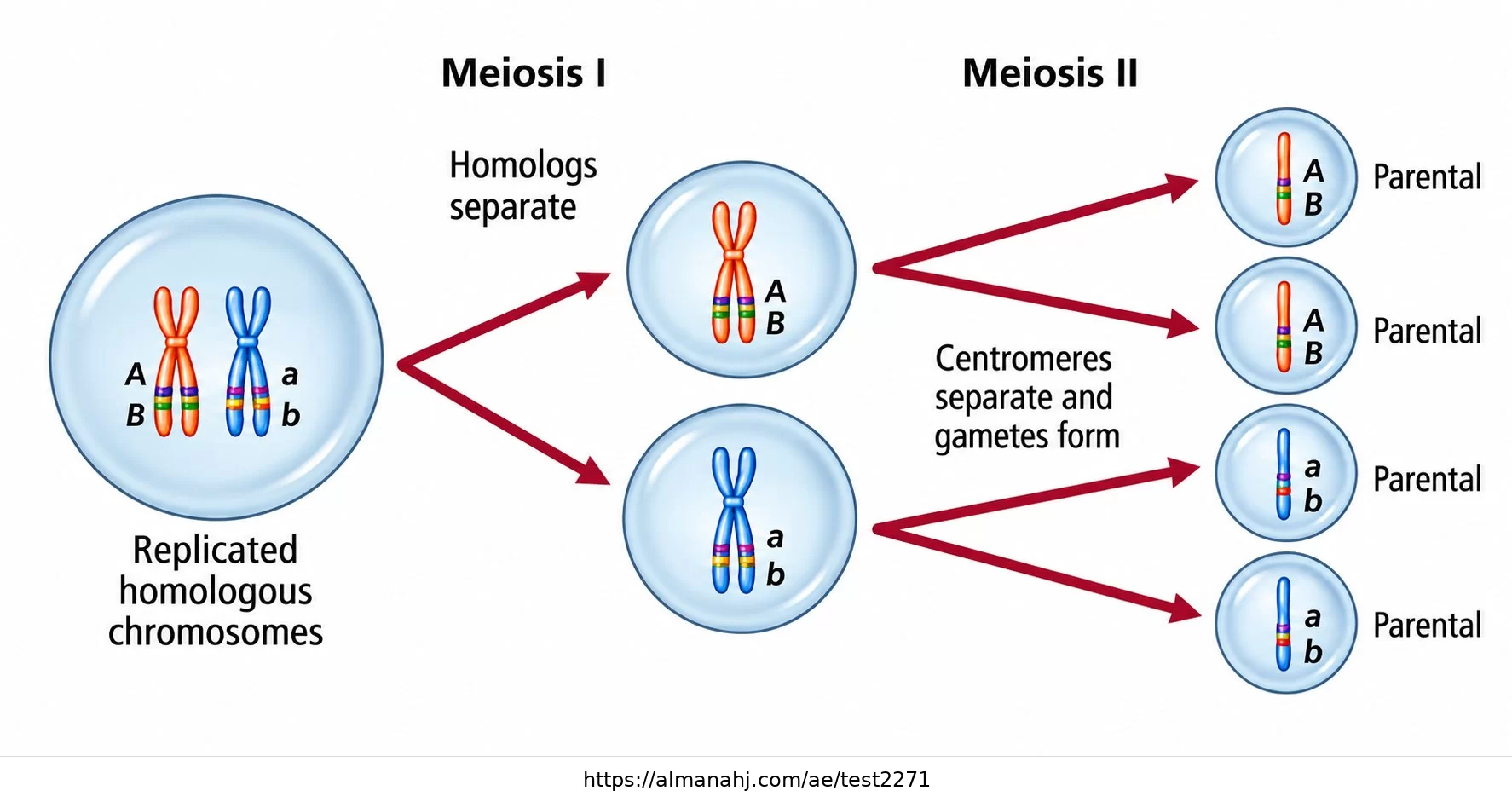
What does the figure represent?
Explanation
The diagram represents linked genes being transmitted together during meiosis.
Question 32
32
Points: 1
The figure shows linked genes. Which of the following statements is incorrect?
Explanation
In the illustrated linkage example, the linked genes remain together and crossing over is not shown occurring.
Question 33
33
Points: 1
The figure shows linked genes. Which of the following statements is correct?
Explanation
Linked genes are located on the same chromosome and usually do not segregate independently.
Question 34
34
Points: 1
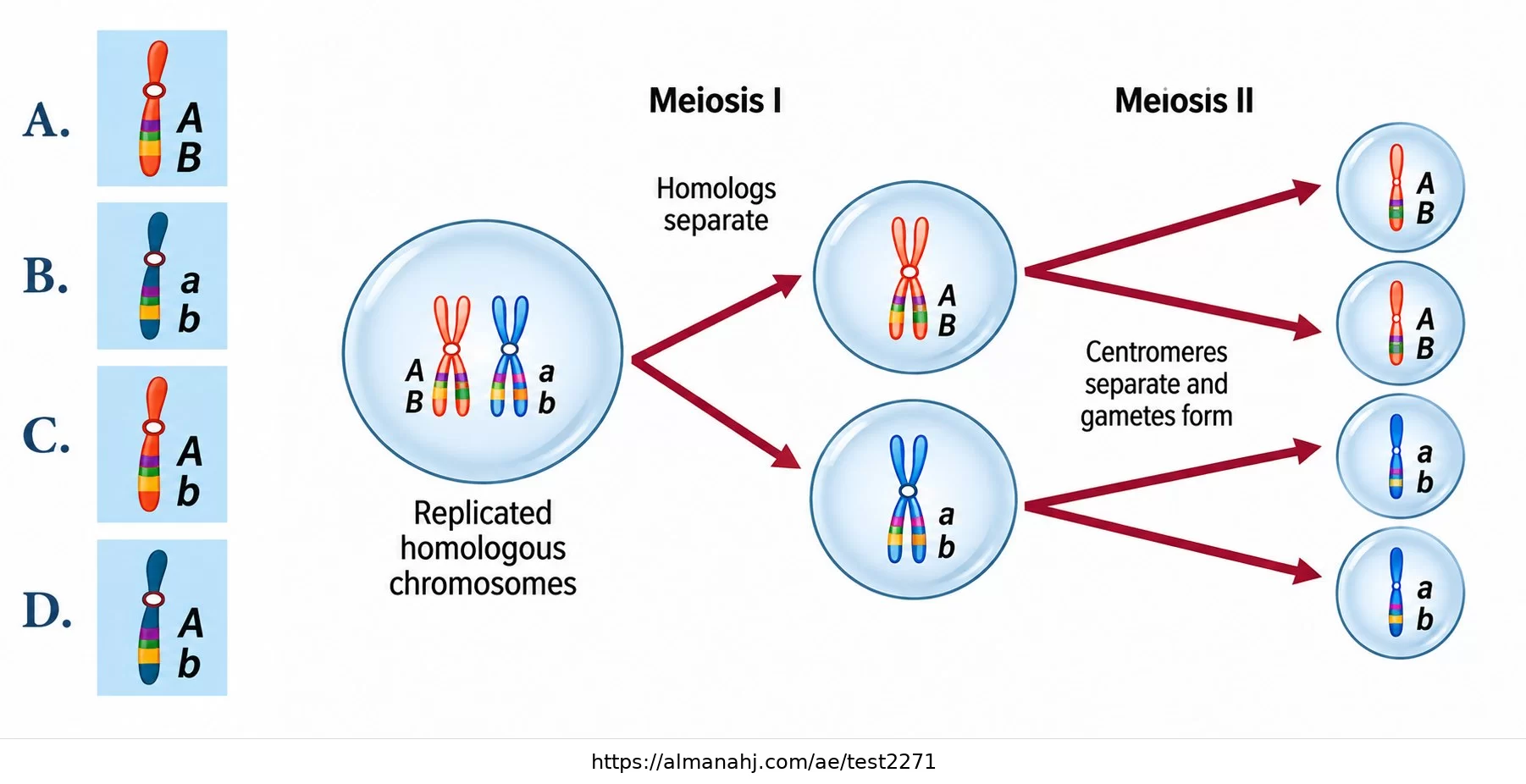
The figure represents the gene linkage concept of inheritance. Which of the following chromosomes can be used to represent the letter X?
Explanation
According to the linkage diagram, chromosome A has the allele arrangement represented by X.
Question 35
35
Points: 1
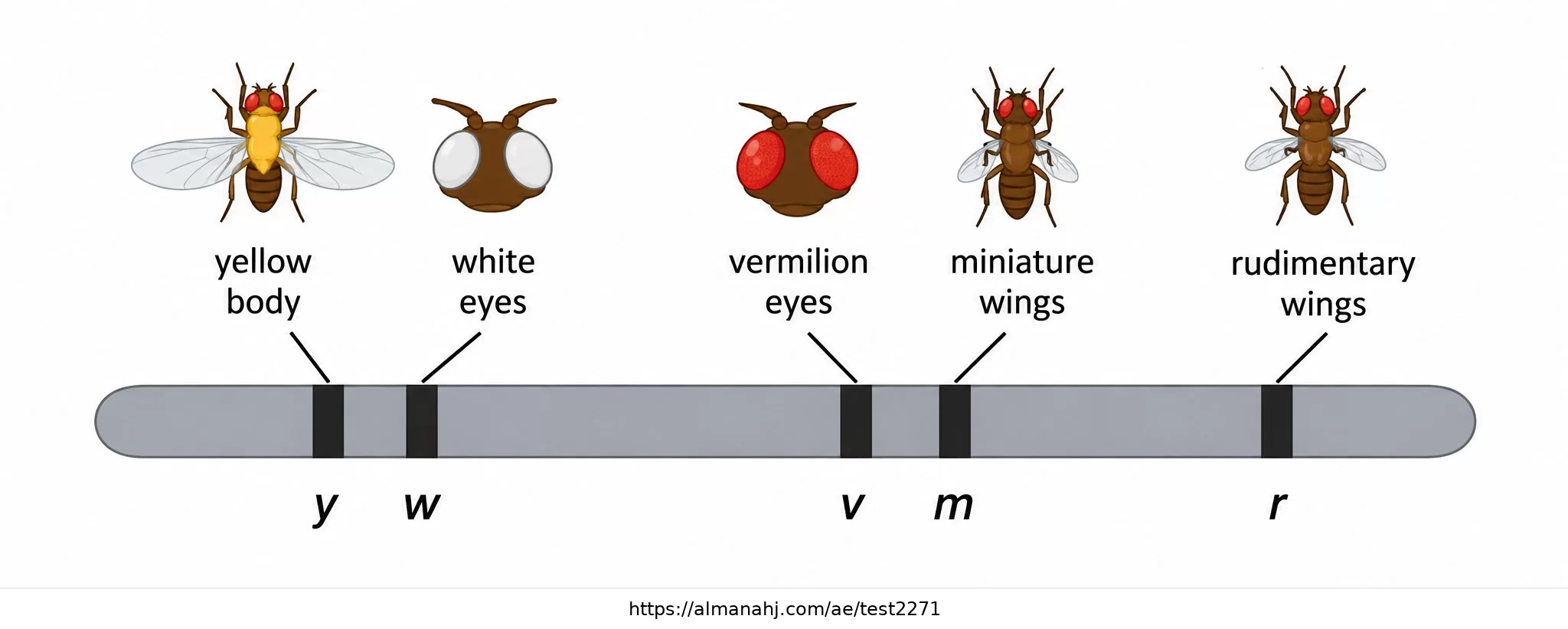
Based on the chromosome map shown, which two alleles have the least frequency of crossing over?
Explanation
Genes that are closest together on a chromosome have the lowest crossover frequency. On the map, y and w are the closest pair among the choices.
Question 36
36
Points: 1
The chromosome map shows that the farther apart two genes are, the higher the crossover frequency. Which of the following sites has the highest crossover frequency?
Explanation
According to the chromosome map in the supplied question, w and m have the greatest relevant separation among the listed choices.
Question 37
37
Points: 1
The chromosome map shows that the farther apart two genes are, the higher the crossover frequency. Which of the following sites has the higher crossover frequency?
Explanation
Among the listed pairs, w and t are the farthest apart on the chromosome map and therefore have the highest crossover frequency.
Question 38
38
Points: 1
The figure shows a chromosome map created using fruit fly data. What are the genes y, w, and v called?
Explanation
The genes y, w, and v are located on the same chromosome and are therefore linked genes.
Question 39
39
Points: 1
One of the following species used in agriculture is most likely a polyploid:
Explanation
Polyploidy is particularly common in plants. Wheat is a well-known agricultural polyploid.
Question 40
40
Points: 1
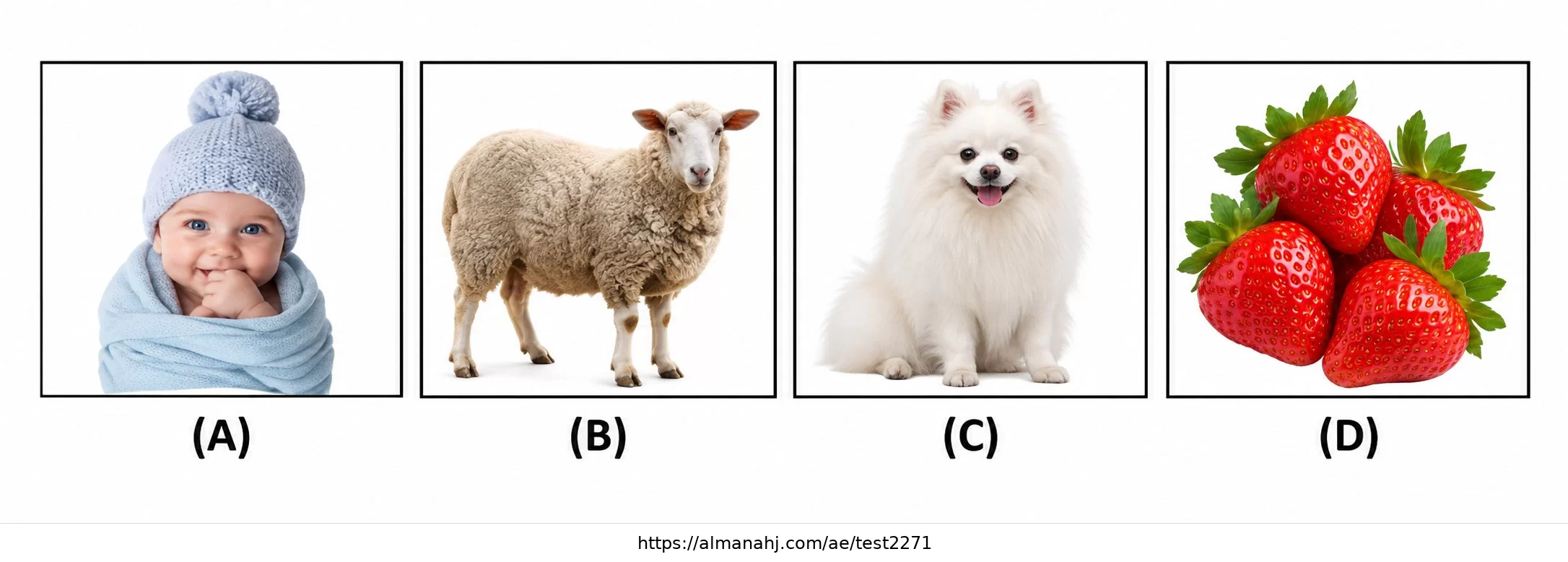
Based on the figure, which of the following indicates an organism for which polyploidy is useful?
Explanation
Polyploidy can be useful in crop plants such as strawberries and can contribute to desirable agricultural characteristics.
Question 41
41
Points: 1
Based on the figure, which of the following indicates an organism that has a very rare likelihood to have polyploidy?
Explanation
According to the supplied material, polyploidy is particularly rare and generally lethal in humans.
Question 42
42
Points: 1
A housefly has six pairs of chromosomes. If two houseflies are crossed, how many possible types of fertilized eggs could result from the random assortment of chromosome pairs?
Explanation
Each housefly can produce 2⁶ = 64 gamete combinations. Therefore 64 × 64 = 4096 possible fertilized egg combinations.
Question 43
43
Points: 1
For a housefly that has six pairs of chromosomes, how many different gamete combinations can result from the random assortment of chromosome pairs during meiosis?
Explanation
Independent assortment produces 2⁶ = 64 different gamete combinations.
Question 44
44
Points: 1
In the chromosome map, yellow body and white eye genes show low crossover frequency. Which inference is correct?
Explanation
A low crossover frequency indicates that the genes are close together on the same chromosome and therefore tightly linked.
Result Tracking
Answered0 / 44
Correct Answers0
Wrong Answers0
Current Percentage0%
Quiz Completed
This is your final result after answering all questions.
Final Result
0/440%
Correct Answers0
Wrong Answers0
Answered Questions0 / 44
Total Possible Points44
You can reopen the page to start again.
يمكنك تسجيل الدخول لحفظ سجل محاولاتك، معرفة أخطائك المتكررة، والحصول على نصائح مخصصة. تسجيل الدخول باستخدام Google
Here are more quizzes for الصف الثاني عشر المتقدم by الفصل الأول and subject أحياء
This section is rendered only when the user reaches it while scrolling.
...
🍪
إشعار ملفات تعريف الارتباط
يستخدم هذا الموقع ملفات تعريف الارتباط لتحسين تجربة التصفح وقياس الأداء وعرض المحتوى بشكل أفضل.
باستخدامك للموقع فإنك توافق على استخدامنا لها وفق
سياسة الخصوصية.