This quiz focuses on the foundational work of Gregor Mendel in the field of genetics. It specifically examines the reasons behind his choice of pea plants as a model organism for heredity research.
🏆 انضم إلى التحدي واحصل على ترتيبك
اختبار شهادة تدريبي مؤقت للصف والمادة والفصل نفسه.
اختر إجابة واحدة لكل سؤال. عند الاختيار ستظهر النتيجة فورًا: الأخضر صحيح، والأحمر خطأ، وسيظهر تفسير الإجابة مباشرة إن كان متوفرًا. وبعد آخر سؤال ستظهر الدرجة النهائية تلقائيًا.
Why did Mendel choose pea plants for his experiments?
Explanation
Mendel chose pea plants because they are true-breeding, which means they consistently produce offspring with the same traits when self-pollinated, allowing for controlled genetic experiments.
Question 2
2
Points: 1
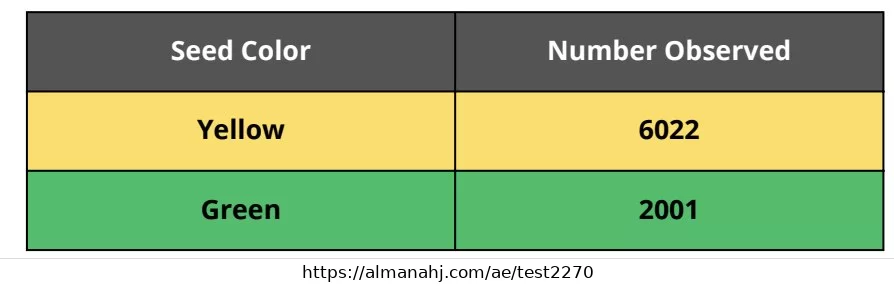
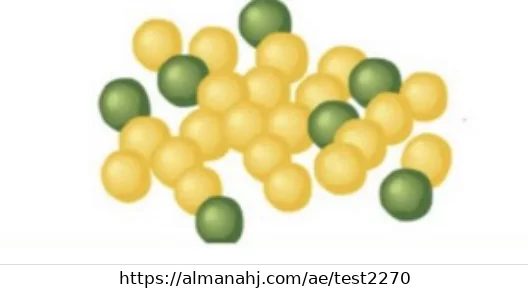
Mendel’s F₂ generation seed color results are shown below. Yellow seeds = 6022 and green seeds = 2001. What is the phenotypic ratio?
Explanation
The observed numbers 6022 yellow and 2001 green are approximately in a 3:1 ratio, which is the expected phenotypic ratio for a monohybrid cross with complete dominance.
Question 3
3
Points: 1
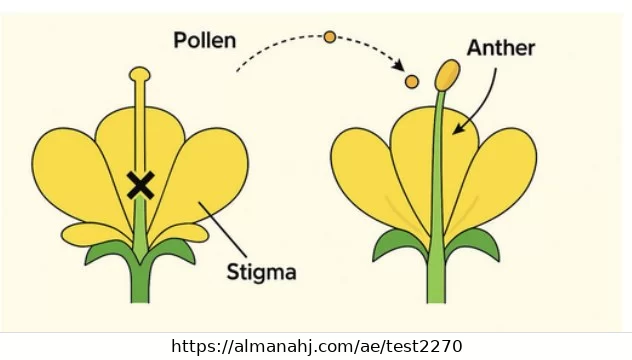
A pea flower has its anthers removed before pollen from another plant is applied. Which process is this?
Explanation
Applying pollen from another plant after removing the anthers prevents self-fertilization and allows controlled cross-pollination.
Question 4
4
Points: 1
Which of the following is a phenotype?
Explanation
A phenotype is an observable characteristic. Yellow seed color is observable, while Yy, YY, and yy are genotypes.
Question 5
5
Points: 1
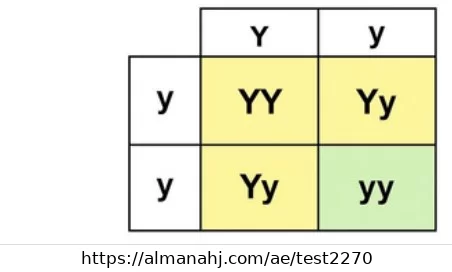
Two heterozygous yellow-seed pea plants (Yy × Yy) are crossed. What is the expected genotypic ratio of the offspring?
Explanation
The cross Yy × Yy produces YY, Yy, Yy, and yy, giving a genotypic ratio of 1 YY : 2 Yy : 1 yy.
Question 6
6
Points: 1
Which of the following statements is true for all heterozygous pea plants?
Explanation
A heterozygous individual carries two different alleles and can pass either the dominant or the recessive allele to its offspring.
Question 7
7
Points: 1
According to Mendel’s law of independent assortment, which of the following is correct?
Explanation
Mendel’s law of independent assortment states that alleles of genes on different chromosomes can assort independently during gamete formation.
Question 8
8
Points: 1
All F₁ offspring display the dominant trait even though they carry the recessive allele. Which type of inheritance does this represent?
Explanation
In complete dominance, the dominant allele completely masks the recessive allele in a heterozygous individual.
Question 9
9
Points: 1
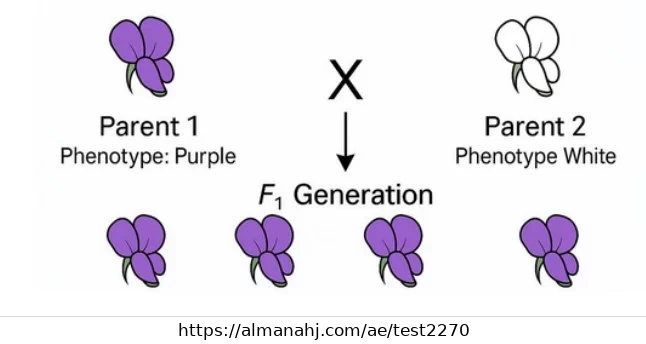
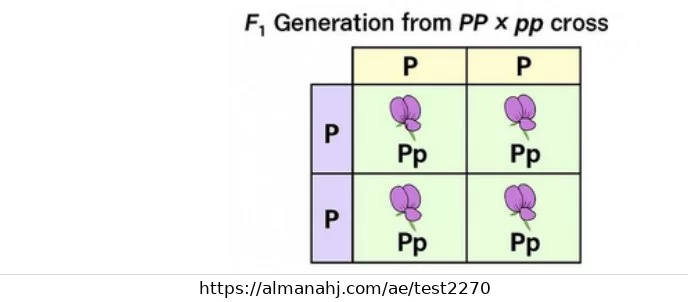
In the F₁ generation, all offspring had the genotype _____ and displayed purple flowers because the purple allele is _____ over the white allele.
Explanation
Crossing true-breeding purple and white plants produces heterozygous Pp offspring. They are purple because the P allele is dominant over the p allele.
Question 10
10
Points: 1
Which of the following terms is another name for true breeding?
Explanation
True-breeding organisms are homozygous for the trait and therefore consistently pass the same allele to their offspring.
Question 11
11
Points: 1
A plant carrying one allele for tall stems and one for short stems is crossed with a plant that is pure for short stems. The offspring are evenly split between tall-stemmed and short-stemmed plants. Which genotypes represent the parents?
Explanation
A heterozygous tall plant is Tt and a pure short plant is tt. The cross Tt × tt produces 50% Tt tall and 50% tt short offspring.
Question 12
12
Points: 1
The term phenotype refers to an organism’s:
Explanation
Phenotype refers to the observable characteristics or physical appearance of an organism.
Question 13
13
Points: 1
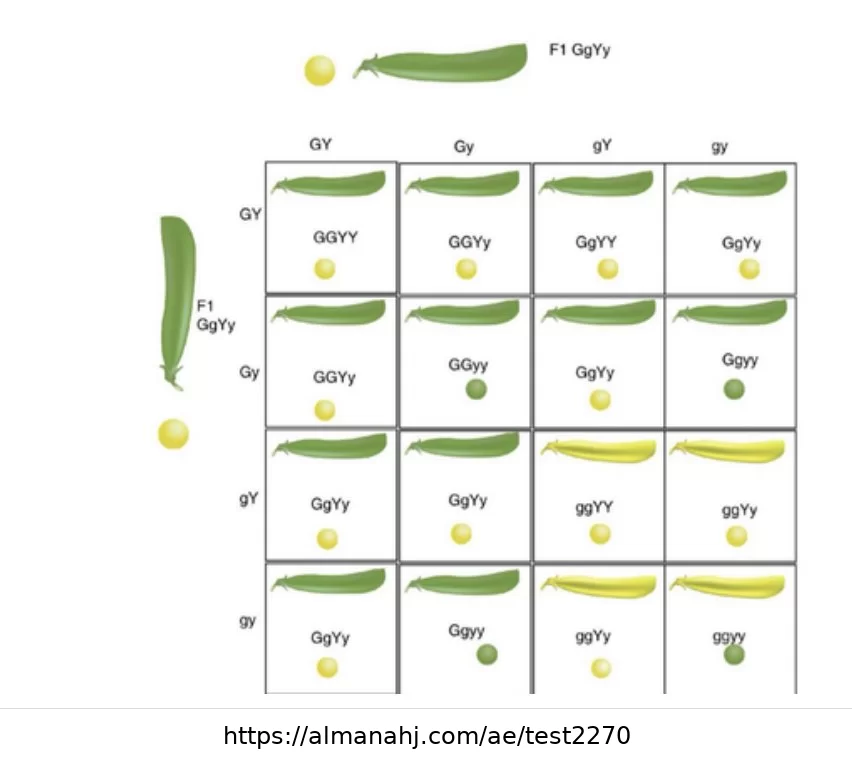
A dihybrid cross is performed between two heterozygous pea plants (GgYy × GgYy). Assuming independent assortment, what is the expected phenotypic ratio in the F₂ generation?
Explanation
A standard dihybrid cross between two individuals heterozygous for both independently assorting genes produces the phenotypic ratio 9:3:3:1.
Question 14
14
Points: 1
Which of the following best describes Mendel’s law of segregation?
Explanation
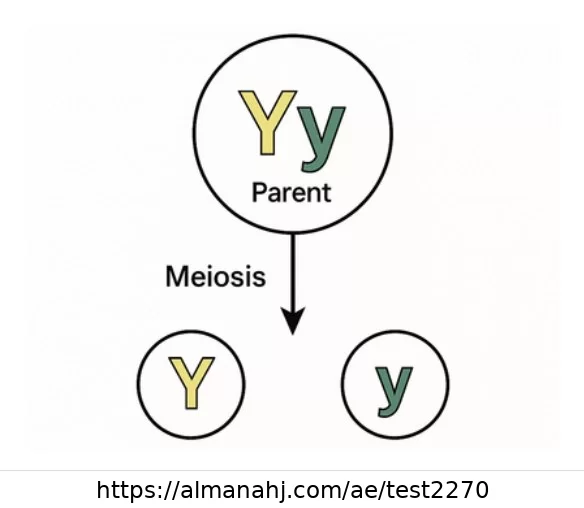
The law of segregation states that the two alleles for a gene separate during gamete formation, so each gamete receives one allele.
Question 15
15
Points: 1
The F₁ generation from crossing true-breeding yellow and green seed plants had what genotype?
Explanation
Crossing homozygous dominant YY with homozygous recessive yy produces offspring that are all heterozygous Yy.
Question 16
16
Points: 1
In a monohybrid cross of heterozygous plants (Yy × Yy), what proportion of offspring are homozygous dominant?
Explanation
Yy × Yy produces YY, Yy, Yy, and yy. One of the four possible offspring genotypes is homozygous dominant YY.
Question 17
17
Points: 1
In Mendel’s experiments, the P generation plants were:
Explanation
Mendel began his crosses using true-breeding parental plants, which were homozygous for the traits being studied.
Question 18
18
Points: 1
Which of the following best demonstrates the process in which alleles separate so that each gamete carries only one allele for each trait?
Explanation
The law of segregation explains that allele pairs separate during gamete formation so each gamete receives only one allele.
Question 19
19
Points: 1
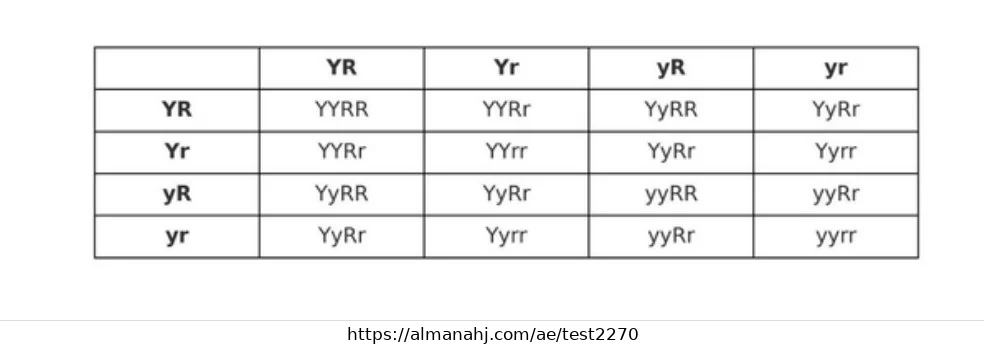
In a dihybrid cross (YyRr × YyRr), what proportion of offspring are expected to be homozygous for both traits?
Explanation
For each gene, the probability of being homozygous is 1/2. For both genes it is 1/2 × 1/2 = 1/4.
Question 20
20
Points: 1
If a plant produces gametes YR, Yr, yR, and yr in equal frequency, what does this suggest?
Explanation
Four equally frequent combinations of the two genes indicate that their alleles assort independently.
Question 21
21
Points: 1
Why did Mendel remove male organs from flowers during cross-pollination?
Explanation
Removing the male reproductive organs prevents the flower from fertilizing itself, allowing Mendel to control which plant supplies the pollen.
Question 22
22
Points: 1
True-breeding plants are always:
Explanation
True-breeding plants are homozygous for the trait, allowing them to consistently produce offspring with that trait when self-fertilized.
Question 23
23
Points: 1
Why did Mendel use pea plants for his experiments?
Explanation
Pea plants have several advantages for genetic studies, including many offspring, controlled pollination, and distinct true-breeding varieties.
Question 24
24
Points: 1
If Mendel’s F₁ yellow-seed plants (Yy) were crossed with green-seed plants (yy), the phenotypic ratio would be:
Explanation
Yy × yy produces 50% Yy yellow offspring and 50% yy green offspring, giving a 1:1 phenotypic ratio.
Question 25
25
Points: 1
In a Punnett square for a trihybrid cross (AaBbCc × AaBbCc), how many squares are needed?
Explanation
Each parent can produce 2³ = 8 types of gametes. A Punnett square therefore requires 8 × 8 = 64 squares.
Question 26
26
Points: 1
A plant has the genotype YyRr. According to the law of independent assortment, how many different types of gametes can this plant produce?
Explanation
The two heterozygous gene pairs produce 2² = 4 possible gametes: YR, Yr, yR, and yr.
Question 27
27
Points: 1
A dihybrid cross between YyRr × YyRr produces which genotypic ratio for the offspring?
Explanation
A dihybrid cross involves 16 possible allele combinations. Its complete genotypic distribution is more complex than the familiar 9:3:3:1 phenotypic ratio.
Question 28
28
Points: 1
Which experimental design choice was most critical for Mendel’s success?
Explanation
Using true-breeding parents gave Mendel genetically consistent starting lines and allowed inheritance patterns to be followed clearly.
Question 29
29
Points: 1
Which of the following represents Mendel’s experiment crossing true-bred white- and purple-flowered pea plants?
Explanation
The cross follows one contrasting characteristic, flower color, so it is a monohybrid cross.
Question 30
30
Points: 1
What is the phenotypic ratio resulting from crossing a black hamster (Bb) with a white hamster (bb)?
Explanation
Bb × bb produces 50% Bb black offspring and 50% bb white offspring, resulting in a 1:1 ratio.
Question 31
31
Points: 1
In garden plants, purple flowers (P) are dominant over white flowers (p), and tall plants (T) are dominant over short plants (t). When PpTt is crossed with pptt, what is the phenotypic ratio?
Explanation
PpTt produces PT, Pt, pT, and pt gametes, while pptt produces only pt. The four resulting phenotypes therefore occur equally, giving a 1:1:1:1 ratio.
Question 32
32
Points: 1
Which of the following statements summarizes the genetic research completed by the Austrian plant breeder Gregor Mendel?
Explanation
Mendel’s experiments with pea plants led him to formulate principles explaining how traits are inherited from parents to offspring.
Question 33
33
Points: 1
Mendel took pollen from a tall pea plant and pollinated a short pea plant. Why was it important that he remove the male parts from the flower of the short plant?
Explanation
Removing the male parts prevents self-pollination and ensures that fertilization occurs using pollen from the selected tall plant.
Question 34
34
Points: 1
A pure-bred tall pea plant (TT) was crossed with a pure-bred short pea plant (tt). All offspring were tall. What is the most likely genotype of the offspring?
Explanation
Every offspring receives T from the TT parent and t from the tt parent, so all offspring have genotype Tt.
Question 35
35
Points: 1
What percentage of offspring will have recessive green seeds if both parent pea plants are hybrids for seed color?
Explanation
Crossing two hybrids Yy × Yy produces YY, Yy, Yy, and yy. Only yy has the recessive phenotype, so the probability is 1/4 or 25%.
Question 36
36
Points: 1
A white mouse with two white parents produces only brown offspring when crossed with a brown mouse. What is the most likely genotype of the white color trait?
Explanation
The white phenotype is recessive, so a white mouse must carry two recessive alleles and therefore be homozygous recessive.
Question 37
37
Points: 1
What describes an allele?
Explanation
An allele is an alternative form of a gene.
Question 38
38
Points: 1
A cross was made between a curled-ear cat and a non-curled-ear cat. All F₁ kittens had non-curled ears. When the F₁ cats were interbred, the phenotypic ratio was 3 non-curled : 1 curled. What can you conclude about the curled-ear trait?
Explanation
The trait that disappears in the F₁ generation and reappears in approximately one quarter of the F₂ generation follows a recessive inheritance pattern.
Question 39
39
Points: 1
What is the phenotypic ratio resulting from crossing a black hamster (Bb) with a white hamster (bb)?
Explanation
The cross Bb × bb produces equal numbers of Bb black and bb white offspring, giving a 1:1 phenotypic ratio.
Question 40
40
Points: 1
Which of the following best describes an organism that has different alleles?
Explanation
A hybrid is heterozygous and carries two different alleles for the gene being considered.
Question 41
41
Points: 1
A curled-ear cat was crossed with a non-curled-ear cat. All F₁ kittens had non-curled ears. When these offspring were crossed with each other, the phenotypic ratio was 3:1 non-curled to curled ears. Which conclusion can be made regarding the curled-ear trait?
Explanation
The 3:1 F₂ ratio indicates complete dominance, with non-curled ears dominant and curled ears recessive.
Question 42
42
Points: 1
Which of the following concepts does NOT follow Mendel’s assortment?
Explanation
According to the supplied answer key, crossing over is the concept identified as not following Mendel’s assortment.
Question 43
43
Points: 1
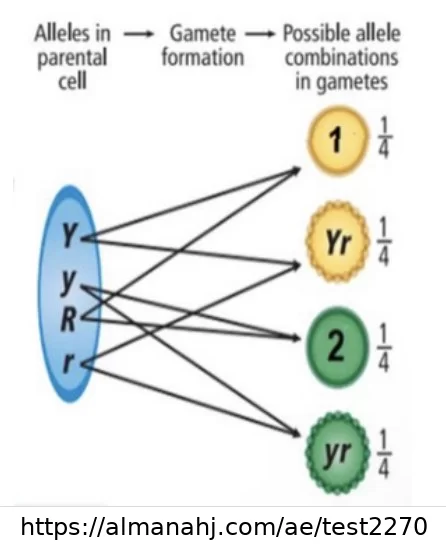
In the diagram illustrating Mendel’s law of independent assortment in a dihybrid cross, which option correctly identifies the gametes represented by numbers (1) and (2)?
Explanation
From the independent-assortment diagram, number (1) represents YR and number (2) represents yR.
Question 44
44
Points: 1
In which situation are the phenotypes of F₂ offspring expected to follow the ratio 9:3:3:1?
Explanation
The classic 9:3:3:1 phenotypic ratio results from a dihybrid cross when the two genes assort independently.
Question 45
45
Points: 1
Two snapdragon plants are crossed, one white-flowered (CᴡCᴡ) and the other pink-flowered (CʳCᴡ). Which ratio describes the phenotypes of the offspring?
Explanation
The white parent produces Cᴡ gametes, while the pink parent produces Cʳ and Cᴡ gametes. Half the offspring are CʳCᴡ pink and half are CᴡCᴡ white.
Question 46
46
Points: 1
In which situation are the phenotypes of F₂ offspring expected to follow the ratio 9:3:3:1?
Explanation
A 9:3:3:1 ratio is characteristic of a dihybrid cross involving two independently assorting genes with complete dominance.
Question 47
47
Points: 1
In a standard dihybrid cross between two pea plants heterozygous for seed color and seed shape, what proportion of the F₂ offspring is expected to have both dominant phenotypes, yellow and round seeds?
Explanation
In a standard dihybrid cross, offspring displaying both dominant phenotypes make up 9 of the 16 possible combinations.
Question 48
48
Points: 1
Which of the following results in four possible gametes, each of which is equally likely to occur in a dihybrid heterozygote?
Explanation
Independent assortment allows a dihybrid heterozygote such as YyRr to produce YR, Yr, yR, and yr gametes with equal probability.
Question 49
49
Points: 1
In the Punnett square shown for a dihybrid cross, which genotype corresponds to the box labeled (A)?
Explanation
According to the labeled Punnett square, box (A) represents the genotype YyRr.
Question 50
50
Points: 1
In the Punnett square shown for a dihybrid cross, which genotype corresponds to the box labeled (A)?
Explanation
The gametes intersecting at box (A) each contribute recessive y and r alleles, producing yyrr.
Question 51
51
Points: 1
In chickens, rose comb (R) is dominant over single comb (r). A homozygous rose-comb chicken (RR) is crossed with a homozygous single-comb chicken (rr), producing F₁ chickens with genotype Rr. When the F₁ chickens are interbred, what is the expected phenotypic ratio in the F₂ generation?
Explanation
Rr × Rr produces RR, Rr, Rr, and rr. Three of four offspring have rose combs and one has a single comb, giving 75% rose and 25% single.
Question 52
52
Points: 1
In mink animals, brown fur (B) is dominant over silver-blue fur (b). A homozygous brown mink (BB) is crossed with a silver-blue mink (bb). If there are 8 offspring, how many are expected to have silver-blue fur?
Explanation
BB × bb produces only Bb offspring. All have the dominant brown phenotype, so none of the 8 offspring is expected to have silver-blue fur.
Question 53
53
Points: 1
If there are five boys and no girls born into a family, what is the probability that the sixth offspring will be a girl?
Explanation
The sex of each offspring is an independent event. The previous five births do not change the probability, so the probability of a girl remains 1/2.
Result Tracking
Answered0 / 53
Correct Answers0
Wrong Answers0
Current Percentage0%
Quiz Completed
This is your final result after answering all questions.
Final Result
0/530%
Correct Answers0
Wrong Answers0
Answered Questions0 / 53
Total Possible Points53
You can reopen the page to start again.
يمكنك تسجيل الدخول لحفظ سجل محاولاتك، معرفة أخطائك المتكررة، والحصول على نصائح مخصصة. تسجيل الدخول باستخدام Google
Here are more quizzes for الصف الثاني عشر المتقدم by الفصل الأول and subject أحياء
This section is rendered only when the user reaches it while scrolling.
...
🍪
إشعار ملفات تعريف الارتباط
يستخدم هذا الموقع ملفات تعريف الارتباط لتحسين تجربة التصفح وقياس الأداء وعرض المحتوى بشكل أفضل.
باستخدامك للموقع فإنك توافق على استخدامنا لها وفق
سياسة الخصوصية.