This comprehensive set of multiple-choice questions covers the fundamental concepts of nuclear physics, including alpha, beta, and gamma radioactive decays. It includes problems on balancing nuclear equations, charge and mass conservation, and calculating remaining activity using half-life graphs and equations. The quiz also explores the mechanisms and applications of nuclear fission and fusion processes.
🏆 انضم إلى التحدي واحصل على ترتيبك
اختبار شهادة تدريبي مؤقت للصف والمادة والفصل نفسه.
اختر إجابة واحدة لكل سؤال. عند الاختيار ستظهر النتيجة فورًا: الأخضر صحيح، والأحمر خطأ، وسيظهر تفسير الإجابة مباشرة إن كان متوفرًا. وبعد آخر سؤال ستظهر الدرجة النهائية تلقائيًا.
Which type of radiation has the highest penetrating ability and requires several centimeters of lead to be stopped?
Explanation
Gamma rays are high-energy photons with no mass or charge, giving them the highest penetrating power compared to alpha or beta particles.
Question 2
2
Points: 1
Match the radiation type with its correct electric charge:
Explanation
Alpha particles consist of two protons and two neutrons (+2 charge), Beta-minus particles are electrons (-1 charge), and Gamma rays are neutral (0 charge).
Question 3
3
Points: 1
When a nucleus undergoes alpha decay, how do its mass number (A) and atomic number (Z) change?
Explanation
An alpha particle is a helium nucleus (^42He), so its emission removes 4 from the mass number and 2 from the atomic number.
Question 4
4
Points: 1
During beta-minus (β^-) decay, what occurs inside the nucleus to produce the emitted electron?
Explanation
In beta-minus decay, a neutron transforms into a proton, an electron (beta particle), and an antineutrino.
Question 5
5
Points: 1
Which of the following is TRUE regarding gamma (γ) decay?
Explanation
Gamma decay is the release of excess energy from an excited nucleus; it does not change the number of protons or neutrons.
Question 6
6
Points: 1
Which radiation type is correctly identified with its physical nature?
Explanation
Alpha radiation consists of helium nuclei (^42He). Beta is an electron/positron, and Gamma is a photon.
Question 7
7
Points: 1
According to the Section Review, why does an alpha particle have very little penetrating power compared to others?
Explanation
Due to its relatively large mass and +2 charge, alpha particles frequently collide with and ionize atoms in their path, losing energy very rapidly.
Question 8
8
Points: 1
In any balanced nuclear equation, what must be true regarding the electric charge?
Explanation
Conservation of charge requires that the total atomic number (representing charge) remains constant across the reaction.
Question 9
9
Points: 1
The Radium isotope ^{226}_{88}Ra undergoes alpha decay to become Radon (^{222}_{86}Rn). Which of the following checks proves that charge is conserved in this reaction?
Explanation
The sum of atomic numbers (subscripts) on the product side (86 + 2 from the alpha particle) equals the atomic number of the parent nucleus (88).
Question 10
10
Points: 1
A Lead isotope ^{209}_{82}Pb decays into Bismuth ^{209}_{83}Bi by emitting a beta particle (^0-1e) and an antineutrino. How is the charge balanced in this equation?
Explanation
Charge conservation is verified by summing the atomic numbers: 82 (Lead) = 83 (Bismuth) + -1 (Beta) + 0 (Antineutrino).
Question 11
11
Points: 1
Consider the reaction: ^{234}_{92}U o ^{230}_{90}Th + X. To conserve both mass number and charge, what must particle X be?
Explanation
The mass change is 234 - 230 = 4 and the charge change is 92 - 90 = 2, which corresponds to an alpha particle (^42He).
Question 12
12
Points: 1
A proton (^11H) collides with Nitrogen-15 (^{15}_7N) to produce an alpha particle (^42He) and a new isotope. Use charge conservation to find the atomic number (Z) of the new isotope.
Explanation
Total initial charge: 1 + 7 = 8. Total final charge: 2 + Z = 8. Therefore, Z = 6, which is Carbon.
Question 13
13
Points: 1
When Nitrogen-14 (^{14}_7N) is bombarded with alpha particles (^42He), a proton (^11H) is emitted along with a new isotope: ^42He + ^{14}_7N o ^11H + ^A_ZX. What are the values of A and Z for the new isotope?
Explanation
Mass: 4 + 14 = 1 + A o A = 17. Charge: 2 + 7 = 1 + Z o Z = 8.
Question 14
14
Points: 1
Based on the reaction in the previous question, which element is represented by the symbol X (where Z = 8)?
Explanation
The element with atomic number Z = 8 is Oxygen.
Question 15
15
Points: 1
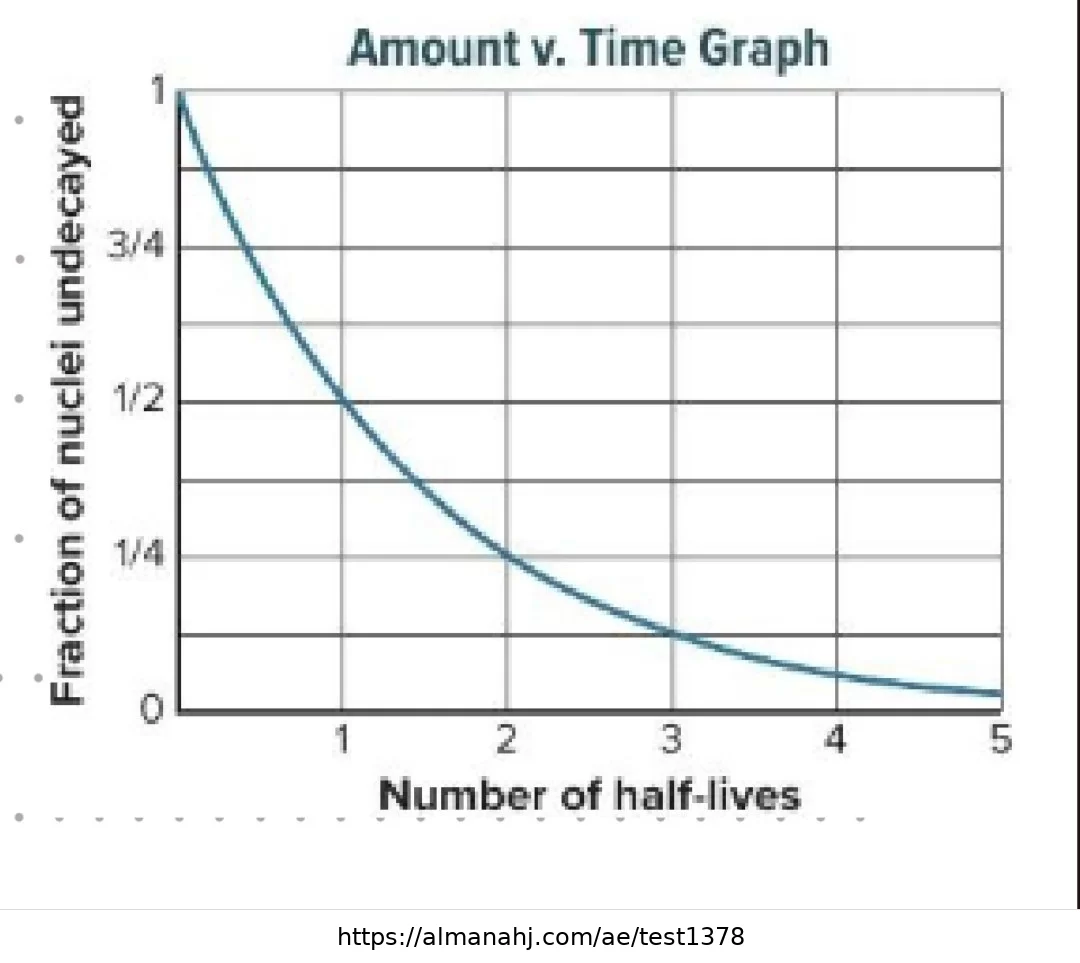
Look at Figure. After a period of time equal to three half-lives, what fraction of the original radioactive nuclei remains undecayed?
Explanation
After 1 half-life 1/2 remains, after 2 half-lives 1/4 remains, and after 3 half-lives (1/2)3 = 1/8 remains.
Question 16
16
Points: 1
A 1.0-g sample of tritium (^31H) is produced. Given that the half-life of tritium is 12.3 years, how much of the sample will remain after 24.6 years?
Explanation
24.6 years is exactly two half-lives (24.6 / 12.3 = 2). 1.0 ext{ g} imes (1/2)2 = 0.25 ext{ g}.
Question 17
17
Points: 1
A sample of polonium-210 has an initial activity of 2 imes 106 Bq. If the sample is kept for a duration equal to two half-lives, what will its activity be?
Explanation
After two half-lives, the activity reduces to one-fourth of its initial value: (2 imes 106) / 4 = 0.5 imes 106 = 5 imes 105 Bq.
Question 18
18
Points: 1
Which of the following best defines the "half-life" of a radioactive isotope?
Explanation
Half-life is the characteristic time it takes for 50% of a radioactive sample's nuclei to undergo decay.
Question 19
19
Points: 1
The process in which a heavy nucleus divides into two or more fragments, releasing a large amount of energy and additional neutrons, is called:
Explanation
Nuclear fission involves splitting a heavy nucleus into smaller daughter nuclei and neutrons, releasing energy.
Question 20
20
Points: 1
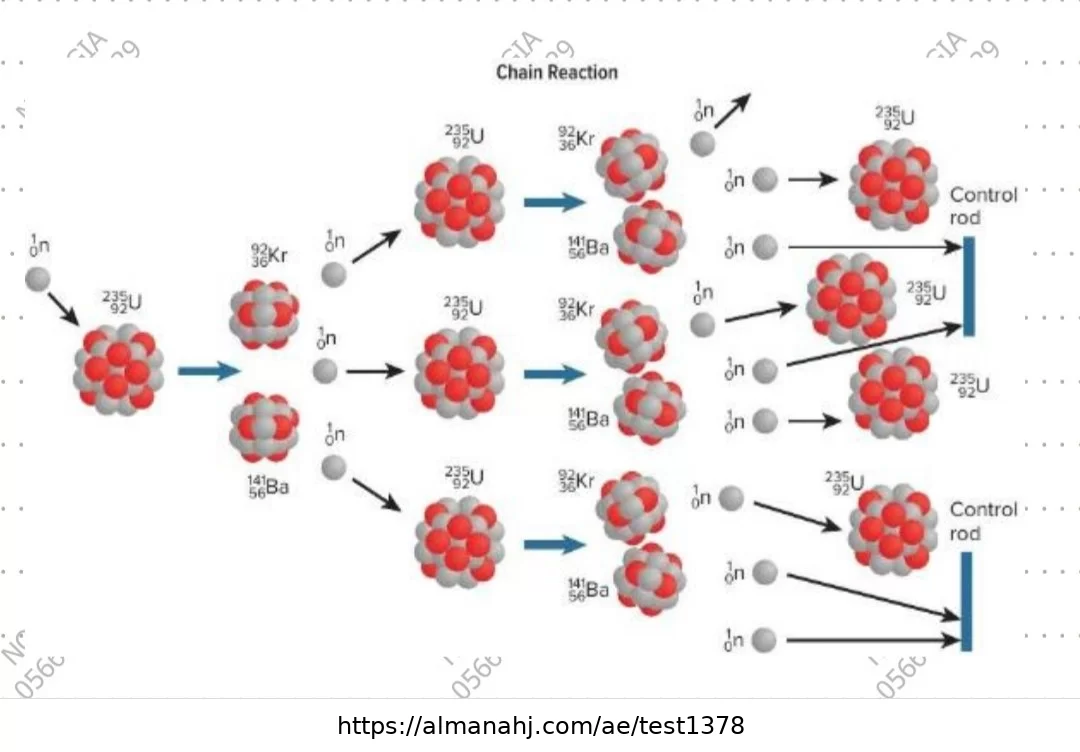
Look at Figure 12 on page 121. What causes a "chain reaction" to continue in a sample of Uranium-235?
Explanation
In a chain reaction, the neutrons emitted from one fission reaction strike other fissile nuclei, causing them to split in turn.
Question 21
21
Points: 1
In a nuclear reactor, what is the specific purpose of Cadmium control rods, as shown in the diagram on page 122?
Explanation
Control rods are made of materials like cadmium that absorb neutrons to prevent the chain reaction from becoming uncontrolled.
Question 22
22
Points: 1
Nuclear fusion is the process in which:
Explanation
Nuclear fusion involves joining light nuclei (like hydrogen isotopes) to form a heavier, more stable nucleus.
Question 23
23
Points: 1
Why does nuclear fusion (like the proton-proton chain in the Sun) require extremely high temperatures (around 2 imes 107 K)?
Explanation
Positively charged nuclei repel each other; high temperatures provide the kinetic energy needed to get them close enough for the strong nuclear force to take over.
Result Tracking
Answered0 / 23
Correct Answers0
Wrong Answers0
Current Percentage0%
Quiz Completed
This is your final result after answering all questions.
Final Result
0/230%
Correct Answers0
Wrong Answers0
Answered Questions0 / 23
Total Possible Points23
You can reopen the page to start again.
يمكنك تسجيل الدخول لحفظ سجل محاولاتك، معرفة أخطائك المتكررة، والحصول على نصائح مخصصة. تسجيل الدخول باستخدام Google
Here are more quizzes for الصف الثاني عشر المتقدم by الفصل الثالث and subject فيزياء
This section is rendered only when the user reaches it while scrolling.
...
🍪
إشعار ملفات تعريف الارتباط
يستخدم هذا الموقع ملفات تعريف الارتباط لتحسين تجربة التصفح وقياس الأداء وعرض المحتوى بشكل أفضل.
باستخدامك للموقع فإنك توافق على استخدامنا لها وفق
سياسة الخصوصية.