Interactive multiple-choice quiz: Atomic and Nuclear Physics Review
This document contains a series of multiple-choice questions focusing on atomic structure, Bohr's model, and nuclear physics concepts. Topics covered include isotopes, nuclear notation, nucleon properties, strong nuclear force, mass defect, and binding energy calculations.
🏆 انضم إلى التحدي واحصل على ترتيبك
اختبار شهادة تدريبي مؤقت للصف والمادة والفصل نفسه.
اختر إجابة واحدة لكل سؤال. عند الاختيار ستظهر النتيجة فورًا: الأخضر صحيح، والأحمر خطأ، وسيظهر تفسير الإجابة مباشرة إن كان متوفرًا. وبعد آخر سؤال ستظهر الدرجة النهائية تلقائيًا.
Starting from Bohr's quantized angular momentum ($mvr = n\frac{h}{2\pi}$), which step leads directly to the stable orbit circumference equation?
Explanation
Rearranging the angular momentum equation $mvr = n\frac{h}{2\pi}$ gives $2\pi r = n\frac{h}{mv}$, which relates the circumference to the de Broglie wavelength.
Question 2
2
Points: 1
Protons and neutrons are collectively referred to by which of the following terms?
Explanation
Nucleons is the collective term for the particles found in the atomic nucleus, namely protons and neutrons.
Question 3
3
Points: 1
The total number of nucleons (protons plus neutrons) in an atom is defined as the:
Explanation
The mass number (A) represents the sum of protons and neutrons in the nucleus.
Question 4
4
Points: 1
In the standard nuclear notation {}_{Z}^{A}X, what does the subscript Z represent?
Explanation
In nuclear notation, the subscript Z is the atomic number, which identifies the number of protons in the nucleus.
Question 5
5
Points: 1
An atom of Uranium-235 is represented as {}_{92}^{235}U. How many neutrons are in the nucleus of this isotope?
Explanation
The number of neutrons is found by subtracting the atomic number from the mass number: 235 - 92 = 143.
Question 6
6
Points: 1
How many neutrons are present in the nucleus of the mercury isotope {}_{80}^{200}Hg?
Explanation
Neutrons = Mass Number (A) - Atomic Number (Z) = 200 - 80 = 120.
Question 7
7
Points: 1
An isotope of oxygen has a mass number of 15. Given that oxygen's atomic number (Z) is 8, how many neutrons does this specific isotope have?
Explanation
The number of neutrons is A - Z = 15 - 8 = 7.
Question 8
8
Points: 1
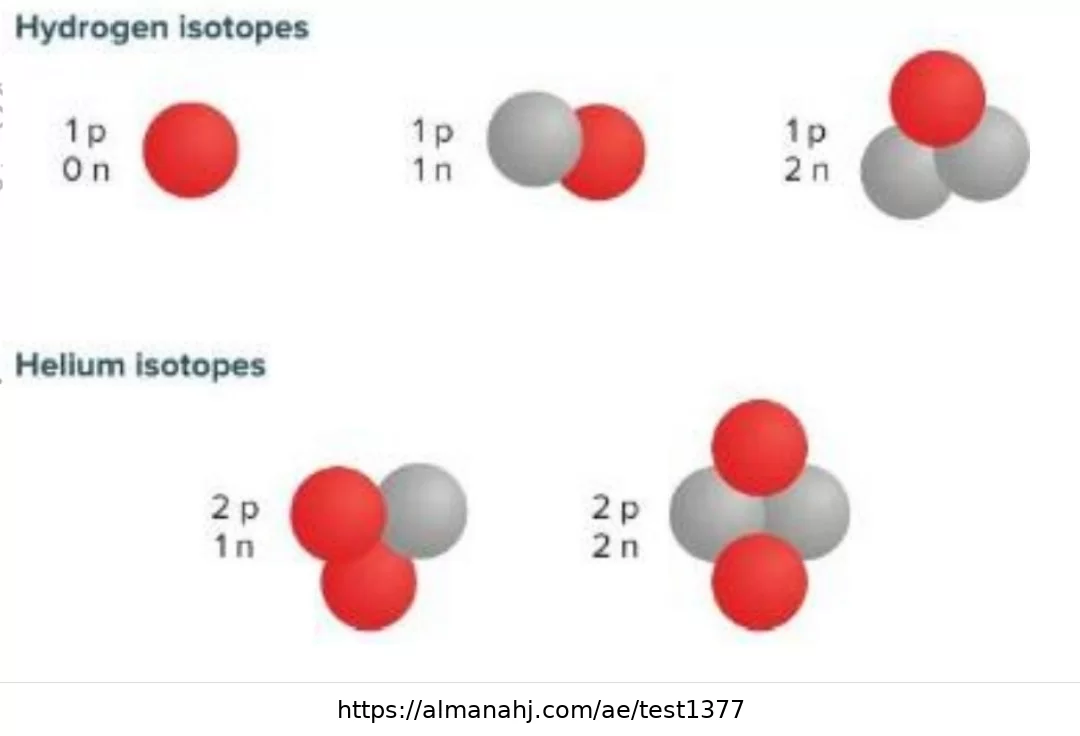
Which of the following symbols correctly represents an isotope of hydrogen that contains two neutrons in its nucleus?
Explanation
Hydrogen has 1 proton. If it has 2 neutrons, the mass number A = 1 + 2 = 3. The symbol is {}_{1}^{3}H (tritium).
Question 9
9
Points: 1
Look at Figure 3. What is the main difference between the three isotopes of hydrogen shown?
Explanation
Isotopes are atoms of the same element (same number of protons) but with different numbers of neutrons.
Question 10
10
Points: 1
The attractive force that acts between nucleons (protons and neutrons) and holds the nucleus together is known as the:
Explanation
The strong nuclear force is the powerful attractive force that binds protons and neutrons together in the nucleus.
Question 11
11
Points: 1
Look at Figure. According to the diagram and the text, between which pairs of nucleons does the strong nuclear force act?
Explanation
The strong nuclear force acts between all pairs of nucleons (protons and neutrons) regardless of their charge.
Question 12
12
Points: 1
How does the strength and range of the strong nuclear force compare to the electromagnetic force?
Explanation
The strong force is much stronger than the electromagnetic force to overcome proton repulsion, but its range is limited to the dimensions of the nucleus.
Question 13
13
Points: 1
What is "mass defect" in nuclear physics?
Explanation
Mass defect is the missing mass that is converted into energy to bind the nucleus together.
Question 14
14
Points: 1
Why don't the protons in a nucleus fly apart due to their mutual electromagnetic repulsion?
Explanation
The strong nuclear force acts as a 'glue' that is significantly stronger than the electrostatic repulsion between positively charged protons.
Question 15
15
Points: 1
The mass of the tritium isotope ({}_{1}^{3}H) is 3.016049 u. Given the mass of a hydrogen atom (1p + 1e) is 1.007825 u and the mass of a neutron is 1.008665 u, what is the mass defect ($\Delta m$) of tritium?
Explanation
Mass defect = [Mass of 1 H atom + 2(Mass of neutron)] - Mass of Tritium = [1.007825 + 2(1.008665)] - 3.016049 = 3.025155 - 3.016049 = 0.009106 u.
Question 16
16
Points: 1
Based on the mass defect of tritium (0.009106 u), what is its binding energy in MeV? (Use 1u = 931.49 MeV)
Explanation
Binding energy = mass defect × energy per u = $0.009106 \times 931.49 \approx 8.48$ MeV.
Question 17
17
Points: 1
The carbon isotope {}_{6}^{12}C has a measured mass of exactly 12.000000 u. What is its mass defect?
Explanation
For C-12 (6p, 6n): $\Delta m = [6(1.007825) + 6(1.008665)] - 12.000000 = 12.098940 - 12.000000 = 0.098940$ u.
Question 18
18
Points: 1
A nitrogen isotope ({}_{7}^{15}N) has a mass of 15.010109 u. What is its binding energy?
Explanation
For N-15 (7p, 8n): $\Delta m = [7(1.007825) + 8(1.008665)] - 15.010109 = 15.124095 - 15.010109 = 0.113986$ u. Energy = $0.113986 \times 931.49 \approx 106.18$ MeV.
Result Tracking
Answered0 / 18
Correct Answers0
Wrong Answers0
Current Percentage0%
Quiz Completed
This is your final result after answering all questions.
Final Result
0/180%
Correct Answers0
Wrong Answers0
Answered Questions0 / 18
Total Possible Points18
You can reopen the page to start again.
يمكنك تسجيل الدخول لحفظ سجل محاولاتك، معرفة أخطائك المتكررة، والحصول على نصائح مخصصة. تسجيل الدخول باستخدام Google
Here are more quizzes for الصف الثاني عشر المتقدم by الفصل الثالث and subject فيزياء
This section is rendered only when the user reaches it while scrolling.
...
🍪
إشعار ملفات تعريف الارتباط
يستخدم هذا الموقع ملفات تعريف الارتباط لتحسين تجربة التصفح وقياس الأداء وعرض المحتوى بشكل أفضل.
باستخدامك للموقع فإنك توافق على استخدامنا لها وفق
سياسة الخصوصية.