This document contains a comprehensive set of multiple-choice questions for Grade 12 Advanced Physics, focusing on Module 10: Energy and Its Conservation and Module 22: Quantum Theory and the Atom. The questions cover topics such as Gravitational Potential Energy, Kinetic Energy, Work-Energy Theorem, Elastic Potential Energy, Conservation of Mechanical Energy, Rotational Kinetic Energy, and the Bohr Model of the Atom. Detailed explanations are provided for each question to clarify physical concepts and calculations.
🏆 انضم إلى التحدي واحصل على ترتيبك
اختبار شهادة تدريبي مؤقت للصف والمادة والفصل نفسه.
اختر إجابة واحدة لكل سؤال. عند الاختيار ستظهر النتيجة فورًا: الأخضر صحيح، والأحمر خطأ، وسيظهر تفسير الإجابة مباشرة إن كان متوفرًا. وبعد آخر سؤال ستظهر الدرجة النهائية تلقائيًا.
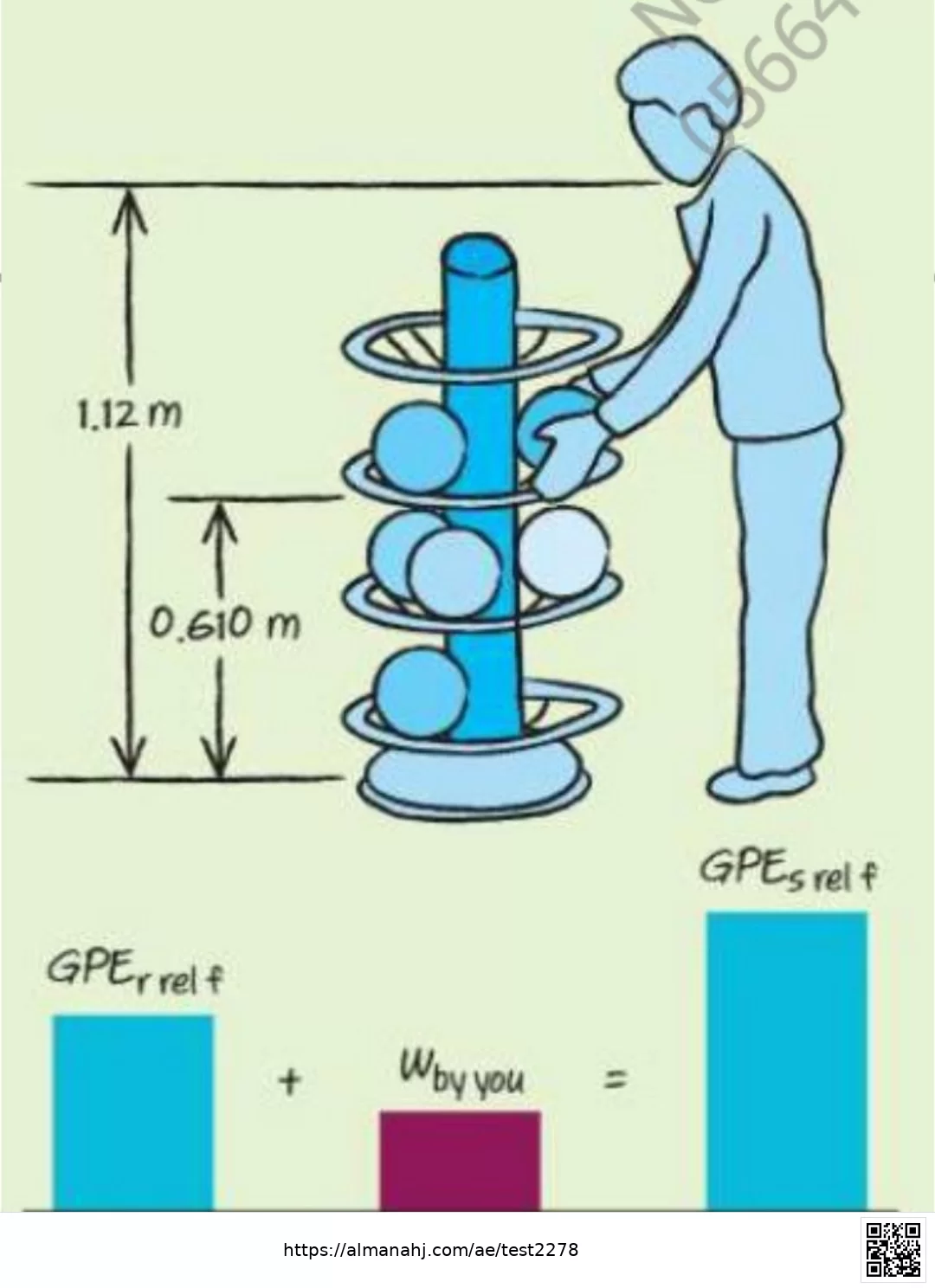
You lift a 7.30-kg bowling ball from the storage rack and hold it up to your shoulder. The storage rack is 0.610 m above the floor and your shoulder is 1.12 m above the floor. When the bowling ball is at your shoulder, what is the ball-Earth system's gravitational potential energy relative to the floor?
Explanation
PE is calculated as mgh. Using the floor as reference (h=1.12 m): PE = 7.30 × 9.8 × 1.12 = 80.1 J, which is 8.0 × 101 J.
Question 2
2
Points: 1
Referring to the bowling ball problem, when the ball is at your shoulder, what is the ball-Earth system's gravitational potential energy relative to the rack?
Explanation
Relative to the rack, the height is 1.12 - 0.610 = 0.51 m. PE = 7.30 × 9.8 × 0.51 = 36.48 J.
Question 3
3
Points: 1
How much work was done by gravity as you lifted the ball from the rack to shoulder level?
Explanation
Work done by gravity is $- \Delta PE$. Since the potential energy increased by 36 J during the lift, the work done by gravity is -36 J.
Question 4
4
Points: 1
What is the potential energy of the ball-Earth system when the bowling ball is on the floor? Use the rack as your reference level.
Explanation
The floor is 0.610 m below the reference level (the rack), so h = -0.610 m. PE = 7.30 × 9.8 × (-0.610) = -43.6 J.
Question 5
5
Points: 1
If you slowly lower a 20.0-kg bag of sand 1.20 m from the trunk of a car to the driveway, how much work do you do?
Explanation
When lowering slowly, the force you apply is upwards while displacement is downwards. $W = \Delta PE = mg(h_f - h_i) = 20.0 \times 9.8 \times (-1.20) = -235.2$ J.
Question 6
6
Points: 1
A boy lifts a 2.2-kg book from his desk, which is 0.80 m high, to a bookshelf that is 2.10 m high. What is the potential energy of the book-Earth system relative to the desk when the book is on the shelf?
Explanation
Height relative to the desk is 2.10 - 0.80 = 1.30 m. PE = 2.2 × 9.8 × 1.30 = 28.028 J.
Question 7
7
Points: 1
A worker picks up a 10.1-kg box from the floor and sets it on a table that is 1.1 m high. He slides the box 5.0 m along the table and then lowers it back to the floor. What were the changes in the box-Earth system's energy, and how did the system's total energy change? (Ignore friction.)
Explanation
Since the box starts and ends at the floor level, the net change in potential energy is zero. Without friction, no work is lost as heat, so total energy remains unchanged.
Question 8
8
Points: 1
A 25.0-kg shell is shot from a cannon at Earth’s surface. The reference level is Earth’s surface. What is the shell-Earth system's gravitational potential energy when the shell's height is 425 m?
Explanation
PE = mgh = 25.0 × 9.8 × 425 = 104,125 J, which is 1.04 × 10⁵ J.
Question 9
9
Points: 1
On a playground, some children push a merry-go-round so that it turns twice as fast as it did before they pushed it. What are the relative changes in angular momentum and rotational kinetic energy of the merry-go-round?
Explanation
Angular momentum $L = I\omega$, so doubling $\omega$ doubles L. Rotational KE $K = \frac{1}{2}I\omega^2$, so doubling $\omega$ increases K by 22 = 4.
Question 10
10
Points: 1
A 12.0-kg box is lifted from the floor to a shelf 2.50 m high. What is the gravitational potential energy of the box-Earth system relative to the floor?
Explanation
PE = mgh = 12.0 × 9.8 × 2.50 = 294 J.
Question 11
11
Points: 1
A spring with a spring constant of k = 400 N/m is compressed by 0.050 m. What is the elastic potential energy stored in the spring?
Explanation
Elastic PE $PE_{sp} = \frac{1}{2}kx^2 = 0.5 \times 400 \times (0.050)^2 = 200 \times 0.0025 = 0.50$ J.
Question 12
12
Points: 1
If the angular velocity of a rotating disk triples (increases by a factor of 3), how does its rotational kinetic energy change?
Explanation
KE depends on the square of velocity ($K \propto \omega^2$). If $\omega$ is tripled, KE increases by 32 = 9.
Question 13
13
Points: 1
A 22.0-kg tree limb is 13.3 m above the ground. During a tropical storm, it falls on a roof that is 6.0 m above the ground. What is the limb's speed when it reaches the roof?
In a belly-flop diving contest, Diver 1 has a mass of 136 kg and steps off a 3.00 m platform. Diver 2 has a mass of 100 kg and leaps upward from the same platform. To what vertical height above the platform must Diver 2 leap so that their impact kinetic energy equals that of Diver 1?
An 8.00-g bullet is fired horizontally into a 9.00-kg block of wood and is embedded in it. After the collision, they slide together at 10.0 cm/s. What was the initial speed of the bullet?
Explanation
Using momentum conservation (m1v1 = (m1+m2)v_f): $0.008 \times v_1 = (9.008) \times 0.10 \implies v_1 = 0.9008 / 0.008 = 112.6$ m/s, which rounds to 113 m/s.
Question 16
16
Points: 1
A 36.0-kg child slides down a playground slide from an initial height of 2.5 m. At the bottom, she moves at 3.0 m/s. How much energy was transformed into thermal energy by friction?
Explanation
Initial energy E_i = mgh = 36 × 9.8 × 2.5 = 882 J. Final KE $K_f = \frac{1}{2}mv^2 = 0.5 \times 36 \times 3^2 = 162$ J. Thermal energy = 882 - 162 = 720 J.
Question 17
17
Points: 1
Which phenomenon could not be explained by classical electromagnetic wave theory?
Explanation
Classical wave theory failed to explain the discrete lines in emission spectra and the ultraviolet catastrophe; these required quantum theory.
Question 18
18
Points: 1
Which of the following equations represents the momentum of a photon?
Explanation
According to de Broglie and Einstein, the momentum of a massless photon is related to its wavelength by $p = h/\lambda$.
Question 19
19
Points: 1
As the temperature of an object increases, the frequency at which maximum energy is emitted:
Explanation
According to Wien's Law and Planck's Law, as temperature rises, the peak of the emission curve shifts toward higher frequencies (shorter wavelengths).
Question 20
20
Points: 1
The vibrating object emits energy in the form of light with a frequency of 5.0 × 10¹⁴ Hz. If the energy is emitted in a single step, find the energy lost by the object.
Explanation
E = hf = 6.63 × 10-34 × 5.0 × 1014 = 3.315 × 10⁻¹⁹ J.
Question 21
21
Points: 1
If frequency doubles, the photon energy will:
Explanation
Energy is directly proportional to frequency (E = hf). If frequency doubles, energy doubles.
Question 22
22
Points: 1
If the temperature of an object doubles, what factor changes the total energy emitted by the object?
Explanation
According to the Stefan-Boltzmann law, the power (energy per time) emitted is proportional to T4. If T doubles, energy increases by 24 = 16.
Question 23
23
Points: 1
Calculate the energy difference between E3 and E2 in the hydrogen atom.
Explanation
In Hydrogen, E_n = -13.6/n2. E3 = -1.51 eV and E2 = -3.4 eV. $\Delta E = |-1.51 - (-3.4)| = 1.89$ eV.
Question 24
24
Points: 1
What is the de Broglie wavelength of a 7.0-kg bowling ball rolling at 8.5 m/s?
Here are more quizzes for الصف الثاني عشر المتقدم by الفصل الأول and subject فيزياء
This section is rendered only when the user reaches it while scrolling.
...
🍪
إشعار ملفات تعريف الارتباط
يستخدم هذا الموقع ملفات تعريف الارتباط لتحسين تجربة التصفح وقياس الأداء وعرض المحتوى بشكل أفضل.
باستخدامك للموقع فإنك توافق على استخدامنا لها وفق
سياسة الخصوصية.