Interactive multiple-choice quiz: Newton's 2nd Law Practice - inspire
Newton's Second Law of Motion: This set of practice problems focuses on the application of Newton's Second Law, which relates force, mass, and acceleration through the formula \(F = ma\). Students are asked to perform various calculations to find missing variables, interpret free-body diagrams to determine net force and resulting mass, and analyze graphical data showing the relationship between force and acceleration. The worksheet also covers the algebraic manipulation of the formula to solve for specific variables.
🏆 انضم إلى التحدي واحصل على ترتيبك
اختبار شهادة تدريبي مؤقت للصف والمادة والفصل نفسه.
اختر إجابة واحدة لكل سؤال. عند الاختيار ستظهر النتيجة فورًا: الأخضر صحيح، والأحمر خطأ، وسيظهر تفسير الإجابة مباشرة إن كان متوفرًا. وبعد آخر سؤال ستظهر الدرجة النهائية تلقائيًا.
(Use Fnet=ma). What is the acceleration of a softball if it has a mass of \(0.5\, kg\) and hits the catcher's mitt with a force of \(25\, N\)?
Explanation
Acceleration is force divided by mass: \(a = 25\, N / 0.5\, kg = 50\, m/s^{2}\). Note that the unit in the correct option is written as kg in the original document instead of m/s2.
(Use Fnet=ma). If an object was accelerating at \(10\, m/s^{2}\), and a force of \(10\, newtons\) was required to accelerate it, what was the object's mass? (m=F/a)
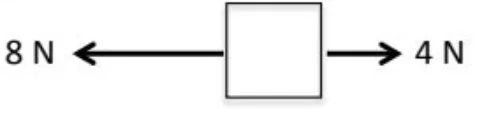
(Use Fnet=ma). Use the diagram to determine the net force, assume the object is accelerating at a rate of \(2\, m/s^{2}\) and determine the mass of the object.
Explanation
The net force from the diagram is \(8\, N - 4\, N = 4\, N\). With an acceleration of \(2\, m/s^{2}\), the mass is \(m = F_{net}/a = 4\, N / 2\, m/s^{2} = 2\, kg\).
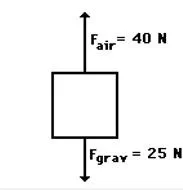
(Use Fnet=ma). Use the diagram to determine the net force, assume the object is accelerating at a rate of \(3\, m/s^{2}\), and determine the object's mass?
Explanation
The net force is \(F_{air} - F_{grav} = 40\, N - 25\, N = 15\, N\). The mass is \(m = F_{net}/a = 15\, N / 3\, m/s^{2} = 5\, kg\).
The larger the mass you have the _____ force you need to change its motion.
Explanation
According to F = ma, force is directly proportional to mass. Therefore, a larger mass requires more force to achieve the same change in motion (acceleration).
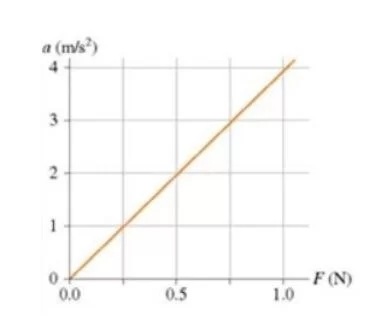
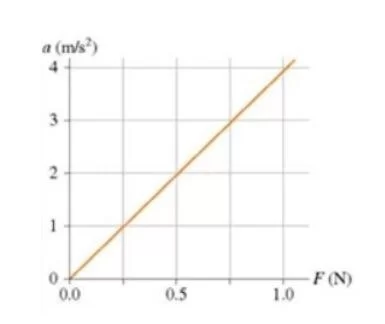
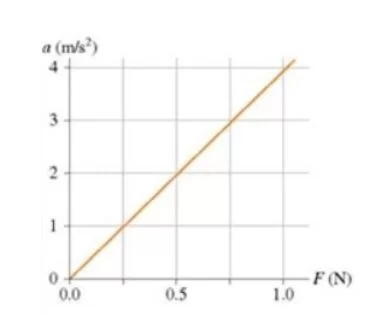
Using Newtons 2nd Law of F=MA, and using the slope of the line in the graph provided, How much mass does this object have when it is accelerated at a rate of \(4\, m/s^{2}\)? (Hint: find the amount of force from the slope first.)
Explanation
From the graph, an acceleration of \(4\, m/s^{2}\) corresponds to a force of \(1.0\, N\). Using m = F/a, the mass is \(1.0 / 4 = 0.25\, kg\). Note: the unit in the option is incorrectly written as 'N' instead of 'kg' in the source.
Here are more quizzes for الصف الحادي عشر المتقدم by الفصل الثالث and subject فيزياء
This section is rendered only when the user reaches it while scrolling.
...
🍪
إشعار ملفات تعريف الارتباط
يستخدم هذا الموقع ملفات تعريف الارتباط لتحسين تجربة التصفح وقياس الأداء وعرض المحتوى بشكل أفضل.
باستخدامك للموقع فإنك توافق على استخدامنا لها وفق
سياسة الخصوصية.