Interactive multiple-choice quiz: Newton's 1st and 2nd Laws - inspire
Newton's First and Second Laws of Motion explain the relationship between an object's mass and the forces acting upon it. The First Law, often called the Law of Inertia, states that objects resist changes to their state of motion; an object at rest stays at rest, and an object in motion continues at a constant velocity unless an unbalanced force acts on it. Inertia is directly dependent on mass, meaning heavier objects have more inertia. The Second Law defines the relationship between force, mass, and acceleration, summarized by the formula \(F = m \cdot a\). This law implies that the acceleration of an object is produced when a force acts on a mass, and the greater the mass of the object, the greater the amount of force needed to accelerate it. Common units in these studies include kilograms for mass and Newtons for force.
🏆 انضم إلى التحدي واحصل على ترتيبك
اختبار شهادة تدريبي مؤقت للصف والمادة والفصل نفسه.
اختر إجابة واحدة لكل سؤال. عند الاختيار ستظهر النتيجة فورًا: الأخضر صحيح، والأحمر خطأ، وسيظهر تفسير الإجابة مباشرة إن كان متوفرًا. وبعد آخر سؤال ستظهر الدرجة النهائية تلقائيًا.
Newton's first law is commonly referred to as the Law of Inertia because it describes the tendency of objects to resist changes in their state of motion.
Newton's First Law describes the behavior of objects at rest (nonmoving) and objects in motion, stating they will maintain their state unless forced to change.
With unbalanced forces, the object will move in the direction of the _______ force.
Explanation
Net force is determined by the vector sum of forces; the object accelerates in the direction of the resulting net force, which is dictated by the larger force when forces are opposing.
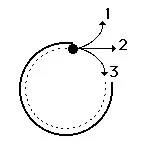
A group of physics teachers are taking some time off for a little putt-putt golf. The 15th hole at the Hole-In-One Putt-Putt Golf Course has a large metal rim that putters must use to guide their ball towards the hole. Mr. S guides a golf ball around the metal rim When the ball leaves the rim, which path (1, 2, or 3) will the golf ball follow?
Explanation
When the ball leaves the circular rim, the centripetal force holding it in a curve vanishes. According to Newton's First Law, the ball will then travel in a straight line tangent to the exit point (Path 2).
According to Newton's second Law, which would take more force to slow down?
Explanation
Slowing down is a form of acceleration (deceleration). Based on the context provided in the answer key, the silver car is assumed to have more mass, requiring more force to change its state of motion.
Newton's Second Law implies that force is directly proportional to mass (F = m × a); thus, a larger mass requires a larger force for a given acceleration.
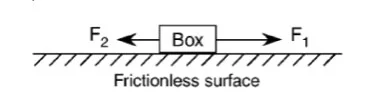
In the diagram below, a box is on a frictionless horizontal surface with forces F1 and F2 acting shown. If the magnitude of F1 is greater than the magnitude of F2, then the box is
Explanation
Because there is a net unbalanced force in the direction of the larger force (F1), the object must accelerate in that direction according to Newton's Second Law.
Here are more quizzes for الصف الحادي عشر المتقدم by الفصل الثالث and subject فيزياء
This section is rendered only when the user reaches it while scrolling.
...
🍪
إشعار ملفات تعريف الارتباط
يستخدم هذا الموقع ملفات تعريف الارتباط لتحسين تجربة التصفح وقياس الأداء وعرض المحتوى بشكل أفضل.
باستخدامك للموقع فإنك توافق على استخدامنا لها وفق
سياسة الخصوصية.