Interactive multiple-choice quiz: اختبار الوحدة الثانية (Quadrilaterals) الرياضيات - ريفيل الصف العاشر المتقدم - الفصل الأول لعام 2026 - 2027
يغطي هذا الاختبار موضوعات الوحدة الثانية من منهج الرياضيات للصف العاشر المتقدم، والمتعلقة بخصائص الأشكال الرباعية مثل متوازي الأضلاع، والمستطيل، والمعين، والمربع، وشبه المنحرف، والطائرة الورقية. تشمل الأسئلة تطبيقات على حساب الزوايا الداخلية والخارجية، واستخدام إحداثيات الرؤوس للتحقق من نوع الشكل الرباعي، بالإضافة إلى حساب أطوال الأضلاع والمنصفات في الأشكال الهندسية المختلفة.
🏆 انضم إلى التحدي واحصل على ترتيبك
اختبار شهادة تدريبي مؤقت للصف والمادة والفصل نفسه.
اختر إجابة واحدة لكل سؤال. عند الاختيار ستظهر النتيجة فورًا: الأخضر صحيح، والأحمر خطأ، وسيظهر تفسير الإجابة مباشرة إن كان متوفرًا. وبعد آخر سؤال ستظهر الدرجة النهائية تلقائيًا.
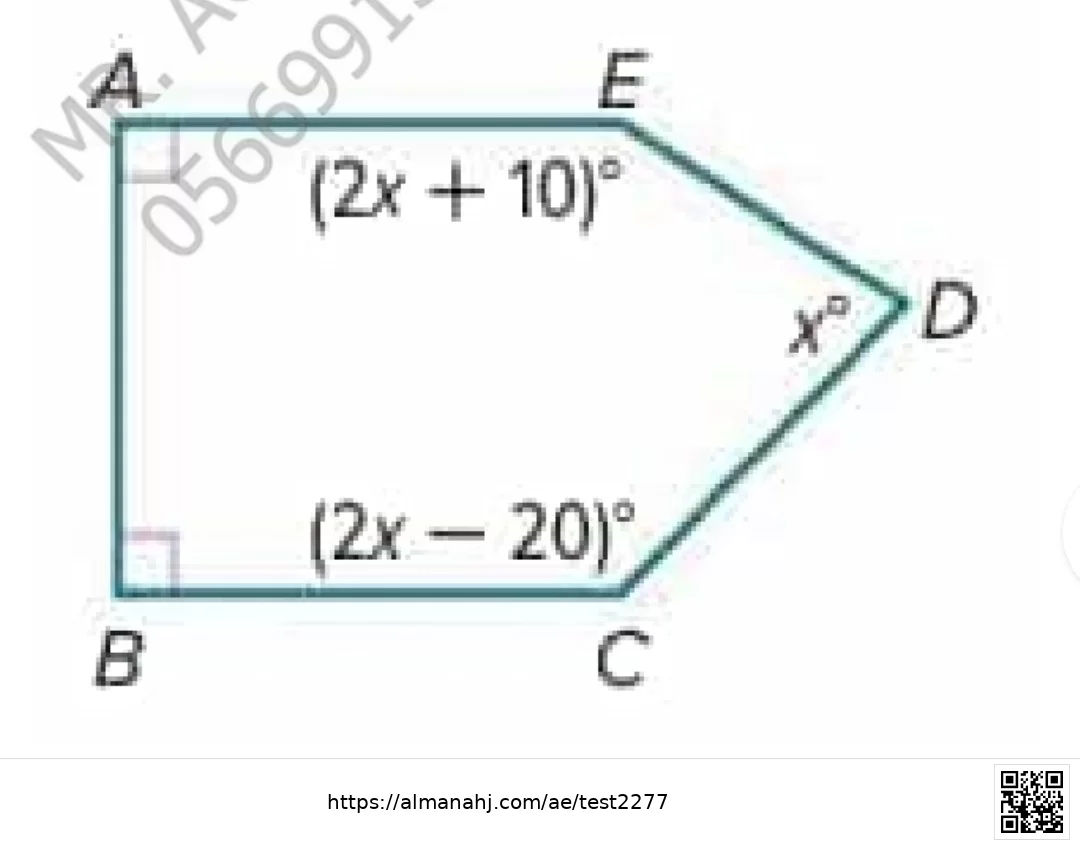
The sum of interior angles of a pentagon is $540^\circ$. By setting up the equation 90 + 90 + (2x+10) + x + (2x-20) = 540, we find x=74, which leads to the measures in option B.
Question 2
2
Points: 1
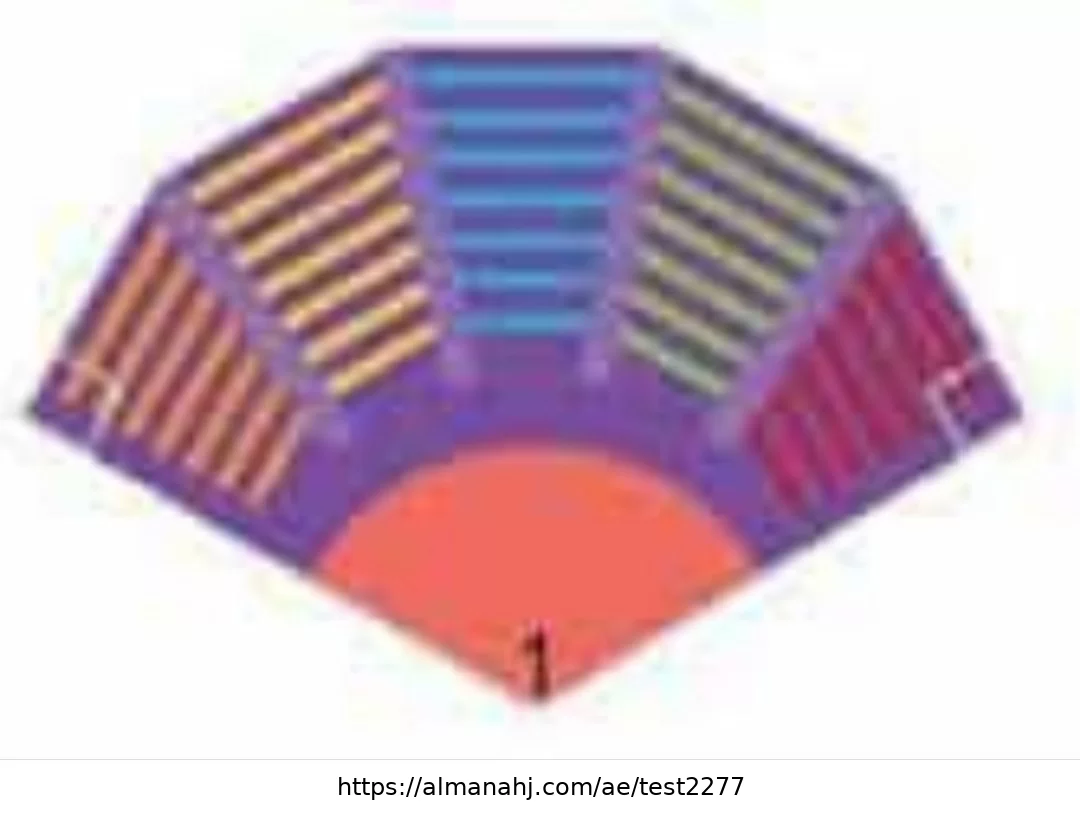
A theater floor plan is shown in the figure. The upper five sides are part of a regular dodecagon. Find $m\angle 1$.
Explanation
The interior angle of a regular dodecagon (n=12) is calculated as $\frac{(12-2)180}{12} = 150^\circ$.
Question 3
3
Points: 1
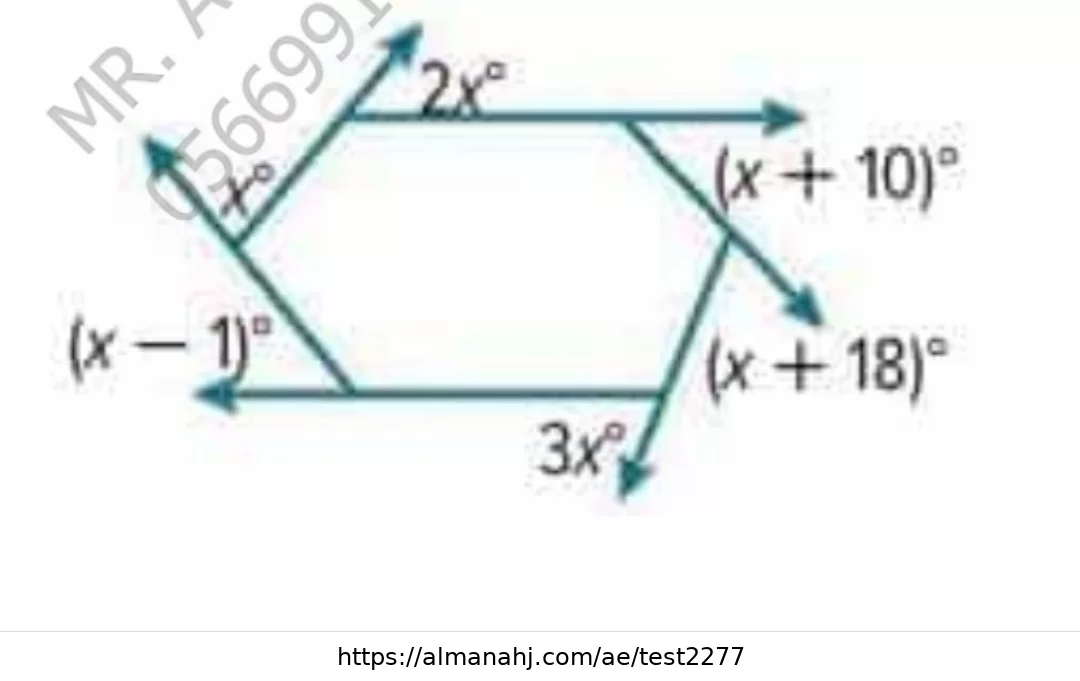
Find the value of x in the diagram.
Explanation
Assuming these are exterior angles, their sum is $360^\circ$. Solving (2x) + (x+10) + (x+18) + (3x) + (x-1) = 360 gives 8x + 27 = 360, leading to $x \approx 41.6$, so 41 is the closest match.
Question 4
4
Points: 1
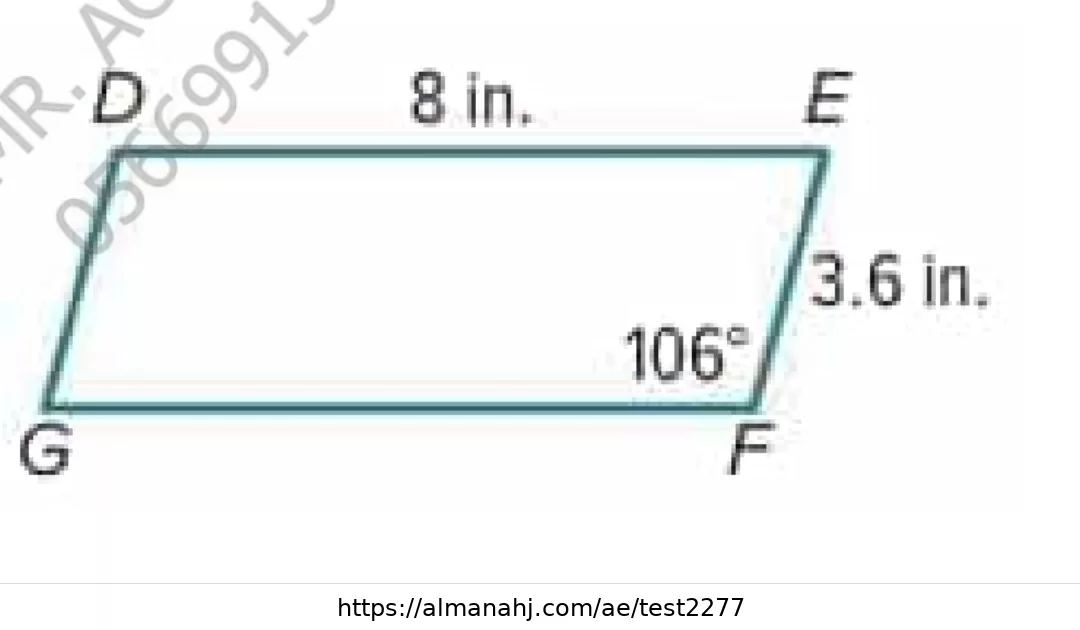
Find the measure. $FG = \dots$ in.
Explanation
In a parallelogram, opposite sides are congruent. Therefore, FG = DE = 8 inches.
Question 5
5
Points: 1
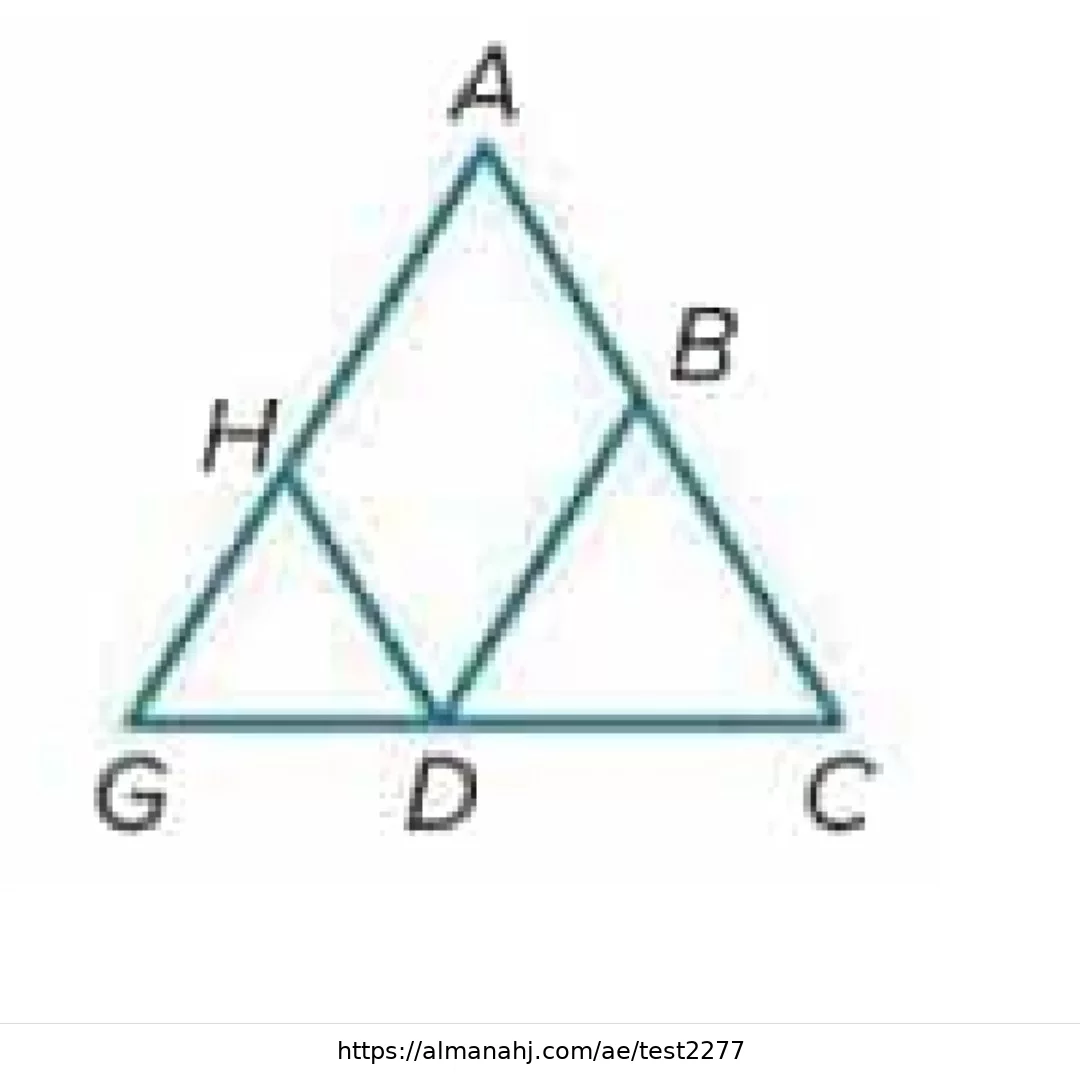
Depends on the diagram. Given: $\square BDHA$, $\overline{CA} \cong \overline{CG}$. Prove: $\angle BDH \cong \angle G$.
Explanation
Since $\overline{CA} \cong \overline{CG}$, $\triangle CAG$ is isosceles, making $\angle A \cong \angle G$. In parallelogram BDHA, opposite angles $\angle BDH$ and $\angle A$ are congruent. By substitution, $\angle BDH \cong \angle G$.
Question 6
6
Points: 1
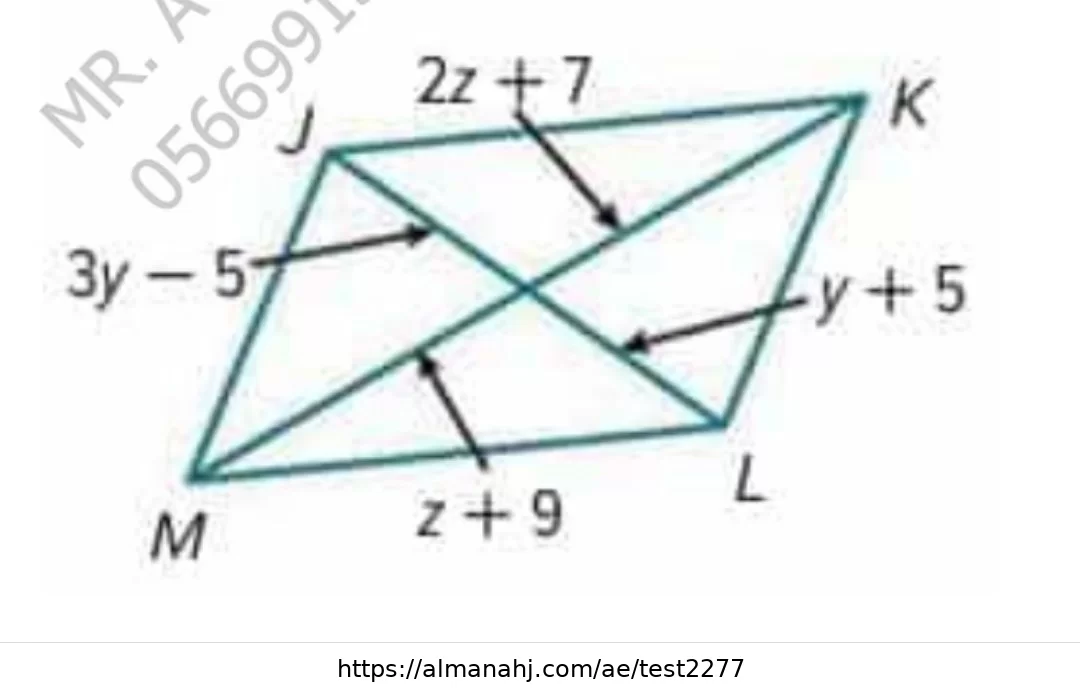
Find the value of the variable in the parallelogram.
Explanation
In a parallelogram, diagonals bisect each other. Solving 2z+7 = z+9 gives z=2, and solving 3y-5 = y+5 gives y=5.
Question 7
7
Points: 1
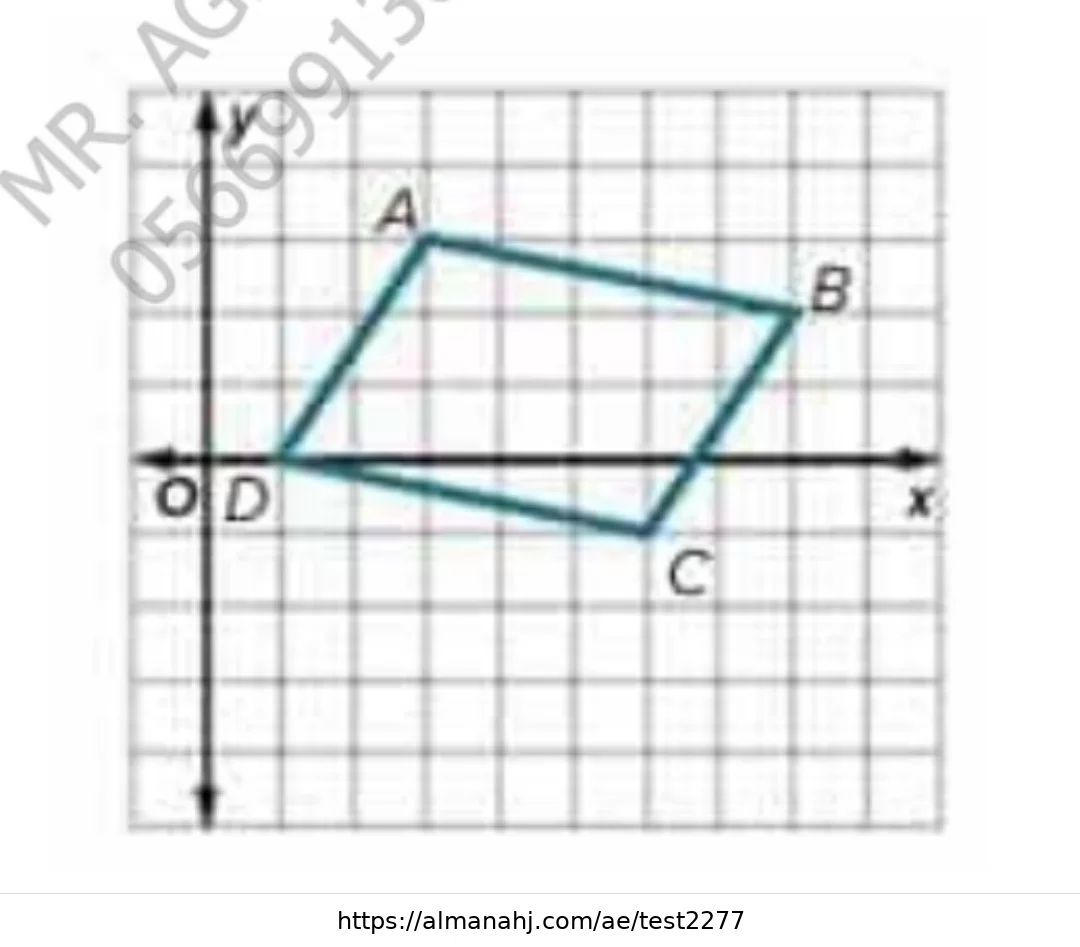
Determine whether quadrilateral ABCD is a parallelogram. Justify your answer.
Explanation
By calculating slopes from the coordinates in the grid, we find that opposite sides have equal slopes (mAB=mCD=-1/5 and mBC=mAD=3), making them parallel.
Question 8
8
Points: 1
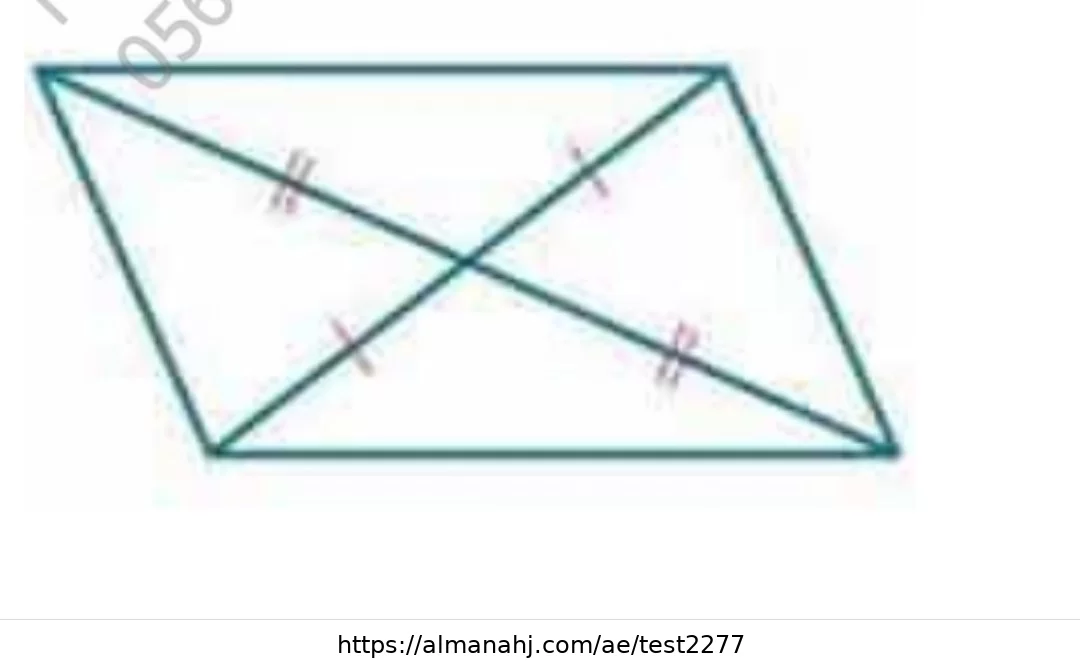
Determine whether the quadrilateral is a parallelogram. Justify your answer.
Explanation
The markings on the diagram show that both diagonals are divided into two equal segments, meaning they bisect each other, which is a property of a parallelogram.
Question 9
9
Points: 1
In the grid shown, if A(2,8), B(12,8), and C(4,4) are vertices of a parallelogram, find vertex D.
Explanation
Since AB is a horizontal segment of length 10 (12-2=10), side CD must also be horizontal with length 10. Starting from C(4,4) and moving 10 units \right gives D(14,4).
Question 10
10
Points: 1
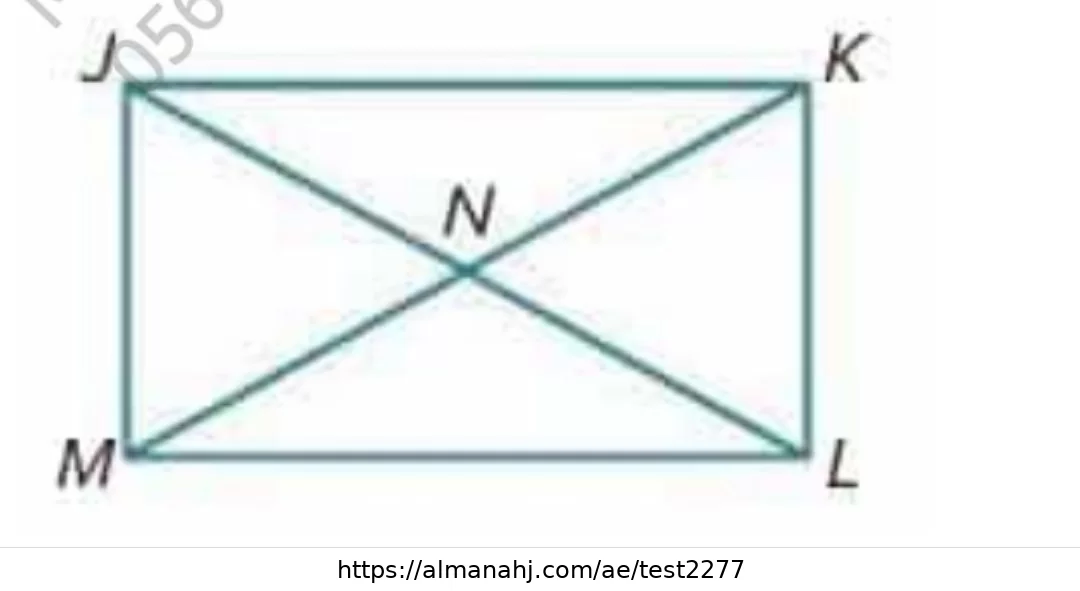
Quadrilateral JKLM is a rectangle. If MN = 3x + 1 and JL = 2x + 9, find MK. Round to the nearest tenth if necessary.
Explanation
In a rectangle, diagonals are equal (JL = MK) and bisect each other (MK = 2 × MN). Setting 2x+9 = 2(3x+1) gives x=1.75. Substituting back, MK = 2(1.75)+9 = 12.5.
Question 11
11
Points: 1
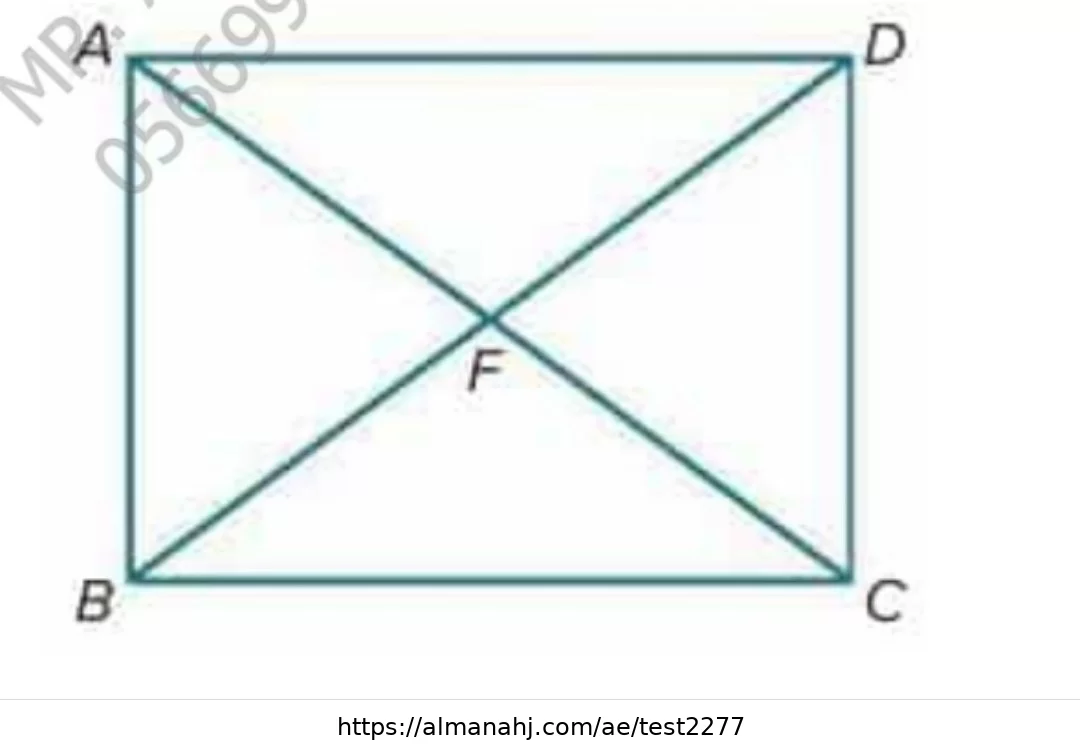
Quadrilateral ABCD is a rectangle. If $m\angle ADB = (4x + 8)^\circ$ and $m\angle DBA = (6x + 12)^\circ$, find the value of x.
Explanation
In a rectangle, the corner angle $\angle DAB$ is $90^\circ$. In $\triangle DAB$, the sum of the other two angles must be $90^\circ$. (4x+8) + (6x+12) = 90 leads to 10x = 70, so x=7.
Question 12
12
Points: 1
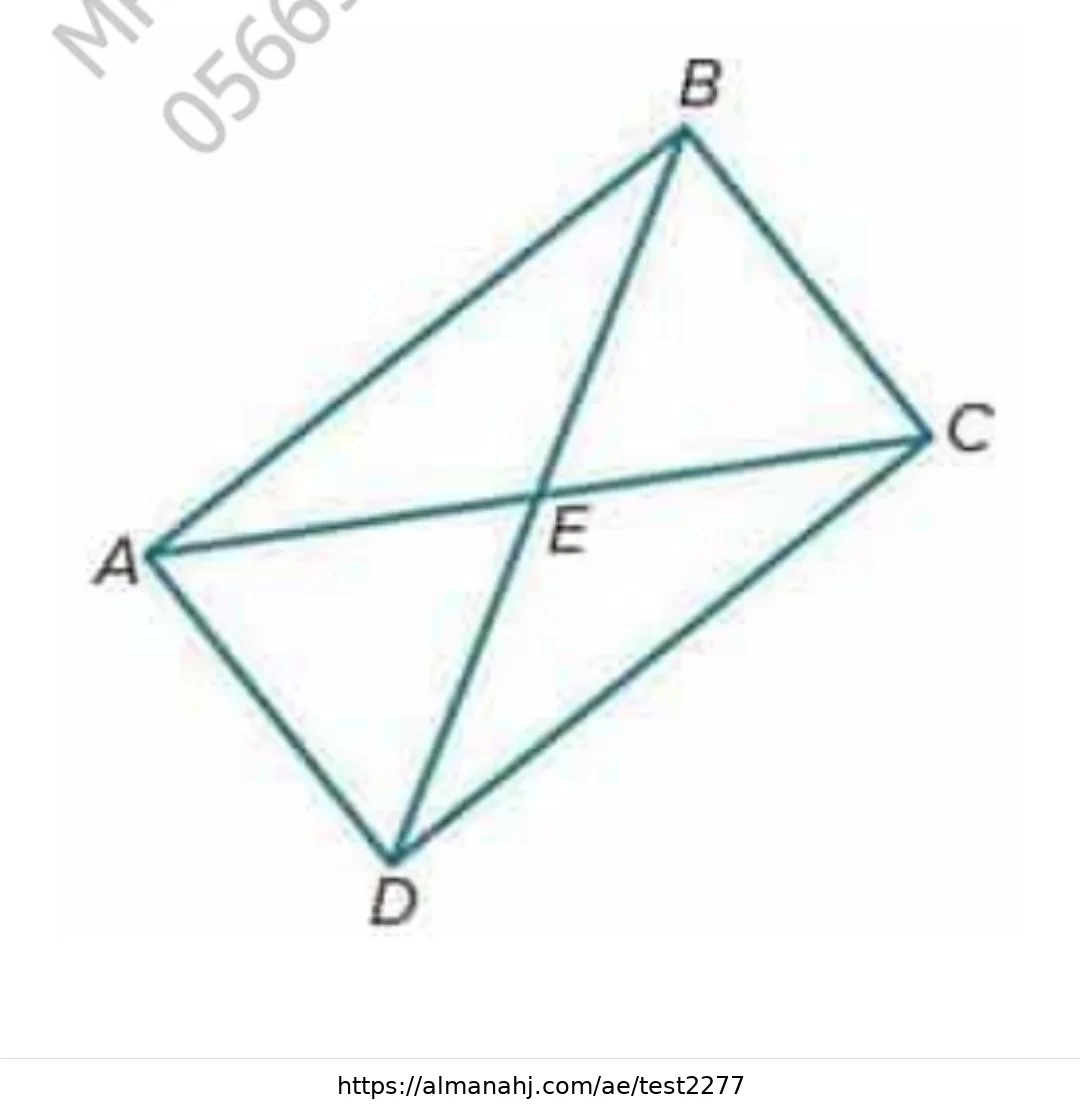
In rectangle ABCD, $m\angle EAB = (4x + 6)^\circ$, $m\angle DEC = (10 - 11y)^\circ$, and $m\angle EBC = 60^\circ$. Find the values of x and y.
Explanation
In $\triangle EBC$, $m\angle EBC=60^\circ$ implies the triangle is equilateral, so $\angle BEC=60^\circ$. Thus $m\angle DEC=120^\circ$. $10-11y=120 \implies y=-10$. Also $m\angle EAB = 90-60=30^\circ$, so $4x+6=30 \implies x=6$.
Question 13
13
Points: 1
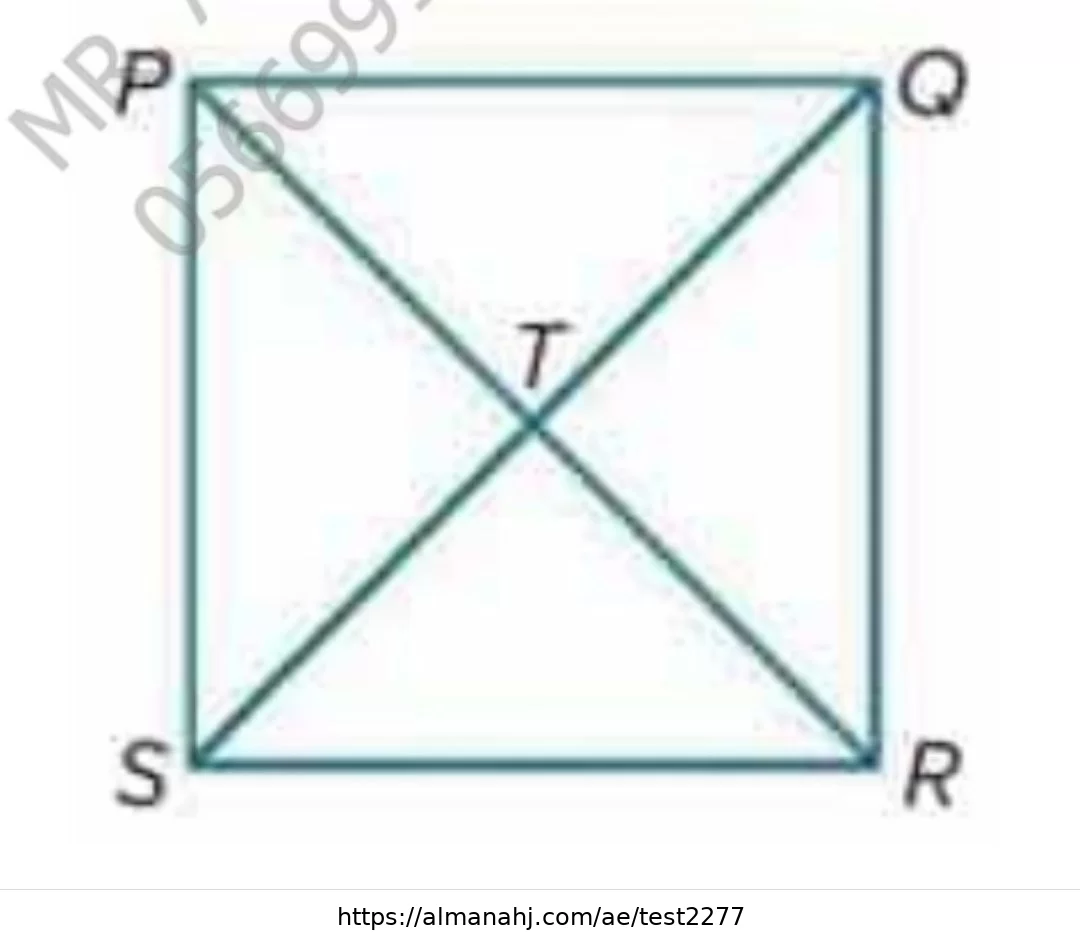
In rhombus PQRS, PQ = 4x + 3, QR = 41, and $m\angle PQT = (2x + 4y)^\circ$. What must the value of y be for rhombus PQRS to be a square?
Explanation
First, $4x+3=41 \implies x=9.5$. For the rhombus to be a square, its diagonals must bisect the angles into $45^\circ$. Thus, $2x+4y=45 \implies 2(9.5)+4y=45 \implies 19+4y=45 \implies 4y=26 \implies y=6.5$.
Question 14
14
Points: 1
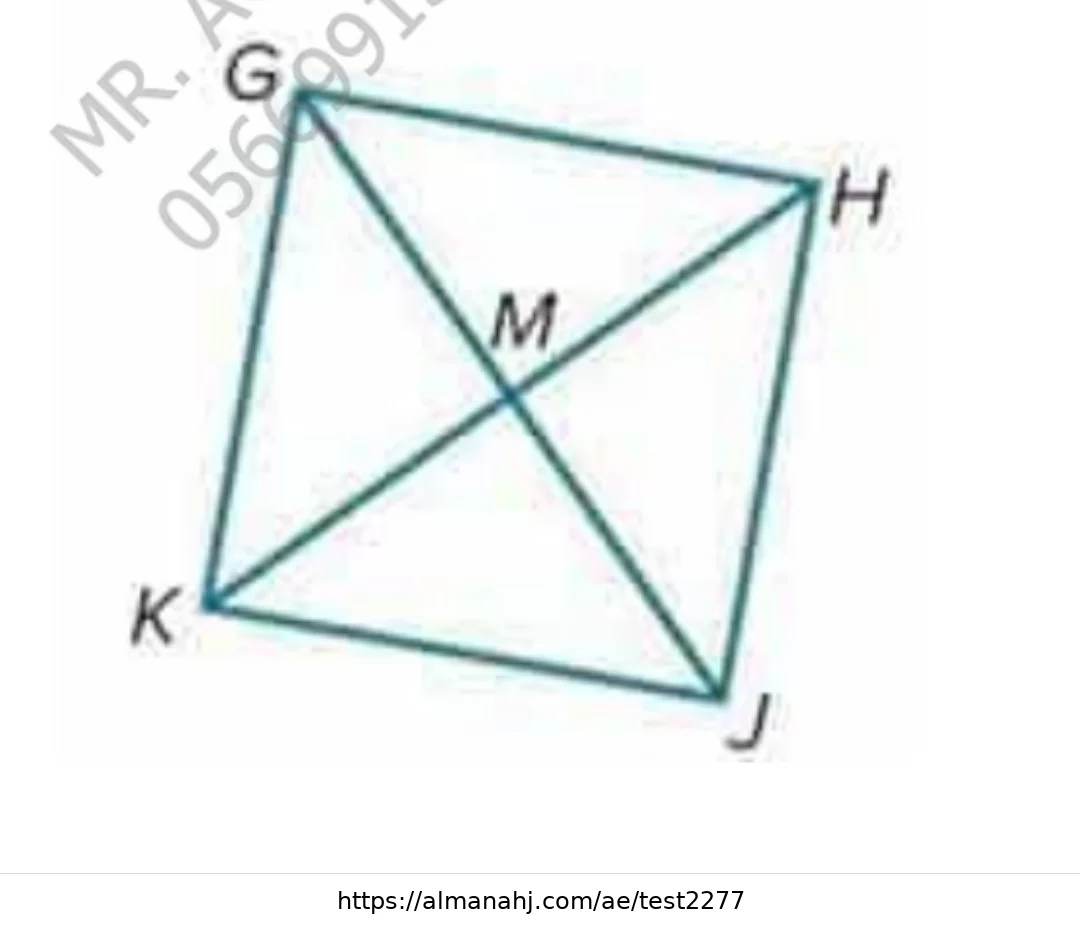
GHJK is a square. If KM = 26.5, find KH.
Explanation
In square GHJK, KH is a diagonal. Since M is the center and KM is half the diagonal, KH = 2 × KM = 2 × 26.5 = 53.
Question 15
15
Points: 1
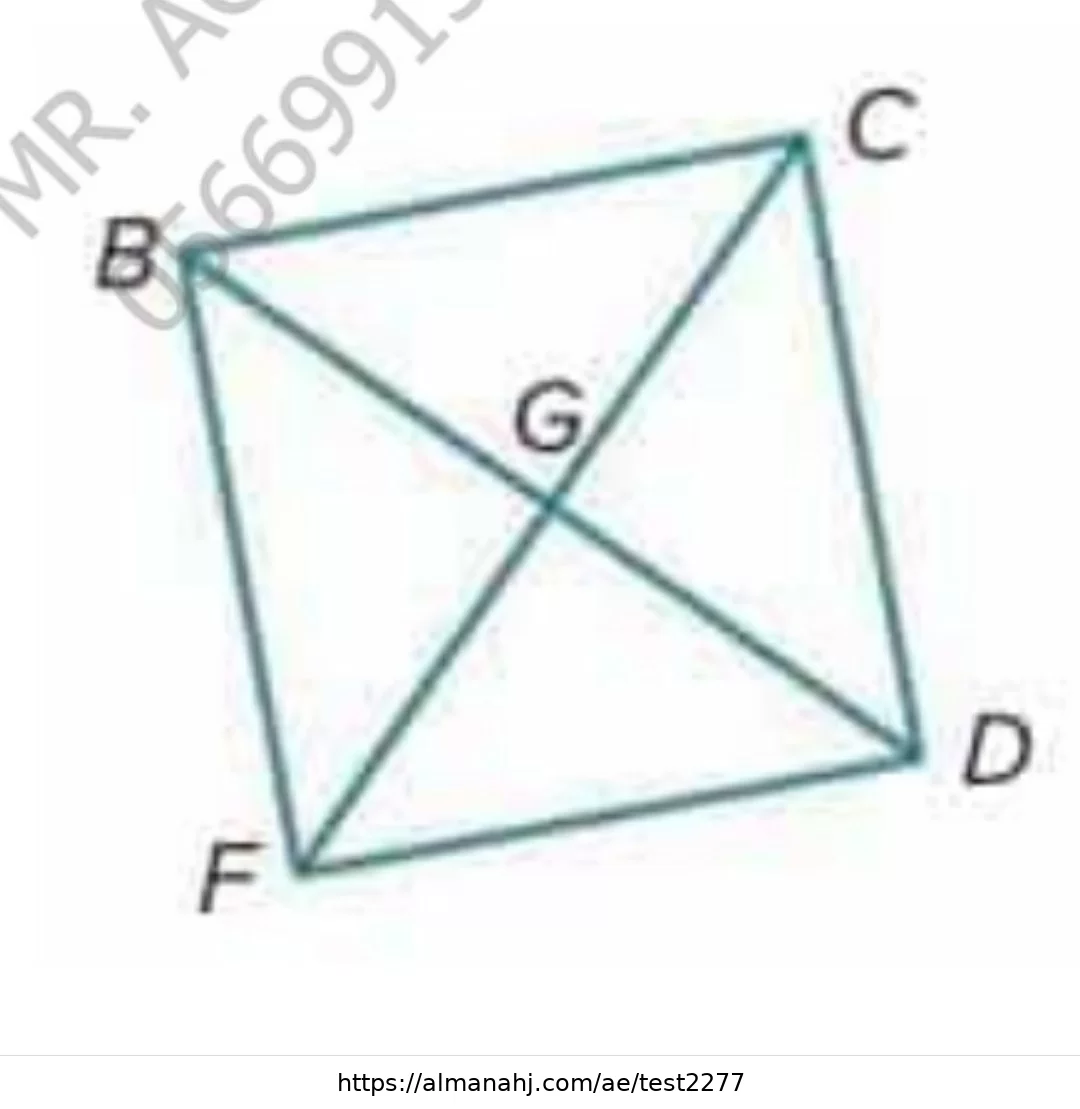
BCDF is a square with FD = 55. Find the measure BD.
Explanation
In a square with side s, the diagonal is $s\sqrt{2}$. Here, $BD = 55 \cdot \sqrt{2} \approx 77.8$.
Question 16
16
Points: 1
Determine whether quadrilateral ABCD with vertices A(-2, -1), B(0,2), C(2, -1), and D(0, -4) is a rhombus, a rectangle, a square, a parallelogram, or none. List all that apply.
Explanation
Calculating side lengths using the distance formula shows all four sides are $\sqrt{13}$. Slopes of adjacent sides are 3/2 and -3/2, which are not negative reciprocals, so the angles are not $90^\circ$. Thus it is a rhombus but not a rectangle/square.
Question 17
17
Points: 1
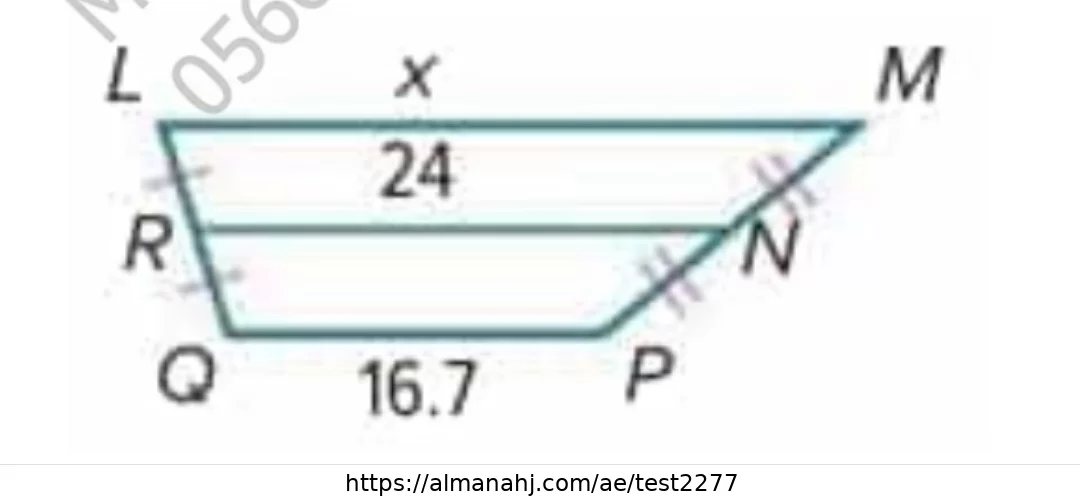
In the figure, $\overline{RN}$ is the midsegment of trapezoid LMPQ. What is the value of x?
Explanation
The length of the midsegment is the average of the bases. $24 = \frac{x + 16.7}{2} \implies 48 = x + 16.7 \implies x = 31.3$.
Question 18
18
Points: 1
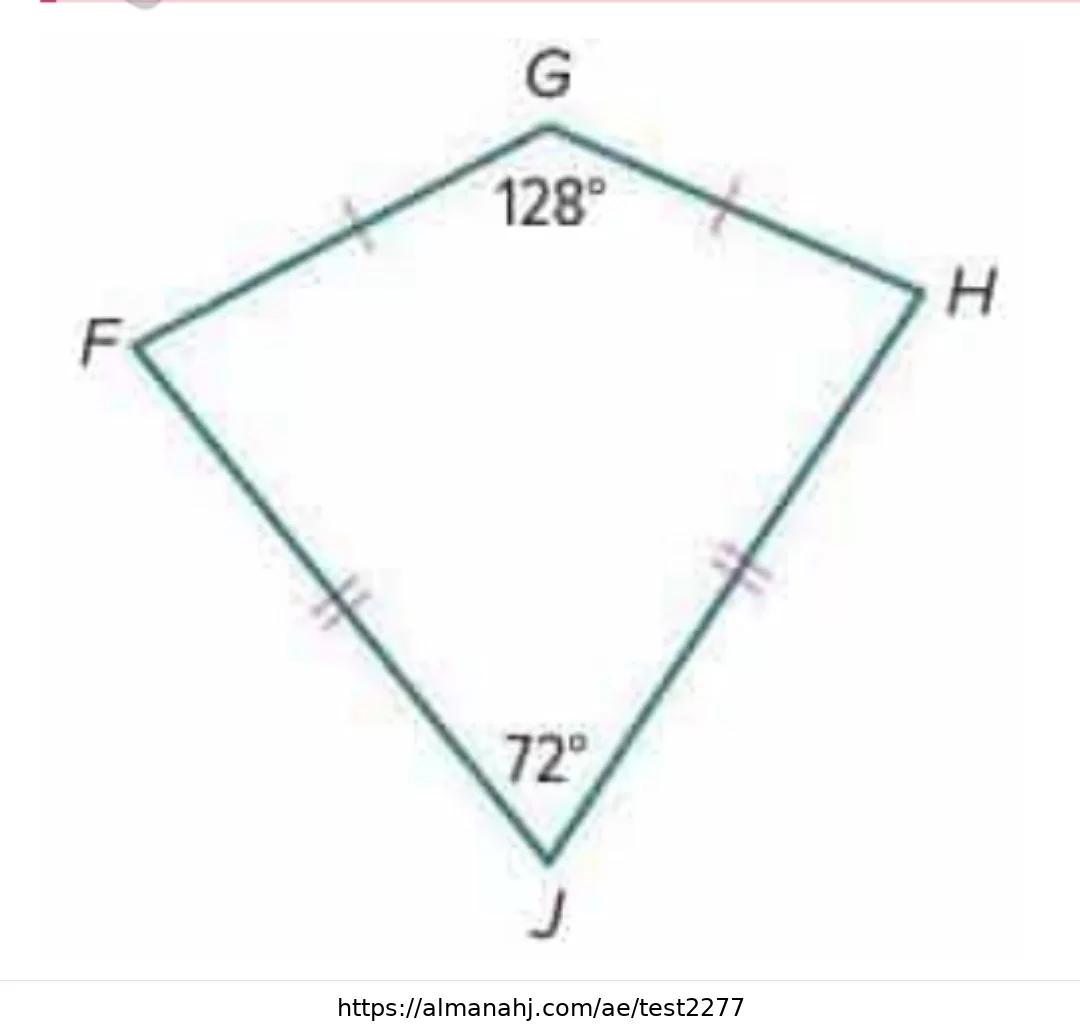
If FGHJ is a kite, find $m\angle F$.
Explanation
A kite has one pair of opposite congruent angles. Here $\angle F \cong \angle H$. The sum of angles is $360^\circ$. $128 + 72 + 2(m\angle F) = 360 \implies 2(m\angle F) = 160 \implies m\angle F = 80^\circ$.
Question 19
19
Points: 1
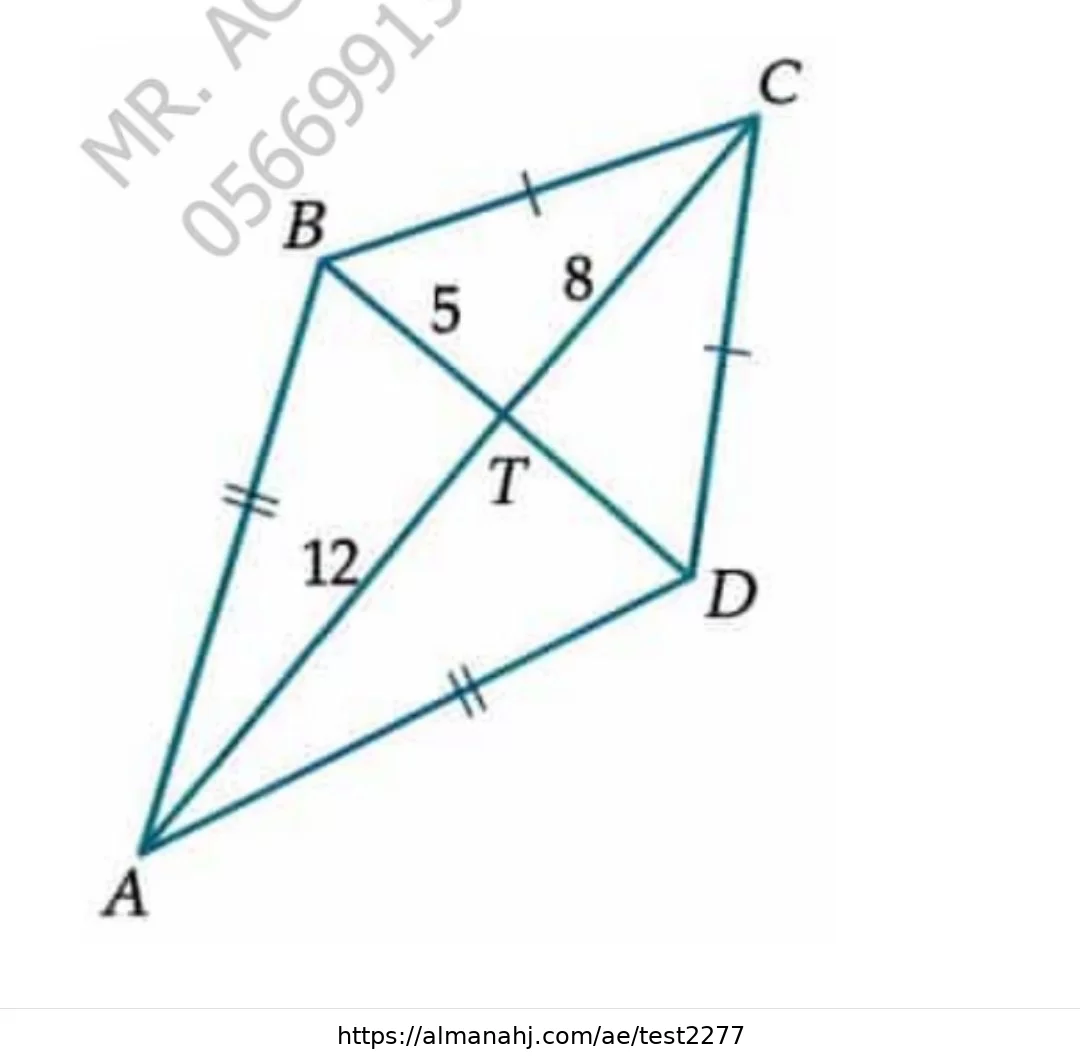
Quadrilateral ABCD is a kite. Find CD.
Explanation
In a kite, diagonals are perpendicular. Using the Pythagorean theorem in the \right triangle with legs 5 and 8, the side length $BC = \sqrt{5^2 + 8^2} = \sqrt{89}$. Since $CD \cong BC$ in a kite, $CD = \sqrt{89}$.
Result Tracking
Answered0 / 19
Correct Answers0
Wrong Answers0
Current Percentage0%
Quiz Completed
This is your final result after answering all questions.
Final Result
0/190%
Correct Answers0
Wrong Answers0
Answered Questions0 / 19
Total Possible Points19
You can reopen the page to start again.
يمكنك تسجيل الدخول لحفظ سجل محاولاتك، معرفة أخطائك المتكررة، والحصول على نصائح مخصصة. تسجيل الدخول باستخدام Google
Here are more quizzes for الصف العاشر المتقدم by الفصل الأول and subject رياضيات
This section is rendered only when the user reaches it while scrolling.
...
🍪
إشعار ملفات تعريف الارتباط
يستخدم هذا الموقع ملفات تعريف الارتباط لتحسين تجربة التصفح وقياس الأداء وعرض المحتوى بشكل أفضل.
باستخدامك للموقع فإنك توافق على استخدامنا لها وفق
سياسة الخصوصية.