Interactive multiple-choice quiz: Physics Inspire Grade 12 General انسباير وفق الهيكل
This document provides a set of multiple-choice questions for Grade 12 General Physics, Third Term (2025-2026), to help students prepare for their exams with confidence. The questions cover key concepts of electrical circuits, including series circuits, equivalent resistance, current, and potential difference. The material is designed to inspire and support students in mastering the subject.
🏆 انضم إلى التحدي واحصل على ترتيبك
اختبار شهادة تدريبي مؤقت للصف والمادة والفصل نفسه.
اختر إجابة واحدة لكل سؤال. عند الاختيار ستظهر النتيجة فورًا: الأخضر صحيح، والأحمر خطأ، وسيظهر تفسير الإجابة مباشرة إن كان متوفرًا. وبعد آخر سؤال ستظهر الدرجة النهائية تلقائيًا.
In the mountain river model used to represent the electrical circuit, what does the "distance that the river descends" from the mountain peak to the plain represent?
Explanation
في نموذج النهر لتمثيل الدائرة الكهربائية، المسافة التي يهبطها النهر من قمة الجبل إلى السهل تُمثل فرق الجهد الكهربائي، وهو القوة الدافعة التي تدفع التيار.
Question 2
2
Points: 1
Which part of the river water cycle represents the "battery or generator" in the electrical circuit according to the physical model?
Explanation
في نموذج دورة الماء النهرية، تُشكل الشمس مصدر الطاقة الذي يرفع الماء إلى الأعلى (التبخر)، تمامًا كما تُشكل البطارية أو المولد مصدر الطاقة الذي يرفع الشحنات الكهربائية إلى جهد أعلى في الدائرة الكهربائية.
Question 3
3
Points: 1
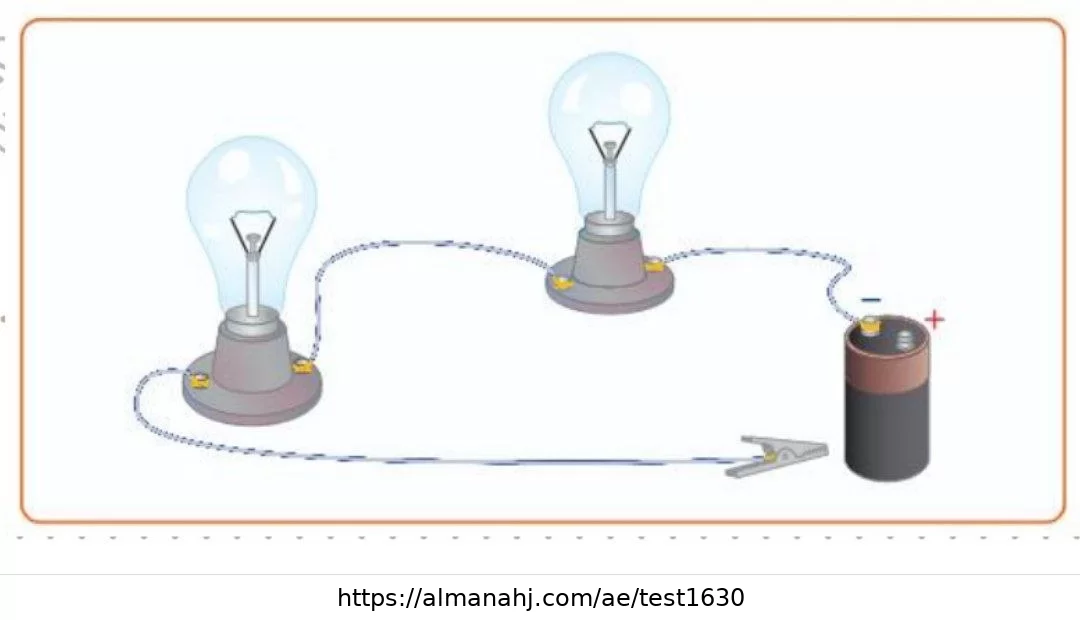
The flow of a mountain river is similar to the electric current in an electrical circuit (as shown in the figure) because:
Explanation
في الدائرة المتسلسلة (كما في النهر المتدفق)، الشحنات الكهربائية (أو كمية الماء) لا تختفي بل تظل ثابتة في أي نقطة في المسار، وهذا يمثل مبدأ حفظ الشحنة.
Question 4
4
Points: 1
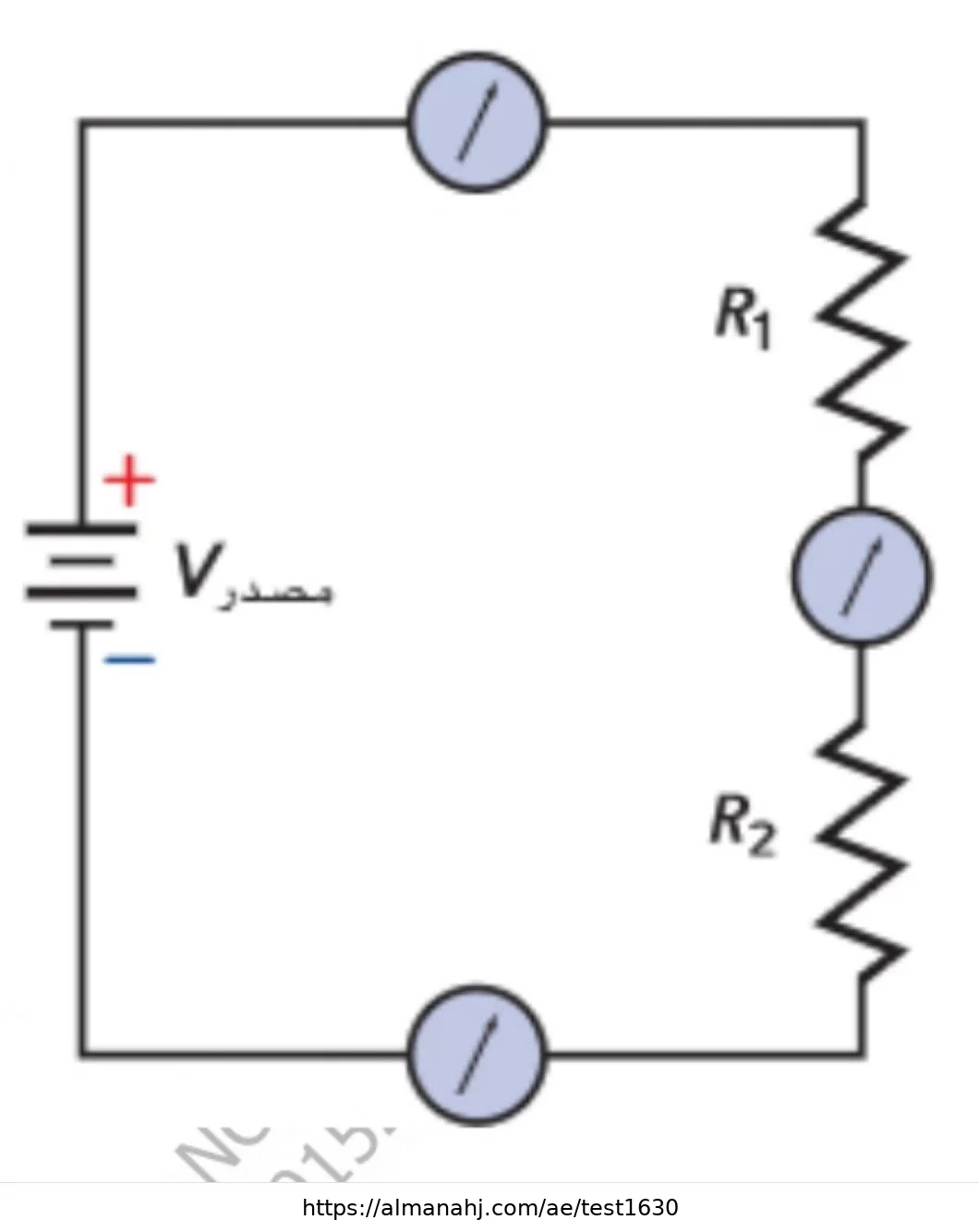
Based on the diagram, if three ammeters are connected in different locations within a series circuit, what will these devices show?
Explanation
في الدائرة المتسلسلة، التيار الكهربائي يكون متساويًا في جميع أجزاء الدائرة، لأن هناك مسارًا واحدًا فقط لتدفق الشحنات. لذا، ستعرض جميع أجهزة الأميتر نفس القيمة.
Question 5
5
Points: 1
What is the precise definition of a "Series Circuit" as shown in the figure?
Explanation
تُعرّف الدائرة المتسلسلة بأنها الدائرة التي توفر مسارًا واحدًا فقط لتدفق التيار الكهربائي، مما يعني أن التيار متساوٍ في جميع أجزائها.
Question 6
6
Points: 1
In the series circuit shown in the figure, if the circuit is opened (the link is cut) at any point, what happens to the current in the rest of the circuit?
Explanation
في الدائرة المتسلسلة، يوجد مسار واحد فقط للتيار. إذا انقطع هذا المسار في أي نقطة، يتوقف تدفق التيار تمامًا في الدائرة بأكملها.
Question 7
7
Points: 1
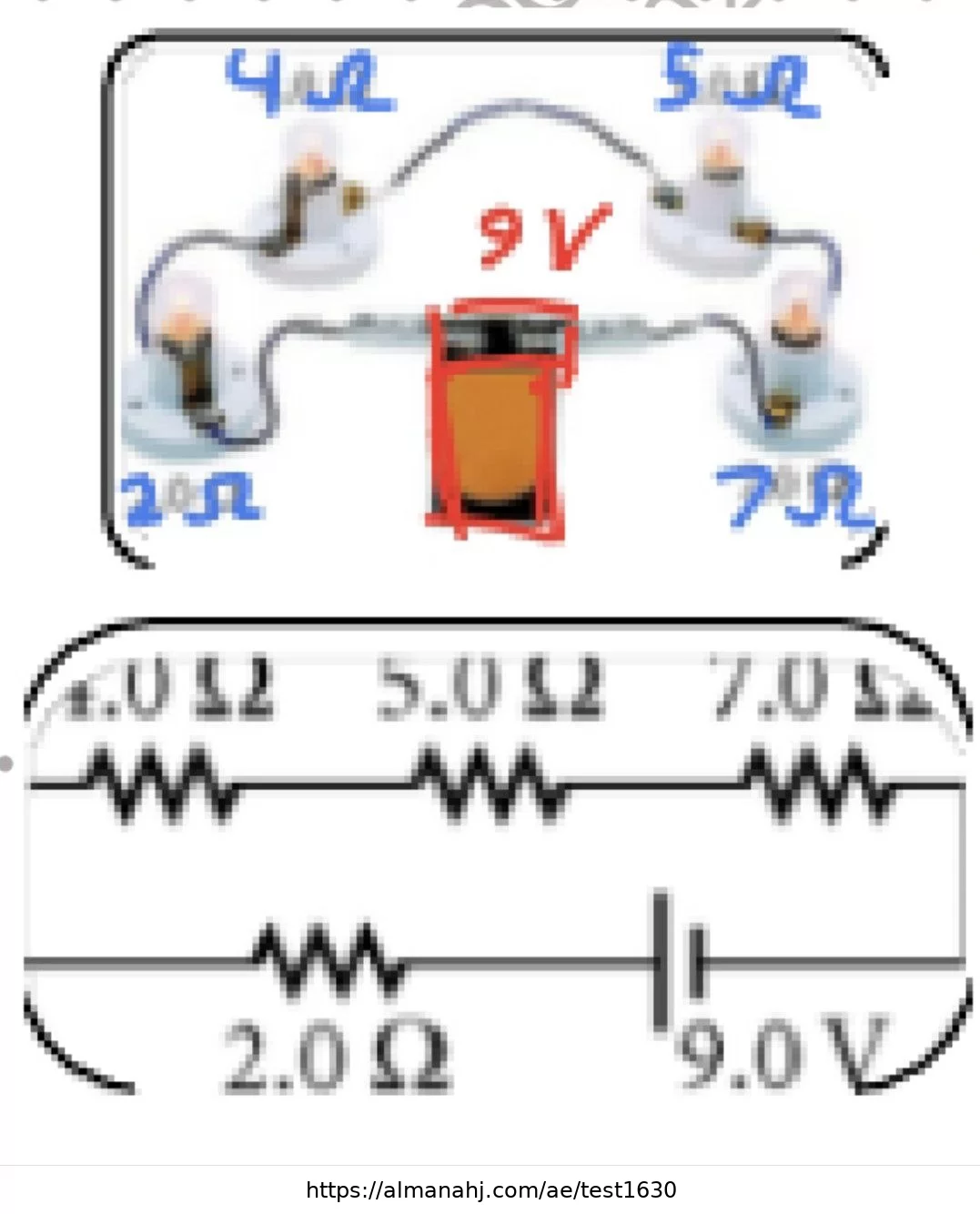
A $9.0\V$ battery is connected to four light bulbs, as shown in the figure. Find the equivalent resistance of the circuit and the current flowing through it?
Explanation
لحساب المقاومة المكافئة لدائرة متسلسلة، نجمع قيم المقاومات الفردية: $R_{eq} = 4.0\ \Omega + 5.0\ \Omega + 7.0\ \Omega + 2.0\ \Omega = 18.0\ \Omega$. التيار الكلي في الدائرة هو $I = V / R_{eq} = 9.0\V / 18.0\ \Omega = 0.5\A$. الخيار الموجود في القائمة يشير إلى المقاومة المكافئة.
Question 8
8
Points: 1
A series circuit has two voltage drops: $5.50\V$ and $6.90\V$. What is the supply voltage?
Explanation
في الدائرة المتسلسلة، الجهد الكلي (جهد المصدر) يساوي مجموع فروق الجهد عبر كل مقاومة. $V_{total} = V_1 + V_2 = 5.50\V + 6.90\V = 12.40\V$.
Question 9
9
Points: 1
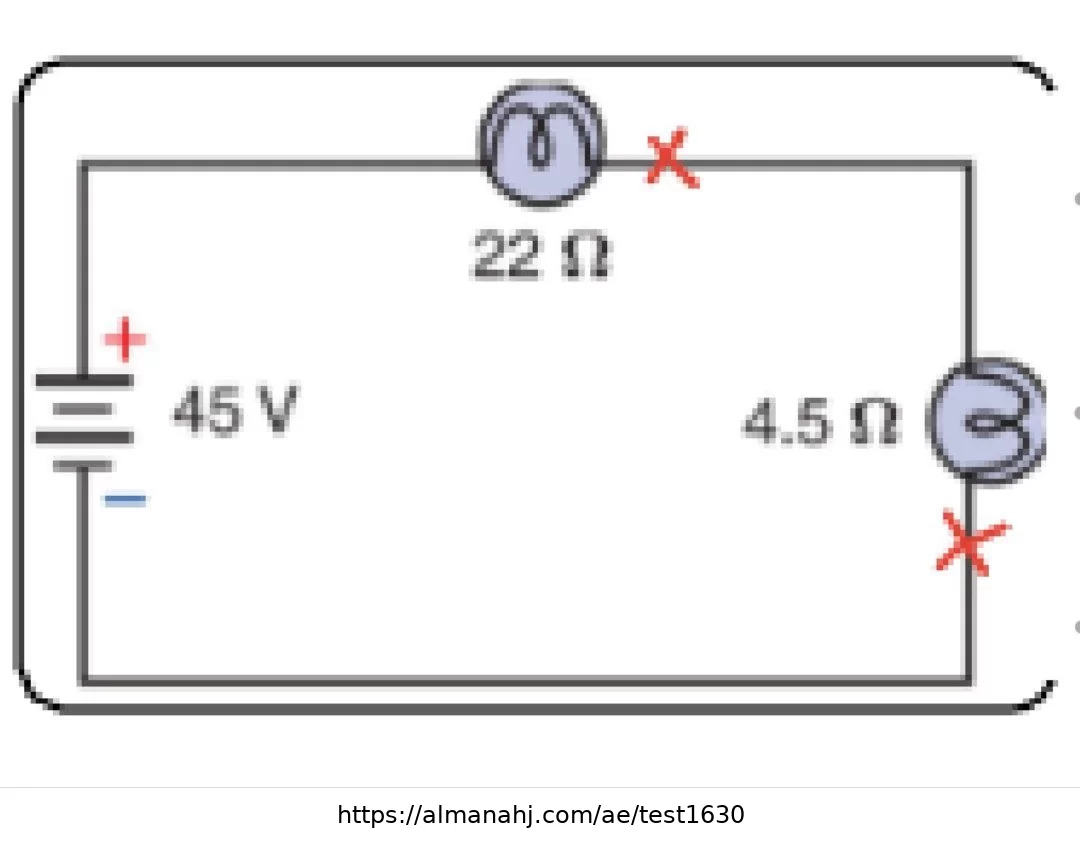
Two lamps, one with a resistance of $22\ \Omega$ and the other $4.5\ \Omega$, were connected in series and placed on a potential difference of $45\V$ as shown in the figure. a. What is the equivalent resistance of the circuit?
Explanation
في الدائرة المتسلسلة، المقاومة المكافئة هي مجموع المقاومات الفردية: $R_{eq} = R_1 + R_2 = 22\ \Omega + 4.5\ \Omega = 26.5\ \Omega$.
Question 10
10
Points: 1
What is the current flowing through the circuit?
Explanation
باستخدام قانون أوم، التيار الكلي في الدائرة هو $I = \frac{V}{R_{eq}} = \frac{45\V}{26.5\ \Omega} \approx 1.698\A$. بالتقريب، يكون التيار $1.7\A$.
Question 11
11
Points: 1
Find the potential difference between the two ends of each lamp.
Explanation
باستخدام قانون أوم، يتم حساب فرق الجهد عبر كل مقاومة: $\Delta V_1 = I \times R_1 = 1.698\A \times 22\ \Omega \approx 37.36\V$. $\Delta V_2 = I \times R_2 = 1.698\A \times 4.5\ \Omega \approx 7.64\V$. الخيار الأقرب هو $\Delta V_1 = 37.4\V, \Delta V_2 = 7.7\V$.
Question 12
12
Points: 1
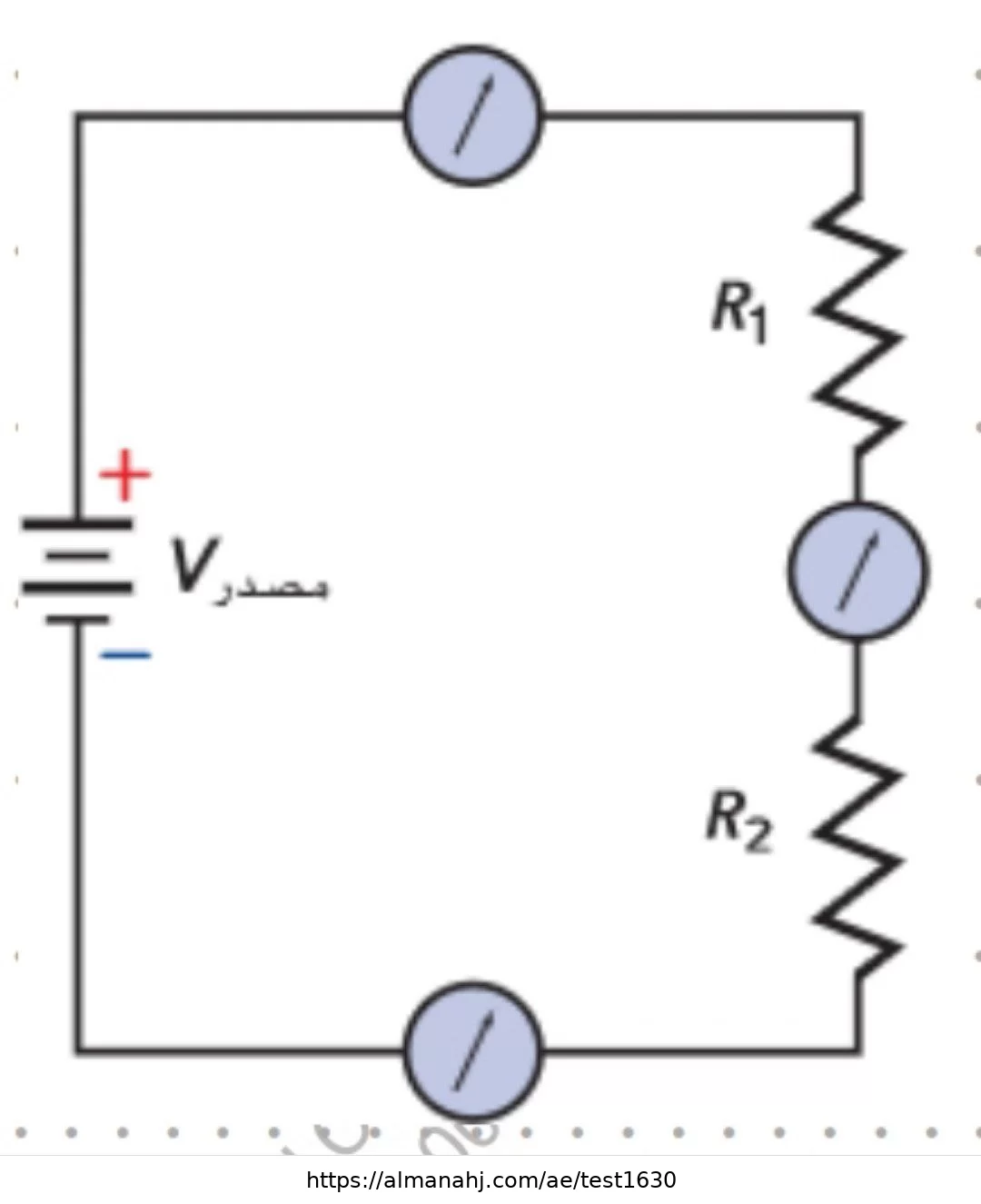
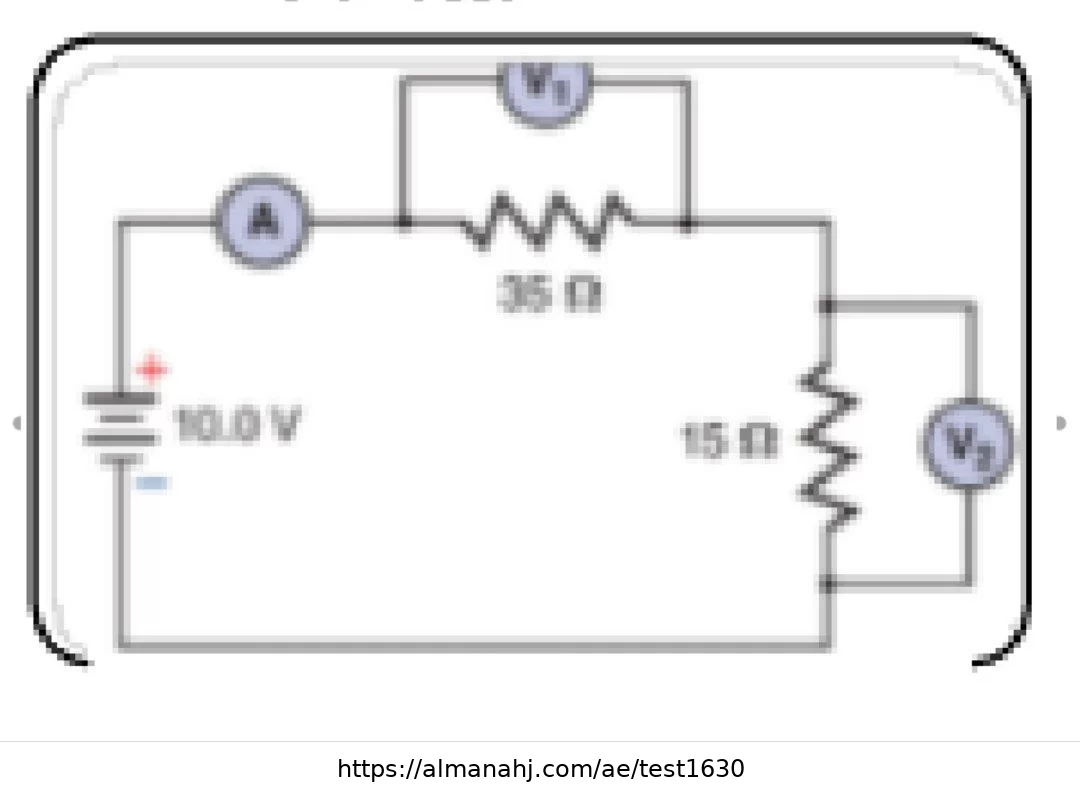
The diagram represents an electrical circuit. a. What is the equivalent resistance in the circuit?
Explanation
في الدائرة المتسلسلة الموضحة في الرسم، المقاومة المكافئة هي مجموع المقاومتين $R_1 = 35\ \Omega$ و $R_2 = 15\ \Omega$. $R_{eq} = 35\ \Omega + 15\ \Omega = 50\ \Omega$.
Question 13
13
Points: 1
What is the ammeter reading?
Explanation
باستخدام قانون أوم، قراءة الأميتر (التيار الكلي) هي $I = \frac{V}{R_{eq}} = \frac{10.0\V}{50\ \Omega} = 0.2\A$.
Question 14
14
Points: 1
What is the reading on voltmeter 1?
Explanation
قراءة الفولتميتر 1 هي فرق الجهد عبر المقاومة R1. باستخدام قانون أوم: $\Delta V_1 = I \times R_1 = 0.2\A \times 35\ \Omega = 7\V$.
Question 15
15
Points: 1
What is the voltmeter reading? (for Voltmeter 2)
Explanation
قراءة الفولتميتر 2 هي فرق الجهد عبر المقاومة R2. باستخدام قانون أوم: $\Delta V_2 = I \times R_2 = 0.2\A \times 15\ \Omega = 3\V$.
Question 16
16
Points: 1
How much energy does the battery provide per minute?
Explanation
الطاقة التي توفرها البطارية في الدقيقة تُحسب من العلاقة E = P × t. أولًا، نحسب القدرة: $P = V \times I = 10.0\V \times 0.2\A = 2\W$. ثم نحسب الطاقة خلال دقيقة (60 ثانية): $E = 2\W \times 60\s = 120\J$.
Question 17
17
Points: 1
Three resistors of values of $5\ \Omega$, $15\ \Omega$, and $12\ \Omega$ are connected in series to a battery with a voltage of [value missing]. What is the equivalent resistance of the circuit?
Explanation
في الدائرة المتسلسلة، تُحسب المقاومة المكافئة بجمع قيم المقاومات الفردية: $R_{eq} = 5\ \Omega + 15\ \Omega + 12\ \Omega = 32\ \Omega$.
Question 18
18
Points: 1
In the previous circuit ($75\V$ battery and equivalent resistance $32\ \Omega$), what is the magnitude of the electric current flowing through the circuit?
Explanation
باستخدام قانون أوم، يُحسب التيار الكلي في الدائرة من العلاقة: $I = \frac{V}{R_{eq}} = \frac{75\V}{32\ \Omega} \approx 2.34375\A$. بالتقريب، يكون التيار $2.34\A$.
Question 19
19
Points: 1
A string of lamps contains ten identical lamps of equal resistance connected in series. When the string is connected to a $117\V$ power supply, the current flowing through the circuit is $0.06\A$. What is the resistance of each lamp?
Explanation
أولًا، نحسب المقاومة المكافئة الكلية للدائرة المتسلسلة: $R_{eq} = \frac{V}{I} = \frac{117\V}{0.06\A} = 1950\ \Omega$. بما أن المصابيح العشرة متطابقة وموصلة على التوالي، فإن مقاومة المصباح الواحد هي: $R_{lamp} = \frac{R_{eq}}{10} = \frac{1950\ \Omega}{10} = 195\ \Omega$. أقرب خيار هو $2.0 \times 10^2\ \Omega$ أو $200\ \Omega$.
Question 20
20
Points: 1
In a series electrical circuit, if an additional resistor is added, the total current in the circuit becomes:
Explanation
عند إضافة مقاومة إضافية في دائرة متسلسلة، تزداد المقاومة الكلية المكافئة للدائرة (Req). ووفقًا لقانون أوم (I = V/Req)، فإن زيادة المقاومة الكلية تؤدي إلى انخفاض التيار الكلي المار في الدائرة، بافتراض ثبات جهد المصدر.
Question 21
21
Points: 1
Calculate the potential difference values across the three resistors: $12\ \Omega$, $15\ \Omega$, and $5\ \Omega$, connected in series to a $75\V$ battery. Verify that the sum of the potential difference values of the resistors equals the potential difference of the battery.
Explanation
أولًا، نحسب المقاومة المكافئة الكلية: $R_{eq} = 12\ \Omega + 15\ \Omega + 5\ \Omega = 32\ \Omega$. ثم نحسب التيار الكلي في الدائرة: $I = \frac{V_{total}}{R_{eq}} = \frac{75\V}{32\ \Omega} \approx 2.34375\A$. الآن نحسب فرق الجهد عبر كل مقاومة: $V_1 = I \times R_1 = 2.34375\A \times 12\ \Omega \approx 28.13\V$. $V_2 = I \times R_2 = 2.34375\A \times 15\ \Omega \approx 35.16\V$. $V_3 = I \times R_3 = 2.34375\A \times 5\ \Omega \approx 11.72\V$. مجموع فروق الجهد: $28.13 + 35.16 + 11.72 = 75.01\V$ (بالتقريب $75\V$). الخيار (ب) هو الأقرب لهذه القيم.
Question 22
22
Points: 1
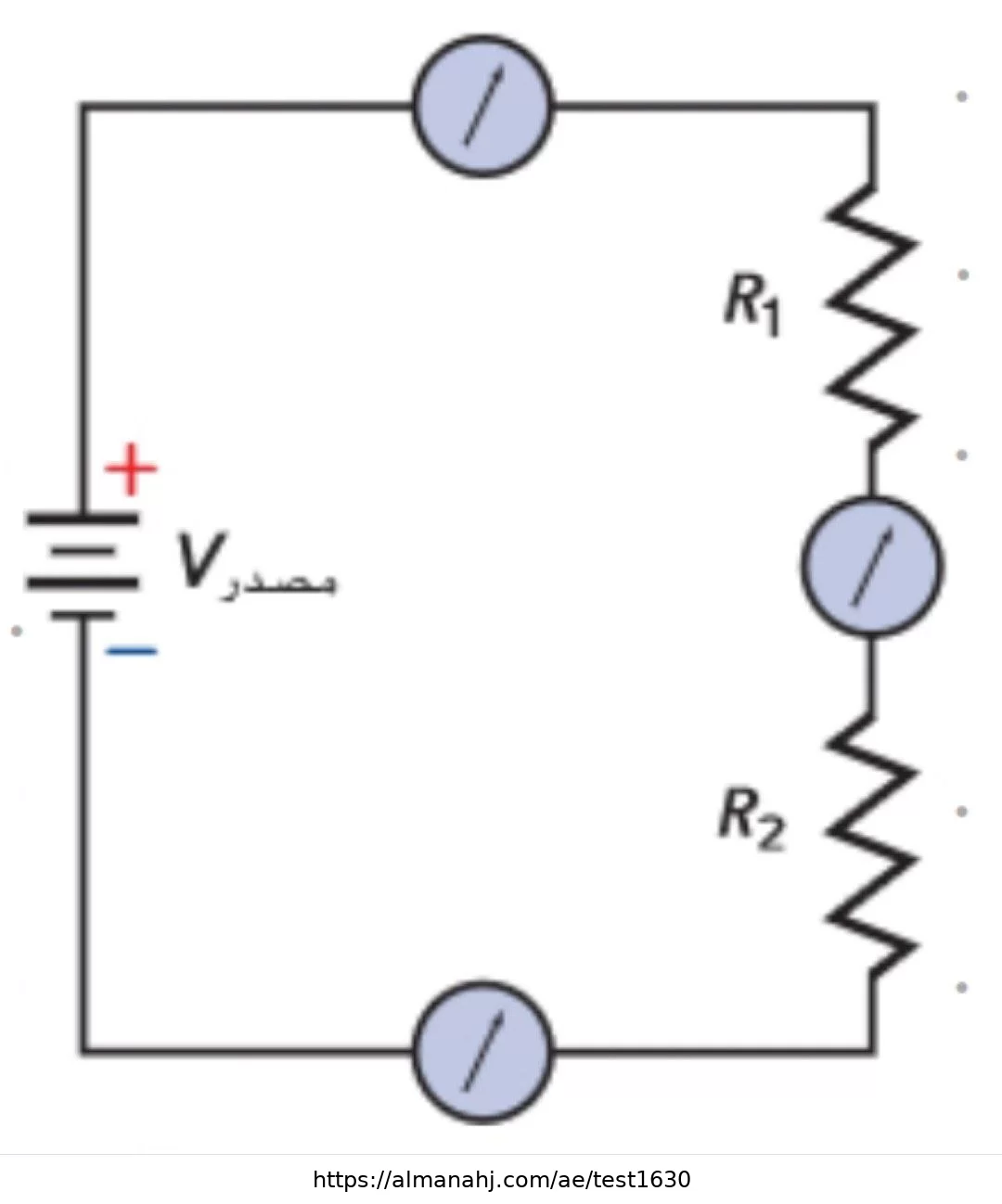
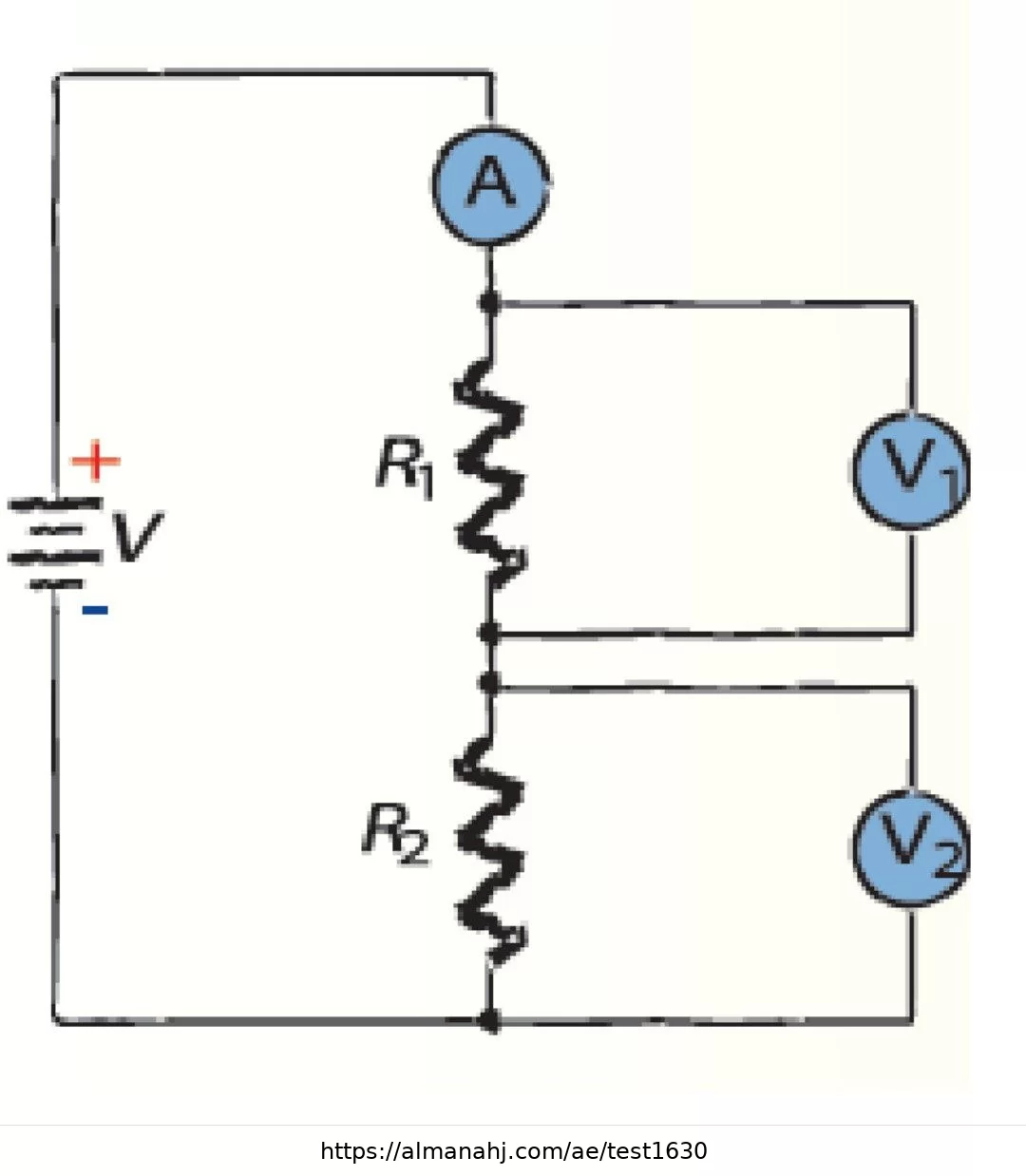
Assume that the values of the electrical circuit elements shown in the example are: $R_1 = 255\ \Omega$, $R_2 = 290\ \Omega$, $\Delta V_1 = 17\V$, If there is no other information, please answer the following: a. What is the current flowing through the circuit?
Explanation
في الدائرة المتسلسلة، التيار هو نفسه عبر كل مقاومة. يمكن حسابه باستخدام قانون أوم من قيم المقاومة R1 وفرق الجهد عبرها $\Delta V_1$: $I = \frac{\Delta V_1}{R_1} = \frac{17\V}{255\ \Omega} \approx 0.06666...\A$. بالتقريب، يكون التيار $0.0667\A$.
Question 23
23
Points: 1
What is the battery voltage?
Explanation
لحساب جهد البطارية، نجمع المقاومتين أولاً للحصول على المقاومة المكافئة: $R_{eq} = R_1 + R_2 = 255\ \Omega + 290\ \Omega = 545\ \Omega$. ثم نستخدم قانون أوم مع التيار الكلي الذي تم حسابه في الجزء السابق ($I \approx 0.06666\A$): $V_{battery} = I \times R_{eq} = 0.06666\A \times 545\ \Omega \approx 36.33\V$. الخيار الأقرب هو $36.4\V$.
Question 24
24
Points: 1
A series circuit consists of a $12\V$ battery and three resistors. The potential difference across one resistor is $1.2\V$, and across another resistor it is $3.3\V$. What is the potential difference across the third resistor?
Explanation
في الدائرة المتسلسلة، مجموع فروق الجهد عبر المقاومات يساوي جهد البطارية الكلي. Vtotal = V1 + V2 + V3 $12\V = 1.2\V + 3.3\V + V_3$ $12\V = 4.5\V + V_3$ $V_3 = 12\V - 4.5\V = 7.5\V$.
Question 25
25
Points: 1
A $22\ \Omega$ resistor and a $33\ \Omega$ resistor are connected in series to a $120\V$ power supply. a. What is the equivalent resistance of the circuit?
Explanation
في الدائرة المتسلسلة، المقاومة المكافئة هي مجموع المقاومات الفردية: $R_{eq} = R_1 + R_2 = 22\ \Omega + 33\ \Omega = 55\ \Omega$.
Question 26
26
Points: 1
What is the value of the current flowing through the circuit?
Explanation
باستخدام قانون أوم، التيار الكلي في الدائرة هو $I = \frac{V}{R_{eq}} = \frac{120\V}{55\ \Omega} \approx 2.1818\A$. بالتقريب، يكون التيار $2.2\A$.
Question 27
27
Points: 1
What is the potential difference across each resistor?
Explanation
لحساب فرق الجهد عبر كل مقاومة، نستخدم قانون أوم (V = I × R): $\Delta V_1 = I \times R_1 = 2.1818\A \times 22\ \Omega \approx 48.0\V$. $\Delta V_2 = I \times R_2 = 2.1818\A \times 33\ \Omega \approx 72.0\V$. مجموع فروق الجهد $48\V + 72\V = 120\V$، وهو جهد البطارية.
Question 28
28
Points: 1
Three resistors of values of $3.3\K\Omega$, $4.7\K\Omega$, and $3.9\K\Omega$ are connected in series via a $12\V$ battery. a. What is the equivalent resistance of the circuit?
Explanation
في الدائرة المتسلسلة، المقاومة المكافئة هي مجموع المقاومات الفردية: $R_{eq} = 3.3\K\Omega + 4.7\K\Omega + 3.9\K\Omega = 11.9\K\Omega$.
Question 29
29
Points: 1
What is the value of the current passing through the resistors?
Explanation
باستخدام قانون أوم، التيار الكلي في الدائرة هو $I = \frac{V}{R_{eq}} = \frac{12\V}{11900\ \Omega} \approx 0.0010084\A$. بالتقريب، يكون التيار $1.0 \times 10^{-3}\A$.
Question 30
30
Points: 1
Which of the following statements correctly describes the current in a series electrical circuit?
Explanation
من خصائص الدائرة المتسلسلة أن التيار الكهربائي يتدفق في مسار واحد فقط، وبالتالي تكون قيمة التيار متساوية في جميع أجزاء الدائرة.
Result Tracking
Answered0 / 30
Correct Answers0
Wrong Answers0
Current Percentage0%
Quiz Completed
This is your final result after answering all questions.
Final Result
0/300%
Correct Answers0
Wrong Answers0
Answered Questions0 / 30
Total Possible Points30
You can reopen the page to start again.
يمكنك تسجيل الدخول لحفظ سجل محاولاتك، معرفة أخطائك المتكررة، والحصول على نصائح مخصصة. تسجيل الدخول باستخدام Google
Here are more quizzes for الصف الثاني عشر العام by الفصل الثالث and subject فيزياء
This section is rendered only when the user reaches it while scrolling.
...
🍪
إشعار ملفات تعريف الارتباط
يستخدم هذا الموقع ملفات تعريف الارتباط لتحسين تجربة التصفح وقياس الأداء وعرض المحتوى بشكل أفضل.
باستخدامك للموقع فإنك توافق على استخدامنا لها وفق
سياسة الخصوصية.