Interactive multiple-choice quiz: اختبار في الفيزياء: الدوائر الكهربائية انسباير وفق الهيكل
يتناول هذا الاختبار الشامل مفاهيم أساسية في الفيزياء الكهربائية، مع التركيز على دوائر مجزئ الجهد وخصائص الدوائر المتوازية. كما يغطي الاختبار قواعد كيرشوف للتيار والجهد، وأهمية أجهزة السلامة الكهربائية مثل الفيوزات وقواطع الدائرة. يهدف الاختبار إلى تقييم فهم الطلاب للتيار والجهد والمقاومة في مختلف أنواع الدوائر الكهربائية وتطبيقاتها العملية.
🏆 انضم إلى التحدي واحصل على ترتيبك
اختبار شهادة تدريبي مؤقت للصف والمادة والفصل نفسه.
اختر إجابة واحدة لكل سؤال. عند الاختيار ستظهر النتيجة فورًا: الأخضر صحيح، والأحمر خطأ، وسيظهر تفسير الإجابة مباشرة إن كان متوفرًا. وبعد آخر سؤال ستظهر الدرجة النهائية تلقائيًا.
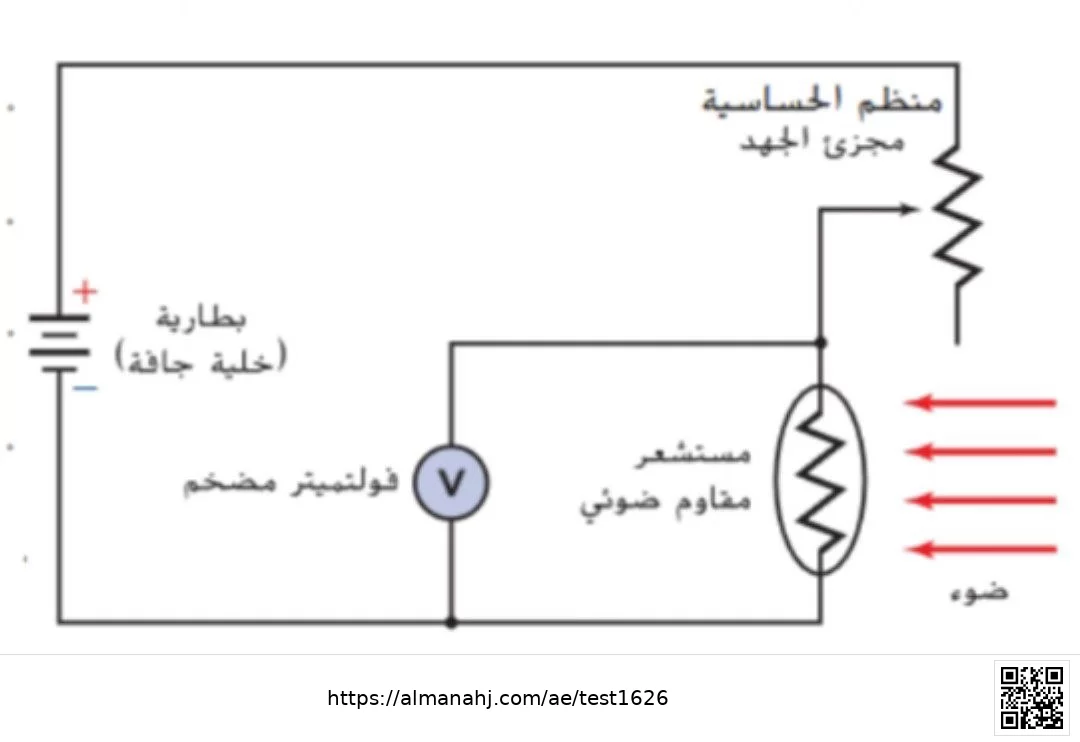
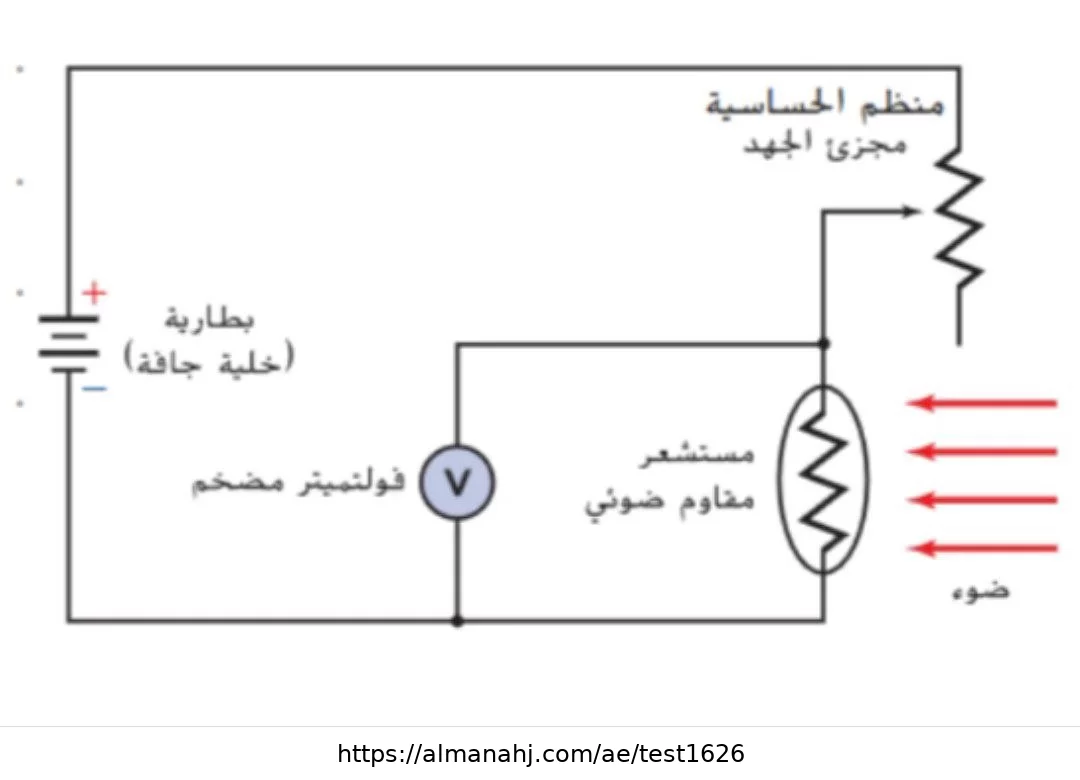
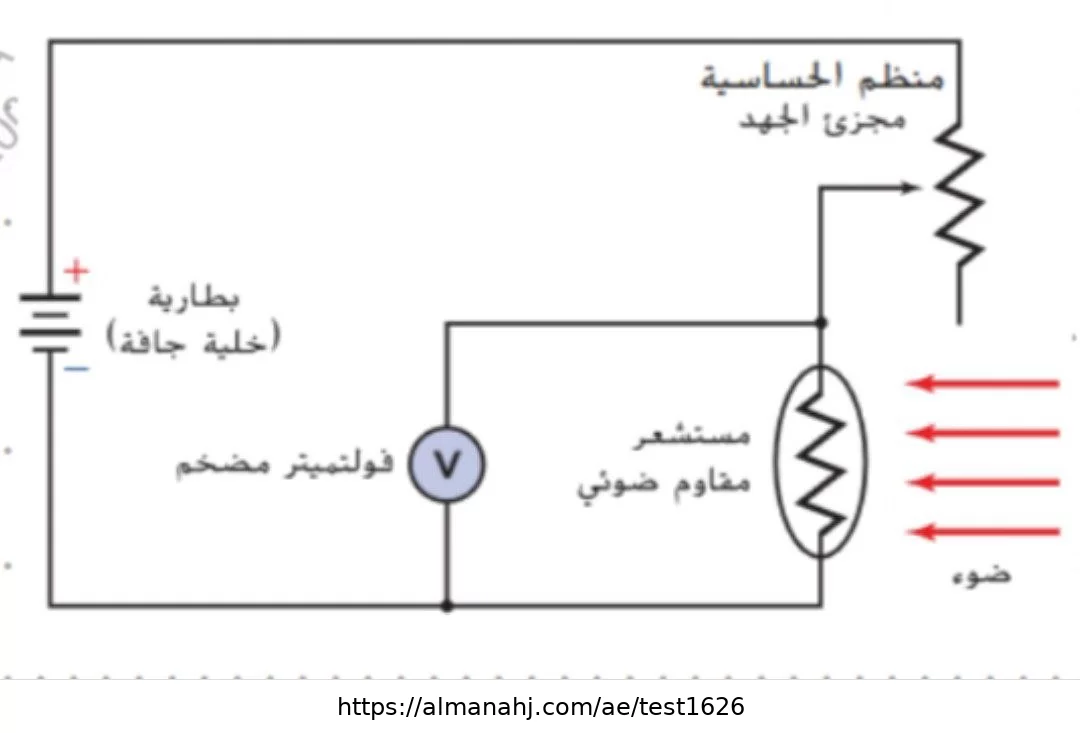
1. Looking at the diagram, what is the primary role of a "voltage divider" in electronic devices such as a light meter?
Explanation
الوظيفة الأساسية لمجزئ الجهد هي توفير جهد أقل من جهد المصدر، مما يسمح بتوفير فرق جهد مطلوب لأجزاء معينة من الدائرة، كما هو الحال في مقياس الضوء حيث يتغير الجهد عبر المقاوم الضوئي.
Question 2
2
Points: 1
2. According to the diagram, how does the resistance of a "photoresistor" (sensor) change when exposed to light?
Explanation
المقاوم الضوئي (LDR) هو جهاز تقل مقاومته بشكل كبير عند تعرضه للضوء. هذا يسمح بمرور تيار أكبر في الدائرة.
Question 3
3
Points: 1
3. The voltage produced by the voltage divider circuit in a light meter (Figure) depends on:
Explanation
في مقياس الضوء الذي يستخدم مجزئ جهد ومقاوم ضوئي، يتغير جهد الخرج بناءً على مقاومة المقاوم الضوئي، والتي تتأثر بكمية الضوء الساقط عليه.
Question 4
4
Points: 1
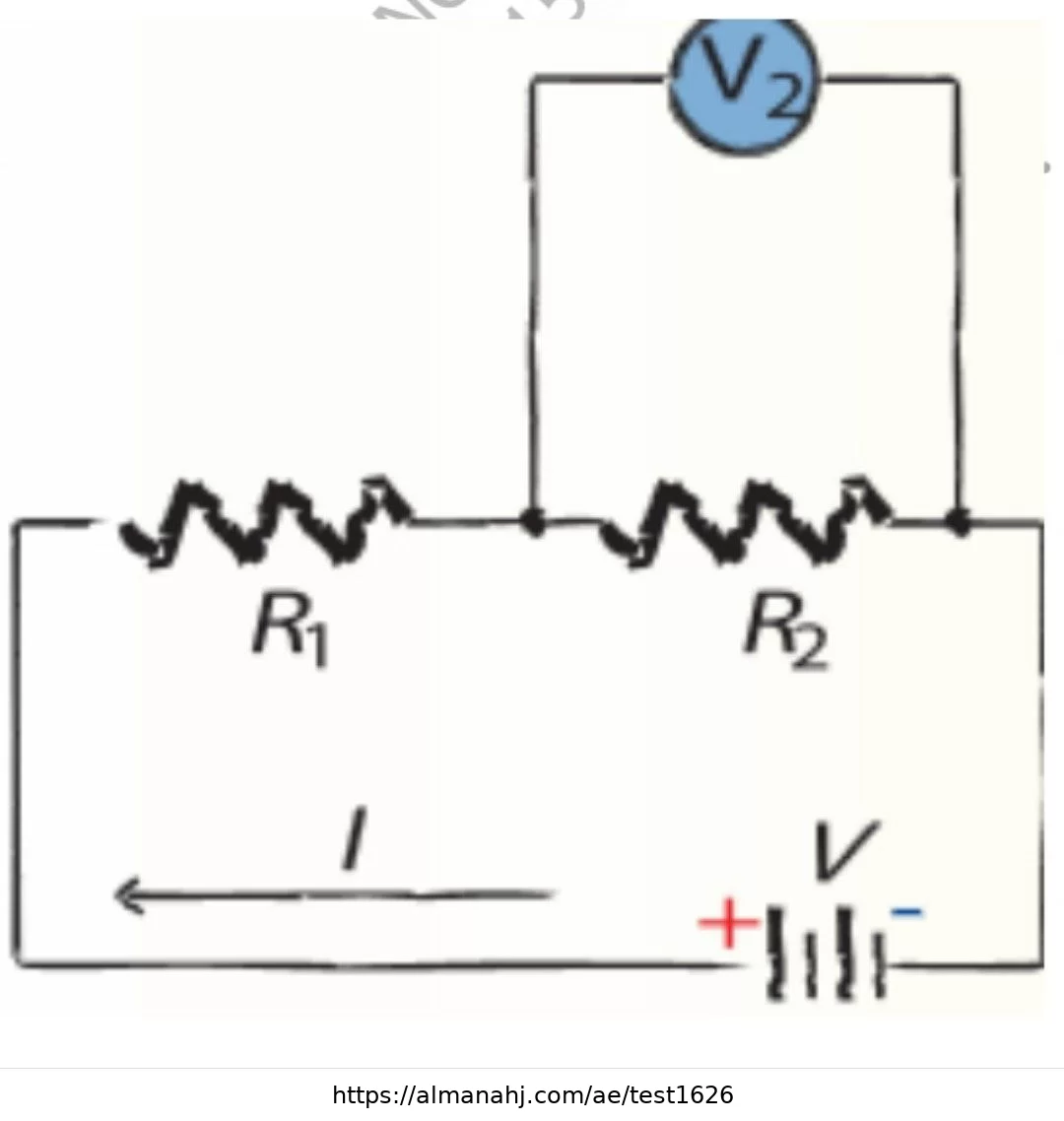
4. (Based on the diagram) A 9.0 V battery is connected to two resistors, $R_1 = 390 \ \Omega$ and $R_2 = 470 \ \Omega$, which act as a voltage divider. What is the magnitude of the voltage across the resistor $R_2 = 470 \ \Omega$?
5. In a voltage divider circuit consisting of two resistors in series, if the value of the resistance is greater than half the equivalent resistance of the circuit, then the potential difference across it is.
Explanation
في دائرة مقسم الجهد، يتناسب فرق الجهد عبر مقاوم طرديًا مع قيمة المقاومة الخاصة به بالنسبة للمقاومة الكلية للدائرة. إذا كانت قيمة المقاومة أكبر من نصف المقاومة الكلية، فإن فرق الجهد عبرها سيكون أكبر من نصف جهد البطارية.
Question 6
6
Points: 1
6. Which of the following equations is correctly used to calculate the potential difference across the second resistor (V2) in a voltage divider circuit consisting of R1 and R2?
Explanation
صيغة مجزئ الجهد لحساب الجهد عبر المقاوم R2 في دائرة توالي هي $V_2 = V_{source} \times \frac{R_2}{R_1 + R_2}$.
Question 7
7
Points: 1
7. Determine the value of a resistor to be used as part of a voltage divider connected to a $1.2 \text{ k}\Omega$ resistor. The potential difference across the $1.2 \text{ k}\Omega$ resistor will be 2.2 V when the source is 12 V.
8. A "voltage divider" circuit is used to produce a voltage source:
Explanation
دائرة مجزئ الجهد تستخدم لإنتاج جهد خرج يكون أقل من جهد المصدر (البطارية) عن طريق تقسيم الجهد بين مقاومتين أو أكثر.
Question 9
9
Points: 1
1. Three resistors with values of $30 \ \Omega$, $60 \ \Omega$, and $20 \ \Omega$ are connected in parallel with a 90 V battery. What is the equivalent resistance of the circuit?
2. In the previous circuit (90 V battery and equivalent resistance $10 \ \Omega$), what is the total current coming out of the battery?
Explanation
وفقًا لقانون أوم، التيار الكلي Itotal في الدائرة يساوي الجهد الكلي Vsource مقسومًا على المقاومة المكافئة Req. $I_{total} = \frac{V_{source}}{R_{eq}} = \frac{90 \text{ V}}{10 \ \Omega} = 9 \text{ A}$.
Question 11
11
Points: 1
3. If two $15 \ \Omega$ resistors and two $15 \ \Omega$ resistors are connected in parallel to a 30 V battery, what is the current flowing through each branch?
Explanation
في الدائرة المتوازية، يكون الجهد متساوياً عبر جميع الفروع. لذلك، إذا كان لدينا مقاومة $15 \ \Omega$ في كل فرع، والجهد الكلي للبطارية هو 30 V، فإن التيار المار عبر كل فرع هو $I = \frac{V}{R} = \frac{30 \text{ V}}{15 \ \Omega} = 2 \text{ A}$.
Question 12
12
Points: 1
4. What happens to the equivalent resistance in a parallel circuit when a new resistance is added to the paths?
Explanation
عند إضافة مقاومة جديدة على التوازي في دائرة، فإنها توفر مسارًا إضافيًا للتيار، مما يقلل من المقاومة الكلية المكافئة للدائرة. دائمًا ما تكون المقاومة المكافئة للدائرة المتوازية أقل من قيمة أصغر مقاومة فردية فيها.
Question 13
13
Points: 1
5. In a parallel circuit, which physical property remains constant across all branches?
Explanation
في الدوائر المتوازية، يكون فرق الجهد الكهربائي (الجهد) متساوياً عبر جميع الفروع المتصلة بالمصدر، بينما يتوزع التيار الكهربائي.
Question 14
14
Points: 1
6. I connected a $120.0 \ \Omega$ resistor, a $60.0 \ \Omega$ resistor, and a $40.0 \ \Omega$ resistor in parallel with a 12.0 V battery. a. What is the equivalent resistance of a parallel circuit?
b. What is the magnitude of the total electric current flowing through the circuit?
Explanation
التيار الكلي Itotal في الدائرة المتوازية يحسب باستخدام قانون أوم $I_{total} = \frac{V_{source}}{R_{eq}}$. بما أن Vsource = 12.0 V و $R_{eq} = 20 \ \Omega$ (من السؤال السابق)، فإن $I_{total} = \frac{12.0 \text{ V}}{20 \ \Omega} = 0.6 \text{ A}$.
Question 16
16
Points: 1
c. What is the current intensity through each branch of the circuit?
Explanation
في الدائرة المتوازية، يكون الجهد عبر كل فرع هو نفسه (جهد المصدر). لحساب التيار في كل فرع نستخدم قانون أوم: $I = \frac{V}{R}$. للفرع الأول ($R_1 = 120 \ \Omega$): $I_1 = \frac{12.0 \text{ V}}{120 \ \Omega} = 0.100 \text{ A}$. للفرع الثاني ($R_2 = 60 \ \Omega$): $I_2 = \frac{12.0 \text{ V}}{60 \ \Omega} = 0.200 \text{ A}$. للفرع الثالث ($R_3 = 40 \ \Omega$): $I_3 = \frac{12.0 \text{ V}}{40 \ \Omega} = 0.300 \text{ A}$.
Question 17
17
Points: 1
1. Kirchhoff's "Junction Rule" is based primarily on the law:
Explanation
قاعدة كيرشوف للتيار (قانون العقدة) تستند إلى مبدأ حفظ الشحنة الكهربائية، حيث أن الشحنة لا تُفنى ولا تُستحدث، وبالتالي فإن مجموع التيارات الداخلة إلى نقطة (عقدة) يساوي مجموع التيارات الخارجة منها.
Question 18
18
Points: 1
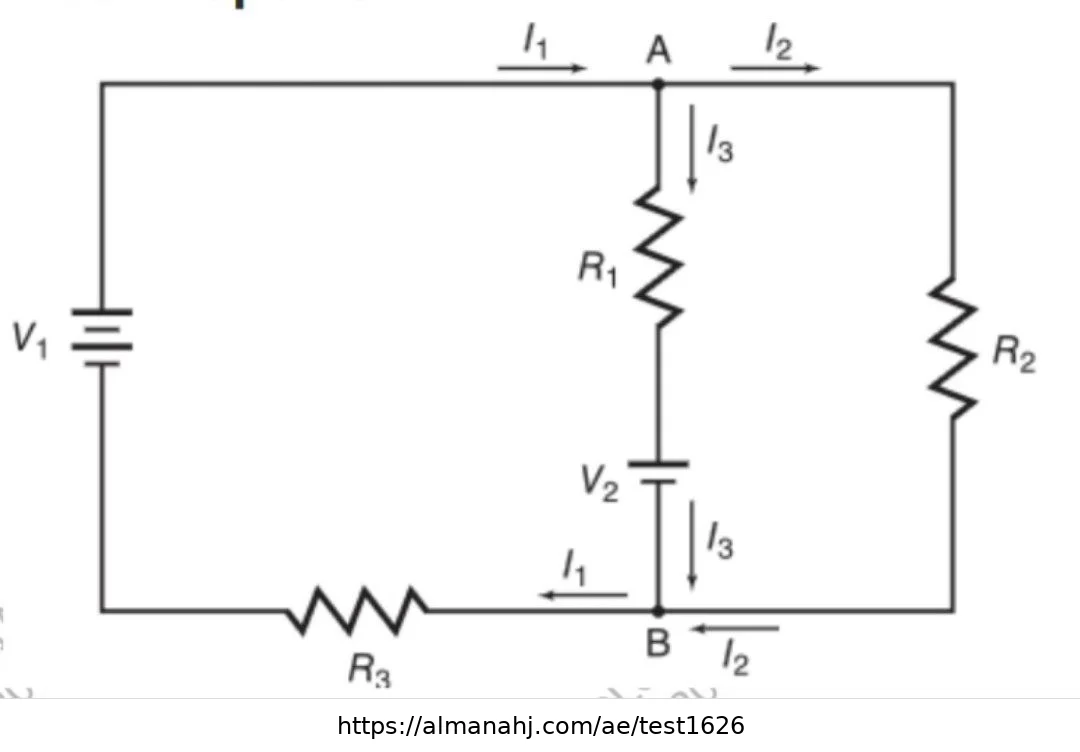
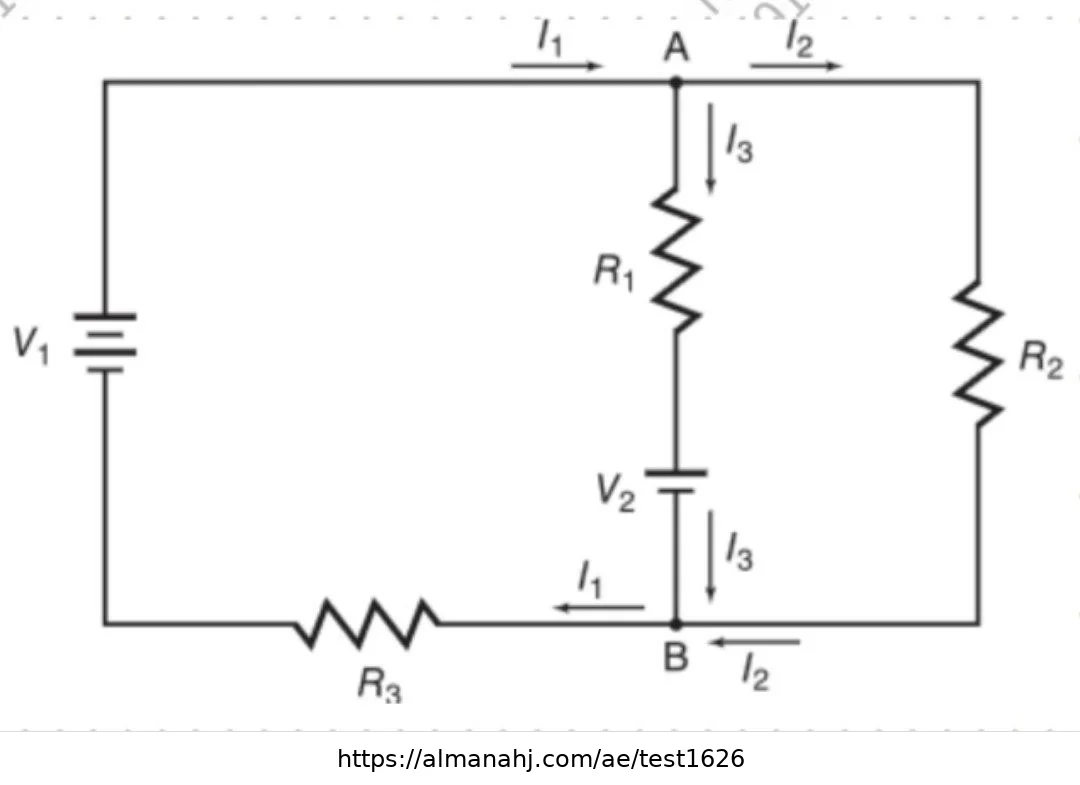
2. Looking at the diagram of connection A, which of the following equations correctly expresses the current flow at that point?
Explanation
وفقًا لقاعدة كيرشوف للتيار (قانون العقدة)، فإن مجموع التيارات الداخلة إلى نقطة (عقدة) يساوي مجموع التيارات الخارجة منها. في النقطة A، التيار I1 يدخل، والتياران I2 و I3 يخرجان. لذا، المعادلة الصحيحة هي I1 = I2 + I3.
Question 19
19
Points: 1
3. If the current entering connection A in the figure is I1 = 1.5 A, and the current passing through the first branch is I3 = 0.6 A, what is the value of the current passing through the second branch?
Explanation
وفقًا لقاعدة كيرشوف للتيار، I1 = I2 + I3. بالتعويض بالقيم المعطاة: 1.5 A = I2 + 0.6 A. بحل المعادلة لـ I2 نحصل على: I2 = 1.5 A - 0.6 A = 0.9 A.
Question 20
20
Points: 1
4. What is the scientific definition of a "junction" in an electrical circuit?
Explanation
العقدة (Junction) في الدائرة الكهربائية هي نقطة التقاء ثلاثة أسلاك أو عناصر على الأقل، حيث تتفرع التيارات أو تتجمع.
Question 21
21
Points: 1
5. Kirchhoff's loop rule (which relates to potential difference) is a direct application of the law:
Explanation
قاعدة كيرشوف للجهد (قانون الحلقة) تستند إلى مبدأ حفظ الطاقة، حيث أن مجموع التغيرات في الجهد حول أي حلقة مغلقة في الدائرة يجب أن يكون صفرًا، لأن الشحنة التي تعود إلى نقطة البداية يجب أن تكون قد اكتسبت أو فقدت نفس القدر من الطاقة.
Question 22
22
Points: 1
6. According to Kirchhoff's junction law (based on the conservation of charge), if a current of 1.0 A enters a junction and branches into two paths, and the current in the first path is 0.3 A, what is the value of the current in the second path?
Explanation
وفقًا لقانون كيرشوف للتيار (قانون العقدة)، فإن التيار الكلي الداخل إلى العقدة يساوي مجموع التيارات الخارجة منها. إذا دخل 1.0 A وتفرع إلى مسارين، حيث كان تيار المسار الأول 0.3 A، فإن تيار المسار الثاني سيكون: 1.0 A - 0.3 A = 0.7 A.
Question 23
23
Points: 1
7. Which of the following statements describes the relationship between the closed loop and energy?
Explanation
قاعدة كيرشوف للجهد (قانون الحلقة) مبنية على مبدأ حفظ الطاقة. هذا يعني أن التغير الكلي في طاقة الشحنة عند إكمالها لدورة كاملة والعودة إلى نقطة البداية في حلقة مغلقة يجب أن يكون صفرًا.
Question 24
24
Points: 1
1. What is the primary function of a "fuse" in an electrical circuit?
Explanation
الفتيل (Fuse) هو جهاز أمان مصمم لحماية الدوائر الكهربائية من التيار الزائد. عندما يمر تيار كبير جدًا عبره، يذوب السلك المعدني الموجود داخله، مما يقطع الدائرة ويوقف تدفق التيار.
Question 25
25
Points: 1
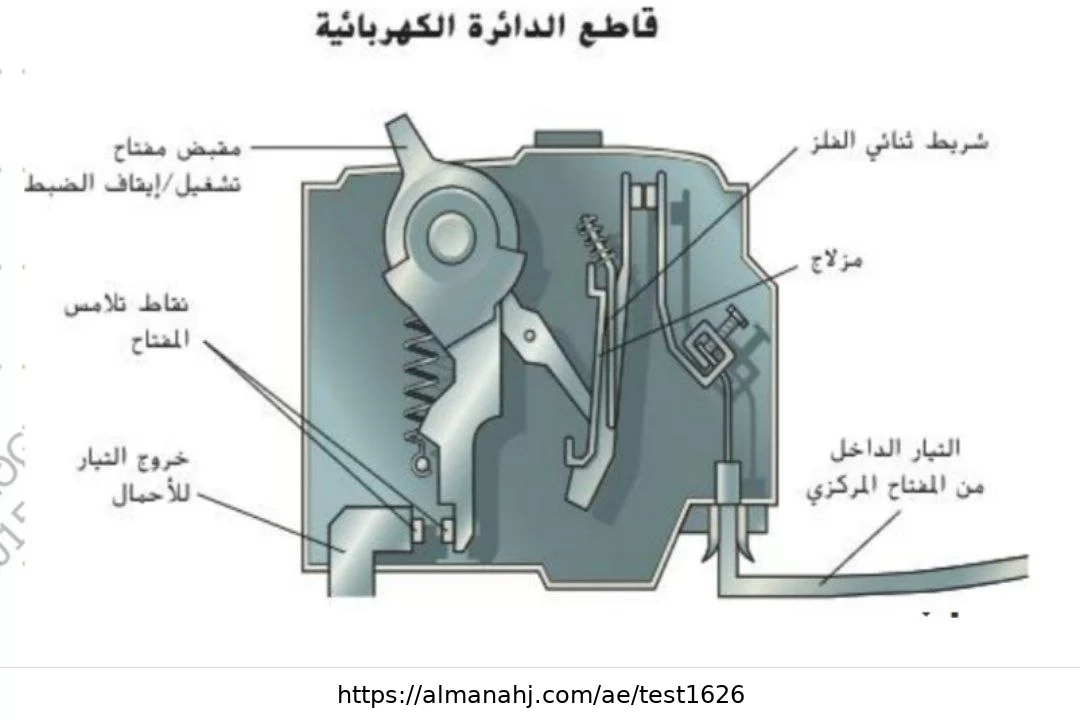
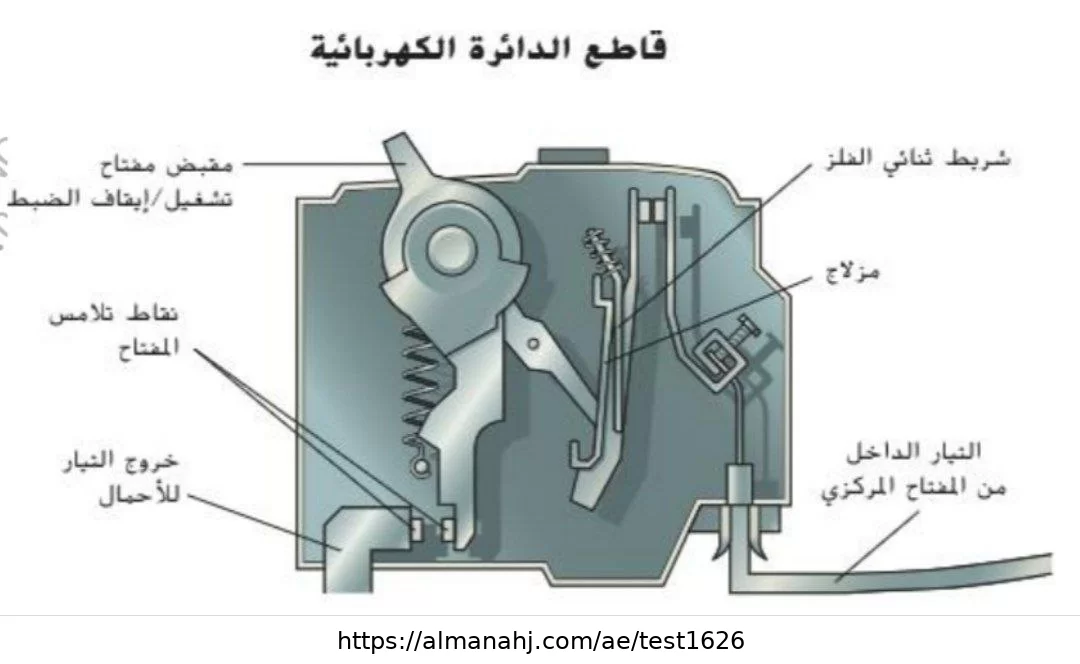
2. Considering the "circuit breaker" shown in the figure, what causes the bimetallic strip to bend and the circuit to open?
Explanation
في قاطع الدائرة الكهربائية، ينثني الشريط ثنائي الفلز نتيجة الحرارة المتولدة عن مرور تيار كهربائي عالٍ جدًا فيه (عند حدوث حمل زائد أو قصر). هذا الانثناء يؤدي إلى فصل نقاط التلامس وفتح الدائرة، مما يحميها.
Question 26
26
Points: 1
3. Electronic sensors detect "tiny differences" in the current caused by an additional current path (such as a leaking current to water)?
Explanation
قاطع دائرة الأعطال الأرضية (GFI) هو جهاز أمان يكتشف الاختلافات الصغيرة في التيار بين السلك الحي والسلك المحايد، مما يشير إلى وجود تيار تسرب (خطأ أرضي)، ويقوم بفصل الدائرة لمنع الصدمات الكهربائية.
Question 27
27
Points: 1
4. Based on the diagram, what happens when the current exceeds the allowed value in the circuit breaker?
Explanation
عندما يتجاوز التيار القيمة المسموح بها في قاطع الدائرة، تسخن الشريحة ثنائية الفلز وتنحني، مما يؤدي إلى تحرير المزلاج الذي بدوره يفتح نقاط التلامس الكهربائية ويقطع تدفق التيار لمنع الضرر.
Question 28
28
Points: 1
5. Why are safety devices (fuses and circuit breakers) necessary in home wiring?
Explanation
أجهزة الأمان مثل الفيوزات وقواطع الدائرة ضرورية في الأسلاك المنزلية لأنها تحمي الدوائر من الأحمال الزائدة والدوائر القصيرة، التي يمكن أن تؤدي إلى ارتفاع درجة الحرارة، وتلف الأجهزة، أو نشوب حرائق.
Question 29
29
Points: 1
6. What is the scientific definition of a "short circuit"?
Explanation
الدائرة القصيرة هي مسار غير مقصود للتيار الكهربائي ذو مقاومة منخفضة جدًا، مما يؤدي إلى تدفق تيار كبير جدًا في الدائرة. يمكن أن يتسبب هذا في ارتفاع درجة الحرارة وتلف المكونات.
Question 30
30
Points: 1
7. Why is a short circuit dangerous in home electrical wiring?
Explanation
تعد الدائرة القصيرة خطيرة لأن التيار الكهربائي الكبير جدًا الذي يمر عبر الأسلاك يولد حرارة عالية جدًا. هذه الحرارة يمكن أن تذيب العزل، وتتلف الأجهزة، وتسبب حرائق.
Result Tracking
Answered0 / 30
Correct Answers0
Wrong Answers0
Current Percentage0%
Quiz Completed
This is your final result after answering all questions.
Final Result
0/300%
Correct Answers0
Wrong Answers0
Answered Questions0 / 30
Total Possible Points30
You can reopen the page to start again.
يمكنك تسجيل الدخول لحفظ سجل محاولاتك، معرفة أخطائك المتكررة، والحصول على نصائح مخصصة. تسجيل الدخول باستخدام Google
Here are more quizzes for الصف الثاني عشر العام by الفصل الثالث and subject فيزياء
This section is rendered only when the user reaches it while scrolling.
...
🍪
إشعار ملفات تعريف الارتباط
يستخدم هذا الموقع ملفات تعريف الارتباط لتحسين تجربة التصفح وقياس الأداء وعرض المحتوى بشكل أفضل.
باستخدامك للموقع فإنك توافق على استخدامنا لها وفق
سياسة الخصوصية.