Online Quiz: British Curriculum Primary 6 Biology Quiz: Reproduction in Plants
Open Online Quiz: British Curriculum Primary 6 Biology Quiz: Reproduction in Plants - 🧬 Biology - Level 6 - Term 1 as an interactive British curriculum quiz with instant marking and explanations.
Level 6🧬 BiologyTerm 12025/2026Teacher: Almanahj
Scan to open this quiz
https://almanahj.com/uk/quizzes/6biology1/125
Print Quiz
Choose the version to send to your printer or save as PDF.
Cambridge Primary 6 Biology: Reproduction in Plants
A Cambridge Primary 6 Biology quiz on flowering plant reproduction, pollination, fertilisation, seeds and germination.
Result Tracking
0Answered
0Correct Answers
0Wrong Answers
0%Current Percentage
Quiz Completed
This is your final result after answering all questions. You can reopen the page to start again.
Question 1
1 point
Use the model. Which process transfers pollen to a stigma?
Explanation
Pollination is the transfer of pollen to a stigma.
Question 2
1 point
Where is pollen produced in a flower?
Explanation
Anthers produce pollen grains.
Question 3
1 point
Which flower part receives pollen?
Explanation
The stigma is adapted to receive pollen.
Question 4
1 point
Where are ovules found?
Explanation
The ovary contains ovules.
Question 5
1 point
What can a fertilised ovule become?
Explanation
After fertilisation an ovule develops into a seed.
Question 6
1 point
What can the ovary become after fertilisation?
Explanation
The ovary may develop into fruit around the seeds.
Question 7
1 point
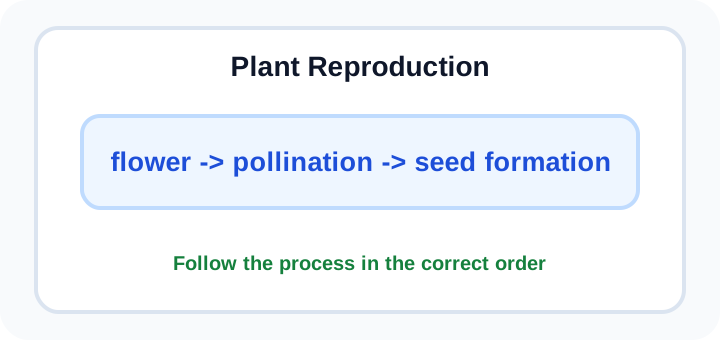
Which sequence is correct?
Explanation
This follows the main reproductive sequence.
Question 8
1 point
Which agent can pollinate flowers?
Explanation
Wind and animals can transfer pollen.
Question 9
1 point
Why do many insect-pollinated flowers have bright petals?
Explanation
Colour can attract insects and other animals.
Question 10
1 point
Why is nectar useful to a flower?
Explanation
Nectar rewards visitors that transfer pollen.
Question 11
1 point
What is fertilisation?
Explanation
Fertilisation occurs after successful pollination.
Question 12
1 point
What is germination?
Explanation
Germination begins when a seed starts growing.
Question 13
1 point
Which conditions are usually needed for germination?
Explanation
Seeds need suitable conditions to germinate.
Question 14
1 point
Why is seed dispersal useful?
Explanation
Dispersal spreads seeds to new places.
Question 15
1 point
Which seed is likely adapted for wind dispersal?
Explanation
Light winged seeds can be carried by wind.
Question 16
1 point
Which fruit feature may help animal dispersal?
Explanation
Animals may eat fruit and later disperse seeds.
Question 17
1 point
How can hooks on seeds help dispersal?
Explanation
Hooked seeds can be transported by animals.
Question 18
1 point
Which part protects the young plant inside a seed?
Explanation
The seed coat protects the embryo.
Question 19
1 point
Why should a germination investigation control seed type?
Explanation
Controlling seed type makes the test fairer.
Question 20
1 point
What is the main idea of this lesson?
Explanation
The full process links flower structures with the next generation.