Online Quiz: British Curriculum Primary 5 Science Quiz: Dissolving and Solutions
Open Online Quiz: British Curriculum Primary 5 Science Quiz: Dissolving and Solutions - 🔬 Science - Level 5 - Term 2 as an interactive British curriculum quiz with instant marking and explanations.
Level 5🔬 ScienceTerm 22025/2026Teacher: Almanahj
Scan to open this quiz
https://almanahj.com/uk/quizzes/5science2/114
Print Quiz
Choose the version to send to your printer or save as PDF.
Cambridge Primary 5 Science: Dissolving and Solutions
This lesson quiz helps learners explain dissolving, solutions, solubility and how to investigate factors that affect dissolving.
Result Tracking
0Answered
0Correct Answers
0Wrong Answers
0%Current Percentage
Quiz Completed
This is your final result after answering all questions. You can reopen the page to start again.
Question 1
1 point
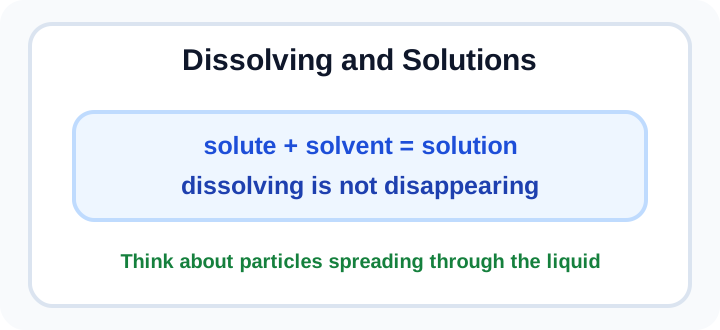
Use the model. What is the solute in salty water?
Explanation
The solute is the substance that dissolves.
Question 2
1 point
What is the solvent in salty water?
Explanation
The solvent is the liquid that dissolves the solute.
Question 3
1 point
What is a solution?
Explanation
A solution is a uniform mixture.
Question 4
1 point
Which substance dissolves in water?
Explanation
Sugar is soluble in water.
Question 5
1 point
Which substance is insoluble in water?
Explanation
Sand does not dissolve in water.
Question 6
1 point
When salt dissolves, what happens to it?
Explanation
Dissolving spreads particles in the solvent.
Question 7
1 point
How can you get salt back from salt water?
Explanation
Evaporation leaves salt crystals behind.
Question 8
1 point
What is solubility?
Explanation
Solubility describes dissolving capacity.
Question 9
1 point
What is a saturated solution?
Explanation
Extra solute remains undissolved.
Question 10
1 point
Which factor often makes sugar dissolve faster?
Explanation
Stirring brings fresh solvent to the solute surface.
Question 11
1 point
Which factor often makes sugar dissolve faster?
Explanation
Higher temperature usually speeds dissolving.
Question 12
1 point
Which factor often makes a solid dissolve faster?
Explanation
Smaller pieces have greater surface area.
Question 13
1 point
In a fair test of temperature on dissolving time, what should change?
Explanation
Only the independent variable should be changed.
Question 14
1 point
What could be the dependent variable in that test?
Explanation
This is the measured result.
Question 15
1 point
Why keep the amount of water the same?
Explanation
Controlled variables make comparisons valid.
Question 16
1 point
Which is not a solution?
Explanation
Sand remains suspended or settles; it does not dissolve.
Question 17
1 point
Why might clear water not be pure?
Explanation
Solutions can look clear.
Question 18
1 point
Which method tells whether a solid dissolved or settled?
Explanation
Insoluble solids settle or remain visible.
Question 19
1 point
What does "concentrated" mean for a solution?
Explanation
Concentration compares solute amount with solvent amount.
Question 20
1 point
Which summary is correct?
Explanation
Dissolving is usually reversible for many simple solutions.