Question 1
Cambridge Primary 1
What do plants need to grow?
A
Only toys
B
Light and water
C
Only stones
D
No air
Explanation
Question 2
Cambridge Primary 1
Which item uses electricity?
A
Pencil
B
Banana
C
Lamp
D
Paper
Explanation
Question 3
Cambridge Primary 1
Which part helps a bird fly?
A
Wings
B
Fins
C
Roots
D
Wheels
Explanation
Question 4
Cambridge Primary 1
Which is the safest way to smell an unknown liquid?
A
Drink it
B
Touch your tongue to it
C
Ask an adult
D
Pour it on your hand
Explanation
Question 5
Cambridge Primary 1
Which object is usually soft?
A
Metal spoon
B
Stone
C
Feather
D
Glass cup
Explanation
Question 6
Cambridge Primary 2
What does a shadow need?
A
Light and an object blocking it
B
Only water
C
Only sound
D
Only soil
Explanation
Question 7
Cambridge Primary 2
Which direction does gravity pull objects?
A
Down towards Earth
B
Up to clouds
C
Sideways only
D
Nowhere
Explanation
Question 8
Cambridge Primary 2
Which material is flexible?
A
Rubber band
B
Brick
C
Glass bottle
D
Stone
Explanation
Question 9
Cambridge Primary 2
Which object gives the clearest reflection?
A
Mirror
B
Towel
C
Carpet
D
Cardboard
Explanation
Question 10
Cambridge Primary 2
Why do we sort materials?
A
To compare their properties
B
To make them alive
C
To stop gravity
D
To remove all colour
Explanation
Question 11
Cambridge Primary 3
What does a skeleton do?
A
Supports and protects the body
B
Makes all food
C
Pumps blood only
D
Stores light
Explanation
Question 12
Cambridge Primary 3
Which teeth are used for cutting food?
A
Incisors
B
Molars
C
Canines only
D
Roots
Explanation
Question 13
Cambridge Primary 3
Why repeat measurements?
A
To improve reliability
B
To make numbers longer
C
To avoid looking
D
To change every variable
Explanation
Question 14
Cambridge Primary 3
Why do scientists draw conclusions?
A
To explain what evidence shows
B
To ignore results
C
To avoid measuring
D
To choose favourite answers
Explanation
Question 15
Cambridge Primary 3
Which is an invertebrate?
A
Butterfly
B
Dog
C
Bird
D
Lizard
Explanation
Question 16
Cambridge Primary 4
Which teeth are used for cutting food?
A
Incisors
B
Molars
C
Canines only
D
Roots
Explanation
Question 17
Cambridge Primary 4
Which method can recover salt from salt water?
A
Evaporation
B
Sieving
C
Using a magnet
D
Stretching
Explanation
Question 18
Cambridge Primary 4
Which surface reflects light best?
A
Smooth shiny surface
B
Rough black cloth
C
Mud
D
Carpet
Explanation
Question 19
Cambridge Primary 4
What is evaporation?
A
Liquid changing to gas
B
Gas changing to liquid
C
Solid changing to liquid
D
Plant making seeds
Explanation
Question 20
Cambridge Primary 4
What gas do plants release during photosynthesis?
A
Oxygen
B
Carbon dioxide only
C
Nitrogen only
D
Methane
Explanation
Question 21
Cambridge Primary 5
Which statement is true?
A
Flowering and non-flowering plants are both plants
B
Only flowering plants have cells
C
Non-flowering plants are animals
D
All non-flowering plants live underwater
Explanation
Question 22
Cambridge Primary 5
Which state is easiest to describe by saying "no fixed shape and no fixed volume"?
A
solid
B
gas
C
crystal
D
liquid
Explanation
Question 23
Cambridge Primary 5
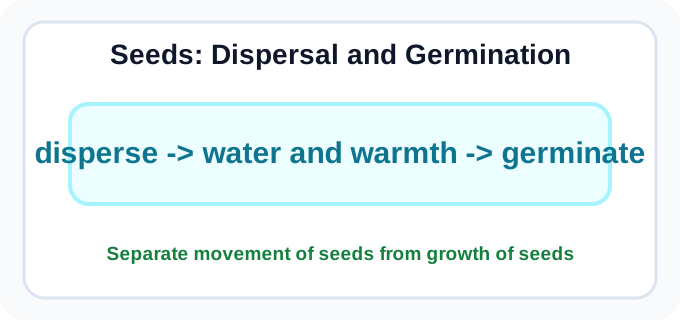
Use the model. What is seed dispersal?
A
first growth of a seed
B
movement of seeds away from the parent plant
C
transfer of pollen
D
formation of nectar
Explanation
Question 24
Cambridge Primary 5
How long does Earth take to rotate once?
A
about 24 minutes
B
about one year exactly for one spin
C
about 24 hours
D
about one month
Explanation
Question 25
Cambridge Primary 5
Which animal shape reduces water resistance?
A
flat square body
B
streamlined fish body
C
large rough board shape
D
spiky open umbrella body
Explanation
Question 26
Cambridge Primary 6
Which chamber pumps blood to the body?
A
Right atrium
B
Left ventricle
C
Right ventricle
D
Left atrium
Explanation
Question 27
Cambridge Primary 6
Which nutrient is important for growth and repair?
A
Salt only
B
Protein
C
Fibre only
D
Water only
Explanation
Question 28
Cambridge Primary 6
Which statement is a conclusion?
A
I like plants
B
The ruler is blue
C
Tomorrow is Saturday
D
The plant with more light grew taller
Explanation
Question 29
Cambridge Primary 6
Which is the best improvement to an investigation?
A
Change all variables
B
Use only one reading
C
Repeat readings and calculate a mean
D
Ignore anomalies always
Explanation
Question 30
Cambridge Primary 6
How can a saturated solution be made to dissolve more solute?
A
Freeze it always
B
Warm it in many cases
C
Add sand
D
Use a magnet
Explanation
Question 31
Cambridge Lower Secondary 7
Which is a renewable energy source?
A
Coal
B
Oil
C
Wind
D
Natural gas
Explanation
Question 32
Cambridge Lower Secondary 7
What is neutralisation?
A
Light reflecting
B
Current flowing
C
Solid melting
D
Acid reacting with alkali to form salt and water
Explanation
Question 33
Cambridge Lower Secondary 7
What is density?
A
Mass divided by volume
B
Force divided by time
C
Current divided by voltage
D
Volume divided by mass
Explanation
Question 34
Cambridge Lower Secondary 7
What is a hypothesis?
A
A final mark
B
A random drawing
C
A testable idea
D
A safety rule only
Explanation
Question 35
Cambridge Lower Secondary 7
What is the role of decomposers?
A
Become planets
B
Break down dead material
C
Stop all food chains
D
Make sunlight
Explanation
Question 36
Cambridge Lower Secondary 8
What is the role of decomposers?
A
Make sunlight
B
Break down dead material
C
Become planets
D
Stop all food chains
Explanation
Question 37
Cambridge Lower Secondary 8
What does acceleration mean?
A
Stored energy only
B
Mass per volume
C
Distance only
D
Change in velocity per second
Explanation
Question 38
Cambridge Lower Secondary 8
Calculate density of a 200 g object with volume 50 cm3 .
A
4 g/cm3
B
0.25 g/cm3
C
10000 g/cm3
D
250 g/cm3
Explanation 3 .
Question 39
Cambridge Lower Secondary 8
Which organism is a consumer?
A
Rabbit
B
Grass
C
Oak tree
D
Algae
Explanation
Question 40
Cambridge Lower Secondary 8
Which wave can travel through a vacuum?
A
Sound
B
Seismic P waves only
C
Light
D
Water waves only
Explanation
Question 41
Cambridge Lower Secondary 9
Which object floats in water if its density is less than water?
A
More dense object
B
Less dense object
C
Any stone
D
Any metal
Explanation
Question 42
Cambridge Lower Secondary 9
Which reaction is exothermic?
A
Evaporation only
B
Combustion
C
Thermal decomposition only
D
Melting ice
Explanation
Question 43
Cambridge Lower Secondary 9
Which energy source is non-renewable?
A
Solar
B
Tidal
C
Coal
D
Wind
Explanation
Question 44
Cambridge Lower Secondary 9
Which gas is needed for aerobic respiration?
A
Nitrogen
B
Helium
C
Oxygen
D
Argon
Explanation
Question 45
Cambridge Lower Secondary 9
Which separation method identifies dyes in ink?
A
Chromatography
B
Decanting
C
Filtration
D
Evaporation only
Explanation
Question 46
Cambridge IGCSE 10
Which process transfers thermal energy in fluids?
A
Ionisation
B
Convection
C
Conduction only in vacuum
D
Reflection
Explanation
Question 47
Cambridge IGCSE 10
What is the product at the cathode in electrolysis of molten lead bromide?
A
Oxygen
B
Bromine
C
Hydrogen
D
Lead
Explanation
Question 48
Cambridge IGCSE 10
What is active transport?
A
Gas burning
B
Water evaporation
C
Movement against a concentration gradient using energy
D
Movement down a gradient only
Explanation
Question 49
Cambridge IGCSE 10
What is the atomic number?
A
Electrons plus neutrons only
B
Number of neutrons only
C
Protons plus neutrons
D
Number of protons
Explanation
Question 50
Cambridge IGCSE 10
Why use a control group?
A
To avoid conclusions
B
To hide data
C
To compare with the experimental group
D
To change all variables
Explanation
Question 51
Cambridge IGCSE 11
Which blood component carries oxygen?
A
Plasma only
B
Red blood cells
C
Platelets
D
White blood cells only
Explanation
Question 52
Cambridge IGCSE 11
Which sampling method uses a square frame?
A
Titration
B
Chromatography
C
Distillation
D
Quadrat sampling
Explanation
Question 53
Cambridge IGCSE 11
Which bonding occurs in sodium chloride?
A
Ionic bonding
B
Metallic bonding only
C
Covalent bonding only
D
Hydrogen bonding only
Explanation
Question 54
Cambridge IGCSE 11
What is the critical angle?
A
Angle of incidence giving angle of refraction 90 degrees
B
Angle of reflection only
C
Angle in a triangle
D
Angle of diffraction
Explanation
Question 55
Cambridge IGCSE 11
A 1200 kg car accelerates at 2.5 m/s2 . Find resultant force.
A
480 N
B
300 N
C
1202.5 N
D
3000 N
Explanation
Question 56
Cambridge AS Level
Which vessel transports water in plants?
A
Artery
B
Vein
C
Xylem
D
Phloem only
Explanation
Question 57
Cambridge AS Level
Which microscope has the highest resolving power?
A
Hand lens
B
Electron microscope
C
Naked eye
D
Light microscope always
Explanation
Question 58
Cambridge AS Level
Which unit is equivalent to a joule?
A
A/V
B
N/s
C
kg/m
D
N m
Explanation
Question 59
Cambridge AS Level
What is the Young modulus?
A
Stress divided by strain
B
Strain divided by stress
C
Force divided by charge
D
Energy divided by time
Explanation
Question 60
Cambridge AS Level
What is the SI unit of electric field strength?
A
N/C
B
J
C
W
D
kg/m3
Explanation
Question 61
Cambridge A Level
What is the function of haemoglobin?
A
Transport oxygen
B
Digest starch
C
Store DNA
D
Make antibodies only
Explanation
Question 62
Cambridge A Level
What does line spectra provide evidence for?
A
Continuous energy only
B
No electrons in atoms
C
Quantised electron energy levels
D
Only chemical bonds
Explanation
Question 63
Cambridge A Level
Which bond holds water molecules to each other?
A
Ionic bond only
B
Hydrogen bond
C
Metallic bond
D
Peptide bond
Explanation
Question 64
Cambridge A Level
What is translation?
A
Evaporation from leaves
B
Ionisation of atoms
C
Assembly of amino acids using mRNA at a ribosome
D
Copying DNA into DNA
Explanation