Newton's Second Law of Motion: This set of practice problems focuses on the application of Newton's Second Law, which relates force, mass, and acceleration through the formula \(F = ma\). Students are asked to perform various calculations to find missing variables, interpret free-body diagrams to determine net force and resulting mass, and analyze graphical data showing the relationship between force and acceleration. The worksheet also covers the algebraic manipulation of the formula to solve for specific variables.
رقم الاختبار803
الصفالصف الحادي عشر المتقدم
المادةفيزياء
الفصلالفصل الثالث
السنة الدراسية2025/2026
عدد الأسئلة18
إجمالي النقاط18
تاريخ الإضافة2026-04-19
الزيارات14
المعلم أو الناشرAmal Salman
اختر إجابة واحدة لكل سؤال. عند الاختيار ستظهر النتيجة فورًا: الأخضر صحيح، والأحمر خطأ، وسيظهر تفسير الإجابة مباشرة إن كان متوفرًا. وبعد آخر سؤال ستظهر الدرجة النهائية تلقائيًا.
Question 1
Points: 1
(Using \(F_{net}=ma\)), What net force is required to accelerate a car at a rate of \(2\, m/s^{2}\) if the car has a mass of \(3,000\, kg\)?
Explanation
Using the formula \(F = m \times a\), where \(m = 3,000\, kg\) and \(a = 2\, m/s^{2}\), the force is \(3,000 \times 2 = 6,000\, N\).
Question 2
Points: 1
(Use \(F_{net}=ma\)), A \(10\, kg\) bowling ball would require what force to accelerate down an alleyway at a rate of \(3\, m/s^{2}\)?
Explanation
Force equals mass \times acceleration: \(F = 10\, kg \times 3\, m/s^{2} = 30\, N\).
Question 3
Points: 1
(Use \(F_{net}=ma\)). Sally has a car that accelerates at \(5\, m/s^{2}\). If the car has a mass of \(1,000\, kg\), how much force does the car produce?
Explanation
Using \(F = ma\): \(F = 1,000\, kg \times 5\, m/s^{2} = 5,000\, N\).
Question 4
Points: 1
(Use \(F_{net}=ma\)). What is the mass of a falling rock if it produces a force of \(147\, N\)? (Acceleration due to gravity = \(9.8\, m/s^{2}\))
Explanation
Mass equals force divided by acceleration: \(m = F/a = 147\, N / 9.8\, m/s^{2} = 15\, kg\).
Question 5
Points: 1
(Use \(F_{net}=ma\)). What is the mass of a truck if it produces a force of \(14,000\, N\) while accelerating at a rate of \(5\, m/s^{2}\)?
Explanation
To find mass, divide force by acceleration: \(m = 14,000\, N / 5\, m/s^{2} = 2,800\, kg\).
Question 6
Points: 1
(Use \(F_{net}=ma\)). What is the acceleration of a softball if it has a mass of \(0.5\, kg\) and hits the catcher's mitt with a force of \(25\, N\)?
Explanation
Acceleration is force divided by mass: \(a = 25\, N / 0.5\, kg = 50\, m/s^{2}\). Note that the unit in the correct option is written as kg in the original document instead of m/s^2.
Question 7
Points: 1
(Use \(F_{net}=ma\)). Your parents' car has a mass of \(2,000\, kg\). If your car produces a force of \(5,000\, N\), at what rate will it accelerate?
Explanation
\(a = F/m = 5,000\, N / 2,000\, kg = 2.5\, m/s^{2}\).
Question 8
Points: 1
(Use \(F_{net}=ma\)). If an object was accelerating at \(10\, m/s^{2}\), and a force of \(10\, newtons\) was required to accelerate it, what was the object's mass? (m=F/a)
Explanation
\(m = F/a = 10\, N / 10\, m/s^{2} = 1\, kg\).
Question 9
Points: 1
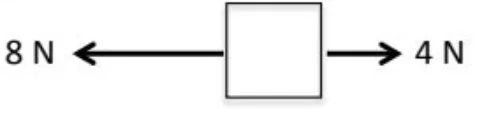
(Use \(F_{net}=ma\)). Use the diagram to determine the net force, assume the object is accelerating at a rate of \(2\, m/s^{2}\) and determine the mass of the object.
Explanation
The net force from the diagram is \(8\, N - 4\, N = 4\, N\). With an acceleration of \(2\, m/s^{2}\), the mass is \(m = F_{net}/a = 4\, N / 2\, m/s^{2} = 2\, kg\).
Question 10
Points: 1
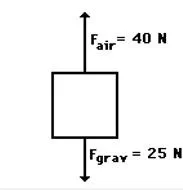
(Use \(F_{net}=ma\)). Use the diagram to determine the net force, assume the object is accelerating at a rate of \(3\, m/s^{2}\), and determine the object's mass?
Explanation
The net force is \(F_{air} - F_{grav} = 40\, N - 25\, N = 15\, N\). The mass is \(m = F_{net}/a = 15\, N / 3\, m/s^{2} = 5\, kg\).
Question 11
Points: 1
What is the equation to solve for FORCE?
Explanation
By definition, Newton's Second Law states that Force equals mass times acceleration (F=ma).
Question 12
Points: 1
Since Force = Mass * Acceleration, how would you manipulate the equation to solve for mass?
Explanation
To isolate mass (m) in the formula F = ma, you must divide both sides by acceleration (a), resulting in m = F/a.
Question 13
Points: 1
The larger the mass you have the _____ force you need to change its motion.
Explanation
According to F = ma, force is directly proportional to mass. Therefore, a larger mass requires more force to achieve the same change in motion (acceleration).
Question 14
Points: 1
Since Force = Mass * Acceleration, how would you manipulate the equation to solve for acceleration?
Explanation
To isolate acceleration (a) in the formula F = ma, you must divide both sides by mass (m), resulting in a = F/m.
Question 15
Points: 1
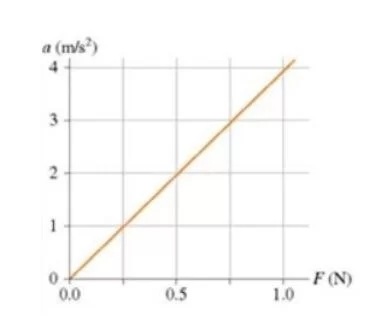
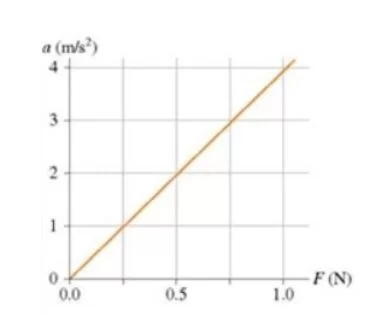
What is the slope of the line?
Explanation
In a graph where acceleration (a) is plotted against force (F), the slope represents the relationship between these two variables (specifically, 1/m).
Question 16
Points: 1
What is the formula for solving for mass in Newtons second law, F=ma?
Explanation
Algebraic rearrangement of F = ma to solve for mass (m) results in m = F/a.
Question 17
Points: 1
Using the slope of the line in the graph provided, determine how much FORCE was required to accelerate this object by a rate of \(2\, m/s^{2}\).
Explanation
Looking at the graph, when acceleration (y-axis) is 2, the corresponding force (x-axis) is 0.5 N.
Question 18
Points: 1
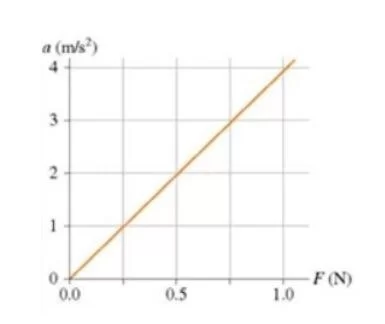
Using Newtons 2nd Law of \(F=MA\), and using the slope of the line in the graph provided, How much mass does this object have when it is accelerated at a rate of \(4\, m/s^{2}\)? (Hint: find the amount of force from the slope first.)
Explanation
From the graph, an acceleration of \(4\, m/s^{2}\) corresponds to a force of \(1.0\, N\). Using \(m = F/a\), the mass is \(1.0 / 4 = 0.25\, kg\). Note: the unit in the option is incorrectly written as 'N' instead of 'kg' in the source.
Result Tracking
Answered0 / 18
Correct Answers0
Wrong Answers0
Current Percentage0%
Quiz Completed
This is your final result after answering all questions.
Final Result
0/180%
Correct Answers0
Wrong Answers0
Answered Questions0 / 18
Total Possible Points18
You can reopen the page to start again.
🍪
إشعار ملفات تعريف الارتباط
يستخدم هذا الموقع ملفات تعريف الارتباط لتحسين تجربة التصفح وقياس الأداء وعرض المحتوى بشكل أفضل.
باستخدامك للموقع فإنك توافق على استخدامنا لها وفق
سياسة الخصوصية.